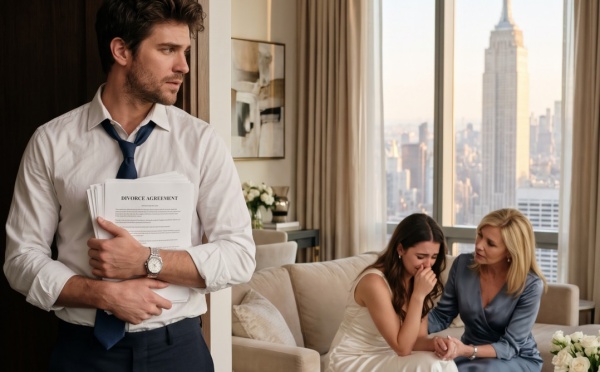
I Was Ready to Divorce My Wife—Then I Heard the Secret She Never Wanted Me to Know. The Night Before Our I went back to our Seattle townhouse to pick up the last documents before our divorce hearing, expecting to leave my key on the counter and walk away from six years of marriage. Then I heard my wife crying behind a half-open door, I Heard My Wife Crying Behind a Half-Open Door…
PART I — THE HALF-OPEN DOOR
The night before I was supposed to divorce my wife, I heard her crying behind a half-open door.
I had come home to pick up the last of my documents, the ones my attorney said I needed to bring to the courthouse in the morning. Twenty-seven pages of divorce papers were inside the leather folder in my hand, crisp, organized, and final-looking. By sunrise, my marriage to Alina Hart was supposed to become a closed file in King County Superior Court.
Then I heard her voice.
“I love him too much to let him stay with me out of pity.”
I stopped in the hallway.
The house was dark except for the warm light spilling from the guest bedroom, the room where her mother had been staying for the past week. Rain tapped against the windows of our townhouse in Seattle, soft and steady, the kind of rain that made the city look like it was always remembering something painful.
I had not planned to see Alina that night.
We had arranged everything through attorneys for nearly two months. I would come by after 9 p.m., pick up the last financial statements from the study, leave my key on the kitchen counter, and be gone before she came downstairs. It was clean. Civil. Efficient.
That was how Alina wanted things.
At least, that was what I had believed.
My name is Ethan Cole, and until eight weeks before that night, I thought my wife had stopped loving me.
Not dramatically.
Not with an affair.
Not with slammed doors or screaming matches or someone sleeping in a hotel.
Alina left me in the quietest way possible.
She stopped reaching for my hand.
She stopped asking if I wanted coffee when she made hers.
She stopped texting me pictures of strange dogs she saw on her walk to the clinic.
She stopped sleeping curled toward me and began lying on the far side of the bed like the mattress was a map and we occupied separate countries.
When I asked what was wrong, she said she was tired.
When I asked if I had done something, she said no.
When I asked if she still loved me, she looked at me with tears in her eyes and said, “Ethan, please don’t make this harder.”
Three days later, she asked for a divorce.
We had been married for six years.
Together for nine.
We met in Portland, Oregon, at a mutual friend’s engagement party where neither of us wanted to be. I was a civil engineer working for a firm that designed bridges and transit infrastructure. She was finishing her residency in internal medicine, exhausted but beautiful in a green dress and worn-out flats she changed into as soon as dinner ended.
She caught me hiding on the balcony with a plate of cake.
“Is that your second piece?” she asked.
“Third.”
She nodded like she respected the honesty.
Then she took my fork and ate a bite.
That was Alina. Direct, tired, funny in a way that could cut through any room. She had dark hair, serious brown eyes, and the kind of focus that made you feel lucky when she turned it on you.
Our first date was tacos from a food truck because she got called into the hospital before our dinner reservation. Our second was at Powell’s Books, where she bought a used copy of a poetry collection and wrote her number inside it even though I already had her number. Our third was a hike near Multnomah Falls, where she informed me halfway up the trail that I looked like a man pretending not to be out of breath.
I fell in love with her because she made life feel both sharper and safer.
Alina was the daughter of Mira Hart, a retired nurse who had immigrated from Romania in her twenties, and David Hart, an American high school history teacher who died of a sudden heart attack when Alina was seventeen. Mira raised Alina with two principles: never depend on anyone completely, and never let suffering make you cruel.
Alina lived by both.
She put herself through college with scholarships and night shifts.
She became a doctor because, as she once told me, “People should not have to be wealthy to be taken seriously when they say something hurts.”
She was not sentimental, but she was deeply tender in private. She taped encouraging notes inside my laptop before big project presentations. She kept every birthday card I ever gave her in a blue box under the bed. She cried during dog rescue commercials and denied it every time.
For years, we were happy.
Not perfect.
Happy.
We bought the townhouse in Queen Anne after I got promoted and she joined a community health clinic near Capitol Hill. It was smaller than what my coworkers expected me to buy, but it had a view of the Space Needle from the upstairs landing if you leaned slightly to the left. Alina said a house that made you work for the view had character.
We talked about children.
Not immediately.
Someday.
After her clinic stabilized.
After my bridge project wrapped.
After we had enough saved.
After life stopped rushing.
Life did not stop rushing.
Then, eighteen months before the divorce papers, Alina got sick.
At first, it was fatigue. She blamed long clinic hours. Then came dizziness, joint pain, fevers that appeared and vanished, bruises she could not explain, and nights when she sat on the bathroom floor because standing made the room tilt.
Doctors are terrible patients.
That is not a cliché.
That is an observable hazard.
Alina explained away every symptom until one afternoon she fainted in the parking garage at work. A nurse found her. She called me from the ER sounding embarrassed, not afraid.
“I’m fine,” she said.
“You fainted next to a Subaru.”
“Seattle is mostly Subarus. Statistically, that was likely.”
That was Alina too. Humor in the doorway of fear.
The tests were inconclusive at first. Autoimmune markers. Anemia. Abnormal inflammatory numbers. Then specialists. Rheumatology. Hematology. Neurology. More blood draws than I could count. Insurance statements that made my eyes blur.
Eventually, she was diagnosed with a complicated autoimmune condition that was treatable but unpredictable. Not immediately fatal. Not simple. The kind of illness that could be managed for years and still change your life without asking permission.
I wanted to help.
I cooked.
I drove her to appointments.
I organized medication schedules.
I argued with insurance representatives until I began recognizing hold music by department.
Alina thanked me at first.
Then she apologized.
Then she withdrew.
“I don’t want to be your project,” she said one night.
We were sitting on the bathroom floor after she had thrown up from a new medication.
“You’re not my project,” I said. “You’re my wife.”
“That’s what you say now.”
“That’s what I mean now.”
She looked at me with a sadness I did not understand then.
“What about in five years?”
“In five years, I’ll still be annoying you.”
She smiled weakly.
But something had entered the room with us.
Not the illness.
Fear.
By spring, Alina was sleeping in the guest room “so I could rest.” By summer, she refused to let me come to appointments unless she needed a ride after sedation. By fall, she asked me whether I had ever thought about the life I could have had with someone easier.
I hated that word.
Easier.
As if love were supposed to be judged by convenience.
Then one Thursday in October, she made dinner.
A real dinner.
Roasted chicken, potatoes, green beans with too much garlic because she said garlic was a constitutional right.
She wore the blue sweater I loved.
For one foolish hour, I thought maybe we were finding our way back.
After dessert, she placed both hands on the table and said, “I think we should end our marriage.”
No dramatic buildup.
No accusation.
Just a sentence placed between us like a surgical instrument.
I stared at her.
“What?”
“I want a divorce.”
“Why?”
She looked down.
“Because this isn’t fair to you.”
I almost laughed because the sentence made no sense.
“Fair to me?”
“You didn’t sign up for this.”
“I literally did. In sickness and in health. It was a whole thing. People clapped.”
“Ethan.”
“No. Don’t Ethan me. Tell me the truth.”
She pressed her lips together.
“I am telling you the truth.”
“You’re telling me a conclusion. Not the truth.”
Tears filled her eyes.
“I can’t be the reason your life gets smaller.”
My anger broke open then.
“My life is smaller without you.”
She flinched.
For a moment, I thought she might reach for me.
Instead, she stood.
“I already spoke to an attorney.”
That was when I understood she had been leaving long before she told me.
The next weeks were a blur of meetings, emails, financial disclosures, appraisals, and polite devastation. We had no children, which made the process simpler on paper and emptier in every other way. Washington is a community property state, and our attorneys kept using words like equitable, practical, uncontested, and respectful.
Respectful.
That word became the wallpaper of our divorce.
We were respectful in emails.
Respectful in asset division.
Respectful about the house.
Respectful about retirement accounts.
Respectful about who kept the dining table from her mother and who kept the old leather chair my dad gave me.
We were so respectful that I began to hate the word.
Because beneath all that civility, I was furious.
Not because she was sick.
Because she had decided for both of us that my love was pity.
And no matter how often I told her it was not, she looked at me like I was a kind man lying to make a dying person comfortable.
Except she was not dying.
Not exactly.
Not according to her doctors.
Not according to the treatment plan.
But something in her had accepted a sentence no one had pronounced.
So I signed where my attorney told me to sign.
I agreed to sell the townhouse because she insisted neither of us should live among “ghost furniture.” I rented a one-bedroom apartment in Ballard with terrible water pressure and a good bakery downstairs. I packed my tools, my books, my winter coats, and the coffee mug that said Structural Engineers Do It With Support because Alina bought it for me and then immediately regretted encouraging my profession’s worst instincts.
She kept the house until closing.
I avoided it unless necessary.
Then came the night before the final hearing.
The night of the half-open door.
I had almost left without hearing anything.
The study was at the back of the house. I found the envelope of tax documents exactly where she said it would be, on the desk beside a sticky note in her handwriting.
Ethan — these are the last W-2s and clinic benefits statements. Thank you for being patient. — A
Patient.
Like I was waiting in a lobby.
I placed the papers in my folder, turned off the study light, and walked toward the kitchen to leave my key.
That was when I heard Mira’s voice from upstairs.
“You cannot make this decision for him, Alina.”
Then Alina crying.
Not soft tears.
Broken ones.
“I already did.”
I should have left.
I know that.
But then she said the sentence that stopped me.
“I love him too much to let him stay with me out of pity.”
My hand tightened around the folder.
Twenty-seven pages.
All those signatures.
All those agreements.
All those careful phrases.
Suddenly, they meant something entirely different.
Mira answered in a low voice.
“And what about the rest?”
There was a pause.
A long one.
Then Mira asked the question that made the hallway seem to tilt beneath me.
“Does Ethan know about the letter from Boston?”
Alina stopped crying.
The silence that followed was worse than any answer.
I stood there in the dark, holding the divorce papers, realizing my wife had been hiding far more than her feelings.
PART II — THE LETTER FROM BOSTON
I did not sleep that night.
I sat in my car three blocks from the townhouse with rain blurring the windshield and the leather folder on the passenger seat like a live thing. My first instinct was to walk back inside, push open that half-open door, and demand answers. But anger makes a bad locksmith. It opens doors by breaking them.
So I called my attorney instead.
Her name was Rebecca Lin, and she was the sort of lawyer who could make silence feel like cross-examination. She had told me from the start that an uncontested divorce was only uncontested if both people understood what they were agreeing to. At the time, I thought that sounded like legal caution.
At 10:48 p.m., it sounded like prophecy.
Rebecca answered on the fourth ring.
“This better involve fire, arrest, or undisclosed assets.”
“I heard something.”
A pause.
“Where are you?”
“In my car. Near the house.”
“Are you safe?”
“Yes.”
“Is Alina safe?”
“I think so.”
“Then start from the beginning.”
I told her what I had heard.
Not everything.
Some things felt too private even while they were tearing me open. I told her about Alina saying she loved me too much to let me stay out of pity. I told her about Mira asking whether I knew about a letter from Boston. I told her I no longer trusted that the divorce petition reflected the full truth.
Rebecca was quiet for several seconds.
Then she said, “Do not confront her tonight.”
“I need to know.”
“You need to know when you are not exhausted and standing outside her house in the rain.”
“She lied to me.”
“Possibly. Or she withheld information she thought she had a reason to withhold. Those are not legally or emotionally identical.”
“I’m supposed to appear in court tomorrow.”
“Yes.”
“What do I do?”
“We can request a continuance if both parties agree or if there is good cause. But you need to understand something, Ethan. A judge is not going to pause a divorce because you overheard your wife loves you. The letter may matter. The medical information may matter. Coercion, capacity, undisclosed finances, insurance concerns, those may matter. Feelings alone do not.”
That sounded brutal.
It was also useful.
“What should I ask her?”
“Ask whether there is material information affecting the divorce that she has not disclosed. Ask whether the letter relates to her health, finances, employment, insurance, or ability to make decisions. Ask with a witness or in writing if possible.”
I leaned my head back against the seat.
“I hate this.”
“I know.”
“No, Rebecca. I hate that I have to ask my wife legal questions about why she’s breaking my heart.”
Her voice softened.
“That is often what divorce does. It turns intimate pain into administrative categories.”
After we hung up, I drove to my apartment in Ballard and placed the folder on the kitchen table. I made coffee I did not drink. At 3 a.m., I searched every major hospital in Boston connected to autoimmune research, then hated myself for doing it. At 5 a.m., I showered. At 6:30, I put on the navy suit Alina once said made me look “like a trustworthy mortgage rate.”
At 7:10, I texted her.
We need to talk before court. In person. Please.
She replied thirteen minutes later.
Is something wrong?
I stared at those words.
Everything.
I heard part of your conversation with your mom last night. I did not mean to. But I heard enough. Please don’t ask me to finalize our divorce without telling me what the letter from Boston is.
For three minutes, the message showed as delivered but not read.
Then read.
Then nothing.
At 7:31, my phone rang.
Alina.
I answered immediately.
Her voice was thin.
“What exactly did you hear?”
“Enough to know this divorce may be based on a lie.”
“It’s not a lie.”
“Then what is it?”
She inhaled unsteadily.
“I can’t do this over the phone.”
“Then meet me.”
“We have court at nine.”
“Not unless we ask to continue.”
“No.”
That one word came fast.
Too fast.
“Alina.”
“No, Ethan. We are not delaying because you overheard something private.”
“The private thing was you saying you still love me.”
She went silent.
I gripped the edge of the table.
“Was that true?”
When she spoke again, her voice was almost a whisper.
“Yes.”
My chest hurt.
“Then why are we doing this?”
“Because love does not fix what is coming.”
“What is coming?”
No answer.
“The letter from Boston?”
Still nothing.
“Alina, I am begging you. Tell me.”
She started crying.
I had heard Alina cry many times over the years: from pain, exhaustion, grief, frustration. This was different. This was a person trying to keep a wall standing with her bare hands while someone she loved pushed from the other side.
Finally, she said, “I’ll meet you at the courthouse. We can talk in one of the conference rooms.”
“No. Before.”
“Ethan—”
“If you make me walk into court not knowing whether you’re divorcing me because you want to or because you’re afraid, I will ask Rebecca to request a continuance on the record.”
That got through.
Not because it was a threat.
Because Alina hated public exposure more than almost anything.
“Fine,” she said. “The coffee shop across from the courthouse. Thirty minutes.”
She hung up.
I arrived first.
The coffee shop on Third Avenue was full of attorneys, clerks, and people pretending not to be terrified before court. Raincoats hung from chair backs. Espresso machines hissed. A toddler at the window table tried to eat the paper sleeve from a cup while his father reviewed documents with dead eyes.
Alina arrived at 8:12.
She wore a charcoal coat, her hair pulled back, face pale without makeup. She looked thinner than she had two months earlier. Her mother came with her but stayed near the entrance, arms folded, watching me with wary compassion.
Alina sat across from me.
For a moment, neither of us spoke.
Then she said, “I didn’t want you to find out like this.”
I laughed once, not because anything was funny.
“You didn’t want me to find out at all.”
She looked down.
“What is the letter?”
She reached into her purse and removed an envelope folded in half. The return address was from Massachusetts General Hospital in Boston, Department of Clinical Immunology and Rare Disease Research.
My mouth went dry.
“When did you get that?”
“Six weeks ago.”
“Before you filed?”
She nodded.
I stared at the envelope.
“What does it say?”
“I was accepted into a clinical trial.”
That was not what I expected.
Of all the possibilities my sleepless mind had constructed, that was not one of them.
“A trial?”
“For patients with refractory autoimmune complications similar to mine. It’s aggressive. It involves months in Boston, immunosuppressive therapy, experimental protocols, monitoring, risks.”
She looked at me then.
“Real risks.”
I tried to understand the shape of it.
“Why didn’t you tell me?”
“Because if I told you, you would come.”
“Yes.”
“You would pause your projects, move to Boston, sleep in hospital chairs, fight insurance, manage medications, pretend you weren’t scared, and call it love.”
“It would be love.”
“It would also be sacrifice.”
“Those are not opposites.”
Her eyes filled.
“They are when only one person keeps paying.”
I sat back.
“Is that what you think our marriage is?”
“No.”
“Then what?”
She pressed the heel of her hand against her chest like it hurt to breathe.
“Ethan, the trial might help. It might not. It could make me worse before it makes me better. I could lose my job. I could lose insurance if the clinic cannot hold my position. I could become dependent on you financially, physically, emotionally. And then what? You spend your thirties and forties caring for someone who may never be healthy?”
“Yes.”
She shook her head.
“You say that now.”
“I said vows.”
“You also wanted children.”
The sentence landed hard.
We had stopped talking about children after her diagnosis, not because I stopped wanting them, but because every conversation became a hallway with locked doors. Fertility, medication safety, pregnancy risk, adoption, foster care, waiting, grieving possible futures before they existed. I thought I had been patient.
Maybe silence had felt to her like disappearance.
“I wanted children with you,” I said.
“And if I can’t?”
“Then we grieve that together.”
She looked away.
“What if I can’t even be the wife you married?”
I reached across the table, then stopped before touching her.
People who are leaving should not be grabbed, even gently.
“You are the wife I married.”
“No, Ethan. I am a medical chart with a mortgage.”
Anger rose in me then, sudden and clean.
“Don’t talk about the woman I love like that.”
She flinched.
Then covered her face.
Mira approached the table.
“Alina.”
“I’m fine.”
“You are not.”
Mira looked at me.
“She received another letter too.”
Alina’s head snapped up.
“Mom.”
Mira ignored her.
“Tell him.”
Alina’s face went white.
“Not here.”
Mira’s voice shook.
“Yes, here. Before a judge ends your marriage because you are too proud and too afraid to let your husband know the whole truth.”
I looked from Mira to Alina.
“What other letter?”
Alina’s hands trembled around her coffee cup.
“It’s not related.”
Mira gave a bitter little laugh.
“It is entirely related.”
Rebecca entered the coffee shop then, scanned the room, and came toward us with the focused expression of someone arriving at emotional wreckage with a legal pad.
“Good,” she said. “No one is in handcuffs.”
Then she saw Alina’s face and softened slightly.
“Do we need to request a continuance?”
Alina whispered, “No.”
I said, “Yes.”
Our eyes met.
For the first time in two months, she did not look away.
Then she slowly reached into her purse again and pulled out a second envelope.
This one was not from Boston.
It was from a law firm in Spokane.
She slid it across the table.
Inside was a letter addressed to Alina, informing her that her late father, David Hart, may have been one of several people affected by a decades-old pension misclassification lawsuit involving the school district where he had worked. The estate might be entitled to a settlement. Not life-changing wealth, but significant enough: an estimated $186,000 before fees and taxes.
I read it twice.
“I don’t understand.”
Alina wiped her face.
“If the settlement came through while we were married, it could complicate property division.”
Rebecca leaned in.
“Possibly, depending on the nature of the claim, inheritance issues, dates, and characterization. But that is exactly why it should have been disclosed.”
Alina’s shoulders collapsed.
“I know.”
Mira crossed her arms.
“She thought if the divorce was final first, the money would be hers alone and she could use it for Boston without burdening you.”
I stared at my wife.
“You hid a possible settlement to pay for medical treatment?”
She said nothing.
I felt something inside me crack, not with anger this time, but grief.
Not because of the money.
Because she had been preparing to survive without me while telling herself that was love.
Rebecca closed the letter carefully.
“We are requesting a continuance.”
Alina opened her mouth.
Rebecca held up one hand.
“I am not your attorney, Dr. Hart, but I strongly recommend you speak with yours before proceeding. There is undisclosed potential property, undisclosed medical circumstances that may affect support and insurance, and apparently unresolved consent about the very reason for this divorce.”
Mira looked relieved.
Alina looked terrified.
I looked down at the twenty-seven pages in my folder.
By that morning, they no longer meant the end of our marriage.
They meant proof of how far fear can travel when no one interrupts it.
PART III — THE TRUTH SHE CALLED MERCY
The judge granted the continuance.
It took less time than I expected.
Our attorneys approached the bench. Words were exchanged in low voices: recent disclosure, potential asset, medical trial, need for review, mutual request after some hesitation. The judge, who looked like she had presided over every possible form of human confusion, set a new status date and told both parties to update disclosures promptly.
Just like that, the divorce did not happen.
No orchestra.
No miracle.
No movie moment.
Just a clerk entering a new date into a system and my marriage remaining legally alive because of procedural necessity.
Alina would not look at me as we left the courtroom.
Her attorney, Daniel Price, a careful man with silver glasses, spoke with her near the hallway windows. Mira sat on a bench with her purse clutched in both hands. Rebecca stood beside me, tapping notes into her phone.
“What now?” I asked.
“Now everyone tells the truth on paper,” she said.
“That sounds romantic.”
“It’s divorce court. Romance left through a side door months ago.”
“Can we undo it?”
“The petition? Maybe. The damage? That depends on both of you.”
I watched Alina across the hallway.
She looked exhausted.
Not relieved.
Not trapped.
Exhausted in a way that made me want to wrap my coat around her shoulders, even though I knew she might step away.
Rebecca followed my gaze.
“Ethan, listen carefully. Loving her does not mean letting her make unilateral decisions that harm you both. But it also does not mean forcing reconciliation because you now know she loves you. If she is acting from fear, that matters. If she still wants a divorce after full disclosure, that matters too.”
I nodded.
Lawyers are useful because they say the thing your heart is trying to avoid.
Alina’s attorney came over with Daniel Price’s card.
He looked at Rebecca.
“My client has agreed to exchange updated disclosures and pause execution of the final agreement pending review.”
Rebecca nodded.
“Good.”
Then he looked at me.
“She is not well today.”
“I know.”
“No,” he said quietly. “You know more than you did yesterday. That is not the same as knowing.”
I disliked him for saying it.
I respected him for being right.
Mira asked if I could drive her and Alina home because Alina was too shaky to manage the ride. Her attorney frowned, Rebecca frowned harder, and Alina looked mortified.
“I can take a rideshare,” Alina said.
“You nearly fainted in the hallway,” Mira replied.
“I did not nearly faint.”
“You sat on the floor beside a vending machine.”
“I was assessing the cleanliness.”
Despite everything, I smiled.
Alina saw it.
For one brief second, we were us.
Then the moment passed.
Rebecca pulled me aside.
“If you drive her, no substantive legal discussion unless both attorneys are present or everyone agrees. I know that sounds absurd. Follow it anyway.”
So I drove them home in near silence.
Mira sat in the back. Alina sat in the passenger seat, hands folded tightly in her lap. Seattle moved around us in wet grays and brake lights. The windshield wipers made a steady, tired sound.
Halfway across town, Alina said, “I’m sorry.”
Mira immediately said, “That is substantive.”
Alina gave a weak laugh.
I kept my eyes on the road.
“I accept the apology as nonbinding emotional commentary.”
Mira snorted.
Alina looked out the window, but I saw her mouth curve slightly.
At the townhouse, I helped Mira carry bags inside. Alina went straight to the couch and sat carefully, as if her body had become a negotiation she was losing. The living room looked the same and completely different. Stacked moving boxes lined the wall. Our wedding photo was gone from the mantel, but the small ceramic fox we bought in Portland still sat beside the lamp.
I had not noticed until that moment that she had not packed it.
Mira made tea because Eastern European mothers do not recognize emotional disaster unless hot liquid is involved.
Then she looked at both of us.
“I am going to say something, and neither of you will interrupt.”
Alina closed her eyes.
“Mom.”
“No.”
Mira set two mugs on the coffee table.
“You both have been very stupid.”
That was not what I expected.
Alina opened her eyes.
“Mom.”
“I said no interrupting.”
Mira pointed at her daughter.
“You decided love means removing yourself before you become inconvenient. That is not love. That is fear wearing a martyr’s coat.”
Then she pointed at me.
“And you decided if you were patient enough, she would eventually believe you. That is also foolish. Sick people do not always hear patience as love. Sometimes they hear it as waiting for the burden to end.”
I sat back.
That one found its mark.
Mira’s voice softened.
“I watched my husband die in one afternoon. No warning. No goodbye. Alina was seventeen. She learned that love can vanish before you prepare. Then she became a doctor and learned bodies can betray anyone at any time. Now her own body feels unreliable, and she thinks the kindest thing is to leave before she is left.”
Alina began crying silently.
Mira looked at me.
“And you, Ethan, are a good man. But good men can still be proud. You wanted your promise to be enough. You did not see that she needed more than reassurance. She needed you to be angry at the fear, not only hurt by the rejection.”
I swallowed.
“What should I have done?”
Mira sighed.
“I do not know. I am a mother. We only sound certain.”
That made Alina laugh through tears.
Then Mira picked up her coat.
“I am going for a walk.”
“In the rain?” Alina asked.
“This is Seattle. If I wait for no rain, I will die in this living room.”
She left us alone.
For several minutes, neither of us spoke.
Then Alina said, “I was afraid if I told you about Boston, you would make it beautiful.”
I looked at her.
“What does that mean?”
“You would say we’d rent an apartment there. You’d learn the hospital routes. You’d find the best cheap Thai food nearby. You’d make spreadsheets for medication side effects. You’d turn terror into logistics.”
“That sounds like me.”
“It is you. And I love you for it. But I was afraid I would let you, and then if the trial failed, I would have taken even more from you.”
“You don’t get to decide what I can give.”
“I know.”
“Do you?”
She looked down.
“I’m trying.”
I sat on the chair across from her instead of beside her.
That felt important.
No crowding.
No claiming.
No rescue staged as romance.
“Alina, do you want a divorce?”
She covered her face with both hands.
“I don’t know anymore.”
The answer hurt.
It also healed something.
Because it was finally true.
Not clean.
Not comforting.
True.
“Do you want me gone?” I asked.
“No.”
“Do you want me to stay because you’re sick?”
“No.”
“Do you believe I only want to stay because you’re sick?”
She hesitated too long.
“That is what we have to deal with,” I said.
She nodded.
“I know.”
We agreed on three things that afternoon.
First, the divorce would remain paused while financial and medical disclosures were corrected.
Second, neither of us would make decisions about reconciliation, separation, Boston, the house, or money without individual counseling and at least one session with a couples therapist who had experience with chronic illness.
Third, we would stop pretending silence was kindness.
It was the most unromantic agreement of our marriage.
It may have been the first honest one in months.
PART IV — BOSTON, MONEY, AND THE SHAPE OF FEAR
The next six weeks changed the way I understood marriage.
Not because everything became easier.
It became harder, actually.
Truth often does that before it does anything useful.
Alina’s clinical trial acceptance was real, conditional, and complicated. The program in Boston required an initial evaluation, possible enrollment, and if accepted after screening, a treatment period lasting anywhere from twelve weeks to six months. Insurance coverage was uncertain. Housing would be expensive. Side effects could be serious.
The letter from the Spokane law firm was also real.
The potential settlement connected to her father’s estate required probate clarification, tax review, and proper disclosure in our divorce proceedings. It was not marital income in the simple way Alina feared, but it could not be hidden either. Her attempt to keep it separate for medical expenses created exactly the kind of legal mess she had been trying to avoid.
Rebecca and Daniel Price handled the paperwork with professional civility.
Alina and I handled the emotional part with far less grace.
We fought in therapy.
Quietly at first.
Then honestly.
Our therapist was Dr. Hannah Mercer, a woman in her fifties who had the unnerving ability to ask one question and then sit comfortably in the wreckage it created.
In our first session, she asked Alina, “What do you believe Ethan loses if he stays married to you?”
Alina answered immediately.
“Freedom.”
Dr. Mercer looked at me.
“What do you believe Alina loses if she stays married to you?”
I opened my mouth.
Then closed it.
Because my first instinct was to say nothing.
That was not true.
“She loses control over the story of her illness,” I said slowly. “She can’t pretend she’s fine if I’m there.”
Alina started crying.
Dr. Mercer nodded.
“There we are.”
In another session, I admitted I was angry.
Not just hurt.
Angry.
Angry that she had treated me like a future deserter. Angry that she had decided my life would be ruined by loving her. Angry that she had hidden Boston and the possible settlement. Angry that she made me feel selfish for wanting a say in my own marriage.
Alina listened with her hands twisted in her lap.
Then she said, “I thought if you hated me a little, leaving would be easier.”
That sentence broke my heart in a new place.
“I did hate you a little,” I said.
She closed her eyes.
“For deciding I was that shallow.”
She nodded.
“I know.”
But the sessions were not just about what Alina had done.
They were also about what I had avoided.
I had made caregiving my proof of love without asking whether she experienced it as partnership or surveillance. I had tracked medications, appointments, symptoms, bills, meals, and side effects. I had become efficient because efficiency kept me from feeling helpless.
But to Alina, my efficiency sometimes felt like disappearance too.
“You stopped telling me when you were scared,” she said.
“I thought that would burden you.”
“I was already burdened. At least fear would have meant I wasn’t alone.”
That stayed with me.
Caregiving can become lonely for both people when everyone is trying too hard to be noble.
Meanwhile, the house sale paused.
Our realtor was annoyed but polite because commission-based disappointment wears a smile. We took the listing down temporarily and agreed neither of us would move back into the old bedroom yet. I stayed in Ballard. Alina stayed at the townhouse with Mira, then alone after Mira returned to Portland.
I came over twice a week.
Not as a husband moving back in.
Not as an ex-husband collecting property.
As Ethan.
Sometimes I fixed things. A loose cabinet hinge. A squeaky stair. The porch light that flickered like a haunted bed-and-breakfast.
Sometimes we ate soup and watched terrible competition shows.
Sometimes we talked about Boston.
Those conversations were the hardest.
The old version of me wanted to say, “I’m coming. End of discussion.”
The new version tried to ask, “What would support look like that does not make you feel erased?”
At first, Alina did not know how to answer.
Then one evening she said, “I want you there for the first evaluation. Not the whole time. Not yet. Just that.”
So we flew to Boston in February.
Separate hotel rooms.
Same flight.
That detail mattered to her.
I hated it and respected it.
Massachusetts General Hospital was both impressive and terrifying, all glass, corridors, badges, waiting areas, and people carrying coffees like medicine. The specialist, Dr. Sayegh, explained the protocol with careful honesty. Potential benefits. Potential risks. No guarantees.
No miracle language.
I appreciated that.
Alina asked clinical questions in her doctor voice. I sat beside her, taking notes, resisting the urge to ask ten more. When Dr. Sayegh stepped out, Alina looked at my notebook.
“You color-coded?”
“Only three colors.”
She smiled.
“That’s restraint for you.”
After the appointment, we walked along the Charles River in freezing wind because Alina insisted she needed air. Boston in February felt like a city designed by someone angry at faces. She tucked her hands into her coat sleeves and looked across the water.
“If I do this, I don’t want you to pause your entire life.”
“I can work remotely part of the time.”
“Ethan.”
“I said part.”
She gave me a look.
I sighed.
“I can come for evaluation weeks, major treatment milestones, and emergencies. We can plan visits instead of me camping in your hospital room full-time.”
She looked surprised.
“You’d agree to that?”
“I want to be your husband, not your warden.”
Her eyes filled again, but she did not cry.
“Thank you.”
On the flight home, she fell asleep with her head against the window. I watched clouds move beneath us and thought about the strange humility of loving an adult. Not a fantasy version who accepts all your help gratefully. Not a helpless version you can save. A real person with fear, pride, agency, and the capacity to hurt you while trying not to.
When we landed in Seattle, she asked if I wanted dinner.
Not because she was too tired to cook.
Not because she needed a ride.
Because she wanted dinner.
We ate ramen near the airport. It was too salty, and the table wobbled. It was the best meal I had eaten in months.
PART V — WHAT THE PAPERS BECAME
The twenty-seven pages of divorce papers never got signed by the judge.
For a long time, I kept my copy in the leather folder on my kitchen table. Not because I wanted to threaten anything. Because I needed to remember how close we had come to letting fear become legally binding.
Eventually, Rebecca told me to either shred them or store them somewhere less dramatic.
“You are not in a gothic novel,” she said.
So I placed them in a box with old tax returns and appliance manuals.
That felt appropriate.
The divorce petition was dismissed without prejudice three months after the continuance.
Without prejudice.
The phrase means it could be filed again later.
I used to hate that.
Now I understand it.
Healing does not require pretending future pain is impossible. It only requires not mistaking possibility for destiny.
Alina was accepted into the Boston trial after screening.
She began treatment in April.
We did not do it perfectly.
No one does.
I traveled back and forth between Seattle and Boston. My firm allowed remote work for part of the week because my manager, a divorced woman with two teenagers and no patience for corporate nonsense, told HR, “He designs bridges. Let him do it from wherever gravity still functions.”
Alina rented a small furnished studio near Beacon Hill through a hospital housing network. It had bad heating, one excellent window, and a radiator that sounded like it was trying to communicate with whales.
I stayed there only when invited.
Sometimes she wanted me close.
Sometimes she wanted space.
Sometimes I handled pharmacy calls and insurance appeals. Sometimes she told me to stop reading side effect forums at midnight because I was becoming “medically feral.” Sometimes she cried because treatment hurt. Sometimes I cried in the stairwell because watching someone suffer makes love feel useless.
But it was not useless.
It was just not a cure.
That distinction took me a while.
The settlement from her father’s pension case eventually came through. After legal fees and estate processing, it was less than the estimate but still substantial: about $142,000 net to Alina as separate inheritance-related proceeds. We used none of it without clear documentation. Some went toward medical and housing costs she chose to cover. Some stayed in an account under her name.
She showed me the statements anyway.
Not because she had to.
Because secrecy had nearly ended us.
I showed her my fear too.
Not elegantly.
But honestly.
When I worried she would decide again that leaving was noble, I told her.
When she worried I would wake up resentful at forty-five, she told me.
When either of us said, “I’m fine,” the other was allowed to ask, “Legal fine or true fine?”
Most of the time, that made us laugh.
Sometimes it made us fight.
The clinical trial helped.
Not magically.
Not completely.
But enough.
Her flares became less frequent. Her bloodwork improved. Her energy returned in uneven increments, like a power grid after a storm. She still had bad days. She still had pain. She still had to build life around limits she never asked for.
But she came back to herself.
And slowly, carefully, we came back to each other.
One year after the night of the half-open door, Alina and I returned to the courthouse.
Not for divorce.
For a small legal appointment to update medical powers of attorney, financial authorizations, wills, and beneficiary designations with actual clarity instead of assumptions. Rebecca recommended it. Daniel Price reviewed Alina’s documents. Everyone behaved like responsible adults, which felt almost suspicious.
Afterward, Alina and I stood outside under the courthouse awning while rain fell in sheets.
Seattle, performing itself.
She looked at me.
“Do you ever think about that morning?”
“The continuance?”
“The coffee shop.”
“Yes.”
“What do you think?”
I considered lying sweetly.
Then I did not.
“I think I almost lost you because we both mistook protection for love.”
She nodded.
“I think that too.”
Then she reached for my hand.
Not dramatically.
Not like a movie.
Just her fingers sliding through mine under a gray sky.
“I’m sorry I tried to leave for you,” she said.
I squeezed her hand.
“I’m sorry I thought staying for you was enough.”
We walked to the car in the rain without rushing.
That night, back at the townhouse we never sold, I found the ceramic fox still beside the lamp. The house looked different now. Not restored to what it had been, because that was impossible. Better, maybe. Stranger. More honest.
The guest room became an actual guest room again instead of a place where fear made decisions behind half-open doors.
The study held both our desks.
The upstairs landing still offered its ridiculous view of the Space Needle if you leaned left.
We still did not know whether we would have children.
That question remained complicated by health, age, risk, and grief. But now we spoke about it directly. Fertility consults. Adoption possibilities. A future with children. A future without them. A life that could still be full either way.
No more locked doors.
No more deciding alone.
On our seventh wedding anniversary, we did not renew our vows publicly or post anything profound online.
We went back to Portland.
We ate tacos from a food truck.
Then we walked through Powell’s Books until Alina found another used poetry collection. At the register, she asked for a pen. Inside the front cover, she wrote something, closed the book, and handed it to me.
I opened it outside under the awning.
Ethan,
Thank you for not letting fear be the only witness.
A.
I stood there, rain hitting the sidewalk around us, and felt the strangest gratitude for everything that had almost happened.
For the papers that were not final.
For the letter from Boston.
For Mira’s refusal to stay quiet.
For Rebecca’s legal caution.
For Daniel Price’s unexpected decency.
For the half-open door.
Mostly, for the fact that love did not save us by being simple.
It saved us by becoming honest.
The night before I was supposed to divorce my wife, I thought I was going home to collect documents and leave my key on the counter.
Instead, I heard the truth crying behind a door.
By morning, the twenty-seven pages in my hand no longer meant failure.
They meant evidence.
Evidence that silence can almost become an ending.
Evidence that mercy without consent can become betrayal.
Evidence that fear will happily sign your name if you let it hold the pen.
But Alina’s mother asked one question.
Does Ethan know about the letter from Boston?
And that question gave our marriage one more chance to answer honestly.
Not perfectly.
Not easily.
But together.
