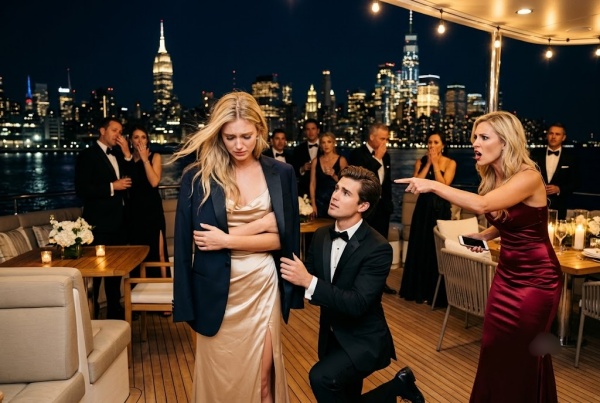
Thousands of people were watching her livestream when my husband’s mistress smiled, threw champagne in my face, and ripped my emerald silk dress in front of everyone. My husband stood there calculating how to make me look like the problem while she demanded I be removed from the yacht. Then the captain walked onto the deck and asked, “What happened here?” Neither of them knew my attorney had already made a call that would change the entire night.
PART I — THE LIVESTREAM
My husband’s mistress threw champagne in my face during a livestream, then ripped my silk dress while thousands of people watched.
For one stunned second, I could not hear the music, the laughter, or the wind moving over the deck of the yacht.
All I felt was the cold champagne sliding down my cheeks and into the neckline of my dress.
Then I heard her laughing.
Her name was Brielle Hart, and she laughed like she believed humiliation was a form of victory. She stood three feet away from me in a white sequined mini dress, holding an empty champagne flute in one hand and her phone in the other. The livestream was still running.
Behind her, the lights of Miami Beach shimmered across the black water like spilled diamonds.
Behind me, the Atlantic wind pressed my torn dress against my skin.
And beside the pool deck bar, my husband, Ethan Whitmore, stood frozen with a look on his face I knew too well.
Not guilt.
Not concern.
Calculation.
My name is Claire Whitmore. I was thirty-eight years old, a brand consultant from Coral Gables, Florida, and for twelve years, I had been married to a man who believed every room, every contract, every friendship, and eventually every woman in his life could be managed like an asset.
Ethan was forty-two, handsome in a way that photographed well, and a real estate developer whose public image was built on glass towers, charity galas, and carefully staged humility. He wore linen shirts, Italian loafers, and the kind of smile that made investors feel chosen.
To the public, we were a power couple.
To his family, I was the woman who had “helped polish him.”
To his employees, I was the quiet force behind the branding that made his projects look less predatory and more visionary.
To Ethan, I had become inconvenient.
That night, we were aboard the Marisol, a 140-foot luxury yacht docked for a private launch party off Biscayne Bay. The event was supposed to celebrate Ethan’s latest development project, Harbor One, a waterfront residential tower marketed as “sustainable coastal living for the next generation of Miami.”
I had written that phrase.
I had also written the investor deck, revised the website copy, secured two lifestyle magazine features, and convinced Ethan not to describe a $3.8 million penthouse as “accessible luxury.”
The yacht was filled with investors, influencers, brokers, architects, city insiders, and people who had perfected the art of laughing at jokes told by richer people. Servers moved through the crowd with tuna tartare, lobster sliders, and tiny spoons of caviar. A DJ played house music at a volume designed to make meaningful conversation impossible.
Brielle was there as a “lifestyle partner.”
That was the phrase Ethan’s marketing team used.
In practice, it meant she had 620,000 Instagram followers, a podcast about women “claiming abundance,” and no obvious professional reason to be at a real estate investor event except that Ethan had invited her.
I had known about the affair for six weeks.
I had suspected it for six months.
Brielle’s presence in Ethan’s life began the way these things often do: innocently enough to make the wife feel petty for noticing.
She commented on his posts.
Then she tagged him from rooftop restaurants.
Then she appeared in project meetings as a “brand voice consultant.”
Then Ethan started taking calls from the balcony.
Then he changed his phone passcode.
Then one afternoon, an invoice came to my email by mistake from a luxury hotel in Palm Beach. It listed a two-night suite, spa services, champagne, and dinner for two.
Ethan told me it was a client expense.
The reservation was under his name.
The spa appointment was under hers.
I did not confront him immediately.
That surprises people when I tell the story.
They imagine betrayal should produce instant screaming, thrown clothes, shattered glass, and dramatic ultimatums. But real betrayal often arrives in layers. At first, you do not want to know what you know. Then you want enough proof that the liar cannot talk you out of your own eyes.
By the night of the yacht party, I had proof.
Messages.
Invoices.
Travel records.
Wire transfers.
Corporate documents.
And one secret so large that Brielle’s champagne stunt would soon seem like the smallest act of stupidity on the deck.
At 9:12 p.m., Brielle started livestreaming from the yacht’s upper deck.
I saw the ring light clipped to her phone first. Then I saw the comments scrolling across her screen as she spun slowly, showing the skyline, the champagne tower, the DJ, the women in designer dresses, and the men pretending not to watch themselves on camera.
“Welcome to the most exclusive launch party in Miami,” she said brightly. “Some of us actually get invited to rooms where decisions happen.”
I was standing near the railing, speaking with Natalie Sloane, an investor from New York who had quietly asked me whether Ethan’s new project had all necessary environmental approvals.
It was an interesting question.
A dangerous one, too.
Before I could answer fully, Brielle drifted toward us with her phone raised.
“And here,” she said, her voice syrupy, “we have the wife.”
The wife.
Not Claire.
Not Ethan’s partner.
The wife.
Natalie stiffened beside me.
I gave Brielle a polite smile.
“Brielle, this is a private conversation.”
She tilted the phone closer to my face.
“Oh, don’t be shy. Everyone wants to know what it’s like being married to Miami’s most eligible developer.”
“I’m sure Ethan would love that description,” I said.
Her smile sharpened.
“Would he?”
That was when I saw Ethan across the deck.
He was watching.
He did not intervene.
Brielle stepped closer.
“You know, Claire, people keep asking me if it’s awkward being around you.”
The comments on her livestream flew by too quickly for me to read, but I caught fragments.
Is that the wife??
OMG drama
She looks mad
Brielle don’t start lol
I kept my voice even.
“Turn the phone off.”
She laughed.
“Why? Afraid people will see the truth?”
Natalie said, “This is inappropriate.”
Brielle ignored her.
“The truth is, some women don’t know when their season is over.”
A few people nearby turned.
Ethan finally moved, but only a step.
“Brielle,” he said quietly.
She did not look at him.
She wanted an audience now.
She wanted a scene she could control, clip, caption, and turn into a story about being bold while I became the bitter older wife who could not accept reality.
I had seen women like Brielle before, though not always in sequins.
They mistake access for power.
They mistake a married man’s attention for proof of superiority.
They think if he betrays another woman for them, it means they have won something precious instead of inherited a man already comfortable with deception.
I reached for her phone.
Not to grab it.
Just to lower it.
That was all she needed.
“Don’t touch me,” she snapped loudly, jerking backward for the camera. “Are you serious?”
“I didn’t touch you.”
“You all saw that, right?” she said to the livestream. “She just came at me.”
The crowd shifted again.
Ethan’s face tightened.
“Claire,” he warned.
There it was.
My name as command.
My name as leash.
My name as reminder: behave.
Brielle picked up a champagne flute from the bar behind her.
“You want to act classy?” she said. “Let’s see how classy you look now.”
Then she threw it in my face.
The champagne hit cold and sharp.
Gasps rose around us.
My eyes burned. My skin prickled. Someone said, “Oh my God.” Natalie grabbed my arm.
I lifted one hand to wipe my face.
Brielle was still filming.
“Oops,” she said. “Guess the truth stings.”
Then, because cruelty often grows braver when it meets silence, she stepped forward and grabbed the front panel of my emerald silk dress.
I wore that dress because it had been my mother’s favorite color.
It was not wildly expensive by yacht-party standards, but it was beautiful. Bias-cut, mid-calf, delicate straps, soft enough to feel like water. I had bought it for my fortieth birthday trip that never happened because Ethan had scheduled a last-minute investor retreat and insisted I attend as “support.”
Brielle yanked.
The fabric tore from the side seam with a sound I felt more than heard.
The crowd gasped again.
My dress split open along my hip.
For the first time that night, Ethan looked alarmed.
Not because I was humiliated.
Because too many people had seen it.
Thousands online.
Dozens in person.
And someone near the bar had already pulled out a second phone to record.
Brielle stepped back, triumphant and breathing fast.
“Maybe now security can get her off the boat,” she said.
That was when the yacht captain arrived.
Captain Robert Hale was in his late fifties, broad-shouldered, silver-haired, and built like a man who had spent most of his life trusting procedure more than charm. He wore a white captain’s uniform, and when he stepped onto the upper deck, the mood changed immediately.
Not because he shouted.
He did not.
He simply looked at the scene—the champagne on my face, the torn dress, Brielle’s raised phone, Ethan’s frozen posture, the watching crowd—and said, “What happened here?”
Brielle answered first.
“She attacked me.”
Natalie said, “That is not true.”
Captain Hale turned to me.
“Ma’am?”
I took a breath.
“This woman threw champagne in my face and tore my dress while livestreaming. I want it documented.”
Brielle rolled her eyes.
“Oh my God, documented? It’s a dress.”
Captain Hale’s expression did not move.
“Ms. Hart, lower the phone.”
She blinked.
“Excuse me?”
“Lower the phone.”
“I’m live.”
“I’m aware.”
Ethan stepped forward quickly.
“Captain, this is a private matter. I’ll handle it.”
Captain Hale turned to him.
“No, Mr. Whitmore. You won’t.”
The deck fell quiet.
That was the first moment Ethan understood something had shifted beyond his control.
Captain Hale looked back at me.
“Mrs. Whitmore, would you like assistance and a private area?”
“Yes,” I said.
Brielle laughed again, but it sounded thinner now.
“Are you seriously taking her side?”
The captain’s voice remained calm.
“I’m taking the side of safety, documentation, and the vessel’s rules.”
Then he signaled to two crew members.
“Please escort Ms. Hart away from Mrs. Whitmore and ask security to preserve all relevant footage.”
Brielle’s face changed.
“What footage?”
Captain Hale glanced toward the upper deck cameras.
“This vessel has security cameras in public areas.”
For the first time all night, Brielle lowered her phone.
And Ethan, my brilliant, polished, untouchable husband, went pale.
Because he knew what Brielle did not.
The most shocking secret of the night had nothing to do with my ruined dress.
It had everything to do with why the yacht had cameras, who owned the vessel, and what the captain had been instructed to do if Ethan tried to leave before midnight.
PART II — THE MARRIAGE THAT BECAME A BRAND
Ethan and I met before he became “Ethan Whitmore.”
Back then, he was just Ethan from Tampa, a commercial real estate associate with ambition bigger than his savings account and a gift for making people believe they had discovered him before the world did.
I was working at a boutique branding agency in Miami, handling campaigns for hotels, restaurants, and luxury developments. I was good at making expensive things sound meaningful. It was a talent I would later question morally, but at twenty-six, it paid my rent and made my parents proud.
Ethan hired our agency for a small mixed-use project in Wynwood.
He arrived late to the first meeting, apologized sincerely, remembered everyone’s name, and stayed afterward to ask me what I really thought of the project’s positioning.
“It sounds like every other developer pretending concrete has a soul,” I told him.
He laughed so hard that two people looked through the conference room glass.
“I need you,” he said.
At first, professionally.
Then personally.
Ethan pursued me with focus. Not pressure, exactly. Attention. He remembered my coffee order, sent articles about artists I liked, and showed up to my father’s retirement party with flowers for my mother. He talked about building things that lasted, about making Miami better, about wanting a partner who challenged him.
I believed him.
For several years, believing him seemed reasonable.
We built a life in Coral Gables. We bought a house with a mango tree in the backyard. We hosted dinners where architects argued about zoning and my friends teased Ethan for using phrases like “placemaking” in casual conversation.
His career grew fast.
Mine did too, though in quieter ways.
I left the agency and started consulting independently. Ethan became my biggest client, then my most complicated one. I named projects, shaped investor presentations, crafted public messaging, and softened criticism when community groups pushed back against development plans.
When journalists asked hard questions, Ethan called me.
When investors hesitated, Ethan asked me to revise the narrative.
When city commissioners needed reassurance, Ethan brought me to dinners and introduced me as “the conscience of the company.”
That phrase used to warm me.
Eventually, it insulted me.
A conscience is not supposed to be decorative.
The first years of marriage were not perfect, but they were alive. We traveled to Savannah, New Orleans, Aspen, and once to Napa Valley, where Ethan got sunburned and proposed a toast to “the woman who makes me look smarter than I am.”
I thought humility was attractive.
I did not yet understand he was telling the truth.
Around year seven, Ethan changed.
Or perhaps success simply revealed what had been waiting.
He became less interested in advice and more interested in agreement. He stopped asking what I thought and started telling me what “we” had decided. If I objected to a campaign angle, he called me negative. If I raised ethical concerns, he said I was letting emotion interfere with business.
He began surrounding himself with people who admired him loudly.
Young brokers.
Influencers.
Consultants with perfect teeth.
Men who called every risky decision “bold.”
Women who laughed at jokes before he finished them.
Brielle entered that circle through a charity event for coastal cleanup.
The irony still irritates me.
She hosted a panel about sustainable luxury, though her actual environmental expertise seemed limited to wearing linen near the ocean. Ethan loved the optics. A glamorous influencer advocating eco-conscious waterfront living was exactly the kind of contradiction Miami high society could digest with enough champagne.
He hired her first for a social campaign.
Then for video content.
Then for “brand partnership strategy.”
Her invoices were ridiculous.
$25,000 for a launch teaser package.
$18,500 for influencer alignment.
$40,000 for a “community storytelling activation” that consisted mostly of Brielle filming herself in a hard hat.
I questioned it.
Ethan told me I was threatened.
“By what?” I asked.
“Her relevance.”
That was the first time he said something cruel enough that I had no response.
After that, I noticed everything.
Brielle posting from restaurants where Ethan had “client dinners.”
Brielle wearing a Cartier bracelet identical to one Ethan claimed he bought for a donor’s wife as a thank-you gift.
Brielle filming from a balcony that looked very much like the private suite Ethan kept for out-of-town investors.
Then came the email from the Palm Beach hotel.
Then came the corporate records.
I found those by accident.
Ethan asked me to locate a Harbor One environmental summary in his home office while he was in Fort Lauderdale. He had grown careless because he had grown confident. His laptop was open, and a folder titled H1 Investor Final sat on the desktop.
Inside were the documents I needed.
Also inside was a subfolder titled Marisol Event.
I opened it expecting party logistics.
Instead, I found contracts involving shell companies, event expenses, promotional partnerships, and a vessel charter agreement for the yacht.
The Marisol was not simply chartered.
It was owned through an LLC connected to Ethan’s project financing network.
That alone was not illegal.
Wealthy people love LLCs the way children love stickers.
But another document froze me.
A private side letter between Ethan and a foreign investor group referenced Harbor One pre-sales, environmental mitigation credits, and “expedited local cooperation.” The language was vague, but the implications were not. Money appeared to be moving in ways not disclosed in the investor materials I had helped create.
I kept reading.
My hands shook.
There were references to payments routed through consulting entities. A coastal impact report marked “draft” even though Ethan had told investors approvals were “substantially complete.” Emails suggested certain project risks had been intentionally minimized in public materials.
And then there was a file labeled C.W. REVIEWED.
C.W.
Claire Whitmore.
Documents I had never reviewed contained notes suggesting I had approved messaging that concealed unresolved issues.
My name had been placed beside decisions I had not made.
That was when betrayal became something bigger than infidelity.
I called my college roommate, Mara Jensen, an attorney in Atlanta who specialized in corporate compliance. I did not send her confidential files immediately. I described hypotheticals. She stopped me after ten minutes.
“Claire, stop talking in hypotheticals. Do you have your own lawyer?”
“No.”
“Get one. Not his lawyer. Not the company’s lawyer. Yours.”
Within forty-eight hours, I met with Elena Price, a Miami attorney who handled high-asset divorce, corporate misconduct, and reputational crisis cases.
Elena was calm, precise, and allergic to drama.
After reviewing what I could legally provide, she gave me the same instruction three times.
“Do not confront him without a plan.”
So I made one.
First, we preserved communications and records I had legitimate access to.
Second, we identified where my name appeared without authorization.
Third, Elena helped me prepare for the possibility that Ethan would try to blame me if regulators, investors, or lenders questioned Harbor One disclosures.
Fourth, she advised me to attend the yacht event.
“Why?” I asked.
“Because if he plans to announce investor commitments based on questionable statements, we need to know. And because if he humiliates you publicly, we document that too.”
“I don’t want to be bait.”
“You’re not bait,” Elena said. “You’re a witness to your own life.”
Captain Hale became part of the story because Elena discovered the yacht’s ownership structure through public and private records. The Marisol was managed by a maritime company with strict liability policies. The captain had authority over passenger safety and event conduct, regardless of Ethan’s status.
Elena sent a confidential notice to the vessel management company the morning of the event.
It requested preservation of security footage, passenger lists, and incident logs if any harassment, assault, intoxication-related disturbance, or forced removal occurred during the event. It also noted that my name had appeared in certain corporate materials under dispute and that I was represented by counsel.
I did not know exactly how seriously they would take it.
Apparently, Captain Hale did.
That was the phone call Brielle and Ethan did not know had happened before I ever stepped onto the yacht.
By the time Brielle threw champagne in my face, the captain had already been warned that something might happen.
By the time she ripped my dress, the cameras were not just recording a party.
They were preserving evidence.
PART III — THE CAPTAIN’S LOG
A crew member named Sofia led me into a private salon below deck.
She handed me a towel, a navy blazer from the crew closet, and a bottle of water. Her kindness nearly broke me. Not because it was extraordinary, but because after public humiliation, ordinary decency feels like being pulled from deep water.
Natalie came with me.
She had removed her own shawl and wrapped it around my waist before we left the deck. She was in her fifties, elegant, unsentimental, and clearly furious in a way she had not yet decided where to place.
“Are you injured?” she asked.
“No. Just embarrassed.”
“That was not embarrassment,” she said. “That was an assault.”
The word made me flinch.
People use words differently after they happen to you.
Champagne in the face sounds like gossip until it is your eyes burning.
A ripped dress sounds like drama until you are holding torn silk closed against your body while strangers stare.
Captain Hale entered five minutes later, knocking first.
“Mrs. Whitmore, I’m sorry for what occurred aboard my vessel.”
“Your vessel?” I asked.
“Operationally, yes. Ownership is separate. Safety is mine.”
I nodded.
He handed me a printed incident form.
“I’ve had security preserve the footage from the upper deck. Several crew members witnessed the incident. Ms. Sloane also gave a statement.”
Natalie straightened.
“I’ll give one as well.”
“Thank you, ma’am.”
I wiped champagne from my collarbone.
“Where is Brielle?”
“In a separate lounge with security nearby.”
“And Ethan?”
The captain paused.
“Speaking with my first officer.”
That meant arguing.
I knew Ethan.
“Is he trying to have me removed?”
Captain Hale’s face remained professional.
“He suggested you were distressed and should be escorted off for your own privacy.”
Natalie made a disgusted sound.
I almost laughed.
Of course he did.
Not because he cared about my privacy. Because removing me would let him regain control of the narrative before investors asked questions.
Captain Hale continued, “Given the circumstances and prior notice from your counsel, I declined.”
Those words steadied me.
Prior notice.
The call had mattered.
Elena had told me she would “make sure the right people understood the importance of documentation.” I had not realized that meant the yacht captain would be ready for Ethan’s first move.
“Thank you,” I said.
“There’s more,” he replied. “Mr. Whitmore requested that the event proceed and that the altercation be treated as a guest dispute.”
“Will it?”
“No. It will be logged as an incident involving unwanted physical contact, property damage, and potential harassment during a livestream.”
Natalie folded her arms.
“Good.”
Captain Hale looked at me directly.
“Do you want law enforcement contacted?”
That question felt huge.
In another life, I might have said no to avoid scandal.
In another life, I might have accepted Ethan’s private apology, allowed him to buy me another dress, and spent six months pretending I did not still feel champagne on my face every time I looked in the mirror.
But that life was over before Brielle lifted the glass.
“Yes,” I said. “I want it reported.”
The captain nodded once.
“I’ll arrange for local authorities to meet us at the dock.”
Natalie placed a hand on my arm.
“Claire, I also need to tell you something.”
Her voice had changed.
Not softer.
More careful.
“I came tonight because I had concerns about Harbor One. My firm was considering a major investment, but the environmental disclosures didn’t match independent information we received. I planned to ask Ethan directly.”
I looked at her.
“And now?”
“Now I’m concerned that the personal chaos may be connected to professional risk.”
“It is.”
She watched me for a long moment.
“Do you have counsel?”
“Yes.”
“Good. Have your counsel call mine tomorrow.”
Above us, the music stopped.
Not faded.
Stopped.
Then came muffled voices.
A shift in the air.
Captain Hale’s radio crackled. He listened, then excused himself.
Natalie and I sat in silence.
My phone buzzed repeatedly.
Ethan.
I did not answer.
Then Brielle’s livestream clip began spreading.
Tara, my assistant, texted first.
Are you okay?? Please tell me you are safe. The video is everywhere.
Then Mara.
Do not respond publicly. Call your lawyer. Save everything.
Then my sister, June, from Denver.
Claire. Pick up if you can. I’m booking a flight if you need me.
I stared at the screen as messages multiplied.
Humiliation has a strange speed online. It leaves your body before you can process it. It becomes content while you are still wet, shaking, and trying to decide whether to cry.
Within twenty minutes, the clip had been reposted by gossip accounts.
Influencer Throws Champagne at Developer’s Wife During Yacht Party
Miami Launch Event Turns Messy
Brielle Hart vs. Ethan Whitmore’s Wife??
People in comments were already choosing teams based on fifteen seconds of footage.
Some called Brielle iconic.
Some called me cold.
Some asked where my dress was from.
Some noticed Ethan standing in the background and asked why he did nothing.
That last group gave me a small, bitter comfort.
Captain Hale returned.
“Mrs. Whitmore, Mr. Whitmore would like to speak with you privately.”
“No.”
“I expected that answer.”
“Did he?”
The captain did not smile, but his eyes almost did.
“No.”
A few minutes later, Ethan ignored the answer and came anyway.
He entered the salon without knocking.
Captain Hale stepped in behind him.
“Mr. Whitmore,” he said sharply.
Ethan raised a hand.
“I just need two minutes with my wife.”
I stood, clutching the blazer closed.
“You don’t get two minutes.”
His eyes flicked to Natalie, then the captain.
“Claire, please. This has gotten out of hand.”
“This?”
“You know what I mean.”
“I know exactly what you mean. Brielle assaulted me on camera, you tried to have me removed, and now you’re worried about investors.”
His face tightened.
“Lower your voice.”
I smiled.
That old instruction.
That old instinct of his.
Control volume, control narrative.
“No.”
Ethan leaned closer.
“You have no idea how much damage you can cause if you let this spiral.”
“Elena has the documents.”
He froze.
There it was.
The sentence beneath the sentence.
Not my dress.
Not Brielle.
Not the livestream.
The documents.
His face lost color.
“What documents?”
“The ones with my initials on them.”
Natalie’s gaze sharpened.
Ethan recovered quickly, but not completely.
“You don’t understand what you’re looking at.”
“I understand enough to have counsel.”
His eyes moved again toward Captain Hale.
“Captain, I need the room.”
Captain Hale did not move.
“No, sir.”
Ethan stared at him.
“I’m the client.”
“You are a passenger aboard a vessel under my command.”
That sentence did something beautiful to the room.
Ethan was not used to limits spoken calmly.
He looked at me again, and for the first time in years, I saw real fear behind his anger.
Not fear of losing me.
Fear of losing ownership of the story.
PART IV — WHAT THE NIGHT EXPOSED
Law enforcement met the yacht at the marina shortly after midnight.
By then, the launch party had collapsed into clusters of whispers and strategic exits. Influencers deleted stories. Brokers pretended to take urgent calls. Investors avoided Ethan as though scandal were contagious through eye contact.
Brielle was escorted off first.
She wore oversized sunglasses despite it being midnight, which would have been funny if I had been less exhausted. Her confidence had drained, replaced by frantic indignation.
“I didn’t assault anyone,” she said loudly. “It was champagne.”
A female officer asked her to step aside and answer questions.
Brielle looked around for Ethan.
He did not go to her.
That was the first consequence she had not expected.
Men like Ethan often promise protection in private and practice distance in public.
I gave my statement in a marina office with fluorescent lights, a vending machine, and a framed poster about boating safety. Natalie gave hers. Captain Hale provided the incident log and confirmed footage preservation.
I did not embellish.
I did not cry.
I described exactly what happened.
Brielle approached while livestreaming.
She made comments.
She threw champagne in my face.
She grabbed and tore my dress.
I wanted the incident documented.
The officer asked if I wanted to pursue charges or at least have the report filed for review. I said I wanted the report filed and would cooperate as advised by counsel.
Elena arrived at 1:10 a.m.
I had never been so happy to see a woman in a black pantsuit.
She looked at me once, then at the blazer, the ruined dress, the drying champagne in my hair, and said, “We’re leaving after I speak with the officers.”
Ethan tried to intercept us outside the marina office.
“Elena,” he said with forced warmth.
She did not shake his hand.
“Mr. Whitmore.”
“This is a misunderstanding.”
“No, it’s an incident with multiple witnesses, video evidence, and a police report.”
His jaw worked.
“Claire and I need to talk.”
“My client will not be speaking with you tonight.”
“Your client is my wife.”
“My client is represented.”
The distinction landed beautifully.
Ethan looked at me.
“Claire, don’t do this.”
It was almost soft.
That was the dangerous version of him.
The tender voice.
The eyes that once convinced me we were building something sacred.
I felt the pull of twelve years.
Then I remembered him standing still while Brielle raised her glass.
“I didn’t do this,” I said.
Elena guided me toward her car.
We drove to a hotel in Brickell instead of my house.
“Why not home?” I asked.
“Because he’ll go there. Because reporters might go there. Because you need rest. Because tomorrow we begin.”
“Begin what?”
She glanced at me.
“Separating your life from his liability.”
I slept three hours.
At 8:00 a.m., Elena returned with coffee, a replacement dress, and a plan.
First, no public statement beyond one carefully worded acknowledgment.
Second, all communications from Ethan would go through counsel.
Third, my team would preserve the livestream, reposts, comments, and any threats or defamatory claims.
Fourth, we would notify relevant business parties that my name and initials may have been used without authorization in certain Harbor One documents.
Fifth, divorce papers were ready if I wanted to file.
I looked out the hotel window at the Miami River.
“File.”
Elena nodded as though she had expected it.
“Today?”
“Today.”
By noon, Ethan’s world had begun shifting.
Natalie’s firm paused investment discussions and requested additional disclosures. Another investor followed. A lender requested clarification on environmental approvals. The vessel management company sent formal notice preserving footage and incident records.
Brielle posted a tearful video claiming she had been “provoked by years of emotional tension people don’t understand.”
It backfired.
Because by then, longer footage had surfaced from another guest’s phone. It showed me standing still. It showed Brielle stepping toward me. It showed the champagne. It showed her hand gripping my dress.
The internet, unpredictable monster that it is, turned.
Not entirely.
It never does.
But enough.
Comments shifted from entertainment to criticism.
This is not cute. That’s assault.
Why didn’t Ethan stop her?
The wife handled that with more grace than anyone there deserved.
If she did this on livestream, imagine what happens off camera.
Brielle deleted her tearful video within two hours.
Ethan released a corporate statement through Whitmore Development.
We are aware of a private incident that occurred during last night’s Harbor One event. The matter is being addressed respectfully and privately. Our commitment to the Harbor One project and our partners remains unchanged.
Respectfully.
Privately.
Two words powerful men use when public truth becomes inconvenient.
Elena read it and smiled without humor.
“Good. Now we respond to the part he didn’t mention.”
That afternoon, letters went out.
Not social media posts.
Not accusations.
Formal legal notices.
They went to Ethan’s company, project counsel, selected investors, insurers, and relevant entities connected to Harbor One disclosures. The letters stated that I disputed any representation that I had reviewed, approved, authored, or endorsed certain documents bearing my initials or name. They requested preservation of records and communications.
By evening, Ethan called Elena’s office eleven times.
He texted me from a new number.
You are burning down both our lives.
Then:
Brielle made a mistake, but this is business. Don’t confuse things.
Then:
If regulators get involved, you’ll be dragged in too. Think carefully.
I forwarded everything to Elena.
She replied:
Do not respond. This helps.
“This helps” became my favorite legal phrase.
The week that followed was brutal.
Reporters called.
Friends resurfaced.
People I barely knew sent messages saying they had “always sensed something off” about Ethan, which was both validating and deeply annoying.
My mother flew in from Charlotte and cried when she saw the bruised-looking mark near my hip where the dress had torn against my skin.
“I’m sorry,” she said.
“For what?”
“For teaching you that being composed was the same as being safe.”
That one hurt.
Because she had.
Not intentionally. My mother was Southern, elegant, and raised by women who believed dignity could solve almost anything. She taught me posture, thank-you notes, and how to keep my voice steady when men interrupted.
Those lessons helped me survive.
They also helped me endure too much.
Two weeks after the yacht party, Harbor One was under formal review by multiple parties. I will not pretend I understood every legal and regulatory process that followed. There were lawyers for investors, lawyers for lenders, environmental consultants, insurance representatives, and eventually government inquiries into certain disclosures and financial structures.
Ethan was not arrested in a dramatic scene.
Real life rarely offers that kind of satisfaction.
Instead, meetings were canceled.
Funding slowed.
Partners demanded indemnities.
Emails were subpoenaed or voluntarily produced depending on who was asking.
People who once fought to sit beside Ethan at dinner suddenly needed distance.
Brielle disappeared from public posting for twelve days, then returned with vague quotes about healing.
Her brand deals suffered.
Not because people suddenly became moral online. Because companies dislike liability with screenshots.
She eventually reached out through an attorney, offering to pay for the dress and requesting that I not pursue the matter further.
Elena asked me what I wanted.
I thought about the dress.
The champagne.
The laughter.
The way she tried to have me removed from a yacht where my own work had helped build the illusion everyone came to celebrate.
“She can pay for the dress,” I said. “But I’m not signing anything that says it didn’t happen.”
So that was that.
As for Ethan, the divorce became exactly what I expected: expensive, strategic, and revealing.
He claimed I had been emotionally unstable.
We produced the yacht footage.
He claimed I had always been involved in Harbor One messaging.
We produced drafts showing where my recommendations had been altered after my review.
He claimed our marital assets were straightforward.
Elena found three more entities I had never heard of.
Each discovery was like opening a closet and finding another door behind it.
At times, I felt foolish for not knowing more.
Elena corrected me.
“Claire, sophisticated concealment is designed to defeat reasonable trust. Do not confuse being deceived with being careless.”
I wrote that down.
I needed to read it often.
PART V — THE WOMAN WHO WALKED OFF THE YACHT
Six months after the yacht party, I moved into a condo in Coconut Grove with huge windows, terrible water pressure, and a balcony just large enough for two chairs and a pot of basil.
It was the first place I had lived as an adult where no decision required Ethan’s opinion.
I bought yellow towels because he hated yellow.
I hung art from local artists he once called “commercially irrelevant.”
I slept diagonally across the bed for a week just because I could.
The divorce was not final yet, but my life had started separating from his in practical ways.
New accounts.
New locks.
New clients.
New routines.
My consulting business survived, though I had to rebuild trust carefully. Some clients worried I was too close to controversy. Others admired how I handled it. A few quietly admitted they had seen men like Ethan attach women’s credibility to questionable ventures before leaving them near the blast radius.
I began specializing in ethical brand strategy and crisis transparency.
That sounds like a neat transformation now.
It was not neat then.
It was messy, frightening, and financially uncomfortable. I turned down two lucrative projects because they smelled too much like the old world: glossy language covering ugly conduct. Each time, I panicked afterward, then remembered that peace has a price and so does self-betrayal.
Natalie became both a client and a friend.
Her firm ultimately walked away from Harbor One. Months later, she hired me to audit messaging practices for another development group that actually wanted community accountability instead of decorative buzzwords.
At our first official meeting, she said, “I trusted you because you didn’t try to pretend the yacht incident was just personal.”
“It wasn’t.”
“No,” she said. “It was governance in a silk dress.”
I laughed for the first time in what felt like weeks.
Captain Hale sent a short email after the incident report was complete.
Mrs. Whitmore, I hope you are well. I wanted to confirm that all requested materials were preserved in accordance with policy. I also wanted to say that no guest should be treated that way aboard any vessel under my command. I wish you calm waters ahead.
I printed it.
Not because it was poetic, though it was.
Because it reminded me that rules matter when people enforce them.
Brielle never apologized directly.
Her attorney sent language that included regret for “the unfortunate escalation.” I declined to dignify that phrase by pretending it meant anything.
But I heard from a mutual acquaintance that she and Ethan did not last long after the scandal.
Of course they did not.
Relationships built on fantasy rarely survive evidence.
Ethan needed Brielle to make him feel admired.
Brielle needed Ethan to make her feel chosen.
Once cameras showed her cruelty and documents exposed his risk, neither one could reflect the illusion back to the other.
Ethan tried several times to speak with me outside counsel.
Once, he sent flowers to my condo.
White orchids.
The same flowers from our wedding.
I donated them to the lobby and told the front desk not to accept anything else.
Another time, he emailed:
I hate how this happened. We built too much for it to end like this.
I stared at that sentence for a long time.
We had built too much.
Yes.
We built campaigns, homes, reputations, dinners, investor decks, holiday cards, inside jokes, routines, and a marriage that looked beautiful from the outside if you did not stand too close to the seams.
But he had also built exits behind my back.
He had built lies into documents.
He had built a version of me on paper who approved things I never approved.
He had built a public stage where his mistress felt safe enough to throw champagne in my face.
So I replied through Elena, not to him directly:
All further communication should remain between counsel.
That was the last personal message I allowed.
A year after the yacht party, I returned to Biscayne Bay for a charity sail benefiting marine restoration.
I almost did not go.
The invitation sat on my counter for two weeks, looking innocent and impossible. The idea of stepping onto another boat made my stomach tighten. My therapist suggested I ask whether I wanted fear to decide for me.
I hated that question.
Mostly because it worked.
So I went.
Not on the Marisol.
A smaller vessel. Daylight. No influencers. No champagne tower. No husband watching from across the deck.
Just sun, wind, water, and people there for reasons that did not involve manufacturing envy.
At one point, I stood near the railing and looked at the Miami skyline.
For a moment, I remembered the cold shock of champagne on my face.
The sound of silk tearing.
The crowd watching.
The terrible awareness that thousands of strangers were seeing one of the worst moments of my life before I had even processed it.
Then I remembered something else.
Captain Hale stepping onto the deck.
His voice.
What happened here?
Not what did you do.
Not why are you upset.
Not how can we make this disappear.
What happened here?
It was such a simple question.
It gave reality a doorway.
That night changed my life, but not because I was humiliated.
Humiliation is what Brielle intended.
Exposure is what happened.
The livestream exposed her cruelty.
The cameras exposed Ethan’s inaction.
The incident report exposed the lie that private misconduct has no public consequences.
The legal notices exposed the fact that my name had been used to support things I had not approved.
And the investigation that followed exposed the fragile architecture of a man who thought charm could outrun paper.
People still ask me whether I regret going to the yacht party.
I don’t.
I regret trusting Ethan long after my instincts warned me.
I regret letting my work become tangled in his ambition.
I regret every time I softened my language so powerful men would keep listening.
But I do not regret standing on that deck.
Because if I had stayed home, Ethan would have announced his project, smiled for photos, and told investors whatever version of the truth served him best. Brielle would have posted from the yacht and implied she belonged there more than I did. My name might have remained attached to documents I never approved until the damage reached me quietly later.
Instead, everything happened under lights.
On camera.
In front of witnesses.
With a captain who followed procedure.
With an attorney who had made a call before the party even began.
That call was the secret neither of them knew about.
Not a dramatic phone call at midnight.
Not a mysterious stranger.
Just a lawyer doing her job before a powerful man could rewrite the night.
That is the part people miss in stories like mine.
The rescue was not luck.
It was preparation.
It was listening to my fear before it became proof.
It was calling a lawyer instead of calling Ethan.
It was preserving documents instead of arguing about feelings.
It was understanding that dignity does not mean staying quiet while someone ruins your life in public.
Dignity can be calm.
It can also be firm.
It can say, “I want this documented.”
It can say, “I am represented.”
It can say, “No, you may not speak to me privately.”
It can walk off a yacht in a borrowed blazer, with a torn dress underneath, and still be the most powerful person in the story.
The emerald dress could not be repaired.
The tailor tried. The silk had torn too deeply along the seam, and champagne had stained the bodice. I kept it anyway for several months, sealed in a garment bag at the back of my closet like evidence from another woman’s life.
Eventually, I took it out.
I expected to cry.
Instead, I felt grateful.
Not for what happened.
Never that.
But for what the dress reminded me of: the exact moment I stopped helping Ethan protect the illusion.
I cut a small square of clean fabric from the hem and placed it in a frame with no photograph, no caption, no explanation.
Just emerald silk.
A reminder that something can be torn and still testify.
The rest I let go.
On the anniversary of the yacht party, I invited my mother, June, Mara, Natalie, and a few close friends to dinner at a small Cuban restaurant in Little Havana.
No champagne.
We drank mojitos.
We ordered too much food.
At the end of the night, June raised her glass and said, “To Claire, who got thrown into a scandal and came out with better lawyers than everyone else.”
Everyone laughed.
Then my mother added softly, “To Claire, who finally stopped mistaking composure for silence.”
That one stayed with me.
Because composure can be powerful.
But silence only protects the people who are counting on it.
So if you ever find yourself standing in the middle of your own public humiliation, with someone laughing, someone filming, and someone you loved pretending not to see, remember this:
You are not required to collapse for the truth to matter.
You are not required to shout for the room to hear you.
You are not required to protect the reputation of someone who would let you be destroyed to protect his own.
Sometimes the most important sentence is not dramatic at all.
Sometimes it is simply:
“I want it documented.”
That sentence saved me.
Not all at once.
Not painlessly.
But it gave the truth a place to stand.
And once the truth was standing, Ethan could no longer push it overboard.
