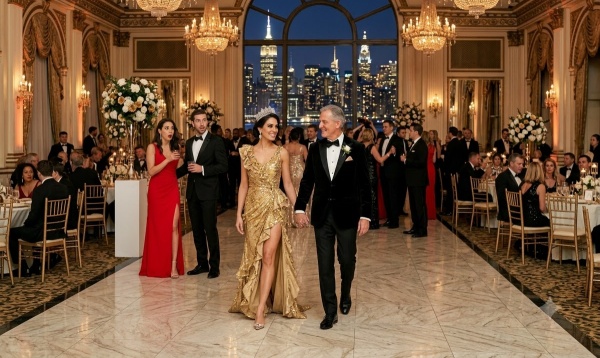
My Husband Announced His Affair at a Chicago Gala and Told Me to Disappear — Three Hours Later, I Walked In With the One Man He Feared Most…
My husband gave me three hours to pack my life into boxes before leaving to publicly debut his mistress at Chicago’s most exclusive gala. He told me the marriage was over, the penthouse was his, and no dramatic scenes would be necessary. What Dominic never imagined was…
PART I — THE ANNOUNCEMENT AT 6:15 P.M.
The light in our penthouse was doing that particular thing it did in late autumn, turning the entire living room gold just before sunset, when Dominic walked in from his dressing room already wearing his tuxedo, adjusting his cufflinks with the kind of casual precision that told me he had rehearsed this moment far more carefully than he wanted me to realize.
My name is Vivian Ashworth, thirty-eight years old, formerly a corporate attorney before I stepped back from practicing law six years ago to support my husband’s rise through Chicago’s financial elite, now standing in the kitchen of our penthouse overlooking Lake Michigan on the forty-second floor of a building on North Lake Shore Drive, holding a glass of water I had just poured, about to learn that the last six years of my life had been building toward exactly this evening.
Dominic Ashworth, forty-two, managing partner at one of the city’s most powerful private equity firms, looked at me with an expression I had seen before in business contexts but never once directed at me personally—the particular coldness of a man closing a deal he considered already finalized.
“I need to tell you something before I leave tonight,” he said, checking his watch rather than looking at me directly. “I’m taking Elise to the Winterbrook Gala. We’re announcing our relationship publicly.”
I set the glass down carefully on the marble counter, aware suddenly of how loud the small sound seemed in the quiet apartment.
“Elise Carrington,” I said, not as a question, because I had suspected for months, though suspicion and confirmation apparently occupy entirely different rooms in a person’s chest.
“Yes,” Dominic said, with the same tone he might use to confirm a dinner reservation. “I’m filing for divorce Monday morning. I’d like you out of the penthouse by tomorrow.”
The Winterbrook Gala was not simply a party. It was the single most exclusive social event on Chicago’s winter calendar, held annually at the Drake Hotel, attended by the city’s most powerful financiers, politicians, and old-money families, the kind of event where reputations were quietly made or unmade over champagne and carefully choreographed small talk. Dominic had spent fifteen years clawing his way toward an invitation to that ballroom, and now he intended to walk through its doors with his mistress on his arm while discarding me the following morning like an outdated business arrangement.
“You’re telling me this three hours before the gala,” I said slowly, “and asking me to be gone by morning.”
“I think it’s cleaner this way,” he said, finally looking at me directly, his expression carrying no trace of guilt, only the efficient satisfaction of a man who believed he had navigated an uncomfortable conversation with admirable brevity. “No dramatic scenes. No drawn-out conversations. We both know this marriage stopped working years ago.”
I thought about correcting him, about reminding him that the marriage had stopped working the moment he decided Elise Carrington’s attention was worth more than six years of partnership, worth more than the countless dinners I had hosted for his investors, the galas I had organized, the connections I had quietly cultivated on his behalf while he built an empire he now believed belonged entirely to him.
I said none of that.
Instead, I asked a single question that made Dominic pause mid-motion while adjusting his bow tie.
“Does Richard Mercer know you’re bringing Elise tonight?”
Something flickered across Dominic’s face, there and gone so quickly I might have missed it if I hadn’t spent fifteen years watching him negotiate deals where the smallest expressions revealed the most important information.
“What does Richard Mercer have to do with any of this?” he asked, his voice carrying a careful neutrality that confirmed exactly how much the name mattered.
Richard Mercer was not simply another attendee at the Winterbrook Gala.
He was the chairman of Mercer Capital Group, one of the three most powerful private investment firms in the Midwest, a man whose approval or disapproval could reshape careers across Chicago’s financial district with a single conversation at the right dinner table, and a man whose name Dominic had spent fifteen years carefully avoiding owing anything to, precisely because men like Richard Mercer collected favors the way other men collected watches, patient and deliberate, always certain the debt would eventually be called.
“Nothing,” I said, picking my water glass back up, allowing myself a small, private smile that I made no effort to hide. “I was just curious.”
Dominic studied me for a long moment, clearly recalibrating something behind his eyes, before apparently deciding my question meant nothing beyond idle curiosity from a wife he had already mentally filed away as yesterday’s business.
“Pack what you need tonight,” he said, straightening his jacket. “I’ll have my attorney send the formal paperwork Monday.”
He left without another word, the door closing behind him with a soft click that somehow felt louder than any slam could have managed, and I stood alone in our penthouse kitchen for several minutes, watching the last gold light fade entirely from the room.
Then I picked up my phone and dialed a number I had saved eight months earlier, back when a conversation at a charity luncheon had quietly rearranged the entire trajectory of what I now understood was about to unfold.
“Richard,” I said, when he answered on the second ring. “It’s Vivian. I need to ask you something, and I need an honest answer.”
PART II — THE DEBT DOMINIC NEVER KNEW ABOUT
Eight months earlier, at a charity luncheon benefiting the Lincoln Park Zoo, I had found myself seated beside Richard Mercer purely by chance, an accident of place-card assignment that would prove to be anything but accidental in its consequences.
I had known Richard socially for years, the way Chicago’s elite circles tend to overlap without ever truly intersecting, but that particular afternoon, over a lunch neither of us particularly wanted to attend, something had shifted in our conversation when Richard mentioned, almost casually, a business dispute from nearly a decade earlier involving his late brother’s investment firm.
“Dominic’s firm handled the liquidation,” Richard had said, swirling wine he barely touched. “Did you know that? Nine years ago. Rushed the valuation. Cost my brother’s estate nearly four million dollars in lost asset value before anyone caught the error.”
I had not known that detail, buried as it was in business history that predated my full awareness of Dominic’s professional dealings, but something in Richard’s carefully measured tone told me this was not simply reminiscence over lunch.
“Why are you telling me this?” I had asked.
Richard had studied me for a long moment, the particular assessment of a man deciding how much a person could be trusted with information that carried genuine weight.
“Because I think, eventually, you’re going to need to know exactly how much your husband owes people in this city,” he said. “And exactly how little he understands about what happens when those debts finally come due.”
I had not fully understood what he meant that afternoon, filing the conversation away as simply another piece of Chicago’s complicated financial history, until three months later, when I discovered the first hotel receipt tucked into Dominic’s jacket pocket, confirming a reservation under a name I would soon learn belonged to Elise Carrington.
From that point forward, I began paying far closer attention to every conversation Dominic had about Richard Mercer, noticing the particular tension that entered his voice whenever Mercer Capital Group came up in discussion, the careful way Dominic avoided situations where he might find himself seated near Richard at industry events, the quiet relief he displayed whenever a deal closed without requiring Mercer Capital’s involvement.
I had called Richard again four months ago, this time with specific questions rather than idle curiosity, and what he told me over that second conversation reshaped my understanding of my own marriage as thoroughly as discovering Dominic’s affair had.
Nine years earlier, during the liquidation of Richard’s brother’s investment firm following his sudden death, Dominic’s firm had rushed a critical asset valuation, failing to properly account for a portfolio of commercial properties that were later discovered to be worth nearly four million dollars more than Dominic’s hasty assessment had indicated. The error had cost the Mercer family estate significantly during a period of grief when they trusted Dominic’s firm to handle matters with appropriate care.
Richard had never pursued legal action, understanding that proving negligence versus simple error would be costly and uncertain, but he had never forgotten, and more importantly, he had spent nine years quietly tracking every subsequent business decision Dominic made, cataloging a pattern of similarly rushed valuations on at least three other transactions where Dominic’s firm had prioritized speed and client acquisition over the kind of careful diligence that protects everyone involved.
“I’ve been patient,” Richard told me during that conversation four months ago. “Patience is simply strategy with better manners. I knew eventually something would create the right opportunity to address what happened to my brother’s estate, and I suspected, knowing men like your husband, that opportunity would likely come through exactly the kind of personal recklessness that eventually catches up with people who believe themselves untouchable.”
I had asked Richard directly what he meant by that, and his answer had been the beginning of a plan I had spent the following four months quietly helping to construct, though neither of us had known precisely when or how it would finally activate.
“If Dominic ever does something reckless enough to threaten his own standing,” Richard said, “something involving poor judgment severe enough to make his partners nervous, I intend to be exactly the person positioned to ensure the consequences land with appropriate weight. And Vivian, I suspect when that moment arrives, you may find yourself needing allies far more than you currently realize.”
Now, standing in my penthouse kitchen three hours before the Winterbrook Gala, phone pressed against my ear, I finally understood exactly what moment Richard had been waiting for.
“He’s bringing Elise Carrington to the gala tonight,” I told Richard. “Announcing their relationship publicly. He’s filing for divorce Monday and wants me out of the penthouse by morning.”
There was a brief silence on the line, the particular pause of a man recalculating a strategy he had spent months preparing.
“Vivian,” Richard said finally, his voice carrying a controlled intensity I had not heard from him before, “how would you feel about attending the Winterbrook Gala tonight, as my guest?”
I looked at my reflection in the dark kitchen window, Lake Michigan barely visible beyond it in the fading evening light, and felt something settle inside me that had been unsettled for the better part of eight months.
“I would feel,” I said slowly, “like it’s exactly where I need to be.”
“Good,” Richard said. “Because I have information about Dominic’s recent transaction with the Hendricks portfolio that his partners at the firm have not yet seen, information that becomes significantly more relevant to discuss publicly once certain personal matters make his judgment a topic of conversation anyway. Be ready by seven-thirty. I’ll send a car.”
PART III — THE HENDRICKS PORTFOLIO
The car Richard sent arrived precisely at 7:30 p.m., a black Mercedes that pulled up to the entrance of our building on North Lake Shore Drive while I stood in the lobby wearing an emerald green gown I had purchased eight months earlier for an occasion I had not yet known would arrive, carrying a small clutch that contained nothing more than my phone, a lipstick, and a folded piece of paper Richard had emailed me an hour earlier.
During the fifteen-minute drive to the Drake Hotel, I read through the document Richard had sent, a detailed summary of a transaction Dominic’s firm had closed six weeks earlier involving the Hendricks family trust, a $62 million commercial real estate portfolio in downtown Chicago that Dominic had personally overseen.
According to Richard’s information, gathered through connections that spanned decades of relationships across Chicago’s financial sector, Dominic had rushed the Hendricks valuation in a manner strikingly similar to the error that had cost Richard’s brother’s estate nearly nine years earlier, pressured by a tight closing timeline and his own eagerness to secure a lucrative deal before a competing firm could intervene.
The valuation had undervalued three key properties by a combined $8.3 million, an error that, if discovered by the Hendricks family or Dominic’s own partners before any correction occurred, would raise serious questions about his judgment, his diligence, and potentially his fitness to continue serving as managing partner at a firm whose entire reputation rested on exactly the kind of careful, trustworthy stewardship Dominic had apparently stopped prioritizing.
“The Hendricks family hasn’t discovered the discrepancy yet,” Richard’s accompanying note explained. “But two of Dominic’s senior partners will be at tonight’s gala. If this information becomes a topic of conversation in the right setting, surrounded by the right witnesses, the consequences will unfold with considerably more weight than any private correction ever could.”
I understood immediately what Richard was offering, not simply the opportunity to walk into that ballroom as his guest while Dominic arrived with his mistress, but the chance to be present when nine years of patient strategy finally, deliberately converged with Dominic’s own reckless timing.
The Drake Hotel’s ballroom was already filling with Chicago’s financial elite when our car arrived, the Winterbrook Gala’s elaborate winter décor transforming the historic space into something that looked more like a scene from old Hollywood than a modern charity fundraiser, chandeliers glittering above tables set with crystal and silver, the city’s wealthiest families and most powerful executives mingling with the particular confidence of people who had spent their entire lives inside rooms exactly like this one.
Richard met me at the entrance, dressed in an impeccably tailored tuxedo, offering his arm with the easy formality of old Chicago money, and together we walked into that ballroom at precisely 8:15 p.m., eleven minutes before Dominic and Elise would make their own entrance according to the timeline I had memorized from Dominic’s earlier comments.
The whispers began almost immediately.
Chicago’s elite social circles operate on information the way financial markets operate on capital, and within minutes of our arrival, I could feel conversations shifting around the room, questions forming behind carefully composed expressions, the particular electricity that accompanies the realization that something significant is about to unfold in a room full of people who understand exactly how much reputations matter in their world.
“Vivian Ashworth,” said Margaret Fenwick, wife of one of Dominic’s senior partners, approaching with the practiced smile of a woman who clearly already knew more than she was letting on. “And Richard Mercer. What an interesting pairing for this evening.”
“Richard and I have been discussing a potential business venture,” I said smoothly, having rehearsed exactly this kind of exchange during the car ride over. “Chicago’s philanthropic community could use more collaboration between people who care about doing things properly.”
Margaret’s eyes sharpened slightly at the emphasis on properly, clearly sensing something beneath the surface of my carefully chosen words, though she said nothing further before excusing herself toward a cluster of other wives whose husbands occupied senior positions at Dominic’s firm.
At 8:26 p.m., exactly as I had anticipated, the ballroom’s energy shifted again as Dominic entered with Elise Carrington on his arm, both of them dressed with the kind of deliberate elegance designed to announce a new chapter rather than simply attend a party.
Dominic’s confident expression froze the moment his eyes found me standing beside Richard Mercer near the center of the ballroom, surrounded by exactly the kind of influential company he had spent fifteen years cultivating relationships to access.
I watched the color drain slightly from his face as he processed, in real time, the magnitude of what my presence beside Richard Mercer actually represented—not simply a wife attending a gala out of spite, but a wife who had apparently formed an alliance with the single most powerful man in the room, a man Dominic had spent fifteen years carefully avoiding, now standing confidently in a space Dominic had believed he fully controlled.
“Vivian,” Dominic said, approaching with Elise slightly behind him, his voice carrying a forced casualness that could not fully mask his unease. “I didn’t expect to see you here tonight.”
“Richard was kind enough to invite me,” I said pleasantly. “We’ve been discussing some interesting developments regarding the Hendricks portfolio.”
The reaction on Dominic’s face was immediate and unmistakable, his careful composure cracking just slightly at the mention of a transaction he clearly believed remained safely contained within his own firm’s private knowledge.
Richard, standing beside me with the relaxed confidence of a man about to execute a plan nine years in the making, smiled with just enough warmth to seem social while carrying an edge sharp enough that Dominic could not possibly misunderstand its meaning.
“Dominic,” Richard said. “I’ve been meaning to discuss something with you and your partners this evening. I believe you’ll find the conversation quite illuminating.”
PART IV — THE CONVERSATION THAT RESHAPED THE ROOM
Within twenty minutes, Richard had quietly gathered a small group near the ballroom’s champagne reception area, including Dominic, Elise standing uncomfortably nearby, and two of Dominic’s senior partners—Harold Whitfield and Preston Caldwell—who had both built their own reputations on the kind of careful, risk-averse diligence that had made their firm one of Chicago’s most trusted names in private equity.
“I thought this might be a good opportunity,” Richard said, his voice carrying easily to the small gathered group without attracting undue attention from the broader ballroom, “to discuss the Hendricks family trust transaction your firm closed six weeks ago.”
Harold Whitfield’s expression shifted immediately into the careful alertness of a man who sensed trouble approaching before fully understanding its shape.
“What about it?” Harold asked.
“My associates have identified a discrepancy in the property valuations,” Richard said smoothly, “specifically regarding three commercial properties that appear to have been undervalued by a combined $8.3 million. The timeline suggests the valuation was rushed considerably faster than standard due diligence protocols typically allow.”
Preston Caldwell’s face had gone noticeably pale, and I watched Dominic’s jaw tighten as the full weight of what was happening settled over him in real time, understanding that Richard had not simply discovered information about the Hendricks deal, but had chosen this exact moment, surrounded by his own senior partners, to make that information impossible to ignore.
“That’s a significant claim,” Harold said carefully. “Do you have documentation?”
“I do,” Richard said, “and I’d be happy to share it with your firm’s internal review team first thing Monday morning, before the Hendricks family’s own representatives inevitably discover the same discrepancy and begin asking considerably less friendly questions.”
The implication landed with precise, devastating clarity: Richard was offering Dominic’s partners the chance to address this internally, discreetly, before it became a public liability, but the very fact that he had chosen to raise it here, now, surrounded by witnesses at the most prestigious social event of the year, ensured that whatever quiet correction followed would carry consequences far beyond a simple financial adjustment.
“Dominic,” Preston Caldwell said slowly, turning toward his partner with an expression that had shifted from confusion into something considerably more serious, “is this accurate? Did you rush this valuation?”
“The timeline was tight,” Dominic said, his voice carrying none of the confident authority I had heard in our penthouse kitchen just hours earlier. “We had competing interest from another firm. I made a judgment call.”
“A judgment call that cost the Hendricks family $8.3 million in undervalued assets,” Richard said pleasantly, as though discussing nothing more significant than weather patterns, “which, I should mention, bears a striking resemblance to a similar judgment call Dominic made nine years ago regarding my late brother’s estate liquidation, an error that cost that family nearly $4 million before anyone identified the problem.”
Harold Whitfield’s expression had transformed entirely now, the careful composure of a seasoned financier giving way to genuine alarm as he processed the implication that this was not an isolated incident but a documented pattern spanning nearly a decade.
“That transaction predates my involvement at the firm,” Harold said, “but if this is accurate, Dominic, we need to have a very serious conversation about your judgment and this firm’s exposure.”
I watched Dominic’s carefully constructed world, the fifteen years of relationship-building and reputation management he had invested in avoiding exactly this kind of exposure, collapse within the span of a four-minute conversation at a gala he had chosen specifically to announce his new relationship with triumphant confidence.
Elise, standing slightly apart from the group throughout this exchange, had grown increasingly uncomfortable, clearly recognizing that the evening she had anticipated—a glamorous public debut as Dominic’s new partner—was rapidly transforming into something considerably more complicated and far less flattering for the man she had chosen to align herself with.
“This is hardly the appropriate venue for business discussions,” Dominic said, attempting to recover some semblance of control over a situation that had already thoroughly escaped him.
“You’re right,” Richard said agreeably. “Though I’d note that you chose this venue specifically to make a different kind of announcement tonight, so I suppose we’re simply following your lead regarding what constitutes appropriate timing for significant personal and professional news.”
The precision of that observation, delivered with Richard’s characteristic calm, landed with the particular sharpness of a man who had waited nine years for exactly this opportunity and intended to make full use of every available moment.
Harold Whitfield excused himself briefly, stepping away to make a phone call that I suspected, correctly, was to the firm’s general counsel, while Preston Caldwell remained, studying Dominic with the particular scrutiny of a business partner recalculating years of trust in real time.
“We’ll need to review every transaction you’ve personally overseen for the past decade,” Preston said quietly. “Starting Monday morning.”
Dominic said nothing, his earlier confidence entirely dissolved into the quiet panic of a man watching the carefully constructed foundation of his professional reputation crumble in front of exactly the people whose respect he had spent his entire career cultivating.
I stood beside Richard throughout this entire exchange, saying almost nothing, understanding that my presence alone carried more weight than any words I might have added, a visible reminder that the woman Dominic had dismissed with such casual cruelty three hours earlier had somehow emerged as an ally to the single most powerful man in that ballroom.
PART V — WHAT THE MORNING ACTUALLY BROUGHT
Dominic and Elise left the Winterbrook Gala shortly before 10:00 p.m., nearly two hours earlier than the triumphant exit Dominic had clearly envisioned when he announced his plans to me in our penthouse kitchen that evening, their departure noted by enough of Chicago’s social elite that by Monday morning, versions of the story had already begun circulating through the particular efficient gossip networks that connect the city’s wealthiest families.
I did not leave the penthouse that night as Dominic had instructed.
Instead, Richard’s car returned me home around 11:30 p.m., and I spent the remainder of that evening calling my own attorney, a formidable divorce specialist named Sandra Kim whom I had quietly retained three months earlier, after that second revealing conversation with Richard had made clear exactly how precarious my marriage’s foundation had become.
“Dominic told me to be out by morning,” I explained to Sandra over the phone. “But Illinois is an equitable distribution state, and this penthouse was purchased with marital funds. I have every legal right to remain here while divorce proceedings are pending.”
“Absolutely,” Sandra confirmed. “He cannot unilaterally force you out of marital property without a court order, regardless of what he claims. Stay exactly where you are. I’ll send formal notice to his attorney first thing Monday morning establishing your continued residency rights.”
By Monday afternoon, the consequences of Richard’s carefully timed revelation had expanded considerably beyond what even I had anticipated. Dominic’s firm had launched a full internal investigation into his handling of both the Hendricks portfolio and the nine-year-old Mercer estate liquidation, and within the week, Harold Whitfield and Preston Caldwell had made the difficult decision to remove Dominic from his position as managing partner, citing a documented pattern of inadequate due diligence that posed unacceptable liability to the firm’s reputation and client relationships.
The Hendricks family, upon learning of the valuation discrepancy, which Dominic’s firm proactively disclosed and corrected before any public scandal could fully materialize, demanded a substantial settlement that further damaged both Dominic’s personal finances and the firm’s broader reputation across Chicago’s tightly connected financial sector.
Elise Carrington, whose own career as a junior associate at a competing firm depended considerably on maintaining relationships within Chicago’s financial elite, distanced herself from Dominic within three weeks of the gala, apparently recognizing that his diminished professional standing offered considerably less value than she had originally calculated when their affair began.
The divorce proceedings that followed, handled meticulously by Sandra Kim, resulted in a significantly more favorable settlement than Dominic had originally anticipated when he confidently told me to be out of our home by morning, Illinois courts recognizing both the marital nature of our penthouse and the substantial contributions I had made over six years toward building the social and professional network that had supported Dominic’s career, even as that same career ultimately imploded under the weight of his own carelessness.
I kept the penthouse.
I kept considerably more of our combined assets than Dominic’s initial confident dismissal had suggested I would receive, Sandra successfully arguing that my six years of unpaid professional support—hosting events, cultivating investor relationships, managing the social infrastructure that had facilitated Dominic’s rise—constituted significant contribution to marital assets deserving appropriate recognition during equitable distribution.
Richard Mercer and I remained friends in the months that followed, our alliance born from mutual necessity evolving into a genuine respect for each other’s patience and strategic clarity, though nothing more complicated than friendship ever developed between us, both of us having learned enough about trust and timing to understand the value of relationships built on something steadier than romantic urgency.
Six months after that gala, I ran into Dominic at a restaurant in River North, both of us navigating the particular awkwardness of former spouses whose shared history had ended in such public, consequential fashion.
“You knew,” he said, without preamble, settling into the booth across from mine despite my clear lack of invitation. “About Richard. About the Hendricks deal. You knew before that night.”
“I knew enough,” I said simply.
“You could have told me,” he said. “Warned me before I walked into that ballroom.”
I studied him for a long moment, this man who had once commanded an entire financial empire with casual confidence, now considerably diminished, working to rebuild a reputation that would likely take years to fully recover, if it ever did.
“You told me I had until morning to pack my life into boxes,” I said. “You decided, in a kitchen conversation that lasted less than five minutes, that fifteen years of partnership deserved nothing more than efficient disposal. I simply decided that if you were determined to make that announcement public, I would ensure the room understood exactly what kind of man was making it.”
Dominic had no response to that, and I watched something settle in his expression that looked uncomfortably close to genuine understanding, perhaps the first moment of real self-awareness I had witnessed from him since this entire ordeal began.
I think often about that evening, about the particular alchemy of patience and timing that transformed a devastating betrayal into something considerably more complicated and, ultimately, more just than Dominic had ever anticipated when he walked into our kitchen wearing his tuxedo, utterly confident that the woman he was discarding possessed neither the resources nor the allies to challenge whatever story he intended to construct.
He had spent fifteen years ensuring he never owed Richard Mercer anything, understanding instinctively that men like Richard collect debts with patience most people cannot sustain.
He never once considered that the debt waiting to be called would arrive not through some calculated business maneuver, but through the quiet, devastating simplicity of his own wife walking into a ballroom on the arm of the one man he had spent an entire career trying to avoid.
I live in that penthouse still, the lake view unchanged, the gold evening light settling across the living room exactly as it had the night everything changed, though the woman who stands in that light now understands something she did not fully grasp six years earlier: some debts, once incurred, simply wait for the right moment to be collected, and some betrayals create exactly the opening that patient, careful people have spent years quietly preparing to fill.
