Twelve Days After Giving Birth, I Faced My Husband and His Pregnant Girlfriend in Court. He Expected a Broken Wife and a Quick Signature—Instead, I Walked Into Court With Our Newborn and the Evidence
PART 1 — The Thirty-Sixth Floor
My husband walked into court expecting my silence, my surrender, and my signature on his divorce papers.
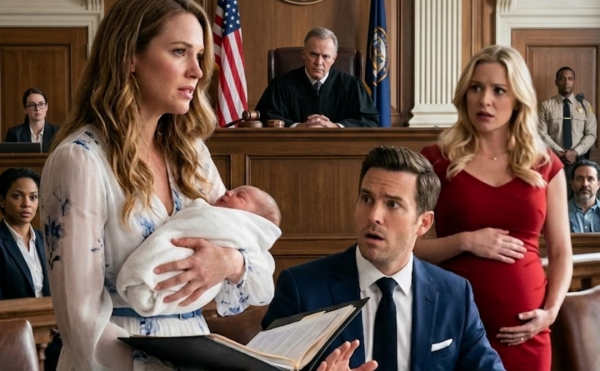
He arrived with his pregnant girlfriend beside him, ready to humiliate the wife he had abandoned in front of attorneys, clerks, and strangers waiting for their own lives to be divided by law. He never realized the black folder I carried in my arms held the one thing that could destroy the future he thought he controlled.
I stepped onto the thirty-sixth floor of the Mecklenburg County Courthouse in Charlotte, North Carolina, with my twelve-day-old son, Owen, sleeping against my chest.
The elevator doors opened to polished floors, fluorescent lights, and the low murmur of people pretending not to stare at other people’s heartbreak. My mother, Linda Parker, walked beside me with the diaper bag over one shoulder and one hand hovering near my back, as if I might fall apart if she stopped guarding the air around me. Honestly, she was not wrong.
I was twenty-nine years old, twelve days postpartum, still moving like my body had been taken apart and put back together by tired hands. Every step pulled at my incision. My milk had leaked through two nursing pads before we even found parking. Owen made a tiny sound against my chest, and I pressed one hand over the wrap holding him close, reminding myself that he was warm, breathing, and here.
That was more than I had been allowed to believe three weeks earlier.
My name is Grace Miller, though before marriage I was Grace Parker, a name I had started writing quietly in the margins of notebooks again. My husband, Derek Miller, was thirty-four, a commercial real estate broker with a polished smile, a leased black BMW, and the type of confidence people often confuse with competence. He loved rooms where he could be seen entering them.
He had once made me feel chosen.
Then he made me feel owned.
Derek and I had been married for four years. Not long enough for people to understand how much damage could fit inside that time. Long enough for me to learn the exact sound of his key in the door, the shape of his moods, and the way his voice changed when he wanted me to doubt my own memory.
We lived in a two-bedroom apartment in South End, close enough to the light rail that Derek called it “urban convenience” and I called it “expensive noise.” I worked as a dental hygienist three days a week before the pregnancy got complicated. Derek always said my income was “nice, but not essential,” which sounded romantic until I realized he used it to justify controlling the bank accounts.
At first, I mistook control for care.
He paid the rent.
He handled the insurance.
He chose our financial advisor.
He said it was easier if I used his credit card for household purchases and transferred my paycheck into the joint account.
He said marriage meant trust.
By the time I understood that trust should not require blindness, I was seven months pregnant and afraid to ask why my debit card declined at Harris Teeter while I was buying prenatal vitamins and strawberries.
The woman beside him in court was Brianna Cole.
She was twenty-six, with shiny auburn hair, soft makeup, and a hand resting protectively on the curve of her belly. She had worked as an event coordinator for one of Derek’s developer clients. According to the timeline I pieced together later, Derek began sleeping with her before my second trimester ultrasound and moved her into a corporate apartment before I knew he was planning to leave me.
He told me about her on a Tuesday night in March.
I remember because rain was hitting the kitchen windows, and I had just folded a load of baby clothes so tiny they still felt imaginary. Derek stood across from me in his navy suit and said, “I can’t keep pretending.”
At first, I thought he meant pretending we were okay.
We had been fighting for months. About money. About his late nights. About his mother calling me “sensitive.” About the way he dismissed every pregnancy symptom as dramatics until my OB put me on modified bed rest for high blood pressure.
Then he said, “I’m in love with someone else.”
My hands froze on a yellow onesie with ducks on it.
I looked down at my belly.
Owen kicked once, hard.
Derek looked at the movement and then away.
“She’s pregnant too,” he said.
That was how I learned my husband had created two future families and planned to choose the one that embarrassed him less.
I did not scream.
I wish I had.
Sometimes I think screaming would have given my body somewhere to put the shock. Instead, I sat very still while Derek explained that he had “tried to do the right thing,” but his connection with Brianna was “different.” He said he wanted a peaceful divorce before the babies arrived. He said we could be adults.
Then he slid a folder across the table.
Divorce papers.
Already drafted.
I was eight months pregnant.
He wanted my signature before I gave birth.
“Grace,” he said gently, like he was offering mercy. “This will be better for everyone if you don’t fight it.”
Better for everyone.
I looked at the papers but did not touch them.
“What about Owen?”
His mouth tightened at our son’s name.
“We’ll share custody.”
“He isn’t born yet.”
“That’s why we should settle now.”
I understood then that Derek was not asking for peace.
He was asking for speed.
Speed protects people who know the full story from people who do not.
He had already hired an attorney, Martin Keller, whose office overlooked Tryon Street and whose emails sounded like expensive furniture. The proposed agreement gave Derek generous custody language, divided our assets in ways that made no sense to me, assigned me certain marital debts I had never seen, and required me to waive claims to several accounts Derek called “business-related.”
I had been tired, swollen, and scared.
But I was not stupid.
I called my mother first.
Then I called an attorney.
Her name was Elena Ruiz, and she worked out of a modest office near Dilworth, with a receptionist who offered me ginger tea and a box of tissues before I said a word. Elena had dark curls, sharp eyes, and a voice so calm it made my panic feel like something that could be organized.
She read Derek’s agreement while I sat across from her with both hands on my belly.
After five minutes, she said, “Do not sign this.”
“I wasn’t planning to.”
“Good. Continue not signing it.”
That was the first full breath I took in days.
Elena explained that North Carolina is an equitable distribution state. That did not mean everything would be split exactly in half, and it did not mean Derek could simply label money “business” and make it disappear. She explained custody could not be decided like a corporate exit plan for a baby who had not yet been born. She explained that debt mattered, documentation mattered, and timing mattered.
Then she asked me a question I was not ready for.
“Do you have access to all marital financial records?”
I laughed once.
It came out ugly.
“No.”
“Do you know all bank accounts in either name?”
“No.”
“Credit cards?”
“No.”
“Retirement accounts?”
“Some.”
“Business interests?”
“He says they aren’t mine.”
“That was not my question.”
I cried then.
Not because Elena was unkind.
Because someone had finally pointed at the cage and called it a cage.
Over the next weeks, while my blood pressure climbed and Owen pressed painfully under my ribs, Elena began asking Derek’s attorney for records. Derek ignored requests at first. Then he produced partial statements, blurry screenshots, and a spreadsheet that looked like it had been made by someone who assumed women could be confused by columns.
Elena was not confused.
Neither was Marcus Bell, the forensic accountant she recommended after seeing the first set of documents.
Marcus was in his late forties, soft-spoken, and terrifyingly good with numbers. He wore plain shirts, kept peppermint candies on his desk, and found hidden financial patterns the way other people find misplaced keys. I met him over Zoom because I was too pregnant to sit comfortably anywhere for long.
“Mrs. Miller,” he said, “I’m going to ask boring questions. Boring questions are where money hides.”
He was right.
Money had been hiding everywhere.
By the time Owen was born, Marcus had identified transfers from our joint account to a limited liability company I had never heard of: Queen City Holdings Group LLC. Derek claimed it was a business vehicle unrelated to the marriage. Marcus found formation documents dated two years after our wedding.
There were also payments to Brianna.
Not many at first.
Small ones labeled event deposits.
Then larger ones labeled consulting.
Then one wire transfer for $18,000 made two days after Derek told me he was leaving.
Marcus also found credit card charges for the corporate apartment where Brianna lived, furniture deliveries, prenatal massage packages, and a $4,700 diamond necklace purchased at a jewelry store in SouthPark Mall.
I had been using coupons for diapers.
Derek had been buying diamonds for his pregnant girlfriend.
Still, that was not the thing in the black folder.
The thing in the black folder came later.
It came because Derek got careless.
Or because Brianna got afraid.
Or because truth sometimes waits until the last possible moment to knock.
Owen was born early after my blood pressure spiked during a routine appointment. I was admitted for observation, then induced when labs showed worsening preeclampsia. Labor failed after twenty hours, Owen’s heart rate dipped, and suddenly I was being rushed into an operating room under bright lights while Derek ignored my calls.
He arrived four hours after the C-section.
Not alone.
Brianna waited downstairs in the hospital lobby.
My mother saw her first.
Brianna wore a cream sweater dress and sat near the gift shop with one hand on her belly, looking irritated by the inconvenience of my emergency delivery. My mother told me later she almost asked security to remove her on principle.
Derek came into my hospital room carrying flowers and resentment.
“Why didn’t anyone tell me sooner?” he asked.
My mother stared at him.
“I called you six times.”
“My phone was on silent.”
“You knew your wife was admitted.”
He looked at me in the bed, pale, shaking, holding our six-pound son against my chest.
Then he looked at Owen.
For a moment, his face softened.
I saw the father he might have been in another life.
Then he said, “We need to talk about the agreement before things get more complicated.”
My mother said, “Get out.”
That was the beginning of the final battle.
Twelve days later, I was at the courthouse.
Owen slept against me.
My incision burned.
The black folder was tucked under my left arm.
And Derek was already there.
He stood near the courtroom doors with Brianna at his side, his attorney behind him, and a look on his face that told me he expected me to break before the judge even called our names.
Brianna looked at Owen, then at me.
Her smile was small and sharp.
Derek leaned close as I approached.
“You brought the baby?” he said.
“He needed to eat,” I replied.
“This is inappropriate.”
I looked at his pregnant girlfriend standing beside him.
“Is it?”
His jaw tightened.
“You’re trying to make me look bad.”
“No, Derek. You’ve handled that.”
Brianna’s face changed.
Elena touched my elbow.
“Grace,” she murmured. “Save it for inside.”
So I did.
For once, I saved everything.
The words.
The anger.
The evidence.
The black folder.
PART 2 — The Signature He Wanted
Derek had always loved signatures.
He loved the finality of them, the authority, the way ink could make a thing official before someone fully understood what they had agreed to. During our marriage, he asked me to sign tax forms, lease amendments, investment authorizations, insurance paperwork, and business documents he said were routine.
Sometimes he would stand over me while I signed.
Sometimes he would place a sticky note beside the line.
Sometimes he would sigh if I tried to read too long.
“Grace, it’s standard,” he would say. “Do you really think I’d ask you to sign something bad for us?”
For us.
Another phrase that had aged badly.
The divorce agreement was the biggest signature he ever wanted from me, but it was not the only one. Two weeks before Owen was born, Derek sent me a document titled Interim Parenting and Financial Cooperation Agreement. It sounded harmless enough to scare me.
Elena read it and said, “Absolutely not.”
The agreement would have given Derek temporary authority to make certain financial decisions “to preserve marital stability.” It also included language stating that I acknowledged his separate business interests, waived objections to certain transfers, and agreed to an accelerated custody schedule once Owen was born.
I said, “Can he do that?”
“He can ask,” Elena said. “He cannot force you.”
“He says if I don’t cooperate, the court will see me as unreasonable.”
Elena removed her glasses.
“Grace, unreasonable is pressuring a heavily pregnant woman to waive financial rights and pre-approve custody terms for a child who has not been born.”
I held onto that sentence like a railing.
Derek did not.
He kept pushing.
He sent emails with phrases like minimizing conflict, protecting both children, and avoiding unnecessary legal fees. By both children, he meant Owen and Brianna’s baby, as if the consequences of his affair should now be managed like a scheduling challenge for everyone else.
Then, five days before my delivery, he sent a text.
If you make this harder than it needs to be, I will ask for primary custody. Your medical issues are documented. Don’t force me to use them.
I screenshotted it.
Elena filed it away.
That was when she told me to stop answering Derek directly except about urgent baby matters. She directed all legal communication through attorneys and asked the court for temporary orders addressing finances, support, custody once the baby was born, and preservation of records.
Derek hated court involvement.
Not because he feared conflict.
Because he feared discovery.
Discovery is not dramatic from the outside. It is not screaming or slammed doors. It is requests for production, subpoenas, account statements, deposition notices, metadata, receipts, and timelines.
It is also where lies go to become tired.
At first, Derek acted insulted.
He claimed Elena was turning a simple divorce into a financial attack. He claimed I had always known about his businesses. He claimed the payments to Brianna were legitimate event-planning fees. He claimed the apartment charges were client hospitality expenses.
Marcus disagreed.
Quietly.
Thoroughly.
With spreadsheets.
He found that Queen City Holdings had received $126,000 from accounts funded during our marriage. Some transfers were routed through Derek’s business account, then partially moved into a personal brokerage account. Several expenditures from Queen City Holdings coincided with Brianna’s move into the corporate apartment.
He also found a business credit card I had not known existed.
I was listed as an authorized user.
I had never received the card.
There were charges for dinners, hotel stays, designer maternity clothes, and one weekend trip to Asheville labeled as a “developer retreat.” Brianna had posted a photo from that same weekend standing on a balcony with mountain views, captioned:
Some seasons are complicated, but love makes them worth it.
I wondered if she had paid for the caption with my grocery money.
Then came the issue of the house.
Derek and I did not own a house together. We rented our South End apartment because Derek said buying would limit his flexibility. But Marcus discovered Derek had put $52,000 toward a down payment on a townhouse in Huntersville.
The buyer was not Derek.
It was Brianna.
More precisely, it was Brianna Cole with a private note in the file referencing “D.M. contribution.”
Derek claimed it was a loan.
There was no loan agreement.
Brianna claimed it was a gift.
That was inconvenient for Derek.
Elena smiled when she read that response.
“People often become honest when lying would make them responsible for repayment.”
I was still processing the townhouse when the second thing happened.
Brianna emailed me.
It was three days after Owen’s birth, while I was home from the hospital and trying to learn how to sit up without crying. My mother was in the kitchen making soup. Owen was asleep in the bassinet beside my bed, wrapped like a burrito and making tiny newborn squeaks.
The email came from Brianna’s personal account.
Subject line:
Please read before court.
I stared at it until my mother came in and asked why I looked like I had seen a ghost.
“Brianna emailed me.”
My mother’s face hardened.
“Forward it to Elena.”
“I haven’t opened it.”
“Forward it anyway.”
I did.
Elena called within ten minutes.
“You may read it,” she said. “Do not respond.”
So I opened it.
Brianna wrote that she knew I hated her. She wrote that she was not proud of how things had started. She wrote that Derek had told her the marriage was already over, that I had refused to divorce him because I wanted his money, and that Owen might not even be his because I had supposedly been “emotionally unstable” during the pregnancy.
I stopped reading there and had to breathe through rage.
Then I continued.
Brianna said Derek had asked her to keep quiet about certain transfers because his attorney was “handling the paperwork.” She said he told her I would sign the settlement after the baby was born because I would be too tired to fight. She said he laughed once and said, Grace signs what I put in front of her if I wait until she’s scared enough.
I read that sentence three times.
My mother read it over my shoulder and whispered, “Dear God.”
But the email did not stop there.
Brianna said Derek had promised to put her name on the Huntersville townhouse free and clear after the divorce. He had also promised that once I signed the agreement, he would “clean up” the business transfers so no one could say marital money had been used improperly.
Then she wrote:
I found out he has been moving money out of the same account he told me was already separated from you. I don’t want to be dragged into fraud. I attached what I have.
Attached were screenshots.
Bank transfers.
Text messages.
A PDF of a wire confirmation.
A photo of a handwritten note in Derek’s writing that said:
Need GP signature on waiver before final. No ED claim. QCH protected.
GP.
Grace Parker.
ED.
Equitable distribution.
QCH.
Queen City Holdings.
My hands went numb.
Elena came to my mother’s house that evening.
Not her assistant.
Not a paralegal.
Elena herself.
Marcus joined by video. For two hours, they reviewed what Brianna had sent. Some of it supported things they already suspected. Some of it opened new questions.
The most important item was a PDF Brianna had apparently photographed from Derek’s laptop. It was a draft affidavit stating that I had been aware of and consented to the use of funds for Queen City Holdings. My signature line was already filled in electronically.
I had never seen the document.
I had never signed it.
The signature looked like mine from a distance but not up close. My real signature had a looping G and a hard downward slash on the P in Parker. This one was smoother, cleaner, almost practiced.
Elena looked at it for a long moment.
“This changes tomorrow.”
I was lying propped against pillows, one hand over my incision, Owen asleep on my chest.
“Tomorrow?”
“The hearing.”
“I thought tomorrow was just about temporary support and the proposed settlement.”
“It was,” Elena said. “Now it is also about preservation, disclosure, and a potentially fraudulent document.”
I swallowed.
“Is Brianna helping me?”
Elena’s expression was careful.
“Brianna is helping herself. That does not mean the evidence is not useful.”
“Will Derek know she sent it?”
“Eventually, yes.”
“He’ll be furious.”
“Yes.”
I looked down at Owen.
“What if this makes him worse?”
Elena leaned forward.
“Grace, Derek is already trying to pressure you into signing away rights, assets, and leverage while you are recovering from childbirth. The evidence does not create the danger. It reveals it.”
That night, I barely slept.
Owen woke every two hours. My body ached. My milk came in painfully. My phone lit up with messages from Derek I did not answer.
We need to settle tomorrow.
Don’t let your lawyer poison this.
Brianna and I are trying to build a peaceful environment for both babies.
If you embarrass me in court, remember that I can make co-parenting very difficult.
Screenshot.
Screenshot.
Screenshot.
At 3:16 a.m., he sent:
Bring the signed papers and this ends.
I looked at Owen sleeping beside me and whispered, “No.”
The next morning, I packed the diaper bag.
My mother packed snacks.
Elena printed copies.
Marcus sent a summary.
And I placed everything in a black folder.
Not because I wanted drama.
Because I needed one place to hold the truth.
PART 3 — Brianna’s Face in the Hallway
Back on the thirty-sixth floor, Derek kept looking at the black folder.
I do not think he understood what it was at first. To him, paperwork belonged to attorneys, accountants, and men like him. The idea that I might arrive with organized evidence seemed to offend his understanding of the natural order.
Brianna understood before he did.
I saw it in her face.
When her eyes landed on the folder, her mouth parted slightly. One hand moved from her belly to the strap of her purse. She looked at Derek, then away.
She knew what she had sent.
She just did not know whether I would use it.
Derek leaned toward her.
“What?” he whispered.
“Nothing,” she said.
But her voice did not sound like nothing.
Elena checked in with the clerk, then guided us to a bench away from Derek. Owen stirred against my chest, rooting slightly. My mother draped a muslin blanket over my shoulder so I could nurse him discreetly.
There I was, feeding a newborn in a courthouse hallway while my husband stood twenty feet away with his pregnant girlfriend and a lawyer who billed more per hour than I used to make in a day.
Life has a cruel sense of staging.
Derek’s attorney, Martin Keller, approached Elena.
“Counselor,” he said smoothly. “My client remains willing to resolve this today if your client is prepared to execute the agreement.”
Elena smiled politely.
“My client will not be executing that agreement.”
Martin’s gaze flicked to me.
“That is unfortunate. Mr. Miller has made generous concessions.”
My mother muttered, “Generous where?”
I pretended not to hear.
Elena said, “We will address matters with the court.”
Martin lowered his voice.
“Is this really necessary with a newborn present?”
Elena’s smile disappeared.
“Your client filed the motion and insisted on today’s setting despite being informed Mrs. Miller delivered by C-section less than two weeks ago. Do not now use the child’s presence as moral leverage.”
Martin’s face tightened.
He returned to Derek.
Derek looked annoyed, then whispered something to Brianna. She shook her head. He frowned.
I wondered if that was the moment she realized Derek had not told his attorney everything.
The courtroom was smaller than I expected.
Not intimate, exactly, but not grand. Wooden benches, flags, a court reporter, a clerk, attorneys arranging files, and a judge’s bench that suddenly seemed both ordinary and terrifying.
The judge was Honorable Caroline Mercer, a woman in her late fifties with silver hair pulled back neatly and a direct gaze. She looked at Owen when we entered, then at me.
“Mrs. Miller,” she said, “are you medically able to proceed today?”
Before Derek could react, Elena stood.
“Your Honor, my client is twelve days postpartum following a C-section and is here because Mr. Miller’s counsel insisted the pending temporary matters proceed. She is prepared to participate, but we may request breaks for medical or infant care needs.”
Judge Mercer looked at Martin.
“Mr. Keller?”
Martin cleared his throat.
“My client believed prompt resolution would benefit all parties.”
The judge’s expression cooled slightly.
“I asked about proceeding, not philosophy.”
Martin nodded.
“We can proceed, Your Honor.”
The first part of the hearing concerned temporary child support, spousal support, medical expenses, and interim custody arrangements for Owen. Elena presented my income, leave status, medical recovery, and Owen’s needs. She emphasized that Owen was a newborn breastfed on demand and that any parenting schedule needed to reflect his age, feeding, and medical guidance.
Derek’s side argued he wanted meaningful parenting time immediately.
That was not unreasonable in itself.
What was unreasonable was how he framed it.
Martin said Derek had “serious concerns” about my willingness to facilitate a relationship between father and child. He referenced my “emotional volatility,” my refusal to sign cooperative paperwork, and my “pattern of excluding Mr. Miller from the birth experience.”
My mother stiffened beside me.
I kept my eyes on Owen.
Elena rose.
“Your Honor, Mrs. Miller did not exclude Mr. Miller from the birth experience. She was induced for medical reasons, underwent an unplanned C-section after labor complications, and Mr. Miller failed to respond promptly to multiple calls. We have call logs.”
Martin began to object.
Judge Mercer raised a hand.
“Mr. Keller, be careful with how you characterize emergency childbirth in this courtroom.”
The air shifted.
Derek looked down.
Then came finances.
Martin argued Derek’s business interests were separate or minimally marital. He claimed the proposed agreement fairly resolved disputed issues without unnecessary expense. He suggested my refusal to sign was driven by anger about Derek’s new relationship.
There it was.
The story he wanted.
Bitter wife.
Pregnant girlfriend.
Successful man trying to move forward.
Elena stood with the black folder in her hands.
I felt Derek’s eyes on it.
“Your Honor,” she said, “we have significant concerns about undisclosed marital transfers, potential dissipation of marital assets, and a draft document purporting to bear my client’s signature on a waiver she never reviewed or executed.”
Derek’s head snapped up.
Brianna closed her eyes.
Martin looked at Derek.
Just for a second.
But long enough.
Elena continued.
“We are requesting preservation orders, production of complete financial records, restraint on further transfers from marital or disputed business accounts, and an order prohibiting either party from presenting disputed signatures or waivers as valid absent authentication.”
Judge Mercer leaned forward.
“What document?”
Elena handed copies to the clerk.
Martin stood.
“Your Honor, this is the first we are hearing of any such allegation.”
Elena turned a page.
“The document was discovered through materials recently provided to my client. It appears to be a draft affidavit stating Mrs. Miller consented to the transfer of marital funds into Queen City Holdings Group LLC. The signature is not hers.”
Derek whispered something to Martin.
Martin whispered back sharply.
Judge Mercer looked at me.
“Mrs. Miller, did you sign this document?”
I stood carefully, one hand supporting Owen.
“No, Your Honor.”
My voice sounded thin, but it did not break.
“Did you authorize anyone to sign it for you?”
“No, Your Honor.”
“Had you seen it before?”
“No, Your Honor.”
Derek stood halfway.
“This is ridiculous.”
Judge Mercer turned to him.
“Mr. Miller, sit down.”
He sat.
His face flushed dark red.
Martin tried to recover. He argued the document was a draft, not filed, not used, and possibly prepared in anticipation of settlement discussions. He said there was no evidence Derek intended to rely on it improperly.
Elena said, “Then Mr. Miller should have no objection to preserving all metadata, producing native files, and identifying who created or modified it.”
Silence.
That silence was worth more than shouting.
The judge asked Martin, “Any objection?”
Martin hesitated.
Derek looked furious.
“No objection to reasonable preservation,” Martin said.
“Good,” said the judge. “The court will define reasonable.”
Brianna stared at the floor.
But Elena was not finished.
She presented Marcus’s preliminary findings: transfers to Queen City Holdings, payments to Brianna, apartment expenses, jewelry, the Huntersville townhouse contribution, and the timing of Derek’s pressure for my signature. She did not accuse more than the documents supported. That made every sentence heavier.
Martin objected repeatedly.
Some objections were sustained.
Many were not.
The judge did not decide final property division that day. Temporary hearings do not resolve everything. But she had seen enough to issue immediate orders preserving assets and records.
Then Elena requested that Derek be prohibited from contacting me directly about settlement, signatures, waivers, or financial documents outside counsel or the approved co-parenting app for child-related issues.
Martin called that unnecessary.
Elena read Derek’s 3:16 a.m. text aloud.
Bring the signed papers and this ends.
Judge Mercer looked at Derek.
“Mr. Miller, did you send that message to your wife twelve days after she delivered your child?”
Derek swallowed.
“I was trying to avoid further conflict.”
The judge’s face did not move.
“That is not how the court reads it.”
I felt my mother exhale beside me.
Then Brianna stood.
Not fully.
Just enough to whisper to Derek, “I need to go.”
He grabbed her wrist.
Not hard enough to be dramatic.
Hard enough that I saw her flinch.
Judge Mercer saw it too.
“Ms. Cole,” the judge said, “you may step out if you need to.”
Brianna pulled her wrist free.
“I’m fine,” she whispered.
But she was not fine.
Neither was Derek.
For the first time since I had known him, he looked like a man who had entered a room expecting to direct the scene and realized someone else had the script.
PART 4 — The Document That Wasn’t Supposed to Exist
The court took a short recess so I could feed Owen and take medication.
Elena led us into a small consultation room. My mother closed the door behind us, then leaned against it like she was keeping a storm outside. I sat in a chair, unwrapped Owen from the carrier, and tried to latch him while my hands shook.
“You did well,” Elena said.
“I feel like I’m going to throw up.”
“That is also acceptable.”
My mother opened a bottle of water and held it out.
“I want to slap him,” she said.
Elena looked at her.
“Please don’t. It creates paperwork.”
For the first time all day, I laughed.
It hurt my incision.
It was worth it.
Owen nursed sleepily, one tiny hand pressed against my skin. I looked down at him and tried to understand how Derek could see this child as leverage. How he could look at a newborn and think about waivers, custody pressure, and financial positioning.
But that was the mistake I had made for years.
I kept asking how Derek could do things as if my inability to imagine them made them less real.
Elena sat across from me.
“There is something you need to be prepared for.”
“What?”
“Derek may claim Brianna fabricated or manipulated the evidence.”
I looked up.
“Would that work?”
“Not if the metadata and financial records support it. But he may try.”
“Why would she send it if she’s still with him?”
Elena’s expression softened, just slightly.
“Fear makes people complicated.”
That was true.
I did not like Brianna.
I did not forgive her.
She had known about me. Maybe not from the beginning, but eventually. She had allowed herself to be presented as Derek’s future while I was still pregnant with his child. She had stood in the courthouse hallway with him like my pain was simply the old chapter before her happy ending.
But she had also sent the email.
People can be both guilty and useful.
Both wrong and afraid.
Both a cause of harm and a witness to larger harm.
When we returned to the courtroom, Martin looked less polished. Derek looked angrier. Brianna looked pale.
Judge Mercer addressed temporary custody.
She ordered that Owen would remain primarily in my care given his age, feeding needs, and my maternity leave. Derek would have frequent short visits several times per week, initially at my mother’s home or another agreed location, expanding as Owen grew and feeding allowed. Exchanges and communication would occur through a parenting app.
Then she looked at Derek.
“Mr. Miller, the court expects respectful communication. The mother of your newborn is recovering from major surgery. Pressure tactics around legal documents will not help your position.”
Derek nodded stiffly.
“Yes, Your Honor.”
The judge also ordered temporary child support based on income records and required Derek to maintain medical insurance for Owen if available through his employment. She ordered both parties not to move, conceal, borrow against, transfer, or dispose of marital or disputed assets except for ordinary living expenses and attorney-approved transactions.
Then came the records.
Derek had to produce complete bank statements, business account records, credit card statements, closing documents related to the Huntersville townhouse contribution, Queen City Holdings formation and transaction records, communications regarding the disputed waiver, and native files for the draft affidavit.
Native files.
Metadata.
Words Derek had not expected to matter.
Martin requested confidentiality restrictions.
Elena agreed to reasonable protections for financial privacy.
Judge Mercer allowed that but made clear privacy did not mean concealment.
The hearing ended after nearly three hours.
No final divorce.
No dramatic declaration.
No handcuffs.
No movie ending.
But Derek did not get my signature.
He did not get silence.
He did not get surrender.
And the black folder left the courtroom as part of a court record.
In the hallway, Derek approached me before Elena could block him.
“You have no idea what you just did,” he said.
His voice was low, tight, shaking.
Owen slept through it.
Elena stepped between us.
“Mr. Miller, all communication through counsel or the parenting app.”
He ignored her and looked over her shoulder at me.
“You think Brianna is your friend now?”
I said nothing.
“You think she told you everything?”
Still nothing.
His eyes sharpened.
“She’ll regret this.”
That was when Brianna, standing behind him, said quietly, “I already do.”
Derek turned.
The hallway went still around them.
Brianna’s hand was on her belly again, but this time it looked less like tenderness and more like protection.
“You don’t get to threaten me too,” she said.
Derek’s face changed.
“Brianna, stop.”
“No. I should have stopped months ago.”
Martin muttered, “This is not the place.”
Brianna laughed once, without humor.
“Apparently court is exactly the place.”
Then she walked toward the elevators.
Derek did not follow.
Not because he did not want to.
Because too many people were watching.
That was Derek’s real religion.
Witnesses.
My mother touched my shoulder.
“Let’s go home.”
On the elevator ride down, Owen woke and began to fuss. The sound was tiny but urgent, the kind of newborn cry that rearranges every priority in the room. I bounced him gently, whispering, “I know, baby. We’re going.”
A woman in a business suit standing beside us smiled softly.
“How old?”
“Twelve days,” I said.
Her eyes widened.
“Oh, honey.”
Two words.
No judgment.
No curiosity.
Just human recognition.
I almost cried.
Outside, Charlotte was bright and loud. Cars moved along the street, people crossed with coffee cups, and office workers hurried back from lunch as if my life had not just shifted under fluorescent lights thirty-six floors above them.
My mother helped me into the passenger seat.
Elena leaned down before closing the door.
“I’ll call you later. Rest if you can.”
I looked at her.
“Did we win?”
She paused.
“Today, we stopped him from winning by default.”
That was enough.
For that day, it was everything.
The next two weeks were ugly.
Derek sent only app-approved messages, but his tone was ice.
I will arrive at 4:00 p.m. for court-ordered parenting time.
Have Owen fed beforehand.
Do not discuss adult matters during exchanges.
The irony nearly glowed.
I followed the order.
My mother stayed present.
Derek held Owen awkwardly at first, like a man trying to appear natural with something he had not practiced caring for. Sometimes he looked genuinely moved. Sometimes he looked at me like Owen’s needs were an inconvenience to his argument.
Brianna did not appear at visits.
Three weeks after court, Elena received notice that Brianna had retained her own attorney. She was cooperating with discovery requests related to payments and transfers made to her or for her benefit. Derek’s attorney objected to some disclosures. The judge compelled several of them.
That was when the document became impossible to explain away.
Metadata showed the disputed waiver had been created on Derek’s laptop six days before he first sent me the settlement agreement. It had been modified twice, including once at 1:42 a.m. the night after I refused to sign. The electronic signature image inserted into the document matched a signature from an old insurance form I had signed two years earlier.
Marcus found the source.
Derek had scanned old household documents into a shared drive.
He had copied my signature.
Not perfectly.
But close enough that if I had been frightened, exhausted, and less represented, he might have used it to pressure me. Maybe not in court immediately. Maybe in negotiations. Maybe as a threat.
Sign now or I show them you already agreed.
That was Derek’s way.
He did not always need the lie to survive scrutiny.
He only needed it to scare someone before scrutiny began.
Elena filed a motion for sanctions and additional protective orders.
Martin’s tone changed after that.
Derek’s too.
The man who once texted me at 3:16 a.m. demanding I bring signed papers now communicated like a customer service representative after legal review.
Please confirm whether Thursday at 5:30 p.m. remains acceptable for parenting time.
I confirmed.
Nothing more.
Meanwhile, Brianna moved out of the apartment Derek had been paying for.
I heard that from Elena, not gossip. Brianna’s attorney informed all parties because her address affected service and discovery. She moved in with her sister in Concord.
Two months later, she gave birth to a baby girl.
Derek was the father.
That fact complicated my emotions in ways I did not want to admit.
The baby was innocent.
Brianna was still the woman who had helped break my marriage.
Derek was now father to two infants born less than three months apart.
And I was supposed to co-parent with him for the next eighteen years.
Some realities are so absurd that anger has to take a number and wait behind logistics.
Diapers.
Court dates.
Pumping.
Discovery responses.
Infant sleep.
Attorney invoices.
Insurance forms.
The life Derek tried to reduce to a signature became a thousand daily acts of endurance.
PART 5 — The Life He Didn’t Control
The divorce was finalized nine months after the courthouse hearing.
By then, Owen was sitting with support, laughing at ceiling fans, and trying to chew on anything within reach. He had Derek’s dark eyes and my dimple in his left cheek. Every time he smiled, I felt something inside me repair by one stitch.
The final settlement was not perfect.
Legal outcomes rarely feel like poetry.
But it was fair enough to let me breathe.
Derek had to account for marital funds transferred into Queen City Holdings. I received an offset for certain dissipation-related expenditures, including payments and benefits to Brianna during the marriage. The disputed waiver was formally rejected and documented as unauthorized. Derek was ordered to pay a portion of my attorney and expert fees related to the signature issue and incomplete disclosures.
The court did not award me everything.
It did not punish Derek for being unfaithful in the way people online might imagine.
North Carolina law did not turn heartbreak into a blank check.
But documentation mattered.
The jewelry, the apartment, the townhouse contribution, the transfers, the fake signature draft—they mattered.
Not because they proved Derek was a bad husband.
Because they proved he had tried to manipulate the financial ending of our marriage while I was vulnerable.
Custody also settled into a structure.
Owen lived primarily with me. Derek had regular parenting time that increased gradually as Owen grew. Exchanges remained documented. Major decisions required communication through the app. Romantic partners were not prohibited forever, but introductions had to follow agreed guidelines and timing.
That clause mattered less because of Brianna and more because of Derek’s tendency to treat people as scenery in his preferred narrative.
Brianna and Derek did not last.
I do not say that with joy.
They broke up before her daughter was six months old. According to what came out through attorneys, Derek accused Brianna of betraying him by sending evidence to me. Brianna accused Derek of lying about money, the divorce, and his ability to provide the life he promised.
I never spoke to her directly after the courthouse.
But six months after the divorce, I received a letter.
Not an email.
A real letter, handwritten on plain white paper.
Elena reviewed it first, then gave it to me.
Brianna wrote that she knew she had no right to ask for forgiveness. She said Derek had lied to her, but she had also ignored things because believing him made her feel chosen. She said watching him turn on me after Owen was born made her realize he would one day do the same to her.
Then she wrote:
I sent the documents because I was scared for myself, but also because I saw your baby in that carrier and understood he was not a negotiation tool. I am sorry it took me that long to see you as a person.
I sat with that sentence for a long time.
I did not write back.
Forgiveness, if it comes, does not always need a mailing address.
My mother asked if I felt vindicated.
I told her I felt older.
That was the truth.
There is a kind of betrayal that does not simply hurt your heart. It rearranges your understanding of safety. It makes you suspicious of soft voices, helpful folders, and the phrase “just sign here.” It teaches your nervous system to read rooms faster than your mind can explain.
For a while, I was afraid of mail.
Afraid of unknown numbers.
Afraid of app notifications from Derek.
Afraid that every polite sentence contained a trap.
Therapy helped.
So did sleep, once Owen began giving me stretches longer than three hours.
So did going back to work part-time.
My coworkers at the dental office threw me a small welcome-back breakfast with muffins, fruit, and a card signed by everyone. Nobody asked for dramatic details. They said Owen was beautiful, my scrubs still fit, and the new scheduling software was terrible.
Normal life can be a mercy.
I moved into a small townhouse in Matthews, not far from my mother. It had two bedrooms, a patch of grass, and a kitchen window that caught morning light. The rent was less than the South End apartment, and the dishwasher made a concerning noise, but it was mine.
The first night there, after Owen fell asleep, I walked through the rooms barefoot.
No Derek.
No footsteps I had to interpret.
No documents waiting beside my dinner plate.
No one sighing because I asked a question.
I opened the kitchen cabinet and placed my mugs exactly where I wanted them.
Then I cried.
Not because I was sad.
Because peace felt unfamiliar enough to hurt.
Derek remained Derek.
He became more careful, not necessarily kinder.
There is a difference.
He followed the parenting plan because consequences had become visible. He paid support because wage withholding made performance less optional. He communicated through the app because every message could be read by attorneys if necessary.
Sometimes, during exchanges, I saw flashes of the charm I had married.
He would make Owen laugh. He would remember a pediatric appointment. He would send a picture of Owen asleep against his shoulder during parenting time with the message:
He did great today.
I appreciated those moments.
I did not build hope on them.
Hope without evidence had cost me enough.
When Owen was fifteen months old, he learned to say “mama” clearly. He said it while sitting in a pile of plastic blocks, holding a wooden giraffe by one leg, looking extremely proud of himself. I clapped so hard he startled, then laughed, then said it again.
“Mama.”
I thought of the courthouse.
The thirty-sixth floor.
The black folder.
Derek standing with Brianna, waiting for my surrender.
He had believed motherhood would weaken me.
In some ways, it did.
It made me softer in places I had armored. It made me cry over diaper commercials and tiny socks. It made me afraid in ways I had never known.
But it also clarified everything.
Before Owen, I negotiated with disrespect because I thought endurance was love.
After Owen, I understood that allowing someone to diminish me would teach my son the wrong language for family.
I wanted him to grow up seeing respect as ordinary.
Boundaries as normal.
Apologies as actions.
Love as something that does not require one person to disappear so another can feel powerful.
One afternoon, when Owen was almost two, Derek tried again to rewrite history.
We were standing outside the supervised exchange center we no longer technically needed but sometimes used when schedules were tense. Owen was holding a toy truck and refusing to let anyone buckle him without first showing the truck to the sky.
Derek said, “You know, things could have been easier if you hadn’t gone nuclear in court.”
I looked at him.
For a second, the old Grace stirred.
The one who would explain.
Defend.
Prove.
Then she rested.
“No, Derek,” I said. “Things could have been easier if you hadn’t forged my signature.”
His face tightened.
“I never filed that document.”
“That’s not the defense you think it is.”
He looked away.
Owen shouted, “Truck!”
We both turned to him.
The conversation ended because toddlers are excellent at destroying dramatic tension.
On the drive home, I realized I had not shaken.
That was new.
Healing is not one big moment.
It is noticing that a sentence that once would have ruined your day now only annoys you at a red light.
I still keep the black folder.
Not with daily papers.
Not where I see it all the time.
It is in a file box in my closet, beside tax returns, medical records, and Owen’s birth certificate. Inside are copies of the email from Brianna, the disputed waiver, Marcus’s summary, Derek’s texts, and the court orders that stopped him from turning pressure into permission.
I do not keep it because I want to live in the past.
I keep it because the past taught me the cost of being undocumented.
Women are often told to be graceful, trusting, forgiving, flexible, and calm.
Those can be beautiful qualities.
They can also be exploited.
So I tell women something different now.
Be kind, but keep records.
Trust, but understand what you sign.
Love, but know where the money goes.
Forgive if you choose, but do not confuse forgiveness with handing someone the pen again.
If a person pressures you to sign quickly, slow down.
If they call your questions disrespectful, ask more.
If they use your exhaustion, illness, pregnancy, or postpartum recovery as leverage, get help immediately.
And if you walk into court with a newborn on your chest and a folder full of truth in your arms, do not let anyone convince you that your trembling means you are weak.
Sometimes trembling is just what strength looks like when it has not slept.
My husband walked into court expecting my silence, my surrender, and my signature on his divorce papers.
He arrived with his pregnant girlfriend beside him, ready to humiliate the wife he had abandoned.
He thought he controlled the money.
The timeline.
The story.
The room.
But he did not control the truth.
He did not control the woman he had mistaken for compliant.
And he did not control the child sleeping against my chest while the life Derek built on pressure, lies, and stolen signatures began to crack in front of a judge.
I stepped onto the thirty-sixth floor of the Charlotte courthouse as a twelve-day-postpartum mother with shaking hands, a healing body, and a baby who needed me.
I walked out without signing away my future.
That was the first day I understood something I wish I had known years earlier:
A signature can change your life.
So can refusing to give one.
