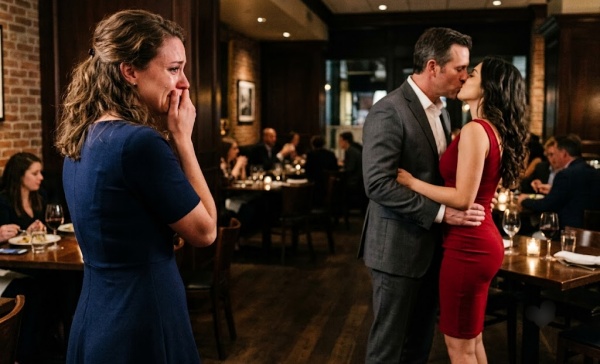
My Wife Whispered, “I Saw You Kissing Her,” and Then Disappeared. It was only a few seconds, but that kiss destroyed everything I thought I had. My wife saw me, whispered the words I deserved to hear, and disappeared from my life before I could explain. Four Years Later, I saw three preschoolers with my face holding her hands, and I understood the real cost of the choice I made.
Part 1: The Night She Vanished
My wife did not scream when she caught me.
She did not throw her wine in my face, slap me across a crowded room, or make the kind of scene people talk about for years. She simply stood at the edge of the hotel ballroom in Nashville, Tennessee, wearing the dark green dress I had always loved, and looked at me like she had finally seen the man I really was.
Then she walked up to me, leaned close enough that no one else could hear, and whispered, “I saw you kissing her.”
That was all.
Five words.
Then she turned around and disappeared from my life.
Her name was Claire Donovan, though when we married, she became Claire Miller because she said she liked the sound of it. I was stupidly proud of that. I liked seeing my last name on her medical forms, her work badge, the return address labels she ordered for our first apartment in East Nashville.
Back then, I thought marriage meant someone had chosen to stand beside me forever. I did not understand that forever still required daily proof. I did not understand that trust could be lost in less than ten seconds.
The woman I kissed was named Rebecca Shaw. She worked in marketing at the software company where I was a regional sales manager. She was funny, sharp, divorced, and very good at making a man feel interesting when his own life had become ordinary.
That is not an excuse.
There is no excuse.
But that is how it started. A joke during a late meeting. A text about work that turned personal. A drink after a conference session. A compliment I should have shut down the second it made me feel taller than I deserved to feel.
The conference was at a hotel downtown, one of those modern places with glass walls, overpriced cocktails, and rooftop views of a city pretending not to be tired. Claire came with me because spouses were invited to the closing dinner. She had taken the afternoon off from the elementary school where she taught second grade, curled her hair, and worn the green dress I once told her made her eyes look like summer rain.
At dinner, I barely looked at her.
That is the part that still makes me sick.
She sat beside me while I laughed too hard at Rebecca’s jokes across the table. She touched my wrist once and asked if I wanted to dance later, and I said, “Maybe,” without even turning my head. I was so busy enjoying attention from another woman that I missed the quiet heartbreak of my own wife sitting inches away.
Later, I told Claire I had to take a call near the elevators. That was a lie. Rebecca had texted me: “Meet me by the terrace?”
I went.
The hallway outside the ballroom was dim, with gold carpet and framed photographs of old Nashville streets. Rebecca stood near the terrace door, holding a glass of white wine, smiling like we were already doing something we could not undo. I should have walked away.
Instead, I kissed her.
It lasted maybe six seconds.
That is the cruel thing about betrayal. Sometimes it does not even take long. A lifetime can crack open inside a moment short enough for an elevator door to close.
When I pulled back, Rebecca laughed nervously and said, “We shouldn’t.”
I said, “No, we shouldn’t.”
Then I turned and saw Claire.
She was standing twenty feet away, one hand on the wall as if she needed it to stay upright. Her face was very pale. Her eyes were not angry yet; they were stunned.
I said her name.
She walked toward me slowly.
Rebecca stepped back. “Claire, I—”
Claire did not even look at her.
She came close to me, close enough that I could smell her perfume, the soft vanilla one she wore only on special nights. Her wedding ring caught the hallway light when she lifted her hand and pressed one finger gently against my chest.
“I saw you kissing her,” she whispered.
Then she walked away.
I followed her, of course. I called her name through the hotel lobby, out toward valet parking, across the sidewalk where people were laughing beside rideshares and tourists in cowboy boots were taking pictures under neon signs. She did not run. She simply moved with terrifying purpose.
By the time I reached the valet stand, she was already getting into a cab.
“Claire, wait,” I said, grabbing the door.
She looked at me through the open window. Her face had changed. The shock was gone, and in its place was something colder.
“Don’t come home tonight,” she said.
Then the cab pulled away.
I stood there under the hotel lights with my tie loosened and my life beginning to split down the middle.
I did not go home immediately. That is another truth I hate. I stayed at the hotel for almost an hour, telling myself she needed space, telling myself if I followed her too soon, I would only make things worse.
Really, I was afraid.
Afraid of her tears. Afraid of her silence. Afraid of what I had become in her eyes.
At 1:12 a.m., I finally drove home. Our house was in a quiet neighborhood outside Franklin, about twenty-five miles south of Nashville. It was a small white ranch with a red front door, two creaky porch steps, and a magnolia tree Claire planted the first spring we lived there.
Her car was gone.
Inside, the house was perfectly still.
Her suitcase was missing from the closet. Her toothbrush was gone from the bathroom. The framed photo from our honeymoon in Charleston had been turned face down on the dresser.
On the kitchen table, she had left her wedding ring.
No note.
No explanation.
Just the ring sitting in the center of the table like a verdict.
I called her phone until it went straight to voicemail. I texted apologies that sounded pathetic even as I typed them. I drove to her sister’s apartment in Murfreesboro, but no one answered the door.
The next morning, I called her school. They said she had requested emergency leave. They would not tell me anything else.
By the third day, I reported her missing.
The officer who came to the house was polite but careful. He asked if Claire had taken clothes, money, identification, medication. I said yes. He asked if there had been a fight. I told him the truth, though I softened it at first because cowards try to control language even after damage is done.
“My wife caught me kissing someone,” I said.
The officer wrote that down.
“She’s an adult,” he told me. “If she left voluntarily and is safe, she has the right not to be contacted.”
That sentence destroyed whatever fantasy I had left. Claire was not missing in the way I wanted her to be. She was gone.
There is a difference.
Weeks passed. Then months.
Her sister finally called me once, three weeks after the night at the hotel. Her voice was sharp enough to cut glass.
“She’s alive,” she said. “That’s all you deserve to know.”
“Where is she?”
“No.”
“I need to talk to her.”
“You needed to be faithful.”
Then she hung up.
I deserved that.
Still, I did not stop looking. Not in illegal ways, not by breaking into accounts or following her family, but in the pathetic ways abandoned people look for proof of a life they no longer have access to. I searched social media. I checked old mutual friends. I drove past places she used to love, as if grief could make her appear at a coffee shop window.
She never did.
After six months, I received divorce papers.
They came by certified mail on a Thursday afternoon while I was eating cold pizza over the kitchen sink. Claire had hired a lawyer in Knoxville. The petition cited irreconcilable differences and inappropriate marital conduct.
There was no mention of children.
There would not have been.
At the time, I did not know she was pregnant.
Part 2: The Life I Thought I Had Lost
The divorce was finalized quietly.
That is how Claire wanted it. No courtroom drama, no social media posts, no public humiliation, no revenge tour through our friend group. She took what was fair, left me the house because she did not want to live in it, and signed every document through her attorney.
I saw her only once during the entire process.
It was at mediation in a bland office building with beige walls and weak coffee. She sat across the table from me wearing a navy blouse, her hair shorter than I remembered, her face calm in a way that made me feel more ashamed than anger ever could have. She did not look broken.
That hurt more than if she had.
I tried to speak to her before we started. “Claire, please. Can we talk for five minutes?”
Her attorney, a woman with silver glasses and no patience, said, “All communication can go through me.”
Claire looked down at her folder and said nothing.
When the mediator asked if there was any chance of reconciliation, I looked at Claire with everything I had left.
She said, “No.”
One word.
Clean and final.
After the divorce, I became the kind of man people felt sorry for only because they did not know the whole story. They knew Claire had left. They knew our marriage ended suddenly. They knew I drank too much for a while and lost weight in a way that made coworkers say, “You doing okay, man?”
Some knew about Rebecca.
Most did not.
Rebecca and I did not become a couple. That may sound obvious, but at the time, people expected scandal to turn into romance, as if betrayal needed a prize at the end. It did not. It turned into nothing.
Two weeks after Claire left, Rebecca cried in my office and said she could not handle being “the reason.” I told her she was not the reason. I was.
She transferred to the Atlanta office by Christmas.
I quit drinking the following spring after waking up on the couch with a voicemail from my mother playing on speaker. She was crying. She said, “Caleb, I lost your father young. I don’t want to lose my son while he’s still alive.”
My father had died of a heart attack when I was twenty-two. He had been a quiet man, an electrician, the kind of father who fixed things without announcing it. For years, I told myself I wanted to become dependable like him.
Instead, I had become a man who destroyed the safest person in his life for six seconds of ego.
I went to therapy.
I did not go because I was noble. I went because guilt had become a room with no windows, and I was tired of pacing inside it. My therapist, Dr. Harlan, had a beard, cardigan sweaters, and a talent for asking questions that made me hate him on Tuesdays and thank him by Friday.
He never let me hide behind “mistake.”
“You made choices,” he said during our third session.
“I know.”
“No,” he said. “You know it intellectually. But you keep using the language of accident because it allows you to grieve the outcome without fully owning the path.”
I sat there in his office, staring at a potted plant, furious because he was right.
Over the next few years, I rebuilt a life that looked functional from the outside. I sold the Franklin house because every room had Claire’s absence in it. I moved into a condo near Germantown, close enough to downtown to hear weekend traffic and far enough from my old life to pretend I was improving.
I changed jobs. I ran half-marathons badly. I learned to cook something besides steak and scrambled eggs because Claire was no longer there to turn groceries into a home. I dated twice, both times ending it before anything serious happened because I could not stand the thought of becoming someone’s future when I had ruined someone else’s past.
Every year on the anniversary of the night Claire left, I did not call her.
That was my one decent habit.
I wanted to. God, I wanted to. I wanted to send long apologies, flowers, letters, proof that I had changed. But therapy taught me that remorse does not give you the right to re-enter someone’s peace.
So I stayed away.
I knew only pieces of her life. Her sister blocked me everywhere. Her old friends stopped mentioning her around me. Once, at a grocery store in Brentwood, I ran into a teacher from Claire’s school who said, “She’s doing well,” and then looked horrified that she had said anything at all.
Doing well.
I held on to those two words for months.
Four years passed.
Four years is long enough for hair to gray at the temples, for restaurants to close, for babies to become preschoolers, for grief to become less like fire and more like weather. It is long enough to tell yourself the story is over.
Then I found out it wasn’t.
It happened at a county literacy fundraiser in Chattanooga.
My company had sponsored a booth because we sold education software to school districts, and I had driven down from Nashville to help with donor meetings. The event was held in a community center near the river, with folding tables, local authors, kids’ crafts, and a silent auction featuring gift baskets nobody really wanted but everyone politely bid on.
I was standing near a table of donated children’s books when I heard a little girl laugh.
It was not just any laugh.
It was Claire’s laugh.
Not exactly, of course. Smaller. Higher. But the same sudden burst of joy, the same little hiccup at the end, the same sound that used to come from our kitchen when I burned pancakes and tried to pretend they were “Cajun style.”
I turned before I meant to.
Three children were sitting on a rug near the story corner, maybe three and a half years old, all wearing paper crowns decorated with stickers. Two boys and one girl. The girl had dark curls and green eyes.
My eyes.
One boy had Claire’s dimples. The other had my father’s serious mouth.
Triplets.
I remember thinking that word before I understood why it had knocked the air out of me.
They were triplets.
A woman crouched beside them, helping one of the boys fix a crooked crown. She had her hair pulled back, and at first I saw only the side of her face. Then she looked up.
Claire.
The room did not blur. That happens only in movies. In real life, everything becomes too sharp. The fluorescent lights, the glue sticks, the cardboard display, the purple marker on one child’s hand.
She saw me.
Her face went white.
The little girl looked between us and asked, “Mommy?”
Mommy.
My knees nearly gave out.
Claire stood slowly. For one second, we were back in that hotel hallway, staring at each other across the wreckage of one choice. Only now there were three children between us.
I whispered, “Claire.”
She gathered the children close without making it look like panic. “Come on, babies. We need to go.”
The girl protested. “But story time—”
“Now, Nora.”
Nora.
One of the boys stood too quickly and dropped his crown. I bent automatically to pick it up. He looked at me with my own eyes and said, “Thank you, sir.”
Sir.
I handed him the crown with a hand that would not stop shaking.
Claire took it before he could.
“Please don’t,” she said quietly.
I did not know if she meant do not touch him, do not speak, do not follow, or do not destroy the life she had built. Maybe she meant all of it.
I stepped back.
She left with the three children, one holding each hand and the third clinging to her jacket.
I stood in the middle of the community center while a volunteer announced raffle tickets over a microphone.
Four years after my wife disappeared, I had found the triplets she never told me about.
And I knew, with a terror deeper than anything I had ever felt, that they might be mine.
Part 3: The Children With My Eyes
I did not follow her.
That is important.
The old version of me would have. The desperate version, the guilty version, the man who believed his pain was an emergency everyone else had to answer. But I had spent four years learning that love without respect becomes another kind of selfishness.
So I stood there and let her leave.
Then I walked outside and threw up behind a row of parked cars.
When I could breathe again, I called my attorney.
Not because I wanted to attack Claire. Not because I wanted to punish her. Because I had just seen three children who looked like my childhood photos, and I did not know what I was allowed to do.
My attorney, Marcus Bell, had handled my condo purchase and a few business contracts. Family law was not his main area, but he knew enough to tell me the first thing clearly.
“Do not show up at her house,” he said.
“I don’t know where she lives.”
“Good. Do not try to find out through friends, social media, private investigators, or anything that could look like harassment until you speak with a family law attorney.”
“I just need to know if they’re mine.”
“I understand,” he said. “But the court will care how you behave right now. Be careful.”
The next morning, Marcus referred me to a family law attorney in Chattanooga named Denise Walker. She had twenty-five years of experience, a direct stare, and no interest in comforting me before correcting me.
I told her everything. The affair. Claire leaving. The divorce. The fundraiser. The triplets. The fact that Claire had never told me she was pregnant.
Denise took notes without changing expression.
When I finished, she said, “You need to understand a few things. If these children were born after your divorce, and you were not listed on the birth certificate, you may have no established legal rights yet. If you believe you are the biological father, you can petition to establish parentage.”
My throat tightened. “Could she get in trouble for not telling me?”
Denise paused.
“That depends on facts we don’t have,” she said. “But right now, focus less on punishment and more on the children’s best interests. Courts do not appreciate parents treating children like prizes or evidence.”
“I don’t want to hurt them.”
“Then do not make yourself the center of their first crisis.”
That sentence stayed with me.
Denise sent a formal letter to Claire’s last known attorney from the divorce. It did not accuse. It did not threaten. It simply stated that I had reason to believe I might be the biological father of Claire’s children and requested communication through counsel regarding parentage testing and possible next steps.
Then we waited.
Those nine days were the longest of my life.
I did not sleep much. I kept seeing the children’s faces. Nora with her curls and suspicious little frown. The boy who said thank you. The other boy tugging on Claire’s jacket with one hand and holding a dinosaur book in the other.
I went through old calendars and did math I hated doing.
Four years earlier, Claire left in late September. If she had already been pregnant, even very early, the timing could fit. Triplets often came early. The children looked around three, maybe almost four.
I found an old photo of Claire and me from three weeks before the conference. We were at a fall festival outside Franklin, standing under string lights, her head against my shoulder. I remembered that night. I remembered coming home, opening a bottle of wine, making love like we were still safe.
She might have known before she left.
Or she might have found out after.
Either possibility made me ache.
On the tenth day, Denise called.
“Claire has retained counsel,” she said. “They are willing to discuss parentage testing, but they want assurances that you will not attempt contact with the children outside an agreed process.”
“Of course,” I said.
“Say it like you understand what it means.”
I closed my eyes. “I will not contact Claire or the children directly. I will go through attorneys.”
“Good.”
The DNA test was scheduled at a neutral clinic in Chattanooga.
I arrived fifteen minutes early and sat in my car gripping the steering wheel like it could keep me from falling apart. Claire arrived in a gray SUV with the children in the back. Her sister drove another car behind her.
The children were cheerful at first, unaware of the legal and emotional wreckage surrounding a cheek swab. Nora wore a yellow cardigan. The boys wore matching sneakers but different shirts, one with rockets and one with dinosaurs.
Claire did not look at me until we were inside.
When she did, I saw exhaustion.
Not hatred. Not exactly.
Exhaustion.
The testing staff was kind. They explained the process in child-friendly words. “We’re just going to tickle the inside of your cheek with a soft little swab.”
The boy in the rocket shirt asked, “Do we get stickers?”
The nurse said yes.
His name, I learned when Claire said it softly, was Owen.
The dinosaur boy was Henry.
Nora, Owen, and Henry.
My children’s names, maybe.
When it was my turn, I sat in the chair while the nurse swabbed my cheek. My hands were still trembling. Nora watched me with open curiosity.
“Are you scared?” she asked.
Claire stiffened.
I looked at her, then back at Nora. “A little.”
She nodded seriously. “I was scared at the dentist, but then I got a sticker.”
Owen said, “I got two stickers because I didn’t bite.”
Henry added, “I did bite.”
Despite everything, I laughed.
Claire’s face changed when she heard it. For one second, grief crossed it like a shadow.
After the test, we stood in the hallway while the children compared stickers. I wanted to say a thousand things. I wanted to ask if she had been alone during pregnancy, whether she had help, whether she hated me every time one of them looked like me.
Instead, I said, “Thank you for agreeing to this.”
Claire looked at the children.
“They deserve the truth,” she said.
Then she left again.
But this time, I knew I would see her.
The results came back six days later.
Denise called me into her office instead of telling me over the phone. That alone told me enough. She handed me the report across her desk.
Probability of paternity: 99.9999%.
All three.
I was the father of triplets.
For a moment, I could not speak. The page shook in my hands until Denise reached across the desk and gently pressed it down.
“Breathe,” she said.
I tried.
I had imagined this moment for days, but imagination is small compared to truth. Three children. Three entire human beings. First steps I missed. First words. Fevers. Birthdays. Favorite songs. Nightmares. Little shoes by the door.
I had not known they existed.
And yet, another truth sat beside that one, heavier and harder to face.
Claire had raised them alone because I had made myself someone she could not trust.
Part 4: The Truth Claire Carried
The first real conversation Claire and I had in four years happened in a lawyer’s conference room.
Not a coffee shop. Not a park. Not one of those emotional movie scenes where forgiveness arrives with soft lighting. A conference room with bottled water, legal pads, two attorneys, and a box of tissues placed in the center of the table like a warning.
Claire sat across from me wearing a cream sweater and no jewelry except a thin gold necklace with three small initials: N, O, H.
Nora, Owen, Henry.
I could not stop looking at it.
Denise began by stating the purpose of the meeting: parentage had been established, and we needed to discuss a path toward legally appropriate, child-centered contact. Claire’s attorney, a calm man named Robert Fields, said Claire wanted stability and gradual transition.
I said I agreed.
Then Claire looked at me and said, “Do you want to know why I didn’t tell you?”
My chest tightened. “Yes.”
Her attorney shifted slightly, but she continued.
“I found out I was pregnant twelve days after I left Nashville,” she said. “I was staying with my sister. I was sick every morning, crying every night, and still wearing your ring on a chain under my shirt because I couldn’t make myself let go yet.”
I looked down.
“I made an appointment thinking it was stress,” she continued. “The nurse said congratulations. I laughed because I thought she was wrong.”
Her voice trembled, but she kept going.
“Then they told me there were three heartbeats.”
I closed my eyes.
Three heartbeats.
“I almost called you from the parking lot,” she said. “I had your number pulled up. I sat there for forty minutes. But every time I tried, I saw you in that hallway with Rebecca.”
“I’m sorry,” I whispered.
“I know.”
There was no softness in it.
“For months, I told myself I would tell you when I was stronger,” she said. “Then I was on bed rest. Then I was in the hospital at thirty weeks. Then they were born early and tiny, and I was trying to keep three babies breathing and fed and alive.”
Her eyes filled.
“Nora was three pounds, two ounces. Owen was three pounds, five. Henry was two pounds, eleven. They spent weeks in the NICU.”
My throat closed.
“I was there every day,” she said. “My sister was there. My mom came when she could. Nurses taught me how to feed them, how to watch their oxygen, how to hold one baby while another cried.”
She looked at me then, and the pain in her face was almost unbearable.
“And you were not there because I did not trust you with us.”
Us.
Not me.
Us.
“I deserved to know,” I said quietly.
Claire’s expression hardened.
“Yes,” she said. “You did. And they deserved a father who had not made their mother feel disposable.”
No one spoke for a moment.
Both things were true.
That is what makes real life harder than a story. There is rarely one clean villain holding all the wrong and one innocent person holding all the pain. I had been wrong. Claire had made a choice that cost me years with my children. But her choice had been born from the wreckage I created.
I could not pretend otherwise.
“I’m not here to take them from you,” I said.
Her eyes searched my face.
“I mean it,” I continued. “I don’t want to scare them. I don’t want to confuse them. I want to know them in whatever way is healthy for them.”
Claire looked down at the necklace.
“They know about you,” she said.
I stopped breathing.
“They do?”
“I told them they had a father who lived far away,” she said. “I didn’t tell them the ugly parts. I told them adults sometimes make sad choices, but children are always loved.”
I put a hand over my mouth.
She had done what I had not deserved.
She had protected them from hating me.
The first visits were supervised by agreement, not because the court ordered it, but because everyone agreed the children needed time. We met at a family counseling center with a playroom full of blocks, dolls, books, and toy trucks with missing wheels.
The counselor, Ms. June, explained that the children could call me Caleb at first. Not Dad. Not Daddy. Caleb.
I said yes.
The first time Nora handed me a plastic teacup and said, “Caleb, you have to drink the soup tea,” I nearly broke.
Owen wanted to build towers and knock them down. Henry wanted to sit near Claire and watch me before deciding whether I was safe. He was the quietest, and I recognized myself in him in ways that scared me.
I attended every visit. I never canceled. I never arrived late.
That sounds like basic decency because it is. But when you have failed people profoundly, basic decency becomes the floor you rebuild from.
After three months, the children stopped saying “Caleb” with uncertainty. After five months, Owen asked if I could come to his preschool art show. After six months, Nora fell asleep against my side while we watched a movie during a daytime visit at Claire’s house, with her sister in the kitchen and boundaries everywhere.
Henry called me Dad first.
It happened at a park.
He was climbing a low wooden structure shaped like a pirate ship when his shoe got stuck between two boards. He panicked and reached for me without thinking.
“Dad, help!”
Everything in me stopped.
Claire heard it too.
I freed his shoe and lifted him down. He wrapped both arms around my neck, embarrassed and relieved. I looked over his shoulder at Claire.
She was crying.
Not loudly. Not for me.
For everything.
That night, after the children were asleep, she texted me for the first time from her own phone.
“He didn’t mean to hurt your feelings by saying it suddenly.”
I stared at the message for a long time before answering.
“He didn’t hurt me. He gave me more than I deserved.”
She did not reply until morning.
“Just don’t make him regret trusting you.”
I never forgot that.
Part 5: The Family I Had to Earn
Fatherhood did not arrive all at once.
Biology arrived in a report. Fatherhood came in car seats, snack cups, bedtime routines, preschool forms, and learning which child needed the dinosaur plate and which one would melt down if socks felt “too bumpy.” It came in doing the ordinary things consistently enough that the children stopped treating me like a visitor.
The court process followed slowly behind the emotional one. We established parentage officially, created a parenting plan, addressed child support, medical insurance, decision-making, and gradual visitation. Claire and I did not improvise with the children’s lives just because feelings were high.
That was one of the first real lessons I learned as a father: love is not enough if it is chaotic.
I owed child support, including discussions about retroactive support. I did not fight that. I had missed years, but I had also not paid for diapers, formula, NICU bills, preschool tuition, winter coats, antibiotics, or the thousand invisible expenses Claire carried without me.
My attorney warned me that some men in my position became defensive about money.
I told her I was done being that kind of man.
The first time I saw the NICU photos, I cried so hard I had to sit down.
Claire showed them to me one evening after the kids were asleep. We were at her kitchen table in Chattanooga, sitting on opposite sides like careful allies. She opened a photo album she had made during those first months.
Nora in an incubator with wires taped to her tiny chest.
Owen wearing a knit hat too big for his head.
Henry’s hand wrapped around Claire’s finger, his whole arm no thicker than my thumb.
There were photos of Claire sleeping in a hospital chair. Claire pumping milk at 3 a.m. Claire holding two babies while a nurse held the third. Claire smiling with exhaustion so deep it looked like pain.
“I was angry at you for not being there,” she said quietly. “Even though I was the one who didn’t tell you.”
“I’m angry at myself for giving you reasons not to,” I said.
She closed the album.
We sat in silence.
The thing about consequences is that they do not cancel each other out. Claire’s silence hurt me. My betrayal helped create her silence. The children lost time with me. I lost time with them. Claire lost the chance to be supported in a pregnancy that nearly broke her body.
There was no single apology big enough to cover all of that.
So I stopped trying to make one apology do the work.
I showed up.
I learned to braid Nora’s hair badly, then better. I learned Owen hated blueberries but liked blueberry muffins, because children enjoy making no sense. I learned Henry needed warnings before transitions, and if you rushed him, he folded inward like a little paper bird.
I bought three car seats and spent two hours in a fire station parking lot while a certified technician showed me how badly I had installed them.
I learned that triplets attract strangers in grocery stores.
“Are they all yours?”
“You’ve got your hands full!”
“Natural or IVF?”
That last question made Claire’s face close every time. People can be shockingly rude when curiosity wears a smile.
One Saturday, while we were all at Target, an older woman asked if I was “babysitting for Mom.”
Nora looked offended.
“He’s not babysitting,” she said. “He’s our dad.”
I had to turn toward a shelf of laundry detergent until I could trust my face.
Claire saw.
She said nothing, but later she handed me a tissue in the parking lot.
We were not back together.
People always ask that part like life is a romance novel and children are a bridge between broken adults. Claire and I did not reunite. She did not owe me a marriage because I became a better father.
That was hard to accept at first, but accepting it was part of becoming better.
I still loved her.
Not the desperate, guilty love that wanted to reverse time. A quieter love. A love that wanted her safe, respected, and free, even if that meant free from me.
Eventually, Claire started dating a pediatric physical therapist named Aaron. He was kind, patient, and had the nerve to be good at assembling IKEA furniture. The first time I met him, I wanted to hate him on principle.
Instead, he shook my hand and said, “I’m not trying to replace anyone. I just care about Claire and the kids.”
I believed him because his actions kept proving it.
That stung.
But it also relieved me.
My children deserved every safe adult they could get.
One evening, after Aaron had been around for several months, Owen asked if families could have “extra people.” Claire and I were both there, sitting on a picnic blanket at a park while the kids ate sandwiches and dropped grapes in the grass.
Claire looked at me.
I said, “Families can have a lot of people who love them.”
Henry asked, “Even if they don’t live in the same house?”
“Especially then,” Claire said.
Nora nodded seriously. “Like stickers. More is better.”
That became our family philosophy for a while.
More love is better.
Not easier. Better.
The hardest conversation came when the children were almost five. Nora asked why I was not there when they were babies. She asked it while coloring at my kitchen table, as casually as if she were asking why elephants had trunks.
I froze.
Claire and I had prepared for this with the counselor, but prepared does not mean ready.
I sat down beside her.
“Your mom and I were not living near each other when you were born,” I said carefully. “I did not know about you right away. When I found out, I wanted to be part of your life, and your mom and I worked with helpers to make sure it happened in a good way.”
Owen looked up. “Did you get lost?”
“In a way,” I said.
Henry asked, “But you found us?”
My throat tightened.
“Yes,” I said. “I found you.”
Nora colored a purple sun.
“Okay,” she said.
Children sometimes accept the first layer of truth with a mercy adults do not deserve. I knew there would be more questions later, harder ones. I knew someday they might learn about the night at the hotel, the divorce, the years I missed.
When that day came, I would not lie.
But I would not make Claire the villain to save myself.
By the time the triplets turned six, our parenting plan felt almost normal. They spent weekdays mostly with Claire, Wednesday dinners with me, and alternating weekends. We shared school events, doctor appointments, birthday planning, and the endless group texts required to keep three children alive and wearing weather-appropriate clothing.
On their sixth birthday, we held a party at a park near the Tennessee River. There were cupcakes, bubbles, a bounce house, and a dinosaur piñata Henry insisted was “too cute to smash,” so we opened it gently with scissors.
Claire laughed so hard she cried.
For a second, I saw the woman in the green dress before I ruined everything. Then I saw the woman she had become after surviving what I did. Stronger. Wiser. Less willing to soften truth for anyone’s comfort.
After the party, while the kids chased bubbles with Aaron and Claire’s sister, I stood beside Claire near the picnic table.
“Thank you,” I said.
“For what?”
“For letting me earn this.”
She watched the children.
“I didn’t do it for you,” she said.
“I know.”
She looked at me then.
“But I’m glad you didn’t waste it.”
That was as close to forgiveness as I expected, and more than I deserved.
Years ago, my wife whispered, “I saw you kissing her,” and disappeared. For a long time, I told myself that was the worst moment of my life. I thought losing Claire was the consequence.
I was wrong.
The real consequence was learning there had been three tiny lives growing in the silence after she left. Three children I might never have known if fate had not placed me near a story rug in Chattanooga. Three children who did not care about my guilt, my explanations, or my ruined marriage.
They only cared whether I showed up.
So I did.
Again and again.
At school drop-off. At pediatric appointments. At soccer games where nobody understood the rules. At midnight when Nora had a fever and Claire called because she was scared. At 6 a.m. when Owen wanted pancakes shaped like dinosaurs and Henry cried because his sock seam felt wrong.
I showed up not to erase what I had done, because some things cannot be erased.
I showed up because love, when it finally grows up, stops asking to be praised for doing what it should have done from the beginning.
I am not the hero of this story.
Claire is not the villain.
Rebecca is barely even the point.
The point is that one selfish moment can echo for years. It can send a wife into hiding, a husband into regret, and three children into the world with a missing piece no one knows how to explain. But the point is also that people can choose differently once the truth finds them.
I cannot go back to the hotel hallway.
I cannot unkiss Rebecca.
I cannot be in the NICU holding my children when they were small enough to fit against Claire’s chest all at once.
But I can be there now.
Last week, Henry fell asleep on my couch with a toy dinosaur in his hand. Owen built a tower from blocks and declared it “structurally suspicious.” Nora asked if I knew how to make French toast the way Mom did, then sighed when I said I could try.
“You’re still learning,” she told me.
She was right.
I am still learning.
Learning how to be a father. Learning how to be honest. Learning that forgiveness is not something you demand from the people you hurt. Learning that sometimes the family you broke does not come back in the shape you wanted, but if you are humble enough, you may still be allowed to stand near it.
Claire once vanished from my life because I made our marriage unsafe for her heart.
Four years later, I found her again with three children I had never known existed.
And every day since, I have understood the truth I should have known before she ever whispered those five words in that hotel hallway.
Trust is not kept by love alone.
It is kept by choices.
And if you destroy it, you may spend the rest of your life proving you finally understand what it was worth.
