I Thought I Could Hide My Affair — Until My Little Boy Wrote the Sentence That Destroyed Me
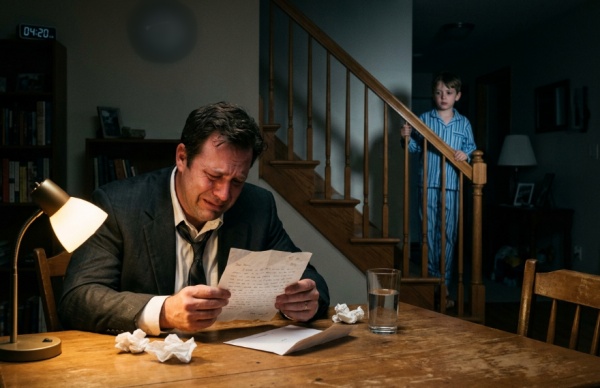
At 4:20 in the morning, I came home to a dark house, a silent kitchen, and a letter waiting under the light. My wife didn’t scream, and no one confronted me at the door. The person who finally exposed what I had become was my eghit-year-old son — with a crayon-marked note that said he was learning how not to need me.
Part 1: The House Was Dark When I Came Home
At 4:20 in the morning, I pulled into my driveway with my headlights off.
I don’t know why I did that. Maybe some guilty part of me believed that if the house didn’t see me, then what I had done didn’t count. Maybe I thought darkness could protect me from the truth I had been carrying around for almost eight months.
The garage door lifted slowly, making that low grinding sound I had promised my wife, Emily, I would fix back in March. I had told her I would take care of it on a Saturday morning. Instead, I spent that Saturday at a hotel outside downtown Nashville, lying to her over the phone while another woman slept beside me.
That was the kind of man I had become.
My name is Nathan Reed. I was thirty-eight years old, married for eleven years, father to an eight-year-old boy named Caleb, and by most outside measurements, I looked like a decent husband. I coached Little League in the spring, grilled burgers on the Fourth of July, paid the mortgage on time, and remembered to bring home orange juice when Emily texted me that we were out.
But people don’t destroy their families all at once. They do it quietly, in small choices they explain away until those choices become a second life.
My second life had a name.
Vanessa.
She worked in marketing for one of the vendors my construction company used. She was thirty-two, funny, confident, and always dressed like she had somewhere better to be. The affair started the way people say these things always start—too many texts, too many private jokes, too many “business drinks” that had nothing to do with business.
At first, I told myself I was lonely.
That was my favorite excuse. Emily and I had become routine, I said. She was always tired, I said. We talked more about grocery lists and Caleb’s school schedule than about anything exciting, I said.
What I didn’t say was that Emily was tired because she worked part-time as a nurse, handled most of Caleb’s homework, packed lunches, remembered dentist appointments, and still asked me every night if I wanted dinner warmed up when I came home late.
I didn’t say that our marriage had become routine because I had stopped showing up for it.
That night—or morning, really—I had told Emily I was driving back from a job site near Knoxville. I said there had been delays, a supplier issue, and bad weather on I-40. It was all very believable because I had become good at making lies sound boring.
The truth was I had been at Vanessa’s apartment in East Nashville.
We had argued. Not the dramatic kind of argument you see in movies, but the exhausted kind that happens when two selfish people realize their secret is no longer romantic. Vanessa wanted me to leave Emily. I told her it was complicated. She laughed and said men like me loved that word because it made cowardice sound thoughtful.
She wasn’t wrong.
When I walked into the house, everything was silent.
The kitchen light over the stove was on, casting a weak yellow glow across the counters. Emily usually left that light on for me when I came home late. It used to feel like love. That morning, it felt like a witness.
Her coffee mug sat in the sink. Caleb’s backpack leaned against the mudroom bench, one strap twisted. His sneakers were beside it, still dusty from the playground.
Everything looked normal.
That was what made it terrifying.
I stood there holding my keys, listening for movement upstairs. No footsteps. No bedroom door opening. No Emily standing at the top of the stairs asking where I had been. No shouting. No crying.
Then I saw the envelope.
It was on the kitchen table, placed directly under the hanging light. My name was written across the front in Emily’s handwriting.
Nathan.
Not “Nate,” which was what she called me when she loved me.
Nathan.
My throat went dry.
I sat down slowly, the wooden chair creaking under me. For a long moment, I just stared at the envelope. I already knew what was inside, or at least I thought I did. Evidence. Screenshots. Accusations. Maybe a letter telling me she was taking Caleb to her sister’s house in Franklin.
I deserved all of it.
Still, my hands shook when I opened it.
Inside was not one letter.
There were two.
The first was from Emily.
It was only four lines.
“Nathan, I know. I’ve known longer than you think. I’m not waking Caleb up to watch his father lie again. Read his note first. Then decide what kind of man you want to be when the sun comes up.”
Below it was a folded piece of construction paper.
Blue.
Caleb’s favorite color.
My son had written my name in green crayon across the top.
“Dad.”
The letters were uneven. The D was too big, and the a looked like a circle with a tail. There were little crayon marks along the edge where his hand must have dragged across the paper.
I unfolded it.
And my life ended in one sentence.
“Mom says I should not wait by the window for you anymore, so I am learning how not to need you.”
I read it once.
Then again.
Then a third time, because my mind refused to accept that eight-year-old hands had written something that heavy.
I had expected Emily’s anger to destroy me.
I had expected a fight, maybe divorce papers, maybe a suitcase waiting by the door.
I had not expected my little boy to quietly explain that he had started practicing life without me.
That sentence did what no threat, no sermon, and no guilty conscience had managed to do.
It showed me what my affair really was.
Not passion.
Not escape.
Not a mistake.
It was abandonment with better excuses.
Part 2: The Boy at the Window
Before everything fell apart, Caleb used to wait for me by the front window.
Our house sat on a quiet street in Hendersonville, Tennessee, twenty-five minutes outside Nashville if traffic was kind and twice that if it wasn’t. It was the kind of neighborhood with basketball hoops in driveways, American flags near mailboxes, and dads who mowed their lawns on Saturday mornings before college football came on.
Caleb’s bedroom faced the street, but he preferred the living room window because he could see the driveway better from there. When he was little, he would press both hands against the glass and fog it up with his breath. Emily used to send me pictures: “Your fan club is waiting.”
Back then, I came home for him.
I would step through the door, and he would run at me full speed, crashing into my legs like a golden retriever puppy. He always had something urgent to tell me—who got in trouble at school, what book his teacher read, how many chicken nuggets he ate at lunch, why dinosaurs would definitely beat robots if the robots didn’t have lasers.
I used to love those stories.
Then, somewhere along the way, I started finding them inconvenient.
That is one of the ugliest truths I have ever admitted.
My son did not become less wonderful. I became less available.
At first, it was work. My company had grown, and I was managing bigger renovation contracts around Middle Tennessee. There were clients in Brentwood, developers in Nashville, suppliers in Murfreesboro, and endless phone calls about materials, permits, schedules, and money.
Emily understood.
She always understood at first.
She would keep Caleb awake a little longer if I said I was close. She would reheat dinner. She would leave porch lights on. She would text me photos of his spelling tests and little drawings he made in school.
Then Vanessa entered the story, and “work” became the mask I wore over selfishness.
If Caleb had a baseball game, I might make it to the last inning and blame traffic. If Emily planned a family movie night, I might say a client needed an emergency meeting. If Caleb asked whether I would be home for dinner, I would ruffle his hair and say, “I’ll try, buddy.”
“I’ll try” became my way of saying no without having the courage to hear myself say it.
One Friday in May, Caleb had a school program. Second graders were performing songs about the fifty states in the cafeteria, and he had one line about Tennessee. He practiced it for two weeks.
“Home of the Great Smoky Mountains and the Grand Ole Opry!”
He said it at breakfast, in the car, while brushing his teeth, and once through a mouthful of macaroni and cheese. Emily texted me three reminders that day. I promised I would be there by 6:30.
At 6:12, Vanessa called.
She said she was upset. She said she needed me. She said she hated feeling like she only got the leftover pieces of my life.
The decent thing would have been to tell her I was going to my son’s school.
Instead, I pulled into a restaurant parking lot off West End Avenue and talked to her for forty-seven minutes. By the time I reached the school, families were already walking out carrying paper programs and plastic cups of lemonade.
Caleb saw me near the entrance.
He smiled automatically, because children often give their parents grace before parents deserve it. Then his smile weakened when he realized I had missed the whole thing.
“It’s okay,” he said before I even apologized.
That should have broken my heart.
Instead, I let his forgiveness make me comfortable.
I bought him ice cream on the way home, as if a $4 vanilla cone could replace showing up. He sat in the back seat, still wearing his paper Tennessee badge, looking out the window. I told myself he was tired.
Now, sitting at the kitchen table months later with his crayon note in my hands, I understood.
He wasn’t tired.
He was learning.
Children learn from what we repeat.
I had taught my son that promises from me were weather forecasts—maybe true, maybe not, nothing to build your day around.
I kept reading the note.
“Mom says I should not wait by the window for you anymore…”
I could picture Emily saying it gently, probably kneeling beside him in her scrubs after another long shift, trying not to sound bitter. She must have watched him wait night after night. She must have seen what I refused to see.
The note continued below that first sentence.
“I know you have important work. Mom says grown-ups have things that are hard. But I think maybe I am one of the hard things.”
I made a sound I didn’t recognize.
Not a sob exactly. More like something had cracked inside my chest.
Caleb thought he was hard to love.
My son, who still slept with a stuffed dog named Captain Waffles, thought my absence was somehow his fault.
He had drawn a small picture at the bottom of the page. Three stick figures stood beside a house. One was labeled Mom. One was labeled Me. The third was labeled Dad, but it was farther away from the others, near a black rectangle I guessed was my truck.
Above the drawing, he had written:
“I am going to be brave like you tell me.”
I covered my mouth with my hand.
I had told him that before his first baseball practice when he was nervous about striking out. I had told him bravery meant doing the right thing even when your stomach felt scared.
Apparently, he had listened.
Apparently, I had not.
Upstairs, the house remained silent.
I wondered if Emily was awake, lying in our bed with her eyes open. I wondered if Caleb was asleep or if he had cried himself tired. I wondered how long they had known.
Then I looked again at Emily’s letter.
“I’ve known longer than you think.”
Those words pulled me into a different kind of fear.
Not the fear of being caught.
The fear of realizing I had been watched while becoming someone unrecognizable.
Part 3: Emily Already Knew
Emily found out in August.
I learned that later, but not from her that morning. That morning, after reading Caleb’s note until the paper softened in my hands, I climbed the stairs like a man walking toward a sentence.
Our bedroom door was half open.
Emily was sitting in the chair near the window, wearing a gray sweatshirt and the pajama pants with tiny stars on them that Caleb had picked out for her one Christmas. Her hair was pulled back, and her face looked pale in the early morning light.
She had not been sleeping.
When she looked at me, she did not cry.
That frightened me more than tears would have.
“Did you read it?” she asked.
I nodded.
My mouth opened, but no words came out. I had prepared apologies in my head for months, the kind of speeches guilty men write before they are caught. I was going to say I never meant to hurt her. I was going to say it got out of control. I was going to say I still loved her.
Standing in front of my wife, those words sounded like trash.
So I said the only true thing.
“I’m sorry.”
Emily looked down at her hands. She was not wearing her wedding ring.
I noticed because I always noticed when consequences finally reached me.
“I know,” she said quietly. “You’ve been sorry in pieces for a long time.”
I sat on the edge of the bed, but she did not invite me closer.
“How long?” I asked.
She laughed once, without humor. “That’s the first question?”
I deserved that.
I stared at the carpet. “No. It shouldn’t be.”
She was quiet for a moment. Then she said, “The first time I suspected? June. The first time I knew? August.”
June.
That meant she had known through Labor Day weekend, through Caleb’s birthday, through our anniversary dinner at a steakhouse in Nashville where I gave her a bracelet and told her I was lucky. She had known through church services, parent-teacher emails, grocery trips, and every night I came home smelling faintly like a different soap.
“How?” I asked, because cowards often want the mechanics of exposure more than the morality of what they did.
Emily leaned back in the chair.
“You changed your phone password,” she said. “You started taking calls in the garage. You bought new shirts but said they were for client meetings. You stopped asking me about my day, but you suddenly cared a lot about whether I was working nights.”
Each sentence landed with calm precision.
“Then one night, Caleb had a fever,” she continued. “I called you six times. You didn’t answer. When you finally called back, I could hear music and a woman laughing before you muted yourself.”
I remembered that night.
Vanessa and I had been at a rooftop bar near Broadway. I told Emily I was meeting a subcontractor. Caleb’s temperature had been 102.3, and Emily had asked if I could come home.
I said I was too far away.
I was twenty-two minutes from the house.
Emily’s voice stayed level, but her eyes had gone bright. “He kept asking for you. I told him you were working.”
I whispered, “Em—”
“Don’t,” she said.
I stopped.
She looked toward the hallway, toward Caleb’s room. “Do you know what he asked me last night?”
I shook my head.
“He asked if you had another family.”
The room moved around me.
I gripped the edge of the mattress.
“He said maybe there was another little boy whose games you were going to. Another house where you ate dinner. Another mom who made you laugh.”
I closed my eyes.
Emily’s voice broke for the first time. “He was trying to make your absence make sense.”
That was the cruelty of what I had done. I had created a mystery in my own home, and my child had filled it with the only explanation his eight-year-old heart could understand: Dad must belong somewhere else now.
“I never wanted him to know,” I said.
Emily looked at me with something colder than anger.
“You didn’t want him to know because it would make you feel guilty. That’s not the same as protecting him.”
I had no defense.
She stood and walked to the dresser. On top of it was a manila folder. She picked it up and held it against her chest for a second before handing it to me.
Inside were printed screenshots.
Texts.
Receipts.
A hotel reservation near Knoxville when I had told her I was staying with a project manager. A dinner receipt from a restaurant in East Nashville. A credit card charge for flowers that Emily never received.
Then came the photos.
Not graphic. Not dramatic. Just enough.
Vanessa and me outside a coffee shop, her hand looped through my arm. Vanessa and me beside my truck in a parking lot. Vanessa wearing the blue flannel shirt Emily had bought me because she said it matched my eyes.
I felt sick.
“Who took these?” I asked.
“My sister’s husband saw you first,” Emily said. “He didn’t want to tell me. Then he did, because that is what decent people do when someone is being lied to.”
I thought of Mark, my brother-in-law, a quiet accountant who never liked drama. He must have hated every second of it.
Emily sat back down.
“I waited because I wanted to understand what I was dealing with,” she said. “A mistake? A midlife crisis? An affair you regretted? But then Caleb started changing.”
I looked up.
“He stopped asking when you’d be home. Then he started asking if he had done something wrong. Last week, he told his teacher he didn’t want to draw a family picture because he didn’t know where to put you.”
I pressed both hands over my face.
Emily continued because she had earned the right to finish.
“Last night, he waited by the window until after midnight. I told him to go to bed. He asked if work loved you more than we did.”
I could not speak.
“So I told him he didn’t have to wait anymore,” she said. “I told him children are allowed to sleep even when adults disappoint them.”
That was when he wrote the note.
My little boy, trying to be brave.
Trying to make sense of a father who came home at 4:20 in the morning to a house full of people he had already left emotionally.
I wanted to ask if I could see him.
But for once, I did not think only of what I wanted.
“Does he know about Vanessa?” I asked.
Emily shook her head. “He knows you lied. He knows you weren’t where you said you were. That’s enough for an eight-year-old.”
She was right.
I looked at the folder, the letter, the evidence of my own selfishness stacked neatly in my lap.
“What happens now?” I asked.
Emily took a deep breath.
“Now you leave for a few days,” she said. “Not to be with her. Not to punish me. You leave because Caleb needs one morning in this house where no one is pretending.”
I looked at her.
She was not asking.
She was setting a boundary.
“I’ll stay at a hotel,” I said.
“You’ll stay wherever you want,” she replied. “But if you go to her, don’t come back here expecting to be a father before you’ve learned how to be honest.”
That sentence stayed with me longer than any insult could have.
Because it wasn’t revenge.
It was truth.
Part 4: The Morning I Told the Truth
I left the house at 6:05 a.m.
The sun was just beginning to rise over the neighborhood, turning the roofs pale gold. A dog barked somewhere down the street. A school bus groaned around the corner, stopping two houses away to pick up the Miller twins.
Ordinary life continued.
That felt insulting somehow.
I sat in my truck at the end of the driveway and looked at the living room window. The curtains were closed. For the first time in years, no small face watched me leave.
I checked my phone.
There were six messages from Vanessa.
“Are you home?”
“Did she say anything?”
“Nate, call me.”
“This is exactly why you need to make a decision.”
“I can’t keep doing this.”
“Do you love me or not?”
A month earlier, those messages would have filled me with panic, desire, and the old sick thrill of being wanted by someone who only saw the version of me I performed for her.
That morning, I felt nothing but exhaustion.
I drove to a chain hotel near the interstate and paid $139 for a room that smelled faintly like bleach and old carpet. The woman at the front desk asked if I wanted one key or two. I almost laughed.
“One,” I said.
The room had beige walls, a king bed, a desk, and a view of the parking lot. It was the kind of place traveling salesmen stayed when storms canceled flights. I sat on the bed and read Caleb’s note again.
Then I called Vanessa.
She answered before the first ring finished.
“Finally,” she said. “What happened?”
I stared at the hotel curtains. “Emily knows.”
A pause.
“How much?”
That was the first thing she asked.
Not “Are you okay?” Not “Is your family okay?” Not even “I’m sorry.”
“How much?”
It revealed something I should have understood long before: our relationship had never been built on love. It was built on secrecy, ego, and the thrill of being chosen over someone else.
“All of it,” I said.
Vanessa exhaled sharply. “Okay. Then maybe this is good. Maybe now you can stop hiding.”
I closed my eyes.
There it was—the fantasy she had carried, the one I had fed when it suited me. The idea that discovery would turn betrayal into destiny. That if Emily found out, I would simply step from one life into another, clean and justified.
But there was nothing clean about it.
“My son wrote me a letter,” I said.
Vanessa was quiet.
“He thinks he’s learning how not to need me.”
She didn’t respond right away. When she did, her voice was softer, but impatient underneath.
“Nate, I’m sorry about Caleb. I really am. But kids adjust. People divorce all the time.”
Kids adjust.
Two words.
So easy for someone who did not have to watch an eight-year-old stop waiting at a window.
I felt the last illusion fall away.
“I can’t see you anymore,” I said.
Her voice changed immediately. “Don’t do that.”
“It’s done.”
“So I’m the mistake now?” she snapped. “After everything you told me?”
I had told her many things. Some were lies. Some were half-truths. Some were selfish feelings I mistook for truth because saying them made me feel less guilty.
“I made you promises I had no right to make,” I said. “I hurt you too. But I’m not leaving my marriage for another lie.”
She laughed bitterly.
“You’re going back to play good husband?”
“No,” I said. “I don’t know if I get to be anyone’s husband after this.”
That silenced her.
I ended the call with her still talking.
Then I blocked her number.
Not because blocking her made me noble. Not because one phone setting repaired anything. But because for eight months I had kept a door open that should never have existed.
After that, I called my father.
He lived in Kentucky, in the same small town where I grew up. My dad was seventy-two, retired from the railroad, and not the kind of man who used ten words when three would do. He answered on the fourth ring.
“You okay?” he asked.
I almost said yes.
The lie rose automatically.
Then I looked at Caleb’s note.
“No,” I said. “I messed up.”
My father listened while I told him. Not every detail. Enough.
When I finished, he was quiet for so long I thought the call had dropped.
Then he said, “Did you come clean because you were ready or because you got caught?”
I swallowed. “Because I got caught.”
“Then don’t pretend it’s courage,” he said.
Those words stung because they were deserved.
“I know.”
“No,” he said. “You’re starting to know. There’s a difference.”
I sat on the edge of the bed, staring at my shoes.
My father sighed.
“When you were little, your mother used to say a child believes their father is the weather,” he said. “If he’s warm, the world feels warm. If he storms, the whole house shakes. You’ve been bad weather in that boy’s life, Nathan.”
I cried then.
Not loudly. Not dramatically. Just a quiet collapse in a cheap hotel room while traffic moved along the interstate outside.
My father did not comfort me too quickly.
After a while, he said, “You don’t fix this by begging. You fix it by becoming someone who tells the truth when lying would be easier.”
That was the first useful instruction anyone gave me.
The next call was harder.
I called a therapist.
Then I called a family attorney—not to attack Emily, not to protect money, not to strategize against the woman I had betrayed, but to understand what separation, custody, and support could look like if Emily chose divorce. The attorney asked if there were safety concerns, substance abuse, or threats in the home. I said no. There was only the damage I had caused.
Saying that out loud mattered.
For months, I had described the affair in passive language.
“It happened.”
“Things got complicated.”
“We crossed a line.”
That morning, I began forcing myself to use active verbs.
I lied.
I chose.
I betrayed.
I abandoned.
By noon, Emily texted me.
“Caleb is at school. He asked if you left because of his note. I told him adults are responsible for adult choices. If you write back, keep it simple and don’t make promises you may not be allowed to keep.”
I read that message five times.
Then I took out hotel stationery and started writing to my son.
I threw away the first three drafts.
They were full of adult nonsense. Explanations. Softened guilt. Too many words.
Finally, I wrote:
“Dear Caleb,
Your note made me very sad, but not because you did anything wrong. You did not make me leave. You did not make me lie. I made bad choices, and those choices hurt you and Mom.
You are not hard to love. You have never been hard to love.
I am sorry I taught you to wait for me and then did not come home. I am going to work on becoming honest and dependable. I will not ask you to trust me today. I will just tell the truth today.
Love, Dad.”
I sent Emily a photo of it first.
She replied twenty minutes later.
“You can mail it. Don’t bring it here.”
So I bought a stamp at the front desk and mailed a letter to my own house, seven miles away.
It was the smallest fatherly act imaginable.
But it was the first one I had done without demanding forgiveness in return.
Part 5: Learning Not to Be Needed
People like stories where the guilty person breaks down, apologizes, and everyone slowly comes back together by Christmas.
Real life is not that generous.
Emily did not take me back because I cried. Caleb did not run into my arms because I wrote one honest letter. Vanessa did not disappear from my mind like a bad dream just because I blocked her number.
Consequences arrived slowly and stayed longer than remorse.
I spent three weeks at that hotel, then moved into a small furnished apartment near Gallatin Road. It had thin walls, a brown couch, and a kitchen table barely big enough for two plates. The first night there, I ate microwave soup standing up because I had forgotten to buy bowls.
I deserved worse, but loneliness still felt like punishment.
Emily filed for legal separation in November.
She did it calmly. No public scene. No revenge post on Facebook. No late-night calls to my mother. Just paperwork, boundaries, and a quiet dignity that made my betrayal look even smaller.
We agreed I would see Caleb with a family counselor at first.
That humbled me more than I can explain.
The first session took place in a cheerful office with board games on the shelves and a basket of fidget toys near the couch. Caleb sat beside Emily, wearing a Tennessee Titans hoodie and sneakers with one untied lace. He looked smaller than I remembered.
Not younger.
Smaller.
As if disappointment had folded him inward.
“Hi, buddy,” I said.
“Hi,” he replied.
He did not get up.
The counselor, Dr. Harris, had kind eyes and a voice that made silence feel less dangerous. She explained that Caleb could say anything he wanted, or nothing at all. She said no one would force him to hug anyone.
I hated hearing that.
Not because it was wrong, but because it was necessary.
Caleb picked at the sleeve of his hoodie. “Did you get my note?”
I nodded. “Yes.”
“Did it make you mad?”
“No,” I said. “It made me understand.”
He looked skeptical in the blunt way only children can.
“Mom said you lied.”
“I did.”
“About work?”
“Yes.”
“Were you with somebody?”
Emily closed her eyes for half a second.
Dr. Harris looked at me, waiting.
This was the moment old Nathan would have softened the truth into fog. I would have said grown-up things are complicated. I would have said I made mistakes. I would have said something that protected me and confused him.
Instead, I said, “Yes. I was spending time with someone I should not have been spending time with, and I lied about it.”
Caleb stared at the carpet.
“Did you like her more than us?”
The question split me open.
“No,” I said, my voice shaking. “But I acted like my feelings mattered more than my family. That was wrong.”
He nodded slowly, not because he accepted it, but because he had received the information.
Then he said, “I don’t want to wait by the window anymore.”
“I know.”
“I moved my chair.”
I blinked. “Your chair?”
“The blue one,” he said. “I put it by my bookshelf.”
Emily wiped under one eye.
That little blue chair had sat near the living room window for years. Caleb used to drag it over after dinner, climb up, and watch for my truck. He had moved it away like a person boarding up a door before a storm.
I wanted to tell him I would earn that chair back.
But Emily’s warning echoed in my mind: don’t make promises you may not be allowed to keep.
So I said, “That makes sense.”
He looked surprised.
I continued, “You shouldn’t have to wait at a window to find out if your dad remembers you.”
His mouth trembled, but he didn’t cry.
I did.
The months that followed were not cinematic.
They were structured.
Therapy every Tuesday. Individual counseling every other Thursday. Child support payments on the first of the month. No unannounced visits. No using Caleb to send messages to Emily. No blaming. No rushing.
I attended Caleb’s basketball games and sat three rows behind Emily. The first time, Caleb saw me and looked away. The second time, he nodded. The fourth time, after making a basket, he glanced over to see if I had watched.
I had.
I did not wave too big. I did not turn the moment into proof of my redemption. I simply clapped and stayed seated.
That became my new job.
Stay.
Not perform.
Not persuade.
Stay.
When Caleb had a school science fair in February, I arrived twenty minutes early and stood near his poster about tornado safety. He explained wind rotation, storm shelters, and why families should keep flashlights and bottled water ready. I listened like it was the most important presentation in the United States, because to me, it was.
At the end, he handed me a small paper cup of lemonade.
“You came before it started,” he said.
“I did.”
He nodded. “Okay.”
That “okay” carried more hope than any hug.
Emily watched from across the cafeteria. She did not smile, but she did not look away either.
Our marriage did not heal the way I wanted it to.
That sentence matters.
Because for a long time, even my remorse had selfishness inside it. I wanted restoration because I wanted relief. I wanted Emily to forgive me so I could stop being the villain in my own story. I wanted Caleb to trust me so I could feel like a good father again.
But real repentance does not ask the injured people to hurry up and make you feel better.
Emily eventually filed for divorce.
She told me in late March, sitting across from me at a mediator’s office with a box of tissues between us.
“I don’t hate you,” she said. “But I don’t feel married to you anymore.”
I nodded, though it hurt.
“I understand.”
She looked tired, but free in a way that made me realize how heavy our home must have felt when I was filling it with lies.
“I hope you become the father Caleb deserves,” she said. “I really do. But I can’t stay married to the man who made him write that note.”
There was no defense against that.
The divorce was finalized in July.
We split assets fairly. Emily kept the house because Caleb needed stability, and I agreed. I took the truck, some tools, half the retirement account, and the knowledge that legal fairness does not erase moral debt.
The first night after the divorce was final, I sat in my apartment with Caleb’s crayon note framed on my desk.
Some people might think framing it was strange.
To me, it was necessary.
Not as punishment, though maybe I deserved that. Not as decoration, because there was nothing decorative about it. I framed it because I never wanted to become fluent in excuses again.
A year after the morning I came home at 4:20, Caleb invited me to his baseball game without Emily prompting him.
He called me himself from her phone.
“Dad?”
“Hey, buddy.”
“I have a game Saturday at ten. You can come if you want.”
If you want.
Children learn careful language when adults have disappointed them.
“I want to,” I said. “I’ll be there.”
He was quiet.
Then he said, “It’s at Field 3, not Field 2.”
“Field 3,” I repeated. “Saturday at ten.”
“Warmups start at nine-thirty.”
“I’ll be there at nine-fifteen.”
Another pause.
“Okay,” he said.
I arrived at 8:55.
I brought a folding chair, black coffee, and no expectations. Emily arrived later with Caleb’s gear bag and a cooler of Gatorade. She saw me, checked her watch, and gave the smallest nod.
Caleb played shortstop that day. He missed one ground ball, caught another, and got a single in the fourth inning. When he reached first base, he looked toward the bleachers.
Not the parking lot.
Not the road.
The bleachers.
Where I was sitting.
I lifted my hand.
He lifted his back.
It was not forgiveness.
Not completely.
It was a beginning.
After the game, he walked over with red dirt on his pants and sweat sticking his hair to his forehead.
“Did you see my hit?” he asked.
“Yes,” I said. “Line drive over second. Best swing of the game.”
He tried not to smile, which meant he wanted to.
Then he looked down at his cleats.
“I don’t wait by the window anymore,” he said.
“I know.”
“But sometimes I look at the bleachers.”
My throat tightened.
“I’ll be there when I say I will,” I said. “And if something ever happens that changes that, I’ll tell you the truth.”
He studied me.
Kids don’t trust speeches. They trust patterns.
Finally, he said, “Okay.”
That word again.
Small. Careful. Precious.
I did not hug him until he stepped toward me first.
When he did, I held him gently, afraid to grip too hard, afraid to make the moment about my need instead of his choice. He smelled like sunscreen, dirt, and Big League Chew.
I closed my eyes.
I had lost my marriage.
I had lost the version of myself I used to sell to other people.
But standing there beside a baseball field in Tennessee, holding my son because he had decided I could, I understood something I wish I had known before I broke everything.
Being needed is not a right.
It is a trust.
And trust is not kept by love you claim to feel. It is kept by the choices you make when no one is clapping, no one is watching, and lying would be easier.
At 4:20 in the morning, I came home thinking my secret life had been exposed.
I was wrong.
What had been exposed was the kind of father my son had been forced to survive.
His crayon-marked note destroyed me, yes.
But it also gave me the first honest blueprint I had ever received.
If my little boy was learning how not to need me, then I had to stop demanding a place in his heart and start becoming someone safe enough to be invited back.
Not all the way.
Not quickly.
Maybe not ever in the way I wanted.
But every Saturday I showed up, every truth I told, every promise I kept, I was no longer asking him to wait by the window.
I was teaching him something better.
That if a man breaks trust, he does not get to rewrite the damage.
He gets to spend the rest of his life proving, quietly and consistently, that the person he loves no longer has to be afraid of believing him.
