“Looking At My Son, I Know Leaving You Was The Smartest Thing I Ever Did,” My Ex-Husband Said… But He Had No Idea That Baby Would Destroy Everything He Built
Part 1: The Toast
“Looking at my son, I know leaving you was the smartest thing I ever did,” Liam said in front of everyone.
The room went quiet in that terrible way rooms do when people are embarrassed but too fascinated to look away. Crystal glasses froze halfway to mouths. Someone near the dessert table let out a soft gasp, then tried to cover it with a cough.
I looked at the baby in his arms.
Then I looked at his terrified new wife.
And I smiled.
Liam Kincaid had always loved an audience. He loved giving speeches at charity galas, charming investors over bourbon, and making people laugh just loudly enough to prove he owned the room. Even during our marriage, I sometimes felt less like his wife and more like a supporting actress in the story of his greatness.
We were standing in the ballroom of the Fairmont Copley Plaza in Boston, under chandeliers that made every lie look expensive. The event was supposed to be a baptism brunch for his infant son, Henry. But Liam had turned it into something else, the way he turned everything into a stage.
There were white roses on every table, champagne in tall flutes, a three-tier cake with pale blue ribbon, and a photographer quietly circling the room. Liam’s parents had invited half of Beacon Hill, several business partners, two city council members, and enough old-money friends to make the brunch feel less like a family gathering and more like a public relations campaign.
I should not have been there.
That is what I told myself while getting dressed that morning in my small apartment in Cambridge. I should have thrown the invitation in the trash, made coffee, and spent Sunday reading on my fire escape like a woman with common sense. But Liam’s mother, Eleanor, had called me personally.
“Please come, Ava,” she had said. “Whatever happened between you and Liam, you were part of this family for eleven years.”
That was not the real reason.
The real reason was guilt.
Eleanor Kincaid came from the kind of New England family that donated wings to hospitals and used phrases like “summering in Nantucket” without irony. She had never fully accepted me, but she had never been openly cruel either. After the divorce, she sent one handwritten note that said, “I am sorry for the pain my son caused.”
It was more than Liam ever gave me.
So I came.
I wore a navy wrap dress, low heels, and the pearl earrings my grandmother left me. Not because I wanted to impress anyone. Because sometimes dignity needs a uniform.
Liam saw me the moment I walked into the ballroom.
He was standing near the fireplace with his new wife, Celeste, at his side. Celeste was twenty-nine, eleven years younger than me, with glossy dark hair, wide brown eyes, and a delicate gold bracelet that matched the one Liam had once bought me for our anniversary. She held herself like a woman trying to look happy while listening for a bomb.
The baby slept in a white christening gown in Eleanor’s arms.
Liam looked exactly the same as he had the last day of our marriage. Tall, polished, handsome in the kind of way that made strangers assume goodness. His gray suit fit perfectly, his watch cost more than my first car, and his smile carried the lazy confidence of a man who believed consequences were for other people.
He kissed Celeste’s temple when he saw me looking.
It was a performance.
The room noticed.
That had always been Liam’s gift. He could wound one person while making everyone else think they had witnessed tenderness.
I kept walking.
Eleanor met me near the entrance and took both my hands. She looked thinner than I remembered, her silver hair pinned carefully, her blue eyes damp. For a second, I felt sorry for her.
Then I remembered she was still standing inside the house that had burned down, trying to save the curtains.
“Ava,” she said. “Thank you for coming.”
“Of course.”
“You look well.”
“So do you.”
Neither of us believed the other, but politeness has carried worse things than grief.
Celeste approached a few minutes later. She held the baby now, one hand supporting his tiny head, the other pressed protectively across his back. Up close, she looked exhausted beneath the makeup.
“Ava,” she said softly.
“Celeste.”
We had met only once before, in a lawyer’s office.
At that time, she had been four months pregnant and wearing a cream dress that made her look like an announcement. Liam had brought her to a mediation session because he wanted me to understand, without saying it directly, that he had already replaced me. She sat beside him with one hand on her stomach and avoided my eyes.
Now she looked directly at me.
There was fear there.
Not jealousy. Not triumph.
Fear.
I noticed it immediately because fear had lived in my own body for years. It had lived there every time Liam came home late and called me suspicious. Every time he corrected me in front of friends with a smile. Every time he used the word “sensitive” to make my pain sound like a personality flaw.
Celeste shifted the baby higher on her shoulder.
“He’s beautiful,” I said.
Her eyes filled for one second, then cleared. “Thank you.”
Before she could say anything else, Liam appeared beside her.
“Ava,” he said warmly, loudly enough for nearby guests to hear. “You made it.”
“I did.”
“That’s generous of you.”
There it was.
The public compliment with the private blade inside.
I smiled. “It was kind of your mother to invite me.”
His jaw tightened for half a second.
Then he laughed. “Always gracious.”
Celeste looked down at the baby.
I wondered if she already knew that Liam’s compliments were often warnings.
The brunch began with polite conversation and too much champagne. I sat at a table near the back with Liam’s aunt Margaret, a retired school principal who had never liked drama unless she could analyze it later. She asked about my work, my apartment, whether I still volunteered at the literacy nonprofit.
I answered calmly.
Yes, I still worked in nonprofit development. Yes, Cambridge was expensive but manageable. Yes, I liked living near the Charles River.
No, I was not dating anyone.
Margaret nodded like she was filing that away for a committee.
Across the room, Liam moved from table to table with Henry in his arms, showing him off like both a miracle and an asset. People congratulated him. Men clapped his shoulder. Women leaned over the baby and said things like, “He looks just like you.”
Each time someone said it, Celeste’s smile tightened.
That was when I knew.
Not guessed.
Knew.
Because two weeks earlier, Celeste had come to my apartment with no makeup, shaking hands, and a manila envelope she could barely hold.
But Liam did not know that.
Not yet.
Part 2: The Marriage He Rewrote
Liam and I were married for eleven years.
For the first three, I thought we were happy. For the next four, I thought we were struggling. For the last four, I thought I was failing at marriage because Liam had become very good at making his disappointment sound like fact.
We met at a fundraiser in Boston when I was twenty-eight and he was thirty-two. I worked for a children’s literacy nonprofit, and he had just become a partner at his family’s commercial real estate firm. He donated $25,000 that night and spent the rest of the evening telling me he admired people who “actually did meaningful work.”
I should have known he was flirting with himself through me.
But I was young, flattered, and tired of men who acted intimidated by competence. Liam seemed different. He asked thoughtful questions, remembered details, and looked at me like my opinions were rare coins.
Six months later, he proposed on Martha’s Vineyard at sunset.
A year after that, I was living in his brownstone on Beacon Hill, learning how to host dinners for people who said “the Cape” like it was a private country. Liam’s mother taught me which silver pattern belonged to which great-grandmother. Liam taught me how to make myself smaller without ever using those words.
At first, the changes were gentle.
He suggested I wear softer colors because navy made me look “severe.” He said my laugh was too loud around his clients. He told me my friends from college were “great, but not really our world.”
Then came the children.
Or rather, the absence of them.
We tried for years. Doctors found no clear reason at first. Then they found mild issues with both of us, nothing impossible, nothing hopeless, but enough to make every month feel like a courtroom verdict.
I wanted a baby.
Liam wanted a legacy.
That difference took me too long to understand.
When treatments failed, he began speaking about fatherhood like I had personally denied him entry to a club. He would stare at families in restaurants and go quiet. He stopped coming to appointments, saying he had meetings, then blamed me for making the process “clinical.”
Once, after a negative test, I cried in the bathroom.
He stood in the doorway and said, “Ava, at some point, you have to stop making this the center of our entire life.”
I remember looking at the pregnancy test in my hand and thinking, I thought it was the center of yours too.
By year nine, Liam’s assistant changed.
Her name was Celeste Marlow.
She was bright, stylish, and efficient in the way ambitious young women often are when powerful men convince them attention is mentorship. Liam praised her constantly. She understood the business. She anticipated needs. She was “refreshing.”
Refreshing.
That word told me everything.
I asked him once if something was happening between them.
He looked genuinely offended. “She works for me.”
“So did half the men who ruined their marriages.”
He stared at me like I had become vulgar. “You need help, Ava.”
The affair lasted at least eight months before he admitted anything. I later learned it had started while I was still scheduling fertility appointments and hiding medical bills in a drawer because I was embarrassed by how much hope cost. Liam was sleeping with Celeste while telling me I had become emotionally exhausting.
The confession came in our kitchen.
Not dramatic. Not tearful.
He simply said, “Celeste is pregnant.”
I remember the tea kettle screaming on the stove behind me. I remember turning it off because even in shock, I was trained to maintain order. I remember Liam watching me, not with guilt, but with impatience.
“How far along?” I asked.
“Fourteen weeks.”
“Is it yours?”
His face hardened. “Don’t insult me.”
That sentence would later become almost funny.
At the time, it split me open.
He told me he wanted a divorce. He said the pregnancy changed everything. He said he had waited long enough for a family and could no longer “live inside disappointment.”
“Disappointment,” I repeated.
He looked at me with pity. That was the worst part. “Ava, you know what I mean.”
I did.
He meant me.
The divorce moved quickly because Liam wanted it to.
Massachusetts divorce law is not a stage play, no matter how badly rich men want to direct it. There were attorneys, financial disclosures, negotiation sessions, property valuations, retirement accounts, and polite emails that contained emotional warfare in twelve-point font.
Liam tried to be generous where people could see.
Privately, he fought over everything.
He wanted the brownstone sold but delayed appraisals. He wanted to keep investment accounts separate even though marital funds had flowed through them. He wanted me to sign a confidentiality agreement so strict that I joked to my attorney it should come with a blindfold.
My attorney, Nora Patel, did not laugh.
“He’s protecting more than his privacy,” she said.
Nora was small, precise, and had the calm stare of a woman who had watched too many men underestimate paperwork. She taught me to stop responding emotionally and start saving everything. Texts. Emails. Receipts. Statements. Dates.
“Truth is not enough,” she said. “Organized truth is what matters.”
So I organized.
By the time the divorce was finalized, Liam had rewritten the story publicly.
We had “grown apart.” The infertility struggle had “changed us.” Celeste was a “new beginning after a painful chapter.” He was “grateful for the past and excited for fatherhood.”
People accepted that because it was clean.
The truth was messy.
The truth was that he cheated, got his mistress pregnant, blamed me for the years he spent resenting his own marriage, and walked away with a son-shaped excuse in his arms.
Or so he thought.
Part 3: The Woman At My Door
Celeste came to my apartment on a rainy Thursday afternoon.
It was early March, cold enough for a wool coat but warm enough that Boston sidewalks were slick instead of icy. I had just come home from work and was still holding a grocery bag with eggs, spinach, and a pint of ice cream I had bought because healing is not always elegant.
When I opened the door, she was standing in the hallway.
No umbrella. No makeup. Hair damp from the rain.
For a second, neither of us spoke.
Then she said, “I’m sorry. I didn’t know where else to go.”
I almost closed the door.
I wish I could say I immediately acted with grace. I did not. I felt every ugly human feeling at once: anger, satisfaction, disgust, curiosity, and a sharp little spark of vindication because she looked exactly as lost as I had once felt.
But she was holding Henry’s diaper bag, and her hands were shaking.
“Where is the baby?” I asked.
“With my sister.”
That answer mattered.
I stepped aside. “Five minutes.”
She came in and stood awkwardly near my small kitchen table. My apartment was nothing like the brownstone. It had radiator heat, uneven floors, and a view of a brick wall if you leaned left.
Still, it was mine.
Celeste looked around like she expected to see the ruin Liam had described.
I poured water because I did not know what else to do. She took the glass but did not drink. Then she placed a manila envelope on the table.
“I think Henry isn’t Liam’s,” she whispered.
The sentence entered the room and sat down between us.
I looked at her. “What?”
She pressed one hand to her mouth, then lowered it. “I think Henry isn’t Liam’s son.”
A lesser version of me would have laughed.
A crueler version would have said, “Congratulations.”
Instead, I sat across from her because the fear in her face had become too large to ignore.
“Explain.”
Celeste told me the story in fragments.
Before Liam, there had been a man named Daniel Reyes, a chef who owned part of a small restaurant in Somerville. They had dated for almost a year, broken up badly, and then gotten back together one final weekend when she was already emotionally tangled with Liam.
“I know how that sounds,” she said.
“It sounds like the truth is inconvenient.”
She flinched but nodded. “Yes.”
She had believed Henry was Liam’s because she wanted him to be. Liam believed it too, mostly because believing it made him feel chosen by fate. When Henry was born, Liam refused any paternity testing, calling it insulting.
Then Daniel saw a picture online.
A friend sent it to him after Liam’s mother posted Henry’s baptism announcement. Daniel contacted Celeste privately and said the timing made him concerned. She panicked and ordered a private test using a legal lab after speaking with her own attorney.
She slid the envelope toward me.
“I haven’t told Liam.”
“Why are you telling me?”
Her eyes filled. “Because he’s going to destroy me.”
There it was.
Not because Liam would be heartbroken.
Because Liam would destroy.
I knew that version of him.
I had divorced that version of him.
Celeste opened the envelope and showed me the report. I did not touch it at first. It was not my document, not my child, not my legal matter.
But I read the line she pointed to.
Probability of paternity: 0.00%.
The tested man was Liam Kincaid.
I sat back.
For months, I had imagined Liam holding his son and feeling vindicated. I had imagined him sleeping peacefully beside Celeste, believing biology had crowned him and erased me. I had imagined the world rewarding him with exactly what he said I could not give.
Now the crown was paper.
“Why come to me?” I asked again.
Celeste cried then, but quietly. “Because you survived him.”
That sentence hit harder than I expected.
She told me Liam had changed after Henry was born. At first, he was proud, attentive, obsessed with appearances. Then he became controlling.
He monitored what she posted. Corrected how she held Henry in front of his parents. Told her she was lucky he had “rescued” her reputation by marrying her before the baby came.
“He said if I ever embarrassed him, I’d learn what it feels like to be nobody,” she whispered.
I looked toward my window, where rain blurred the city lights.
That sounded like Liam.
Not the charming Liam from charity photos.
The real one.
“What do you want from me?” I asked.
“I don’t know.”
“Yes, you do.”
She wiped her face. “I need to tell the truth, but I’m scared. Daniel is filing to establish paternity. My attorney says I can’t hide it. Liam’s parents planned this big baptism brunch, and Liam invited half the city. I asked him to cancel. He refused.”
I stared at her.
The brunch.
The invitation.
Eleanor’s phone call.
Suddenly, I understood why Celeste looked like a woman listening for a bomb.
“He’s going to make a speech,” Celeste said. “He keeps saying it’s time everyone sees what real family looks like.”
I almost closed my eyes.
Real family.
Liam never could resist making a weapon out of a room.
“Then don’t go,” I said.
She laughed weakly. “You know he won’t accept that.”
I did.
But I also knew something else.
“You need to listen carefully,” I said. “I am not your attorney, your friend, or your shield. What happened to me does not make me responsible for saving you from what you helped create.”
She nodded, crying harder. “I know.”
“But Henry is a baby,” I continued. “And he deserves adults who tell the truth without using him as a grenade.”
Her face crumpled.
I gave her Nora’s office number and told her to speak only through her own lawyer. I told her not to confront Liam alone if she felt unsafe. I told her to keep records and stop letting shame make her delay reality.
Then she stood to leave.
At the door, she turned back.
“I believed him about you,” she said.
I said nothing.
“He told me you were cold. That you didn’t want children badly enough. That you made him feel like a failure.”
My throat tightened.
Celeste whispered, “I’m sorry.”
I looked at the woman who had helped break my life and saw, to my surprise, not a villain.
A coward.
A selfish one.
A frightened one.
But also a woman who had finally realized that the story Liam told about me had only been the first draft of the story he would one day tell about her.
“Be better for your son,” I said.
She nodded and left.
Two weeks later, I walked into the Fairmont ballroom.
Not for Liam.
Not for Celeste.
For the baby whose entire life was about to become evidence unless someone in that room remembered he was innocent.
Part 4: The Baby In His Arms
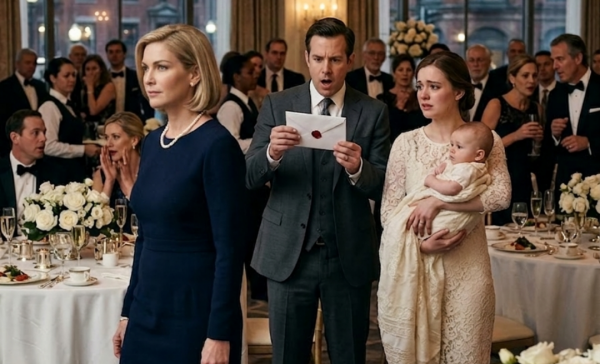
Liam tapped a spoon against his champagne glass just after dessert.
The sound rang through the ballroom, bright and delicate. Conversations faded. Chairs shifted. The photographer moved closer.
Celeste went pale.
Henry had woken from his nap and was now in Liam’s arms, blinking under the chandelier light. He was a sweet baby, round-cheeked and calm, with dark eyes and a tiny fist curled against Liam’s lapel. Whatever truth surrounded him, none of it belonged to him.
Liam smiled at the room.
“Thank you all for being here today,” he began. “Celeste and I are overwhelmed by your love and support.”
Celeste stood beside him, hands clasped tightly in front of her.
Eleanor dabbed at her eyes with a linen napkin. Liam’s father, Malcolm, raised his glass. Several guests smiled warmly, eager to participate in the beautiful version of the story.
Liam continued.
“This past year has taught me a lot about courage, second chances, and what it means to build the family you were meant to have.”
I felt Margaret stiffen beside me.
She knew.
Not the details, but enough.
Liam’s eyes swept the room and landed on me.
For one second, Nora’s voice echoed in my head.
Do not react.
But Liam wanted reaction.
He needed it.
He adjusted Henry in his arms and smiled with the same expression he had worn across negotiation tables, charity stages, and our ruined kitchen.
“Some chapters close because they were never meant to give you what your heart needed,” he said. “And some doors open to show you exactly where you belong.”
Celeste whispered, “Liam.”
He ignored her.
Then he lifted Henry slightly, as if presenting proof.
“Looking at my son, I know leaving you was the smartest thing I ever did,” he said, staring directly at me.
The room froze.
There it was.
The cruelty he had wrapped in fatherhood.
I looked at Henry.
Then at Celeste.
She was terrified.
Not embarrassed. Not jealous. Terrified.
And I smiled.
Not because I wanted Liam destroyed.
Because I realized he had finally said the quiet part in front of witnesses.
Liam’s smile flickered when I did not look wounded.
He had expected me to flinch. Maybe cry. Maybe leave the room so he could pretend my absence was proof that he was right about me. Instead, I lifted my water glass and took a slow sip.
The ballroom doors opened.
A man in a dark suit stepped inside with a leather folder.
Most guests barely noticed at first. In rooms like that, men in suits are furniture until they speak. But Celeste saw him immediately, and her face drained of color.
The man approached Liam’s table and asked quietly, “Liam Kincaid?”
Liam’s expression sharpened. “Yes?”
The man handed him an envelope.
“You’ve been served.”
The words landed softly.
The effect was not soft.
Liam stared at the envelope. “What is this?”
The man turned to Celeste and handed her another.
“Celeste Kincaid?”
Her hands shook as she accepted it.
A murmur moved through the room.
The process server left as calmly as he had entered.
Liam looked at the envelope, then at Celeste. “What is this?”
Celeste did not answer.
Eleanor stood. “Liam?”
He tore open the envelope with one hand while still holding Henry. Malcolm stepped forward and carefully took the baby from him, perhaps the only decent instinct anyone in that family showed that day.
Liam scanned the first page.
His face changed.
Not dramatically at first.
Just enough.
The color left his cheeks, and his mouth tightened as if every muscle in his face had been ordered not to collapse.
“What is this?” he said again, but this time his voice was lower.
Celeste whispered, “Liam, I wanted to tell you privately.”
The room erupted into murmurs.
Liam looked at her like she had transformed into someone else. “Privately?”
“Please,” she said.
“What is it?” Eleanor demanded.
Liam ignored his mother and flipped to the next page.
I knew what he was reading.
A petition filed by Daniel Reyes to establish paternity and parental rights. Attached references to lab testing. Legal language. Dates. Facts.
Organized truth.
Liam lifted his eyes to Celeste.
“Is he mine?” he asked.
The room went silent again, deeper this time.
Celeste began to cry.
“Liam—”
“Is he mine?”
Henry made a small sound in Malcolm’s arms.
That sound, more than anything, stopped me from feeling satisfaction.
Because the baby was in the middle of adults who had all failed him in different ways. Liam had used him as proof. Celeste had hidden behind him. Daniel, whoever he was, was now arriving through legal papers instead of a nursery door.
And I was standing there watching the truth do what truth does.
It did not care about timing.
Celeste said, “I’m sorry.”
Liam stepped back as if she had struck him.
Eleanor grabbed the back of a chair. “No.”
Malcolm looked down at Henry, his face unreadable.
Guests began whispering openly now. Phones remained mostly in purses, thank God, because old Boston money still understood that public scandal should be savored privately first.
Liam turned toward me.
Of course he did.
Men like Liam always look for someone to blame in the doorway of their own burning house.
“You knew,” he said.
I set my glass down.
Celeste looked at me, panicked.
I spoke carefully.
“I knew enough to understand you should not use a child to humiliate anyone.”
His eyes narrowed. “You did this.”
“No,” I said. “You did.”
He laughed once, harsh and broken. “You arranged this?”
“I didn’t file that petition. I didn’t choose the timing of the service. I didn’t lie about paternity, and I didn’t make that speech.”
The words stayed calm because I needed them to.
For Henry.
For myself.
For every version of me that Liam had once called unstable when I was simply telling the truth.
Celeste stepped forward. “Ava didn’t do anything.”
Liam turned on her. “You don’t get to speak.”
The room heard that too.
Good.
Celeste flinched, then straightened.
Something passed across her face. Not courage yet, but the beginning of it.
“Yes,” she said quietly. “I do.”
Liam stared at her.
She reached for Henry, and Malcolm hesitated only a second before handing the baby back. Celeste held him close, tears running down her face, but her voice steadied.
“I made terrible choices,” she said. “But Henry is not a weapon. He is a baby.”
For the first time, I respected her.
Not enough to forget.
But enough to recognize a woman trying to step out of a lie before it swallowed her child whole.
Eleanor sat down slowly, one hand pressed to her chest.
Liam looked around the ballroom and saw what he had built collapsing in real time. The family-man image. The perfect second chance. The son he had paraded as proof that leaving me had been destiny.
All of it cracked under fluorescent legal paper.
He turned back to me.
His voice was barely above a whisper.
“Are you happy now?”
I thought about that.
I thought about our marriage, the years of subtle blame, the fertility appointments, the way he made my body feel like a failed investment. I thought about Celeste at my door, Henry asleep somewhere else, and the envelope that had trembled in her hands.
Then I said the truth.
“No, Liam. I’m free.”
And I walked out before anyone could make me part of his scene.
Part 5: What The Truth Took And What It Gave Back
The scandal spread by dinner.
That was Boston for you. People could pretend to value discretion, but news moved through private group chats faster than traffic on Storrow Drive. By Monday morning, several donors had quietly asked questions about Liam’s judgment, his firm’s partners were “concerned,” and Eleanor had retreated to her summer house in Marblehead.
I did not comment.
Not publicly.
Not privately, except to Nora.
She called me the next morning and said, “I heard.”
“I’m sure everyone heard.”
“Are you okay?”
I looked around my apartment at the plants on the windowsill, the stack of library books on my coffee table, and the mug of tea warming my hands.
“Yes,” I said, surprised to mean it.
Liam sent one message that afternoon.
“You ruined my life.”
I stared at it for a long time.
Then I deleted it without replying.
Not because I had nothing to say.
Because he no longer had the right to make me spend my words on his version of reality.
Over the next few months, the truth settled into legal channels where it belonged. Daniel Reyes established paternity through the court. Celeste filed for separation from Liam less than six weeks after the brunch. Henry became the center of a parenting plan instead of a prop in a rich man’s redemption story.
I heard pieces through Nora, through Margaret, through the unavoidable hum of a city that enjoyed pretending it did not gossip.
Liam’s firm did not collapse, but his reputation changed. The partners who once admired his confidence began calling it recklessness. The donors who praised his family values stopped inviting him to speak about legacy.
The cruelest punishment for a man like Liam was not losing money.
It was losing the audience.
Celeste wrote me a letter in May.
Actual paper. Blue ink. Careful handwriting.
She said she was sorry for the affair, for believing Liam’s version of me, for participating in my humiliation, and for waiting too long to tell the truth. She said motherhood had shown her that cowardice could feel like protection until it harmed the person you most wanted to protect.
She did not ask for forgiveness.
That made it easier to consider.
I wrote back three sentences.
“I hope Henry grows up surrounded by truth. I hope you become the kind of mother who chooses courage before crisis. I accept your apology, but I am not part of your life.”
It felt fair.
Eleanor called once.
I let it go to voicemail.
Her message was brief. She said she was sorry. She said she had failed to see what Liam had become because mothers sometimes mistake pride for loyalty.
I saved the message for a week, then deleted it.
Some apologies are real.
That does not mean they need to become doors.
As for me, I kept living.
At first, living felt like an act of rebellion. I bought flowers for my apartment every Friday because Liam used to say cut flowers were wasteful. I took a pottery class even though everything I made looked like it had survived a small accident. I started running along the Charles, slowly, badly, with a playlist full of songs Liam would have mocked.
Then rebellion became routine.
Routine became peace.
Peace became a life.
A year after the brunch, I stood on a dock in Maine with my friend Julia, eating lobster rolls wrapped in paper while seagulls screamed like unpaid creditors overhead. The air smelled like salt, sunscreen, and fried clams. My phone buzzed with a news alert about a real estate development Liam’s firm had lost to a competitor.
I glanced at it, then turned the phone face down.
Julia raised an eyebrow. “Anything interesting?”
“No,” I said.
And for once, it was true.
Liam was no longer interesting to me.
That was the final freedom.
Not hating him.
Not proving him wrong.
Not watching his carefully built life crack in a ballroom full of witnesses.
Just waking up one day and realizing the man who once controlled the weather inside my chest had become background noise.
I think about Henry sometimes.
Not often, but gently. I hope he is loved well. I hope the adults around him learn to speak about biology, responsibility, and family without turning him into evidence of anyone’s victory or failure.
Because children are not verdicts.
They are not proof that one woman won and another lost.
They are not trophies for men who need legacy more than love.
They are people.
That is what Liam never understood.
He looked at Henry and saw validation. He looked at me and saw the absence of what he wanted. He looked at Celeste and saw a doorway into the life he believed he deserved.
He never looked long enough to see the truth.
At the brunch, when he said leaving me was the smartest thing he ever did, he thought he was burying me.
But all he buried was the last version of me that cared what he thought.
The woman who walked into that ballroom still carried old wounds. The woman who walked out left them there beneath the chandeliers, among the champagne glasses, legal envelopes, and whispers. She walked into the Boston afternoon alone, but not lonely.
People love dramatic endings.
They love the moment the smile dies, the mistress trembles, the process server enters, and the powerful man realizes the world is watching. I understand that. I was there.
But the real ending came later.
It came in quiet mornings.
In rent paid by my own paycheck.
In a kitchen where no one corrected how loudly I laughed.
In a body I stopped blaming for a marriage that failed because of character, not biology.
Liam once believed a son would prove he had chosen correctly.
Instead, that baby revealed the truth about everyone in the room.
Celeste’s fear.
Liam’s cruelty.
His family’s pride.
And my own strength.
Not the loud kind. Not the kind that needs Escalades, courtrooms, or applause.
The kind that lets a woman smile at an insult because she knows the truth is already walking toward the door with papers in its hand.
That is the kind of strength I have now.
And unlike Liam’s perfect little story, no one can take it from me.
