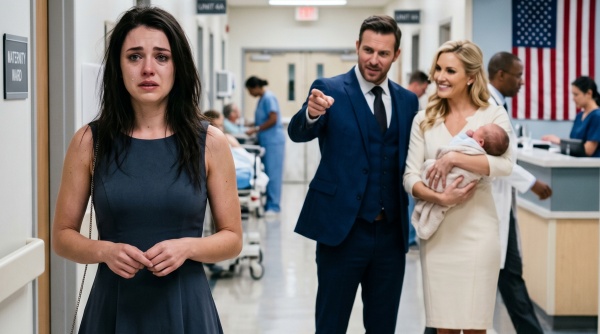
Because of a Baby Boy, My Husband Left Me for My Best Friend. One Year Later, My Ex-Husband Mocked Me in a Hospital Waiting Room — Until the DNA Results Arrived
Daniel was holding another woman’s baby when he told everyone that divorcing me was the smartest decision of his life. He thought he had finally gotten the son he always wanted, while I was just the “difficult ex-wife” he left behind. But he didn’t know…
Part 1: The Waiting Room
My ex-husband was holding another woman’s baby when he told an entire hospital waiting room that divorcing me was “the smartest thing he had ever done.”
Not quietly.
Not with shame.
Not with even the smallest flicker of regret.
He said it like a punchline.
The baby in his arms was wrapped in a pale blue blanket, the kind hospitals use when a family wants everyone to know it’s a boy before anyone even asks. My former best friend, Megan, sat beside him in a wheelchair, wearing fuzzy socks and the exhausted glow of a woman who had recently given birth and expected the whole world to applaud.
And maybe the world had applauded.
At least, his world had.
My ex-husband, Daniel Whitaker, had always wanted a son. Not a child. Not a family. A son. He wanted someone to carry the Whitaker name, inherit his law firm one day, wear tiny Chicago Bears jerseys, and prove to his father that the family line was still “strong.”
That word used to make me uncomfortable.
Strong.
As if daughters were weak.
As if women were pauses between generations of men.
But I was thirty-four then, married, hopeful, and still trying to believe the man I loved had more depth than the language he inherited.
My name is Claire Whitaker.
At least, it used to be.
Now I’m Claire Bennett again, the name I was born with, the name I had to fight to hear without flinching after Daniel turned our marriage into a courtroom exhibit.
We were at Lurie Children’s Hospital in downtown Chicago on a bitter February afternoon, the kind of day when Lake Michigan wind cut through your coat like it had a personal grudge. The waiting room smelled like disinfectant, stale coffee, and the quiet fear of parents trying not to cry in front of their children.
I was there for my son.
My baby boy.
Noah.
He was six months old, small for his age, with Daniel’s dark hair and my mother’s serious eyes. He had been admitted two nights earlier with RSV complications, and although the doctors said he was improving, I had not slept more than forty minutes at a time since the first ambulance ride.
Daniel did not know about Noah.
That was not because I had hidden him.
That part matters.
I had tried to tell Daniel when I found out I was pregnant. I called. I texted. I sent a certified letter through my attorney after he blocked my number. His lawyer responded that Daniel “denied any possibility of paternity” and considered my claim “an attempt to disrupt his new family.”
His new family.
That was what he called Megan and the baby she was carrying.
A boy.
The boy he left me for.
One year earlier, Megan had stood in my kitchen with tears in her eyes and one hand on her stomach. She told me she was pregnant. She told me Daniel was the father. She told me they were in love.
I remember staring at the mug in my hand because it had suddenly become the only solid thing in the room.
Daniel came home twenty minutes later and did not deny it.
He looked relieved.
As if betrayal was easier than pretending.
Within a month, he had filed for divorce. Within three, he had moved into Megan’s townhouse in Lincoln Park. By the time I discovered my own pregnancy, he had already become someone who spoke to me only through attorneys and claimed I was “emotionally unstable” because I cried when my husband left me for the woman who had been my maid of honor.
So no, I did not hide Noah.
Daniel refused to look.
And now, one year later, he was sitting across from me in a hospital waiting room, holding Megan’s baby boy like a trophy.
His parents were there too.
Richard and Elaine Whitaker.
Old money, North Shore manners, matching camel coats. Elaine had once called me “the daughter we never had.” After Megan’s pregnancy announcement, she stopped returning my calls.
The first time Daniel saw me in the waiting room, his smile twisted.
“Well,” he said, loud enough for the row of chairs between us to hear. “If it isn’t Claire.”
Megan stiffened.
I said nothing.
I was holding a paper cup of coffee that had gone cold an hour earlier. My hair was pulled into a messy bun, my sweatshirt had spit-up on one sleeve, and my eyes felt swollen from two nights of hospital lights.
Daniel looked me up and down.
“Rough year?” he asked.
Elaine whispered, “Daniel.”
But she did not sound horrified.
Only embarrassed.
That was worse.
Megan adjusted the baby blanket around her son. The child slept through everything, innocent as snow.
“I didn’t know you were here,” Megan said.
Her voice was soft. Careful. The voice of someone who had learned to play fragile when consequences entered the room.
“My son is upstairs,” I said.
Daniel laughed.
It was short, sharp, cruel.
“Your son?”
I looked at him.
His eyes narrowed.
Megan turned toward him. “Daniel—”
“No, I want to hear this,” he said. “Claire has a son now?”
He leaned back in his chair, shifting Megan’s baby in his arms as if to display him.
“Congratulations,” he said. “Did you finally find someone willing to play house?”
Something inside me went still.
Not calm.
Still.
There is a difference.
Elaine looked uncomfortable now. Richard stared at the floor.
I took a slow breath.
“Daniel, this is a hospital. Keep your voice down.”
“Oh, now you care about appearances?” he said. “That’s rich.”
Megan whispered his name again, but he ignored her.
He had an audience, and Daniel loved an audience. He had been a trial attorney before joining his father’s firm, and even at dinner parties he spoke like he was addressing a jury.
He lifted the baby slightly.
“You know what?” he said to the waiting room, though he pretended he was only speaking to me. “Divorcing Claire was the smartest thing I ever did. I wasted years trying to build a family with someone who made everything difficult. Then life gave me a son the moment I stopped begging the wrong woman.”
The words landed one by one.
Wasted.
Difficult.
Wrong woman.
I felt them.
But I did not break.
Because just then, the elevator doors opened behind him.
My attorney, Denise Harper, stepped into the waiting room holding a navy folder.
And behind her, a pediatric nurse appeared at the doorway and called, “Ms. Bennett? Noah’s awake. You can come back now.”
Daniel’s head turned.
Slowly.
“Noah?” he repeated.
Denise’s eyes moved from him to me.
Then she said quietly, “Claire, the results came in.”
Daniel looked at the folder.
Then at me.
For the first time that day, the confidence left his face.
Part 2: The Son He Wanted
Daniel and I met at a charity fundraiser in Chicago nine years earlier.
He was handsome in a polished, expensive way: dark suit, perfect posture, smile trained by private school and courtroom ambition. I was working in nonprofit development then, helping run a scholarship organization for first-generation college students. Daniel donated $25,000 that night and asked me to dinner before the check cleared.
He was charming.
That is the part people hate to hear after a betrayal.
They want monsters to arrive wearing signs.
But Daniel opened doors. Sent flowers. Remembered my coffee order. He drove through a snowstorm once to bring me soup when I had the flu and sat on my couch watching old movies until I fell asleep.
I married that man.
Or I married the version of him that still needed to impress me.
The first two years were good.
We bought a townhouse in Lakeview, traveled to Napa, hosted Thanksgiving, and talked about children like they were a future already waiting in the hallway. Daniel wanted three. I wanted two. He joked that if the first was a boy, he could relax.
I thought it was just a joke.
Then came the tests.
The calendars.
The ovulation strips.
The cheerful fertility clinic posters showing smiling couples holding babies in impossibly clean rooms.
Month after month, nothing happened.
At first, Daniel was supportive. He held my hand during appointments, told me we were a team, and said it didn’t matter how our family came to us. But after the first year, something changed.
His patience became performance.
He still came to appointments when his schedule allowed, but he checked emails in the waiting room. He still said the right things, but he said them like someone reading from a brochure. When doctors suggested more testing on both of us, he resisted.
“I’m fine,” he said. “My family never had trouble having kids.”
As if fertility were a family brand.
Eventually, the tests showed nothing dramatic.
Unexplained infertility, they called it.
A phrase that sounds gentle until you live inside it.
It means nobody can tell you why your body keeps refusing the future you planned.
During that time, Megan was my safest place.
Or so I thought.
Megan Riley had been my best friend since college at Northwestern. She was the loud one, the beautiful one, the one who could walk into a bar in Wrigleyville and make strangers feel like they had been invited. She stood beside me at my wedding in a champagne-colored bridesmaid dress and cried harder than my mother.
When fertility treatments made me bloated and exhausted, Megan brought soup.
When I lost the first pregnancy at nine weeks, she slept on my living room floor because I did not want to be alone.
When Daniel grew distant, she told me men sometimes “process grief differently.”
I believed her because I needed to.
The affair began, I later learned, after my second miscarriage.
That detail had a cruelty I still cannot fully explain.
Daniel told Megan he felt invisible. Megan told Daniel she understood. He said I had become consumed by loss. She said he deserved joy.
They called it comfort.
People love soft words for ugly choices.
Six months later, Megan told him she was pregnant.
A boy.
That was the moment Daniel became shameless.
He told me at our kitchen table while Megan sat beside him, crying into a tissue as if she were the injured party.
“I didn’t mean for this to happen,” Daniel said.
I remember staring at him.
“You didn’t mean to sleep with my best friend?”
His jaw tightened. “Claire, don’t make this vulgar.”
Vulgar.
That was Daniel too.
He could break a vow and still criticize the vocabulary of the person bleeding from it.
Megan whispered, “We’re in love.”
I turned to her.
She had one hand on her stomach.
Not yet showing, but already performing motherhood like it gave her immunity.
“You were at my house after the miscarriage,” I said.
Her face crumpled.
“I know.”
“You held me while I cried.”
“I know.”
“Then you went to him?”
Daniel stood. “Enough.”
I laughed.
A small, dead sound.
“Enough?”
He straightened his shoulders. “I’m filing for divorce. Megan is having my son. I’m not going to apologize for choosing a real family.”
That sentence followed me for months.
A real family.
As if my losses had been imaginary.
As if I had failed an audition.
As if the child Megan carried made her a woman in a way my grief had failed to make me one.
The divorce was brutal.
Not because we had a complicated estate. We didn’t. The townhouse had equity, we had retirement accounts, savings, debts, furniture, wedding china. Ordinary middle-class success dressed up in North Side polish.
It was brutal because Daniel wanted the story.
He wanted to leave as the man who had finally chosen happiness after years with a “cold, difficult wife.” He wanted Megan to be the brave woman carrying his miracle son. He wanted me to be the sad chapter before the real legacy began.
His parents accepted that story because it was easier.
A grandson makes people morally flexible.
By the time the divorce finalized, I was six weeks pregnant.
I found out alone in the bathroom of the apartment I had rented near Andersonville after moving out. I sat on the floor holding the test, shaking so hard I could barely breathe.
For several minutes, I did not feel joy.
I felt fear.
Then I called Daniel.
Straight to voicemail.
I texted.
No answer.
I emailed.
His attorney responded two days later.
Mr. Whitaker denies paternity and requests that Ms. Bennett refrain from making further unsupported claims during an emotionally sensitive time.
Emotionally sensitive time.
That meant Megan’s baby shower.
Blue balloons.
Custom cookies.
A banner that read Welcome Baby James.
I received the photos from people who claimed they “thought I should know.” I deleted every one except the photo of Daniel holding a tiny Bears jersey with tears in his eyes.
I kept that one.
Not because I wanted to suffer.
Because one day I knew someone would ask why I stopped begging him to listen.
And I wanted to remember.
Part 3: The Truth in the File
Noah was born in August during a thunderstorm.
Six pounds, four ounces.
Dark hair.
Strong lungs.
A scowl so serious the delivery nurse laughed and said, “This little man came out ready to file a complaint.”
My mother was with me.
Denise, my attorney, came the next day with flowers and paperwork.
I listed Daniel as the alleged father, because the law required truth even when men preferred denial. Denise filed the appropriate petition to establish paternity and child support. Daniel’s attorney delayed, objected, requested more time, and claimed service issues, but the process moved anyway.
That is the thing about courts.
Slow does not mean stopped.
Meanwhile, Megan gave birth to James three months before Noah.
Daniel posted the announcement everywhere.
My son. My legacy. My whole heart.
The caption made me physically ill.
Not because of the baby.
James was innocent.
All babies are.
It made me sick because Daniel had used fatherhood like a weapon before he even understood what it meant.
When Noah got sick that February, I was too tired to think about Daniel.
RSV had been spreading through daycares and playgroups across the city. Noah’s breathing became fast one evening, then scary. By midnight, I was in the ER at Lurie Children’s with my mother beside me and my heart lodged somewhere in my throat.
The doctors were kind.
The nurses were saints.
Noah needed oxygen, monitoring, and time. They told me babies often recover well, but no reassurance can fully reach a mother watching machines track her child’s breath.
On the second day, Denise called.
“The court-ordered paternity results are back,” she said.
I stepped into a quiet hallway outside the pediatric unit.
“And?”
“You already know,” she said gently.
I closed my eyes.
“Say it.”
“Daniel is Noah’s biological father. Probability greater than 99.99 percent.”
I leaned against the wall.
For months, I had known.
Noah had Daniel’s hair, Daniel’s chin, Daniel’s stubborn little crease between his eyebrows. But knowing in your bones and seeing it in a legal document are different kinds of truth.
“Claire?”
“I’m here.”
“I’m bringing the certified copy to the hospital. We’ll file immediately.”
I looked through the glass at Noah sleeping in the crib, oxygen tubes beneath his tiny nose.
“Okay.”
“There’s something else,” Denise said.
Her tone changed.
“What?”
“Daniel’s attorney contacted me this morning. Apparently, there may be a separate paternity issue regarding Megan’s baby.”
I froze.
“What does that mean?”
“I don’t have details I can share as fact yet. But I was told Daniel requested testing after a medical issue required family history clarification.”
My mind went blank for a second.
Megan’s baby.
James.
Not Daniel’s?
I did not ask Denise to speculate.
I had learned to love facts too much.
An hour later, I went downstairs to get coffee while my mother sat with Noah. I had not showered properly in two days. My sweatshirt was wrinkled, my hair was a disaster, and I looked exactly like what I was: a mother surviving a hospital stay.
That was when I saw Daniel.
He sat in the main waiting area with Megan, his parents, and baby James.
I later learned James had been brought in for evaluation after a frightening episode at home. He was stable, thank God. But the scare had led doctors to ask for detailed family medical history, and something in that process had cracked open a door Megan had kept locked.
When Daniel saw me, instead of looking ashamed or concerned, he performed.
That was always his instinct.
If there was an audience, Daniel became the man he wanted people to believe he was.
He mocked me.
He called divorcing me the smartest thing he had ever done.
He said life gave him a son when he stopped begging the wrong woman.
I stood there holding cold coffee and let him speak.
Because Denise had just texted me.
I’m downstairs. Don’t engage until I get there.
So I waited.
It is amazing how much power there is in waiting.
Daniel thought my silence meant humiliation.
He did not know silence had become my strongest evidence.
When the nurse called me back to Noah’s room and Denise appeared with the folder, Daniel’s expression shifted.
He knew legal paper when he saw it.
It was his family language.
“What results?” he demanded.
Denise did not answer him at first. She looked at me.
“Do you want privacy?”
Daniel laughed harshly. “Privacy? She’s the one who keeps dragging my name into things.”
Elaine finally spoke. “Daniel, stop.”
But he didn’t.
“No,” he said. “If Claire is claiming I’m responsible for whatever mess she’s in now, she can say it in front of everyone.”
I looked at Denise.
Then I looked at Daniel.
“Fine,” I said.
Denise opened the folder and removed one page.
“This is the court-ordered paternity report regarding Noah Bennett,” she said calmly. “Daniel Whitaker is confirmed as the biological father.”
The waiting room went silent.
Daniel blinked.
“What?”
I did not move.
Denise continued. “We will be filing the report today and seeking appropriate child support, medical contribution, and a parenting plan through the court.”
Megan’s face changed first.
Not shock.
Fear.
Elaine made a small sound and covered her mouth.
Richard stood slowly.
Daniel reached for the paper. “Give me that.”
Denise did not.
“I will provide copies to your counsel.”
“That’s impossible,” Daniel said.
“No,” I said quietly. “It’s inconvenient.”
His eyes snapped to mine.
“You didn’t tell me.”
That almost made me laugh.
But I didn’t.
“I called you. I texted you. I emailed you. I sent notice through counsel. You denied him before he was born.”
His mouth opened.
No words came.
Then the second truth entered the room.
Not from me.
From Megan.
She began crying.
Not soft tears.
Not performance.
Real panic.
“Daniel,” she whispered.
He turned to her.
“What?”
She looked at baby James, then at Daniel, then at his parents.
“I need to tell you something.”
Part 4: The Son He Chose
Daniel’s face hardened before Megan even finished the first sentence.
That told me part of him already knew.
Maybe he had noticed dates that didn’t quite work. Maybe the hospital questions had forced him to look at facts he preferred to avoid. Maybe a man who builds a life on denial can still feel the floor cracking beneath him.
Megan clutched the blue blanket around James.
“I didn’t know how to tell you,” she said.
Elaine lowered her hand from her mouth.
Richard stared at his son.
Daniel’s voice was low. “Tell me what?”
Megan’s eyes flicked toward me.
I felt nothing for her in that moment.
No rage.
No satisfaction.
Only exhaustion.
Her confession did not give me back my marriage. It did not erase the nights I cried alone while pregnant. It did not undo Daniel’s cruelty in the waiting room two minutes earlier.
But it mattered.
Because truth always matters.
“James might not be yours,” Megan said.
Daniel took one step back.
The baby stirred in his arms.
He looked down at him as if the child had changed shape.
That was the first time I hated him that day.
Not for betraying me.
Not for mocking me.
For looking at an innocent baby like love had terms and conditions.
“What do you mean might not?” he asked.
Megan began sobbing. “It was before we were official. You said you weren’t sure when you were leaving Claire. I was scared. I thought if you knew there was a chance—”
“A chance?” he repeated.
A security guard near the entrance glanced over.
Denise touched my elbow lightly.
“We should go,” she whispered.
But I could not move yet.
Daniel had stood in that waiting room holding another woman’s baby, using him as proof that leaving me was wisdom. Now he was learning that the child he rejected was his, and the child he chose might not be.
If this had been fiction, I might have said something sharp.
Something perfect.
Something that would make strangers clap.
Real life is not that clean.
All I said was, “Noah needs me.”
Daniel turned toward me.
His face looked stripped.
“Claire.”
I shook my head.
“No.”
“You have to let me see him.”
“No, Daniel. The court will decide how that happens.”
“I’m his father.”
“You became his father on paper five minutes ago,” I said. “I became his mother the moment I carried him alone.”
That landed.
Even Richard flinched.
Elaine stepped toward me, crying now.
“Claire, I’m so sorry. I didn’t know.”
I looked at her.
“You didn’t ask.”
Her face crumpled.
I did not comfort her.
There are apologies that deserve acknowledgment.
There are others that arrive too late and ask too much.
I turned and walked toward the elevator with Denise beside me.
Behind us, Daniel’s voice rose.
Megan cried.
A nurse asked them to lower their voices.
James began to wail.
And upstairs, my son was waking from a nap, looking for the mother who had never once denied him.
The legal aftermath began that week.
Daniel’s attorney suddenly became cooperative.
That was almost funny.
For months, they had delayed paternity proceedings, dismissed my claims, and implied I was unstable. Once the test confirmed Daniel was Noah’s father, they wanted “amicable resolution.”
Denise was polite.
Denise was also merciless with timelines.
She filed for child support, retroactive medical contributions, and a parenting schedule that prioritized Noah’s health, age, and need for stability. Daniel requested immediate visitation. The court did not grant his fantasy version of fatherhood.
He had never met Noah.
He had ignored legal notice.
He had publicly denied paternity.
The judge ordered a gradual introduction, supervised at first, with strict communication through a parenting app.
Daniel hated that.
I did not care.
Megan’s situation unfolded separately.
James’s paternity became her legal problem, not mine. I heard enough through mutual acquaintances to know Daniel requested a DNA test. I heard enough to know the result excluded him.
I did not celebrate.
James was still a baby.
He had not lied.
He had not betrayed anyone.
He deserved adults who cared more about his wellbeing than their pride.
Whether Daniel understood that was another matter.
For a while, Daniel tried to come back emotionally.
Not romantically at first. He was too proud for that. He began with fatherhood.
Messages through the app.
Can you send a picture of Noah?
What size diapers does he wear?
Does he like music?
Then came regret disguised as reflection.
I handled things badly.
I was lied to too.
We were both hurt by Megan.
That one almost made me throw my phone.
We were both hurt.
As if he and I had been passengers in the same crash.
As if he had not been driving.
Denise advised me to keep responses brief and child-focused.
So I did.
Noah wears size 3 diapers.
His pediatrician appointment is Friday.
Please confirm supervised visit time by noon.
No emotional courtroom.
No late-night arguments.
No reopening wounds so Daniel could feel less alone inside the consequences.
Megan moved out of Daniel’s condo two months later.
Elaine tried to visit me.
I agreed once, in a coffee shop near Lincoln Park, without Noah.
She cried before she even sat down.
“I should have believed you,” she said.
I stirred my tea.
“Yes.”
She looked startled by the simplicity of the answer.
“I wanted a grandson so badly,” she whispered.
“You had one,” I said. “You just preferred the one who came with a story you liked.”
She covered her face.
That time, I did feel something.
Not forgiveness.
But pity.
Wanting something too badly can make people cruel to whoever stands between them and the dream.
Elaine asked if she could be part of Noah’s life someday.
I told her that would depend on consistency, respect, and the court-approved plan. No ambushes. No pressure. No pretending the past did not happen.
She agreed.
Time would tell whether she meant it.
Part 5: The Family That Stayed
Noah recovered from RSV.
Not immediately.
Not easily.
But he recovered.
The first night back home, I placed him in his crib and stood there for almost an hour watching his chest rise and fall. My mother eventually came in, wrapped an arm around me, and said, “You can sleep now.”
I shook my head.
“Not yet.”
She did not argue.
Mothers understand.
By spring, Noah was rounder, louder, and deeply offended by peas. He had discovered his feet, ceiling fans, and the power of screaming in grocery stores. He smiled with his whole face, the kind of smile that made strangers stop in Target and say, “Well, aren’t you something?”
He was something.
He was everything.
Daniel’s supervised visits began in April.
The first one took place at a family center in Chicago with a social worker present. I sat in the parking lot the entire hour, hands locked around the steering wheel, reminding myself that allowing Noah to know his father under safe conditions was not the same as forgiving Daniel.
When Daniel came out, his eyes were red.
“He looks like me,” he said.
I said nothing.
He swallowed. “Thank you for bringing him.”
“I followed the order.”
That hurt him.
Good.
Not because I wanted to be cruel, but because Daniel had spent years believing access to people was something his charm could restore. I needed him to learn that trust had procedures now.
Over time, visits became longer.
Daniel did not transform into a perfect father. Life is not a movie. He missed one visit because of a work conflict and sent an apology through the app that sounded like a legal memo. He brought an age-inappropriate toy once and argued when the social worker corrected him.
But he also showed up more often than I expected.
That complicated my anger.
People can fail you profoundly and still try to become something better for someone else. I did not have to applaud it. I only had to make sure Noah was safe.
As for me, I rebuilt quietly.
I returned to work part-time at the nonprofit, then full-time by summer. I moved from the apartment in Andersonville to a small condo in Evanston, close enough to the lake that I could walk Noah along the water in his stroller.
Our home was not grand.
It had one bathroom, a tiny balcony, and a kitchen drawer that stuck unless you pulled it exactly right.
But it was peaceful.
No one lied in it.
No one called me difficult for asking reasonable questions.
No one used my grief as an excuse to betray me.
On Noah’s first birthday, I threw a small party at a park near the lake.
My mother came. Denise came with a gift shaped suspiciously like a legal brief but turned out to be board books. A few friends came too, real friends, the kind who had stayed after the drama stopped being fresh.
Elaine and Richard came for thirty minutes with my permission.
Daniel came separately, as the parenting plan required at that stage.
He brought a small blue sweater.
I recognized it immediately.
It was not new.
It was the tiny Bears sweater from Megan’s baby shower, the one he had held in the photo that hurt me for months.
My face must have changed.
Daniel looked down.
“I bought a new one,” he said quickly. “Same style. Different sweater. I wouldn’t do that.”
I studied him.
For once, he seemed to understand why something mattered before I explained it.
“Thank you,” I said.
It was the first kind thing I had said to him in over a year.
He nodded, eyes lowered.
After the party, when everyone left and Noah fell asleep against my shoulder, I sat on a bench overlooking Lake Michigan. The water was bright and restless under the afternoon sun.
My mother sat beside me.
“Are you happy?” she asked.
I looked at Noah.
Then at the lake.
“I’m not unhappy.”
She smiled.
“That’s a start.”
It was.
Happiness after betrayal does not arrive dressed like fireworks.
Sometimes it comes as a quiet afternoon without dread.
A baby asleep on your chest.
A phone that does not make your stomach drop when it buzzes.
A home where the silence is not punishment.
Daniel eventually apologized.
A real apology, not a strategy.
It came in a letter he sent through the parenting app, which was very Daniel and also probably the only reason I read it. He wrote that he had been cruel, vain, and obsessed with the idea of a son as proof of himself. He wrote that he had turned fatherhood into a trophy before he understood it as a responsibility.
He wrote that denying Noah before knowing him was the worst thing he had ever done.
I read the letter twice.
Then I saved it in a folder labeled For Noah Someday.
I did not reply.
Not every apology requires absolution.
Sometimes the best you can do is preserve the truth for the child who will eventually ask where everyone was when he arrived.
A year after the hospital waiting room, I returned to Lurie Children’s for Noah’s follow-up appointment.
He was healthy.
Wild.
Furious about being weighed.
The nurse laughed and said, “He’s got opinions.”
“Yes,” I said. “He comes by that honestly.”
As we left, I paused near the same waiting area where Daniel had mocked me. The chairs had been rearranged. A new family sat near the window. A little girl in purple sneakers colored on a clipboard while her father held her backpack.
Nothing about the room remembered us.
That felt unfair at first.
Then freeing.
Places do not hold power forever.
Sometimes we do.
I looked at Noah in his stroller, chewing on a teething ring and kicking one socked foot.
Because of a baby boy, my husband left me for my best friend.
That was the story people liked.
It was dramatic.
Easy to repeat.
But it was not the whole truth.
Because of another baby boy, I learned what love without performance looked like.
I learned that family is not the person who claims you loudly in public when it flatters them. Family is the person who answers the phone at 3 a.m., shows up at the hospital, signs the forms, holds the baby, and stays after the waiting room empties.
Daniel had thought he was choosing his legacy.
He had confused legacy with pride.
Megan had thought a baby could secure a future.
She had confused motherhood with leverage.
And I had thought losing my marriage meant losing my family.
I was wrong too.
My family was in the stroller in front of me.
In my mother’s spare bedroom during the newborn months.
In Denise’s steady voice on the worst days.
In the friends who came over with groceries and did not ask for gossip in exchange.
In the quiet life I built after the loud one collapsed.
As I pushed Noah toward the elevator, my phone buzzed.
A message from Daniel through the parenting app.
Hope the appointment went well. Please let me know if there are updates.
I looked at it for a moment.
Then typed back:
He’s healthy. Next visit in six months.
Simple.
Civil.
Enough.
The elevator doors opened.
Noah squealed at his reflection in the metal doors, delighted by the baby staring back at him.
I laughed.
Not bitterly.
Not bravely.
Just laughed.
One year earlier, Daniel had stood in that waiting room holding another woman’s child and announced that leaving me was the smartest thing he had ever done.
Maybe, in a way, he was right.
Not for the reason he thought.
Because when he left, he made room for the truth.
And when the truth finally came out, it did not destroy me.
It handed me my son.
And showed me exactly who deserved to stay.
