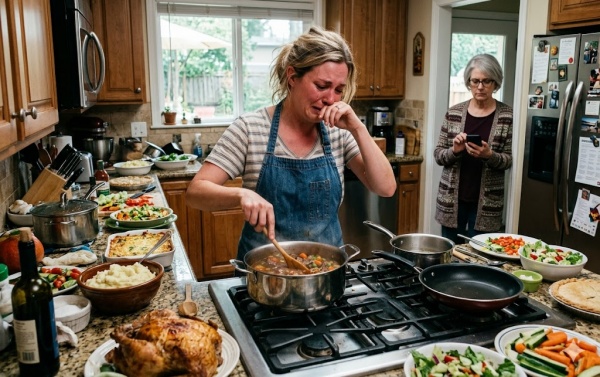
I Was 8 Months Pregnant anh Cooking a Memorial Dinner for my late father-in-law , When the Notification Popped Up. My Husband’s Mistress Sent a Video to Brag About the Affair. She Didn’t Realize My Mother-in-Law Was the One Who Saw It.
What she didn’t know? My MIL is a billionaire who built her empire on the bones of people who crossed her.
PART ONE: The Iron Lady’s Pride
If you grew up in Fairfield County, you already know the name Eleanor Vance.
She doesn’t need an introduction. Her name is on three office towers in Stamford, a wing of Greenwich Hospital, and the lips of every real estate developer from here to Manhattan. She built a billion-dollar commercial real estate empire from a single $40,000 loan she took out at twenty-six — back when banks still asked women if their husbands had co-signed. She didn’t have a husband. She had a plan.
People warned me before I married her son. “Living under Eleanor’s roof is like being a gazelle in a lion’s den,” my college roommate told me at my bridal shower, half-joking, half-serious. “She will eat you alive.” But here’s what nobody tells you about lions: they are ferociously loyal to their own.
From the very first Sunday dinner on Greenwich Avenue, Eleanor treated me differently than I expected. Not with coldness. Not with the icy scrutiny I’d spent months bracing for. She treated me like the daughter she never had — the one she’d always wanted but never got. She taught me how to read a balance sheet, how to hold my own in a room full of men who didn’t want me there, how to order wine at a business dinner without flinching at the price. She said I had “the spine of a Vance without the ego.” I have thought about that sentence almost every day since.
I think I understood, even then, why she loved me the way she did. I was the only person in her orbit who genuinely, completely did not want her money.
Then there was Mark.
Mark Vance was what happens when brilliance meets zero accountability. He had the jaw of a movie star, a Harvard MBA, and a trust fund that had never once required him to feel the weight of consequence. He was charming in the way that only men who’ve never been told “no” can be — effortlessly, dangerously charming, the kind of charming that feels like sunlight on your face until you realize it’s been slowly burning you the entire time. I fell for it completely and without reservation, the way only a woman who believes in the best version of people can fall.
By the time I was four months pregnant with our first child, I already knew something was wrong. The late nights. The “urgent client dinners” that left no paper trail. The way his phone was always face-down on the nightstand, screen pressed against the wood like it was hiding something with its whole body. I was battling morning sickness so severe I had lost eleven pounds, and I was carrying the emotional weight of a marriage that was quietly rotting from the inside — the kind of rot you can smell before you can see, that spreads through the walls before it shows on the surface.
I knew about the “late-night closings.” I knew what they really were.
But I stayed silent. I told myself it was for the baby. I told myself my grace, my patience, my unconditional love would eventually reach him — that somewhere under the Harvard MBA and the trust fund and the beautiful carelessness, there was the man I had chosen, and he would find his way back. I told myself that if I just held on a little longer, he would remember who he was supposed to be.
I was about to learn the hardest lesson of my adult life.
In the Vance family, grace doesn’t win wars. Power does.
PART TWO: The Five-Year Memorial
It was the fifth anniversary of my father-in-law’s passing.
Robert Vance had been a quiet, steady man — the kind of husband Eleanor had built her empire alongside, the kind of father who showed up to every single one of Mark’s lacrosse games even when he had board meetings scheduled that same afternoon. He died of a sudden heart attack at sixty-one, and Eleanor had never fully recovered in the way that certain people never fully recover from losing the one person who was their anchor in the world. She honored him every year with a formal memorial dinner — fifty guests, the most influential people in Connecticut, a five-course meal prepared with the care of someone who believed that love, properly expressed, takes the form of attention to detail.
This year, I was hosting it. Eight months pregnant, swollen ankles, a back that screamed every time I bent over the oven, and a catering staff that had called out two people sick that morning. I was in the kitchen by six a.m. in a maternity apron, elbow-deep in prep work for a standing rib roast that needed to feed a room full of people who had opinions about everything and the confidence to share all of them. It was, by any reasonable measure, one of the more physically demanding mornings of my life.
Eleanor arrived at ten a.m., her Hermès scarf knotted perfectly at her throat, her reading glasses perched on her nose, a leather portfolio under her arm as though she had come directly from a board meeting, because she probably had. She took one look at me — flushed, sweating, flour along both forearms — and her expression shifted in that particular way it did when she was recalibrating a situation she did not like.
“Where is Mark?” she asked, her voice dropping to the specific register she used when she was already calculating something.
“He had an urgent meeting in the city,” I said, not meeting her eyes. “He’ll be back by four.”
It was a lie. I didn’t know where Mark was. He had left before I woke up, and his last text — sent at 7:14 a.m. — said only “Don’t wait up.” On his own father’s memorial day. Four words, sent and done, as if the day meant nothing, as if the woman standing in the kitchen with flour on her arms and his child pressing against her ribs meant nothing either.
Eleanor looked at me for a long moment. She didn’t push. She didn’t ask a follow-up question or offer a comment or fill the silence with anything at all. She simply set down her portfolio, rolled up her sleeves, and started helping me with the roast without another word. That was Eleanor. She never wasted energy on anger she couldn’t yet use.
By noon, the kitchen smelled incredible and the table was set and the florist had come and gone and the 2015 Bordeaux was breathing on the sideboard. I was working on the pastry crust for the dessert tart, my hands buried in dough, when my iPhone buzzed on the marble island — just out of reach, my back already complaining at the thought of crossing the kitchen.
“Mom, can you check that?” I called over my shoulder. “If it’s Mark, tell him we’re out of the 2015 Bordeaux and he needs to stop at Zachys on his way back.”
Eleanor picked up the phone.
I didn’t see her face change. I had my back to her, focused on the pastry crust, and the kitchen was loud with the low sound of the oven and the music playing from the small speaker on the counter. But I heard it — the almost imperceptible sound of her breath catching. Just once. Just briefly. Like a door closing very quietly in a very large and otherwise silent house.
The kitchen went still.
PART THREE: The Video From “The Muse”
The notification was from a contact saved as “The Muse.”
It wasn’t a text. It was a video — and Eleanor’s hand began to tremble, not with grief and not with shock, but with something colder and more deliberate and more controlled than either of those. The kind of trembling that happens when a person of enormous self-discipline is fighting to contain something that has no clean outlet, something that has been building for years and has just, finally, found a specific target.
Later, she would tell me what she saw.
Tiffany — twenty-four years old, a “freelance brand consultant” Mark had met at a networking event in SoHo eight months earlier — had filmed herself lying in a motel bed, her head resting on Mark’s bare chest, smirking directly into the camera with the particular confidence of someone who has never once, in her entire life, genuinely faced a consequence. The caption she had typed was deliberate and precise and designed, word by word, to inflict maximum damage on a woman she had never met and apparently felt nothing toward except contempt.
“Your husband and I are having the time of our lives right now, honey. 😘 He says I’m ten times better in bed than his ‘boring, pregnant wife.’ He even recorded this himself so he could bring it home and ‘teach’ you how to keep a man happy. You’re welcome. Catch you later.”
She had sent it to my number. Not to a group. Not as some impulsive miscalculation. Deliberately, specifically, triumphantly — to me, on this exact day, at this exact hour, timed so that I would see it while I was standing in the kitchen eight months pregnant, cooking a memorial dinner for the man whose son was currently in a motel with her. She had thought it through. She wanted to see it land. She wanted to break me in the particular, irreversible way that only a woman with nothing to lose tries to break a woman with everything at stake.
“Mom?” I said, still not turning around. “Is it Mark? Is everything okay?”
There was a pause that lasted exactly three seconds.
“It’s nothing, sweetheart,” Eleanor said, and her voice was perfectly, terrifyingly calm — the voice she used in board meetings when someone had just made a very serious mistake and she had already decided exactly what was going to happen next. “Just spam. Keep going on the tart — it’s looking beautiful.”
I heard her set the phone back down on the island. I heard the soft, measured click of her heels as she moved toward the hallway. And then she stopped.
“I have to step out for a bit,” she said. “A business matter just came up. I’ll be back well before the guests arrive.”
She walked out. The sound of her Christian Louboutin heels on the hardwood floor was slow and deliberate and absolutely rhythmic — like a metronome counting down to something inevitable. The front door closed. The kitchen was quiet. I turned back to my pastry crust and told myself it was probably nothing, told myself the dinner needed me, told myself that whatever it was, Eleanor was handling it, and Eleanor handled things.
Tiffany had sent that video believing she was delivering a killing blow to a lonely, powerless pregnant woman in an empty kitchen.
She had no idea she had just handed her phone number, her face, her location, and her intentions to the most dangerous woman in the state of Connecticut.
PART FOUR: Room 302
Eleanor did not call Mark.
She called a man named Davis — her head of private security, a former U.S. Army intelligence officer who had spent fifteen years handling sensitive matters for the Vance family’s corporate interests with the kind of quiet competence that never appeared in any organizational chart. Within four minutes of their conversation, Davis had pinged the GPS tracker Eleanor had quietly embedded in the Rolex she had given Mark for his thirtieth birthday — a $28,000 watch he wore every single day without ever once thinking about what else it might be doing besides telling him the time.
The signal placed him at the Harborview Motor Inn on the edge of town — an $89-a-night property with a broken ice machine, a parking lot full of pickup trucks, and the specific anonymity of a place that exists precisely because some people need somewhere to be invisible. Room 302.
Eleanor’s black Escalade pulled into the parking lot eleven minutes after she left my kitchen.
She walked to the front desk, placed five crisp hundred-dollar bills on the counter in front of the manager — a heavyset man in his fifties who looked up from his phone with eyes that took in her silk dress and her posture and her expression and completed their calculation almost instantly — and held out her hand without saying a word. He gave her the master key. No questions. No hesitation.
Inside Room 302, Tiffany was stretched across the bed in a silk robe, scrolling her phone with a satisfied expression, waiting for the fallout she had engineered to arrive. She was expecting a tearful phone call from a devastated wife. She was expecting the satisfying collapse of someone else’s world. She was, in every way she understood the situation, expecting to win.
The door opened.
Mark, standing by the window in a towel with a glass of bourbon, turned around — and the color left his face in a single, comprehensive wave, the way color leaves a photograph left too long in direct sunlight. He looked, for the first time in his adult life, like a man who understood that he had run completely out of room.
“Mom—” he started. “How did you—”
“On your father’s memorial day,” Eleanor said, her voice barely above a whisper, each word placed with the precision of someone who has thought very carefully about what they are going to say and decided these are the right words. “On the day your pregnant wife is in our kitchen cooking for fifty people. This is where you are.”
It wasn’t a question. It was a verdict. It was the sound of a woman who had built an empire from nothing, who had stood at her husband’s grave five years ago and carried the weight of a family on her back without bending, who had looked at her son his entire life and believed, despite everything, that somewhere underneath the charm and the carelessness and the Harvard degree, there was something worth the investment of her faith.
The sound of that verdict was very quiet and very final.
Tiffany, whose understanding of consequences had been formed in a world where she had never truly faced any, did not read the room.
She sat up, pulled the sheet around herself, and lifted her chin with the kind of manufactured bravado that only exists in people who have never looked at something truly immovable and recognized it for what it is. “And who exactly are you supposed to be?” she said. “His mommy? He’s a grown man. He can make his own choices.”
Eleanor turned to look at her slowly. The way a person turns to look at a problem after they have already decided on the solution.
“You sent a video to my daughter-in-law’s phone,” she said. “While she is eight months pregnant. While she is cooking a memorial dinner for my late husband. You sent it to brag.”
Tiffany’s smile flickered — just slightly, just briefly, the first crack in a performance she had been rehearsing. “I sent it to her. Not to you. This has nothing to do with you.”
“Everything in this family,” Eleanor said simply, “has to do with me.”
What happened next happened quickly and without the shape of intention.
Tiffany moved forward — whether to grab Eleanor’s phone from her hand or simply to close the physical distance in a room where she was losing the psychological one, it was never entirely clear afterward. Eleanor, who trained five mornings a week at a private boxing gym in Cos Cob and whose body had forty years of muscle memory around the instinct of getting out of someone’s way, stepped to the side with a calm that was almost clinical. Tiffany, her momentum already committed, her feet tangled in the sheets that had pooled at the foot of the bed, lost her balance completely.
She pitched forward with her full weight and the corner of the solid oak dresser caught her in the lower abdomen with a sound that was sickening and absolute.
Mark called 911 before Tiffany had stopped screaming. Eleanor stood in the center of the room with her hands clasped in front of her, her face completely still, and waited for the ambulance the way she waited for everything — without urgency, without panic, without any visible sign of the internal landscape of a woman processing a moment that had just irrevocably changed the shape of everything.
At Greenwich Hospital — the same hospital with Eleanor Vance’s name on the east wing, the same surgical team that had attended to members of this family for twenty years — the operating team worked for two hours. When the attending surgeon emerged into the hallway, his expression said everything before his words did.
The blunt force trauma had caused a severe internal injury. Emergency surgery had been necessary to save her life. The damage was permanent. Tiffany was twenty-four years old, and she would not be able to have children.
Mark stood against the wall in the clothes he had thrown on at the motel, looking like a man watching an avalanche in slow motion and understanding, fully and finally, that he had been the one who started it.
Eleanor sat on the waiting bench with her ankles crossed and her hands folded and her silk dress perfectly smooth, and she looked like what she was: a woman who had seen the worst of what the world can do and had decided, a long time ago, that the only response was to become something the world could not easily undo.
When Tiffany came out of anesthesia, Eleanor walked into the recovery room alone. She set a sealed envelope on the bedside tray — a cashier’s check, covering every dollar of Tiffany’s medical bills in full — and stood at the foot of the bed looking at the young woman who had sent a video designed to destroy someone’s life and had instead destroyed her own.
“That envelope covers your medical bills,” she said quietly. “Consider it the last act of generosity you will ever receive from this family.”
She waited one beat.
“As of this morning, I have frozen every trust account in Mark’s name, revoked his access to all Vance corporate accounts, and had him removed from the board of directors. He has no salary, no assets, and no inheritance — not until I decide otherwise, if I ever do.” She paused. “He will leave this hospital with the clothes on his back and nothing else. So I want you to think carefully, Tiffany. You came after my daughter-in-law because you believed you could offer my son something she couldn’t. You believed you were the better option.”
Eleanor picked up her bag. She smoothed the front of her dress with one hand.
“Now tell me — what exactly do you have to offer a man like Mark Vance when you have no money, no leverage, no status, and no legacy?”
Tiffany said nothing. The fight had left the room entirely. There was nothing left to say, and for the first time in her life, she knew it.
Eleanor walked out.
PART FIVE: The New Hierarchy
Mark came home at nine p.m.
The memorial dinner had gone beautifully. Fifty guests. Five courses. The standing rib roast had been exactly right, and the tart had been exactly right, and the 2015 Bordeaux — which Mark had never stopped at Zachys to replace, because of course he hadn’t — had been supplemented by Eleanor, who had called the sommelier at her wine locker in Stamford from the hospital parking lot and had two cases delivered to the house by seven-thirty with the efficiency of a woman who has never once allowed a logistical problem to become an emotional one.
I had stood at the head of that table in my maternity dress and hosted fifty of the most powerful people in Connecticut entirely alone, and I had done it perfectly, and not a single person in that room knew what had happened that afternoon. Not until the toast.
When Mark walked through the front door at nine, I was sitting in the living room in the dark, both hands resting on my stomach, feeling our daughter move against my palms with the small, insistent kicks that had become, over these eight months, the most reliable comfort in my life. He stood in the doorway for a long moment. He looked like a man who had aged considerably in a single day — not in his face exactly, but in his posture, in the way he was holding his body, as though something structural had shifted and he was still figuring out how to stand without it.
He got down on his knees on the hardwood floor in front of me. He was already crying before he started talking, which was the first genuinely unperformed thing I had seen from him in longer than I could clearly remember. He said everything — every word a person says when they have been caught and stripped of every available defense and have nothing left between themselves and the truth except the truth itself. He was sorry. He was ashamed. He loved me. He loved our daughter. He would do anything, anything at all, if I would just tell him what anything looked like.
I looked at him for a long time. I did not speak. And I felt, for the first time in what seemed like years, absolutely nothing — not anger, not grief, not love, not the complicated amalgam of all three that had been the weather of my inner life for so many months. Just a profound and clarifying stillness, the way the air feels after a storm has moved through completely and the sky is clean and you can see farther than you could before.
I didn’t ask him to leave that night. I have a daughter coming in four weeks, and I have a legacy to protect, and I am not a woman who makes permanent decisions from inside a twenty-four-hour window of shock. But I want to be clear about something: I am not the same woman who was standing in that kitchen that morning with flour on her arms, covering for a man who didn’t deserve it. That woman is gone. She left sometime between the notification and the memorial toast, and she is not coming back.
At the closing toast, Eleanor stood and addressed the room. Her voice was steady and clear and carried the particular authority of someone who is not making an announcement but issuing a correction — a recalibration of the record that she has decided the room needs to hear.
“Robert always believed that legacy was not about money,” she said. “It was about who you trusted with it.”
She paused for exactly one beat.
“Effective immediately, I am designating my daughter-in-law as the sole successor to the Vance Estate. My grandchild will inherit everything this family has built. Mark will serve in an advisory capacity — unpaid, monitored, and on a probation that has no defined end date. One more failure of character, and he is removed from this family’s story permanently.”
The room was very quiet. Fifty of the most powerful people in Connecticut looked at one another, and then they raised their glasses, and the sound of crystal touching crystal in that dining room was the sound of something being decided, officially and publicly, in front of witnesses.
Mark still lives in this house. He sleeps in the guest room at the end of the hall. He has his Harvard MBA and his Rolex — the one with the GPS tracker, which he now knows about — and the good jaw that used to be enough to get him anything he wanted, and none of it means very much anymore without the name and the capital and the access that a woman in a silk dress just took back in a single sentence. He is learning, for the first time in his life, what consequence feels like. It is a slow, quiet, daily education, and I have no obligation to make it easier.
Tiffany was discharged four days after surgery. She left no forwarding address. She is somewhere out there carrying a scar that will never fully fade and the memory of a caption she typed with a smirk in a motel room, not knowing that the phone she had sent it to was in the hands of the one woman in Connecticut she should have been afraid of most.
Some women, it turns out, are not prey — no matter how vulnerable they appear from the outside. Some women are standing in a kitchen with flour on their arms while an empire is being quietly rearranged in their name.
And me?
I am eight months pregnant. I am the heir to a billion-dollar estate. I am sitting in the most beautiful house in Greenwich, Connecticut, with the winter light coming in off the Long Island Sound and my daughter kicking every time I laugh, and I am deciding my own future on my own timeline with the patience of a woman who has learned — the very hard way — that grace and power are not opposites.
They are just a matter of sequence.
