Part 1: The Signature He Thought Was His Victory
My name is Victoria Ashford, and I am 41 years old, and I am writing this from the living room of my penthouse apartment in downtown Seattle — the same penthouse my ex-husband Marcus believed he had just won in our divorce settlement when I signed the papers three days ago and walked out without saying a word.
I am writing this because what happened in the 72 hours after I signed those papers has been the subject of frantic phone calls, emergency legal meetings, and a level of panic from Marcus and his attorney that I want to document with complete accuracy before the story gets distorted by people who were not there and who do not understand what actually happened. I am also writing this because I think there is value in showing that underestimating someone — particularly a woman you have spent years dismissing and controlling — can be the most expensive mistake you ever make.
I need to describe the marriage before I describe the divorce, because understanding who Marcus was and what he believed about me is essential to understanding why he made the catastrophic error he made. Marcus Brennan and I met fourteen years ago when we were both working in finance in New York City.
I was a portfolio manager at a private equity firm, and Marcus was a commercial real estate broker who was charming, ambitious, and confident in the specific way that men who have always been told they are special tend to be confident. We dated for two years before he proposed with a three-carat diamond ring at a restaurant in Manhattan that cost $600 per person. We got married in the Hamptons in a wedding that cost $180,000 and that was featured in a regional lifestyle magazine.
The first five years of our marriage were good, or at least they appeared good from the outside. We lived in a luxury apartment on the Upper East Side. We traveled to Europe twice a year. We attended charity galas and art auctions and the kind of social events where people wear designer clothes and talk about their investment portfolios. But beneath the surface, there were problems that I chose to ignore because I was busy with my career and because I wanted to believe that the marriage I had built was real.
Marcus was controlling about money, insisting that we keep our finances separate even though we were married. He was dismissive of my career, making comments about how “lucky” I was to work at a firm where my father had connections, as if my MBA from Wharton and my twelve years of experience meant nothing. And he was obsessed with appearances, with making sure that everyone saw us as the perfect power couple even when we barely spoke to each other at home.
Eight years ago, my mother died. Her name was Eleanor Ashford, and she had been a painter — not famous, but talented and dedicated, someone who had spent forty years creating beautiful oil paintings of landscapes and still lifes that she sold in small galleries and gave to family and friends. When she died, she left me everything: her house in Connecticut, her savings of approximately $400,000, and her entire collection of paintings — 47 pieces that she had kept rather than sold, pieces that represented her life’s work.
I was devastated by her death, and the paintings became precious to me in a way that had nothing to do with their monetary value. They were my mother’s legacy, her voice, the physical evidence that she had existed and created beauty in the world.
Marcus’s reaction to my inheritance was telling. He immediately suggested we sell my mother’s house and invest the money in a property he was developing. He suggested we sell the paintings — “They’re just taking up space, and you could get at least $50,000 for the whole collection if you find the right buyer.”
I refused. I kept the house and rented it out. I kept the paintings and had them professionally framed and displayed in our apartment. And I kept my mother’s savings in a separate account that Marcus had no access to. This was the beginning of the end of our marriage, though I did not realize it at the time. Marcus had expected that my inheritance would become “our” money, and when I made it clear that it would not, he became resentful in ways that grew more obvious over time.
Part 2: The Affair, the Demand, and the Divorce He Thought He Controlled
Three years ago, I discovered that Marcus was having an affair. I found out in the specific, humiliating way that people usually find out — I saw text messages on his phone that he had forgotten to delete, messages to a woman named Sienna who worked as a marketing director at one of the real estate firms Marcus did business with. The messages were explicit and made it clear that the affair had been going on for at least six months.
I confronted Marcus. He did not deny it. He said he had been “unhappy” in our marriage, that I was “too focused on work,” that Sienna made him feel appreciated in ways I did not. He said he wanted a divorce.
I was hurt, but I was not surprised. Our marriage had been deteriorating for years, and the affair was simply the final confirmation that it was over. I agreed to the divorce. But then Marcus made a demand that I want to describe with complete accuracy because it reveals everything about who he was and what he believed he was entitled to.
He said, “I want the penthouse. I want half of your inheritance from your mother. And I want half of the value of those paintings. We’ve been married for eleven years. I’m entitled to half of everything you have.”
I need to explain the penthouse, because it is central to what happened next. Two years after my mother died, I sold her house in Connecticut for $680,000 and used that money, combined with my own savings, to purchase a penthouse apartment in downtown Seattle. We had moved to Seattle because Marcus had taken a job with a commercial real estate firm there, and I had transferred to the Seattle office of my firm.
The penthouse cost $1.8 million, and I paid for it entirely with my own money — the proceeds from my mother’s house, my savings, and a portion of the inheritance she had left me. Marcus’s name was not on the deed. He had not contributed a single dollar to the purchase. But because we were married and because Washington is a community property state, Marcus believed — or his attorney had told him — that he was entitled to half of the penthouse’s value in the divorce.
The paintings were a different issue. Under Washington law, property that is inherited is generally considered separate property, not community property, which meant that Marcus had no legal claim to my mother’s paintings. But Marcus argued that because the paintings had increased in value during our marriage — one of them had been appraised at $12,000, significantly more than it would have been worth when my mother was alive — he was entitled to half of that increase in value. His attorney sent me a letter demanding $150,000 as his share of the “marital appreciation” of the painting collection.
I hired an attorney, a woman named Catherine Liu who specialized in high-net-worth divorces and who had a reputation for being brilliant and ruthless. I told Catherine everything: the penthouse, the paintings, the inheritance, Marcus’s affair, his demands. Catherine listened carefully and then she said, “Victoria, I can fight this. I can argue that the penthouse is your separate property because you purchased it with inherited funds.
I can argue that the paintings are separate property and that any appreciation is also separate property. But it’s going to be expensive, it’s going to take time, and there’s no guarantee we’ll win on every point. Or—” she paused, “—we can give him exactly what he’s asking for, but in a way that ensures he gets nothing.”
I looked at her. “What do you mean?” Catherine smiled. “I mean we draft a settlement agreement that appears to give Marcus everything he wants, but that is structured in a way that protects your actual assets. We make him think he’s won. And then we let him discover what he’s actually signed.”
Part 3: The Agreement He Signed Without Reading Carefully
Catherine and I spent two weeks drafting the settlement agreement. It was a complex document, 47 pages long, filled with legal language and schedules and exhibits. The key provisions, as they appeared on the surface, were these: Marcus would receive the penthouse apartment in downtown Seattle, valued at $2.1 million. He would receive 23 of my mother’s paintings, representing half of the collection. He would receive $200,000 in cash as his share of other marital assets. In exchange, I would keep my retirement accounts, my car, my personal belongings, and the remaining 24 paintings. There would be no spousal support paid by either party.
Marcus was thrilled. He called me the day after his attorney sent him the draft agreement and said, “I’m glad you’re finally being reasonable about this. You’re getting a good deal too — you keep your retirement money and half the paintings. This is fair.” I did not correct him. I simply said, “I just want this to be over.” We scheduled a meeting to sign the papers.
The signing took place on a Tuesday afternoon in March at Catherine’s office in downtown Seattle. Marcus arrived with his attorney, a man named Gerald Hoffman who had a reputation for being aggressive but who I had learned, through Catherine, was not particularly detail-oriented.
Catherine, Marcus, Gerald, and I sat around a conference table. Catherine walked through the settlement agreement page by page, summarizing each section. Gerald nodded along, occasionally making notes. Marcus looked bored, impatient to get through the formalities. When Catherine finished, she slid the signature pages across the table. Marcus signed without hesitation. I signed. Our attorneys signed as witnesses. It was done.
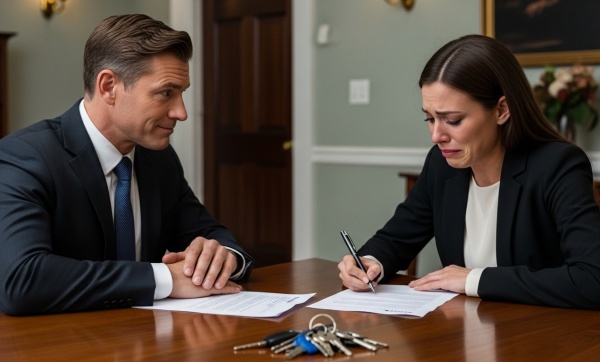
Marcus stood up and held out his hand for me to shake. “No hard feelings, Victoria. I hope we can both move on and be happy.” I shook his hand and said, “I’m sure we will.” Then I took the keys to the penthouse out of my purse and set them on the table in front of him. “The penthouse is yours,” I said. “I’ll have my things moved out by the end of the week.”
Marcus picked up the keys and smiled — the specific, satisfied smile of someone who believes they have just won something valuable. I walked out of the office, got in my car, and drove to the hotel where I had been staying for the past month. And I waited.
The call came the next morning at 9:47 a.m. It was not Marcus who called — it was Gerald Hoffman, his attorney, and I could hear the panic in his voice even before he spoke. “Ms. Ashford, I need to speak with you immediately about the settlement agreement. There appears to be a significant issue that we need to address.” I said, calmly, “I’m not sure what you mean, Mr. Hoffman. The agreement was signed yesterday. It’s final.” He said, “Ms. Ashford, did you read section 12, subsection C, paragraph 4?” I said, “I read every word of the agreement, Mr. Hoffman. Did you?”
Part 4: The Truth Hidden in Section 12, Subsection C, Paragraph 4
I want to describe exactly what was in the settlement agreement, because the precision matters and because it is the reason Marcus went from thinking he had won everything to realizing he had won nothing. Section 12 of the agreement dealt with the division of real property — specifically, the penthouse apartment.
The language in the first part of Section 12 was straightforward: “Husband shall receive all right, title, and interest in the real property located at 1500 Fourth Avenue, Unit 3401, Seattle, Washington, commonly known as the Penthouse Apartment.” This was what Marcus and his attorney had focused on. This was what made Marcus think he was getting a $2.1 million asset.
But Section 12, subsection C, paragraph 4 contained additional language that Gerald had apparently skimmed over or not fully understood. It read: “Notwithstanding the foregoing, Husband acknowledges that the Penthouse Apartment was purchased by Wife using separate property funds consisting of proceeds from the sale of inherited real property and inherited cash assets. Husband further acknowledges that he has made no financial contribution to the acquisition, maintenance, or improvement of the Penthouse Apartment.
As such, Husband’s receipt of the Penthouse Apartment pursuant to this Agreement constitutes a taxable gift from Wife to Husband under Internal Revenue Code Section 2501, and Husband agrees to be solely responsible for any and all gift tax liability arising from said transfer, estimated to be $798,000 based on the current fair market value of the property.”
In other words: Marcus was receiving the penthouse, but because it was my separate property and he had not paid for it, the transfer was legally classified as a gift from me to him. And under federal tax law, when someone receives a gift worth more than the annual exclusion amount — which in 2026 is $18,000 — the recipient is responsible for paying gift tax on the excess value. The gift tax rate is 40%. Marcus was receiving a penthouse worth $2.1 million, which meant he owed gift tax of approximately $798,000. And because he had signed the agreement acknowledging this, he could not claim he did not know.
The paintings had a similar provision. Section 14 of the agreement stated that Marcus would receive 23 paintings from my mother’s collection, with a combined appraised value of $287,000. But Section 14, subsection B, paragraph 3 stated: “Husband acknowledges that the Paintings constitute inherited separate property of Wife and that Husband has no legal claim to said Paintings under Washington community property law.
Husband’s receipt of the Paintings pursuant to this Agreement constitutes a taxable gift from Wife to Husband, and Husband agrees to be solely responsible for any and all gift tax liability arising from said transfer, estimated to be $107,600 based on the current appraised value of the Paintings.”
Marcus had signed an agreement that gave him a penthouse and paintings worth a combined $2.387 million, but that also made him responsible for paying $905,600 in gift taxes. He did not have $905,600. And because the agreement was signed and legally binding, he could not refuse the gifts without my consent — and I was not going to give it.
Part 5: The Panic, the Consequences, and the Victory He Never Saw Coming
Gerald Hoffman called me three more times that day, each time more desperate than the last. He said the gift tax provision was “unconscionable,” that it was “hidden” in the agreement, that no reasonable person would have agreed to it if they had understood it. I said, “Mr. Hoffman, the provision was clearly stated in the agreement. It was your responsibility to read it and explain it to your client.
The fact that you failed to do so is not my problem.” He threatened to sue to set aside the agreement. Catherine sent him a letter explaining that the agreement was valid, that Marcus had signed it voluntarily with the advice of counsel, and that any attempt to challenge it would be unsuccessful and would result in Marcus being responsible for my attorney’s fees as well.
Marcus called me directly two days later, screaming. “You set me up! You tricked me! There’s no way I can pay $900,000 in taxes! I’ll have to sell the penthouse just to pay the IRS!” I said, calmly, “Marcus, you wanted the penthouse. You wanted the paintings. I gave you exactly what you asked for. The fact that you didn’t read the agreement carefully is not my fault.” He said, “I’ll fight this. I’ll take you to court. I’ll—” I interrupted him. “Marcus, you can try. But you signed the agreement. Your attorney reviewed it. And every provision in it is legal and enforceable. Or—” I paused, “—you can agree to a modification.”
The modification I proposed was simple: Marcus would return the penthouse and the paintings to me. In exchange, I would pay him $50,000 as a settlement — far less than he had originally demanded, but enough that he could walk away without being completely destroyed financially. Marcus, faced with the choice between paying $900,000 in gift taxes or accepting $50,000, chose the $50,000. We signed an amended agreement two weeks later. I got my penthouse back. I got all of my mother’s paintings back. And Marcus got $50,000 and the knowledge that he had been completely outmaneuvered by the woman he had underestimated.
I am 41 years old and I am writing this from my penthouse in Seattle, surrounded by my mother’s paintings, living in the home I bought with my own money and that I will never have to share with someone who did not value me. I am writing this because I want other women who are going through divorces with men who think they are entitled to everything to know that you do not have to accept being taken advantage of. You can be smart. You can be strategic. You can hire good attorneys who understand how to protect your assets. And you can make sure that the person who underestimated you learns exactly how much that mistake cost them.
Marcus thought one signature gave him my home, my money, and my mother’s legacy. What it actually gave him was a $900,000 tax bill and a lesson in why you should never assume the woman across the table from you is less intelligent than you are. I signed the divorce papers, set my penthouse keys on the table, and walked out while Marcus smiled like he’d finally won. The next morning, his lawyer called him shouting, “What exactly did you just sign?” And by the time Marcus understood the answer to that question, it was too late.
