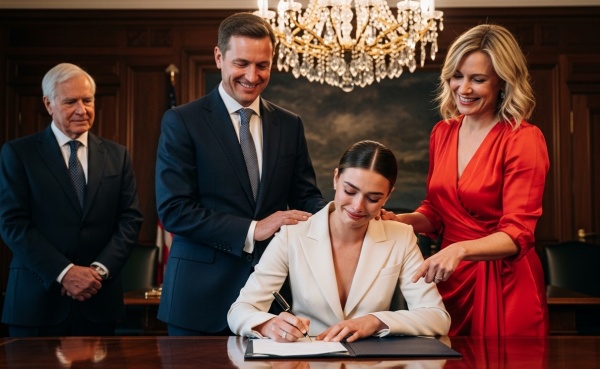
They laughed and forced her to sign the divorce papers — unbeknownst to anyone, her billionaire father was watching from the back of the room…
Part 1: The Humiliation
The conference room at Whitmore & Associates Law Firm smelled of expensive leather, stale coffee, and the bitter end of a marriage. Located on the 42nd floor of a gleaming high-rise in downtown Chicago, floor-to-ceiling windows offered a panoramic view of Lake Michigan, gray and choppy under March clouds.
Isabella Chen sat on one side of the long mahogany table, her hands folded carefully in her lap. She wore a simple cream-colored cardigan that had seen better days and no jewelry—not even the three-carat diamond wedding ring she’d removed three days ago and left on the bathroom counter of the penthouse she’d once called home.
Across from her sat her soon-to-be ex-husband, Marcus Sterling. He looked every inch the successful tech entrepreneur he claimed to be: custom-tailored navy suit from a Savile Row tailor, a Patek Philippe watch on his wrist worth more than most people earned in a year, and a smile so sharp it could cut glass.
“Let’s make this simple, Isabella,” Marcus said, sliding the thick packet of divorce documents across the polished table. The papers made a soft whisper against the wood. “I’m tired. You’re tired. We both know this marriage was a mistake from the start.”
“A mistake,” Isabella repeated softly, her voice steady despite the way her heart was hammering against her ribs. Her eyes focused on the words “Petition for Dissolution of Marriage” printed in bold letters at the top of the first page.
“Don’t play the victim,” Marcus sighed, leaning back in his leather chair with the casual confidence of someone who’d never been told no. “Look, when we met two years ago, you were just a barista at that coffee shop in Lincoln Park. I thought I was giving you a chance at a better life. I thought you’d be grateful to be Mrs. Marcus Sterling, wife of the CEO of NexTech Solutions. But let’s be honest… you never fit into my world. You don’t know how to dress for investor galas. You can’t hold a conversation with venture capitalists. You’re just… ordinary.”
He waved his hand dismissively, as if her ordinariness was a personal affront to him.
A voice cut in from the corner of the room—high-pitched, dripping with barely concealed glee.

“She really is ordinary, Marcus,” said Vanessa, Marcus’s executive assistant, who was perched on the windowsill scrolling through her phone. She was twenty-three, blonde, wearing a skin-tight red dress completely inappropriate for a legal proceeding. “And her cooking? God, who serves pot roast to a tech CEO? It’s like something from the 1950s. So embarrassing.”
Marcus let out a short laugh. “Exactly. Look, Isabella, the point is this: NexTech is going public next month. My lawyers and PR team agree it’s better to make a clean break now. Being single looks better than being married to a nobody when I’m ringing the opening bell at the NASDAQ.”
Isabella looked at him—really looked at him. This was the man she’d married in a small ceremony at City Hall two years ago. The man who’d promised to love her through everything. The man who’d cried on her shoulder when his first startup failed, who’d eaten ramen noodles with her in her tiny studio apartment when he couldn’t afford anything else.
Or had that man ever really existed?
“So that’s it?” Isabella asked quietly. “Two years of marriage, and now I’m just a liability to your stock price?”
“It’s business, Isabella. Don’t make it emotional.” Marcus tapped the papers with his manicured fingers. “Here’s the deal. The prenup you signed—remember that?—says you get nothing, because you brought nothing into this marriage. But because I’m a generous guy…”
He reached into his jacket pocket and pulled out a sleek black American Express card. He tossed it onto the table where it spun once before coming to rest near Isabella’s folded hands.
“There’s $25,000 loaded on that card. That’s enough for first and last month’s rent on a studio apartment in… I don’t know, somewhere affordable. Maybe Cicero or something. And you can keep the 2015 Honda Civic.”
The lawyer sitting next to Marcus—a sweaty, nervous man named Gerald Hutchins—cleared his throat. “Uh, Mr. Sterling, technically the Honda is registered under the company’s fleet lease program…”
“Let her keep the damn car, Gerald,” Marcus snapped. “I’m feeling generous today.” He turned back to Isabella with a smirk. “See? I’m not the bad guy here. Now sign the papers. I have a lunch meeting at Alinea at one o’clock, and you know how hard it is to get a reservation there.”
Isabella stared at the documents. Then at the credit card. Twenty-five thousand dollars. Two years ago, she’d met Marcus when he was just getting NexTech off the ground. He’d been stressed, barely able to make payroll, living on takeout and energy drinks, spending hours at the coffee shop where she worked part-time while finishing her business degree at DePaul University.
He hadn’t rescued her. She’d been the one who listened to his half-baked business ideas at 2 AM. She’d been the one who organized his chaotic schedule and introduced him to her former professor who became his first major investor. She’d even quietly used her own savings—money she’d told him was from her grandmother’s life insurance policy—to cover the rent on his first office space when his initial funding fell through.
But he’d forgotten all of that. Or maybe he’d never really seen it in the first place.
“You really think I want your money, Marcus?” Isabella asked, her voice barely above a whisper.
“Everyone wants money, Isabella. Especially people like you—people who have nothing.” Marcus snorted. “Just sign the papers. Stop dragging this out. Unless you’re waiting for some kind of miracle.”
From her spot by the window, Vanessa let out another giggle. “Maybe she thinks you’ll change your mind, babe. Like in the movies.”
“This isn’t a movie,” Marcus said coldly. “This is real life. And in real life, people like me end up with people who actually add value to our lives. People like Vanessa, who understands my world.”
Isabella felt something crack inside her chest—not her heart breaking, but something else. The last fragile thread of hope that maybe, somehow, the man she’d married was still in there somewhere.
He wasn’t.
She reached into her worn leather purse. Marcus tensed slightly, as if expecting her to pull out something dramatic. But she only withdrew a simple ballpoint pen—the cheap kind you get free from banks.
“I don’t want your money, Marcus,” Isabella said quietly, her hand steady as she clicked the pen. “And I don’t want the Honda either.”
Part 2: The Signature
Marcus’s lawyer, Gerald, looked relieved. “Excellent. If you’ll just sign on the highlighted lines, Mrs. Sterling—”
“Ms. Chen,” Isabella corrected softly. “I’ll be going back to my maiden name.”
“Of course, of course. Ms. Chen. If you’ll sign here, here, and initial here…” Gerald flipped through the pages with practiced efficiency, pointing to each yellow-highlighted section.
Isabella began to sign. Her handwriting was neat, careful, each letter formed with deliberate precision. Marcus watched with barely concealed impatience, checking his watch every few seconds.
“You know what the best part is?” Marcus said, unable to help himself. “After the IPO, I’ll be worth somewhere around $300 million. Maybe more if the market’s good. And you?” He laughed. “You’ll be back to making lattes for $15 an hour plus tips. I almost feel sorry for you.”
“Almost?” Isabella asked without looking up from the papers.
“Well, you made your choice when you married someone out of your league. You should have known it wouldn’t last.”
Vanessa chimed in again. “I told Marcus you were probably just a gold digger from the start. But he’s too nice. He actually thought you loved him.”
Isabella’s pen paused for just a fraction of a second. Then she continued signing.
“I did love him,” she said quietly. “I loved the man I thought he was. The man who cried when his mother died. The man who said he wanted to build something meaningful, not just make money. But that man doesn’t exist anymore. Maybe he never did.”
“Oh, spare me the melodrama,” Marcus groaned. “You’re not in some tragic romance novel. You’re just a girl who got lucky for two years and now it’s over. Sign the last page and we can all move on with our lives.”
Isabella signed the final page. She set down the pen with a soft click against the mahogany table.
“There,” she said. “It’s done.”
Gerald quickly gathered the papers, checking each signature. “Perfect. Everything appears to be in order. Judge Morrison should be able to finalize this within 30 days, and then—”
“Actually,” a deep voice said from the back of the room, “I don’t think Judge Morrison will be finalizing anything.”
Everyone froze.
Isabella didn’t turn around, but she saw Marcus’s face go pale. She saw Gerald’s eyes widen. She saw Vanessa finally look up from her phone, confusion written across her heavily made-up face.
“Who the hell are you?” Marcus demanded, half-rising from his chair. “This is a private meeting. Security should have—”
“Security works for me,” the man said calmly, stepping forward from the shadows near the door where he’d been standing so quietly that no one had noticed him. “As does the building manager, the law firm that’s renting this space, and—as of about six months ago—the majority shareholders of your company, Mr. Sterling.”
The man was in his early sixties, wearing an impeccably tailored charcoal suit that probably cost more than Marcus’s car. His hair was silver at the temples, his face weathered but distinguished. He moved with the quiet confidence of someone who’d never had to raise his voice to command a room.
Marcus stared at him. “I… I don’t understand. Who are you?”
The man smiled—a smile that didn’t reach his eyes. “My name is James Chen. Perhaps you’ve heard of me?”
The color drained completely from Marcus’s face. Even Gerald looked like he might faint.
James Chen. The James Chen. Founder and CEO of Chen Global Industries, one of the largest private equity firms in North America. The man who’d turned a small import business into a multi-billion dollar empire. The man whose investment decisions could make or break entire companies.
The man who, according to every business publication, had no children and no family to speak of.
Except that wasn’t quite true.
Part 3: The Revelation
“That’s… that’s impossible,” Marcus stammered. “James Chen doesn’t have any children. Everyone knows that. It’s been in Forbes, in Bloomberg, in—”
“In every article written by journalists who only know what I choose to tell them,” James said calmly. He walked slowly around the table, his hand trailing along the polished wood. “I’ve worked very hard to keep my daughter out of the public eye, Mr. Sterling. To give her a chance at a normal life, away from the circus that comes with being associated with my name.”
He stopped behind Isabella’s chair, placing a gentle hand on her shoulder.
“Isabella is my only child,” he continued. “Her mother—my late wife, Susan—and I agreed when Isabella was young that we would keep her identity private. We wanted her to grow up without the burden of the Chen name. To make her own choices, find her own path, meet people who valued her for who she was, not for her family’s money.”
Isabella finally spoke, her voice steady. “I went to public school under my mother’s maiden name. I worked part-time jobs through college. I lived in a studio apartment and took the L train to work every day. I wanted to know what it was like to be… ordinary.”
“But you’re not ordinary,” James said softly, pride evident in his voice. “You graduated summa cum laude from DePaul with a degree in business administration. You built a successful consulting practice before you even turned twenty-five. And when you met this man”—he gestured dismissively at Marcus—”you saw potential in him. You believed in him. You helped him build his company with your own money, your own connections, your own expertise.”
Marcus looked like he’d been hit by a truck. “Wait. Wait. The investor who saved NexTech when we were about to go under—Professor Williams from DePaul—that was because of you?”
“I introduced them,” Isabella said simply. “Professor Williams was my mentor. He trusted my judgment about promising startups.”
“And the $50,000 that mysteriously appeared in the company account when you couldn’t make payroll?” James added. “That wasn’t from some angel investor who wanted to remain anonymous. That was my daughter’s money. Money she’d earned herself and chose to invest in you.”
“And the connections to the venture capital firms in Silicon Valley?” Isabella continued, her voice growing stronger. “The ones who suddenly took interest in a small Chicago tech startup? I made those introductions. I wrote the pitch decks. I coached you through the presentations.”
Marcus sat down heavily, his face ashen. “But… but you never said anything. You never told me…”
“You never asked,” Isabella said simply. “You just assumed I was some poor girl you’d rescued. You liked that narrative. It made you feel powerful, generous. The self-made man who married beneath him out of the goodness of his heart.”
Vanessa, who’d been silent throughout this exchange, finally found her voice. “This is insane. If you’re really James Chen’s daughter, why would you work as a barista? Why would you live in some crappy apartment?”
James turned his cold gaze on her. “Because unlike some people, my daughter understands that character isn’t built in luxury. It’s built through work, through struggle, through understanding what it means to earn something rather than have it handed to you.”
He turned back to Marcus. “When Isabella told me she was getting married, I had you investigated, of course. What father wouldn’t? The report came back… adequate. You had ambition, intelligence, a decent business plan. You weren’t from money, but neither was I originally. I thought perhaps you might be worthy of my daughter.”
“I had one condition,” James continued. “I told Isabella that I wouldn’t interfere in her marriage. That she’d asked for the chance to live an ordinary life, and I would respect that. But I also told her that if she ever needed me, I would be there.”
He pulled out his phone and showed Marcus the screen. It was a text message, sent three days ago: Dad, I’m ready to come home.
“That’s when I knew it was time to stop watching from the sidelines,” James said quietly.
Part 4: The Reckoning
Gerald, the lawyer, was frantically flipping through papers, his hands shaking. “Mr. Chen, sir, I had no idea. If I had known—”
“If you had known, you would have what?” James asked coldly. “Advised your client differently? Treated my daughter with respect? Done your job with integrity instead of helping a fool humiliate his wife?”
“I… I…”
“You’re fired,” James said simply. “Whitmore & Associates will receive a call from my legal team within the hour. I suggest you start looking for new employment.”
He turned to Marcus. “As for you, Mr. Sterling. Let’s talk about NexTech Solutions, shall we?”
Marcus looked like he might be sick. “What about it?”
“Six months ago, Chen Global Industries quietly acquired a controlling interest in your company through several shell corporations. We now own 51% of NexTech. Which means we control the board. Which means we control… you.”
“That’s… you can’t…” Marcus’s voice was barely a whisper.
“I can, and I did. You see, I’ve been watching you, Mr. Sterling. Watching how you treated my daughter. How you took credit for her ideas. How you paraded around like a self-made man while standing on her shoulders. How you flaunted your affair with your assistant—yes, I know all about that—while my daughter kept your household running and your company from collapsing.”
James pulled out a folder from his briefcase and dropped it on the table. It landed with a heavy thud.
“This is a forensic audit of NexTech Solutions, conducted by the best accountants money can buy. Would you like to know what they found?”
Marcus said nothing, his face gray.
“Embezzlement. Misappropriation of funds. Fraudulent expense reports. You’ve been using company money to pay for your luxury apartment, your cars, your expensive dinners, your gifts to Ms. Vanessa here. That’s corporate fraud, Mr. Sterling. The SEC tends to frown on that sort of thing, especially from a company about to go public.”
“I… I can explain—”
“I’m sure you can. You can explain it to the federal prosecutors who will be receiving this file tomorrow morning. Unless…”
Marcus looked up, a desperate hope flickering in his eyes. “Unless what?”
“Unless you sign some papers of your own,” James said, pulling out another document. “This is a resignation letter, effective immediately. You will step down as CEO of NexTech. You will surrender all your stock options. You will issue a public statement saying you’re leaving to pursue other opportunities. And you will never, ever contact my daughter again.”
“But… but NexTech is my company! I built it!”
“No,” Isabella said, speaking for the first time in several minutes. Her voice was quiet but firm. “We built it. And you destroyed it. Or you would have, if my father hadn’t stepped in to save it.”
“If you don’t sign,” James continued, “the audit goes to the SEC. You’ll be arrested, probably within 48 hours. You’ll be charged with multiple felonies. You’ll spend the next five to ten years in federal prison, and you’ll never work in tech again. Your choice.”
Marcus stared at the document, his hands trembling. “This isn’t fair.”
“Fair?” Isabella stood up, and for the first time, Marcus saw real anger in her eyes. “You want to talk about fair? Was it fair when you told your investors that the business model was your idea, when I was the one who developed it? Was it fair when you introduced Vanessa as your ‘right hand’ at company events while I stood in the corner? Was it fair when you told me I was ordinary, boring, not good enough for your world?”
Her voice didn’t rise, but each word landed like a hammer blow.
“I loved you, Marcus. I really did. I saw potential in you, and I wanted to help you achieve it. But you didn’t want a partner. You wanted an audience. Someone to applaud your success and stay quiet about their own contributions.”
She picked up the black Amex card he’d tossed at her earlier and held it up.
“Twenty-five thousand dollars. That’s what you thought I was worth. Two years of marriage, countless hours of work, my savings, my connections, my ideas—all worth about the price of a used car.”
She dropped the card back on the table with a sharp click.
“Keep your money, Marcus. I don’t need it. I never did.”
Part 5: The New Beginning
Marcus signed the papers with shaking hands. He had no choice, really. Federal prison or a humiliating resignation? It wasn’t much of a choice at all.
When he finished, James collected the documents and handed them to his own lawyer—a sharp-eyed woman named Patricia who’d been standing silently by the door the entire time.
“Ms. Rodriguez will handle the transition,” James said. “You have until 5 PM today to clear out your office. Security will escort you from the building. Any company property—laptop, phone, access cards—will be surrendered immediately.”
Marcus stood on shaky legs. He looked at Isabella one last time, and she saw something she’d never seen before in his eyes: genuine regret. Not for how he’d treated her, but for what he’d lost.
“I really didn’t know,” he said quietly. “About your father. About… everything.”
“I know,” Isabella said. “That’s what made it so easy to walk away. You never saw me, Marcus. You only saw what you wanted to see.”
Marcus left without another word, Vanessa trailing behind him, her earlier confidence completely evaporated. She didn’t even look at Isabella as she passed.
When the door closed behind them, Isabella let out a long breath she didn’t know she’d been holding. Her father wrapped an arm around her shoulders.
“You okay, sweetheart?”
“I am now,” she said, leaning into his embrace. “Thank you for respecting my wishes. For letting me try to do this on my own.”
“You did do it on your own,” James said firmly. “You built a life, earned a degree, started a career. You fell in love—even if it was with the wrong person. Those were your choices, your experiences. I just… helped with the ending.”
Isabella smiled. “Some help. You basically took apart his entire life in fifteen minutes.”
“He took apart his own life,” James corrected. “I just made sure he faced the consequences. There’s a difference.”
They walked to the elevator together. As they descended from the 42nd floor, James asked, “So what now? Come back to work at Chen Global? We could use someone with your skills in the acquisitions department.”
Isabella considered it. “Maybe. But I think I want to do something different. NexTech is going to need a new CEO, right?”
James raised an eyebrow. “Are you suggesting…?”
“I built that company as much as Marcus did. More, actually. I know every aspect of the business. I have relationships with all the key investors and clients. And I have ideas for where it should go next—ideas Marcus never wanted to hear because they came from his ‘ordinary’ wife.”
A slow smile spread across James’s face. “The board meeting is scheduled for next week. I’ll make sure your name is on the list of candidates.”
“I don’t want special treatment because I’m your daughter,” Isabella said quickly.
“You won’t get it. But you will get a fair chance to present your vision for the company. What the board does with that information is up to them.” He paused. “Though I should mention that the board consists of some of the smartest business minds I know. They’ll recognize talent when they see it.”
They stepped out of the building into the gray Chicago afternoon. A sleek black Mercedes was waiting at the curb, James’s driver standing by the open door.
“Want a ride?” James asked.
Isabella looked at the car, then at the L train station half a block away. For two years, she’d taken public transportation, lived in a small apartment, worked hard to maintain the ordinary life she’d chosen. But that chapter was over now.
“Yeah,” she said, climbing into the car. “I think I do.”
As they drove through downtown Chicago, James asked, “Do you regret it? The last two years?”
Isabella thought about it. “No. I learned a lot. About business, about people, about myself. I learned that I could build something from nothing. I learned that I’m stronger than I thought. And I learned that love isn’t about rescuing someone or being rescued. It’s about seeing each other clearly and choosing each other anyway.”
“Wise words,” James said.
“I also learned,” Isabella continued with a slight smile, “that being ordinary isn’t the worst thing in the world. But being underestimated? That’s a powerful advantage.”
Three weeks later, Isabella Chen was announced as the new CEO of NexTech Solutions. The press release mentioned her MBA from DePaul, her previous consulting work, and her “fresh vision for the company’s future.” It didn’t mention her father, and it didn’t mention her brief marriage to the previous CEO.
The company’s IPO was postponed for six months while Isabella restructured operations and cleaned up the financial irregularities Marcus had left behind. When NexTech finally went public, it was valued at $450 million—50% more than the original projections.
Marcus Sterling, meanwhile, took a job at a small startup in Austin, Texas. He never faced criminal charges—James had decided that public humiliation and professional ruin were punishment enough. Vanessa went with him, though their relationship didn’t last six months.
On the day of the IPO, as Isabella stood on the floor of the NASDAQ preparing to ring the opening bell, her father stood beside her. The cameras flashed, capturing the moment for financial news outlets around the world.
“Proud of you, sweetheart,” James whispered.
“Thanks, Dad,” Isabella whispered back. “For everything. For letting me fall. And for catching me when I needed it.”
“That’s what family does,” James said simply.
The bell rang, and NexTech’s stock began to trade. Isabella watched the numbers climb on the big board, surrounded by her team—the real team she’d built over the past few months, people who valued her ideas and respected her leadership.
She thought briefly about that day in the conference room, about Marcus tossing a credit card at her like she was a problem to be solved with money. About how close she’d come to believing she really was ordinary, really was nothing.
But she’d learned the truth: she’d never been ordinary. She’d just been underestimated.
And sometimes, that was the greatest advantage of all.
