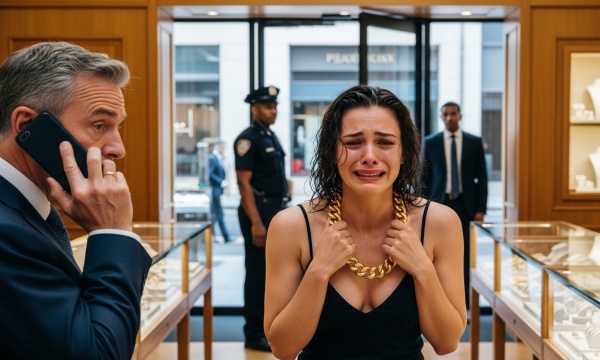
I Tried to Pawn My Dead Mother’s Necklace to Pay Rent—The Jeweler’s Face Went White
The eviction notice gave me three days. Standing in that pawn shop, desperate and humiliated, I never imagined that the necklace I was about to sell for rent money would unlock a mystery that had haunted a family for over two decades.
Part One: The Final Notice
The day I walked out of the El Paso County Courthouse, the Colorado sun felt different—harsher, more indifferent. I carried two bulging trash bags stuffed with clothes, a phone with a spiderweb crack across the screen, and my mother’s silver necklace tucked safely in my jacket pocket. That necklace was the only thing of value I had left.
Derek Lawson, my ex-husband, got everything else. The three-bedroom ranch house in the suburbs. The 2022 Honda CR-V. Even the couch we’d picked out together at Ashley Furniture on a rainy Saturday afternoon that now felt like it belonged to someone else’s life. Judge Morrison called the settlement “equitable.” Derek’s smirk suggested he called it a win.
The weeks that followed blurred together in a haze of double shifts at Rosie’s Diner, counting crumpled dollar bills, and pretending I wasn’t one bad day away from sleeping in my car. My studio apartment on the south side of Colorado Springs wasn’t much—barely 400 square feet with a kitchenette and a bathroom where the shower never got quite hot enough—but it was mine. Or at least, it had been.
The eviction notice appeared on a Tuesday evening, taped to my door in all its fluorescent orange glory. FINAL NOTICE: PAY $1,847 BY FRIDAY OR VACATE PREMISES. I read it three times, each word sinking deeper into my chest like stones into water.
That night, I sat at my wobbly kitchen table under the flickering overhead light and pulled out the shoebox I’d kept hidden in my closet since Mom died four years ago. Inside were photographs with scalloped edges, letters written in her careful cursive, a ticket stub from a Rockies game we’d attended when I was twelve, and the necklace.
I lifted it carefully, feeling its surprising weight in my palm. The silver had tarnished slightly over the years, but the delicate filigree work still caught the light beautifully. A small teardrop-shaped moonstone hung from the center, milky and luminous. Mom had worn it every single day until the cancer made her too weak to fasten the clasp.
“I’m so sorry, Mom,” I whispered, my voice cracking in the empty apartment. “I don’t have any other choice.”
Part Two: Whitman Jewelers
Wednesday morning, I walked into Whitman Jewelers on Tejon Street downtown, my heart hammering against my ribs. The shop was elegant in an understated way—gleaming glass cases, soft classical music playing from hidden speakers, the faint scent of lemon polish in the air.
Behind the counter stood a thin man in his sixties, wearing a perfectly pressed gray vest and a jeweler’s loupe hanging from a silver chain around his neck. His name tag read “Mr. Donnelly” in engraved script.
“Good morning,” he said warmly, his eyes crinkling at the corners. “How can I help you today?”
I swallowed hard, forcing the words out. “I need to sell this necklace. It’s… it’s urgent.”
I placed it on the black velvet pad between us, trying not to think about Mom fastening it around her neck every morning, the small ritual that had been as constant as her coffee and crossword puzzle.
Mr. Donnelly reached for it casually, but the moment his fingers touched the silver, everything changed. His entire body went rigid. The color drained from his face so quickly I thought he might faint. He lifted the necklace with trembling hands, turning it toward the light, examining the clasp with an intensity that made my stomach drop.
“Where…” His voice came out as barely a whisper. “Where did you get this?”
“It was my mother’s,” I said, instinctively defensive. “She left it to me when she passed. Why? What’s wrong?”
Instead of answering, Mr. Donnelly grabbed the phone on the counter, his fingers shaking so badly he had to dial twice. “Sir, you need to come to the shop immediately,” he said, his voice urgent and strange. “The pendant. It’s here. Someone just walked in with it.”
Ice flooded my veins. “Who are you calling? What’s going on?”
Before he could answer, I heard a lock click somewhere in the back of the shop. A door I hadn’t noticed before opened, and a tall man in an impeccably tailored charcoal suit emerged, flanked by two security personnel in dark blazers.
The man was probably in his early seventies, with silver hair swept back from a distinguished face and eyes that locked onto me with an intensity that made me want to run. But his expression wasn’t angry or threatening—it was stunned. Almost disbelieving.
“Close the shop,” he said quietly to Mr. Donnelly, never taking his eyes off me. “Lock the front door.”
“I’m not staying here,” I said, grabbing for the necklace. “I don’t know what this is about, but—”
“Please.” The man held up both hands, palms out, in a gesture of peace. “My name is Leonard Whitman. I own this store. And I promise you, I mean no harm. But that necklace…” He paused, his voice catching slightly. “That necklace was made in this very workshop. Only three were ever created. And I know exactly where each one should be.”
My pulse roared in my ears. “It belonged to my mother. Marjorie Henderson. She’s been gone for four years, and this is all I have left of her.”
Leonard’s jaw tightened. Slowly, carefully, he reached into his jacket and pulled out a leather portfolio. He opened it on the counter between us, revealing photographs, documents, and a yellowed missing child poster that made my breath stop.
MISSING: Emma Rose Whitman. Age 3. Last seen June 14, 2003. Sacramento, California.
The little girl in the photo had dark curly hair and wide hazel eyes. She was wearing a white dress with strawberries on it. And around her neck was a silver necklace with a moonstone pendant.
“Twenty-three years ago,” Leonard said, his voice carefully controlled, “my granddaughter disappeared from a park in Sacramento while my daughter was loading groceries into the car. She turned her back for less than two minutes. When she looked again, Emma was gone.” He touched the photograph with one finger. “The police searched for months. We hired private investigators. We never stopped looking. And that necklace—the one you’re holding—was around her neck the day she vanished.”
The room tilted. I gripped the edge of the counter, trying to process what he was saying. “I’m twenty-six years old,” I heard myself say. “My mom… Marjorie found me at a children’s shelter in Sacramento when I was three. She was a social worker. She said I was brought in alone, no parents, no records. Just wearing this necklace. She fostered me, then adopted me a year later.”
Leonard’s composure cracked. For just a moment, raw grief flashed across his face before he regained control. “Then you understand why I need to know the truth,” he said softly. “I’m asking you to take a DNA test. If I’m wrong, I’ll compensate you generously for your time and never contact you again. But if I’m right…”
“If you’re right, then my entire life is a lie,” I finished, my voice hollow.
Mr. Donnelly spoke up gently. “Miss, the necklace alone is insured for $45,000. If Mr. Whitman’s claim is valid, you’d never have to worry about rent again.”
I looked down at the necklace, at the missing child poster, at Leonard Whitman’s desperate, hopeful face. My phone buzzed in my pocket—a text from Derek: Heard you’re pawning jewelry now. Classy. Really scraping the bottom of the barrel, aren’t you?
Something inside me hardened. I’d spent the last six months being told I was worthless, that I’d never amount to anything, that I was lucky Derek had even married me in the first place. Maybe it was time to find out who I really was.
“Okay,” I said. “Let’s do the test.”
Part Three: Waiting
The DNA testing facility was in a medical building off Academy Boulevard, sterile and anonymous. Leonard arranged everything, but he made sure I understood every form, every consent document, every step of the process before I signed anything. A nurse swabbed the inside of my cheek, sealed the sample in a vial, and told us results would take 48 to 72 hours.
Standing in the parking lot afterward, Leonard handed me an envelope.
“What’s this?” I asked.
“Enough to cover three months of rent and expenses,” he said. “No strings attached. Whether the test comes back positive or negative, you need stability right now. Consider it… a loan, if that makes you more comfortable.”
I opened the envelope and nearly dropped it. Inside was a cashier’s check for $6,000.
“I can’t accept this,” I whispered, even though every desperate cell in my body screamed at me to take it.
“You can, and you will,” Leonard said firmly. “Your mother—Marjorie—she gave you a life when you had nothing. She deserves to be honored for that, regardless of how this turns out. Let me help you the way she helped you.”
Tears burned my eyes. I nodded, unable to speak.
The next two days were the longest of my life. I paid my landlord, watched him grudgingly remove the eviction notice, and went through the motions at work. But my mind was somewhere else entirely, caught between fear and impossible hope.
On Friday afternoon, my phone rang. The caller ID showed the testing facility’s number. My hands shook so badly I almost couldn’t answer.
“Miss Henderson?” the nurse’s professional voice came through. “Your results are ready. Would you like me to read them to you, or would you prefer to come in?”
“Just… just tell me,” I managed.
“The test confirms a biological relationship consistent with Leonard Whitman being your paternal grandfather. The probability of relatedness is 99.97%.”
The phone slipped from my fingers, clattering onto my kitchen table. I couldn’t breathe. Couldn’t think. The walls of my tiny apartment seemed to close in and expand simultaneously.
I was Emma Rose Whitman.
I had been missing for twenty-three years.
And I had a family.
Part Four: The Truth Unfolds
Leonard came to my apartment that evening, and for the first time, I saw him not as a wealthy stranger but as my grandfather. We sat across from each other at my wobbly table, and he told me everything.
His daughter—my mother—was named Catherine. She’d been twenty-eight when I was taken, a kindergarten teacher married to a man named Michael Whitman, a software engineer. They’d been at McKinley Park in Sacramento, just a routine Saturday morning. Catherine had turned to put grocery bags in the trunk. When she looked back, I was gone.
“The investigation went on for years,” Leonard said, his voice heavy with old pain. “The police suspected Michael at first, which nearly destroyed their marriage. Then they suspected Catherine. Then random predators, custody disputes, human trafficking rings. Every lead went nowhere. Michael couldn’t handle it. He left when you’d been gone for two years. Catherine…” He paused, swallowing hard. “Catherine never recovered. She died five years ago. Heart attack, the doctors said. But I think it was a broken heart.”
“And my… my biological father?” I asked.
“Michael moved to Oregon. Remarried. Started over. I can give you his contact information if you want it, but I haven’t spoken to him in over a decade.”
I processed this slowly, feeling like I was assembling a jigsaw puzzle of someone else’s life. “What about Marjorie? My mom—the woman who raised me. How did she end up with me?”
Leonard pulled out more documents. “I’ve had investigators working around the clock since Wednesday. Marjorie Henderson was a social worker in Sacramento in 2003. She had a clean record, by all accounts a good woman. But here’s what we found: three weeks before you disappeared, she filed for emergency foster certification. And the shelter where you were supposedly ‘found’? It was run by her college roommate.”
The implication hit me like a physical blow. “You think she took me? Planned it?”
“I think,” Leonard said carefully, “that the truth is complicated. Maybe she saw a child she believed was neglected or in danger. Maybe she convinced herself she was rescuing you. Or maybe…” He hesitated. “Maybe someone else took you, and she provided a way to hide you, believing she was doing the right thing.”
I thought about Mom—Marjorie—the woman who had braided my hair and taught me to ride a bike, who had worked double shifts to pay for my braces and college textbooks, who had held my hand through every nightmare and heartbreak. Had she stolen me? Saved me? Both?
“I don’t know what to feel,” I admitted, my voice breaking.
“You don’t have to know yet,” Leonard said gently. “This is going to take time. But Emma—” He stopped, correcting himself. “I’m sorry. What do you want to be called?”
I’d been “Emma” for the first three years of my life, years I couldn’t remember. I’d been “Claire” for twenty-three years, the name Marjorie had given me. Who was I really?
“Claire,” I said finally. “I’m still Claire. But maybe… maybe I can be Emma too. Both.”
Leonard’s eyes glistened. “I’d like that very much.”
Part Five: Moving Forward
The next few weeks were a whirlwind. Leonard introduced me to extended family—aunts, uncles, cousins I’d never known existed. They welcomed me with a mixture of joy, disbelief, and cautious hope. Some were skeptical at first, wondering if I was a con artist, but the DNA results and childhood photos (I had the same distinctive birthmark on my left shoulder blade that baby Emma had) eventually convinced everyone.
Leonard set me up in a furnished apartment in a better neighborhood, helped me buy a reliable used car, and offered me a job managing the administrative side of his jewelry business. “No pressure,” he said. “But if you’re interested, the position is yours. And if you’d rather do something else entirely, I’ll support that too.”
For the first time in years, I felt like I could breathe.
But not everything was resolved. Derek started calling and texting obsessively when he heard about my “rich grandfather,” alternating between apologies and demands for money. I blocked his number and filed a restraining order when he showed up at my new apartment uninvited.
And then there was the question of Marjorie. Leonard wanted to pursue legal action, to find out exactly what had happened and whether others had been involved. But every time I thought about it, I remembered her reading to me before bed, teaching me to make her grandmother’s apple pie recipe, sitting beside my hospital bed when I had pneumonia in fourth grade.
“She loved me,” I told Leonard one evening as we sat in his study, surrounded by leather-bound books and family photographs. “Whatever she did, however it started… she loved me. And she’s gone. Pursuing this won’t bring her back or change what happened.”
Leonard was quiet for a long moment. “You’re more forgiving than I could be,” he said finally.
“Maybe,” I said. “Or maybe I just don’t want to spend the rest of my life angry at a ghost. I’d rather spend it getting to know the family I have now.”
He reached across the desk and squeezed my hand. “Your mother—Catherine—would have been so proud of the woman you’ve become.”
Epilogue: Six Months Later
I stood in Whitman Jewelers on a bright Saturday morning, helping a young couple select an engagement ring. The woman kept gravitating toward a vintage-style setting with delicate filigree work, and I found myself smiling.
“That’s beautiful,” I told her. “And actually, the design is based on a piece from our family collection. There’s a story behind it, if you’d like to hear…”
After they left, happy and holding hands, I walked to the back workshop where Mr. Donnelly was repairing a watch. On the wall hung three framed photographs: one of Catherine holding baby Emma, one of Marjorie and me at my high school graduation, and one recent photo of Leonard and me at a family dinner.
Two mothers. Two names. One complicated, impossible, precious life.
I touched the silver necklace around my neck—the one that had brought me here, that had connected past and present in ways I never could have imagined.
“Ready for lunch?” Leonard called from the doorway.
“Absolutely,” I said, grabbing my purse. “I’m starving.”
As we walked out into the Colorado sunshine, I realized something: I’d walked into this shop six months ago with nothing but desperation and a piece of jewelry I was ready to sell. I’d walked out with a family, a future, and finally, finally, the truth about who I was.
Sometimes the things we’re ready to let go of are exactly what we need to hold onto.
And sometimes, the end of everything is really just the beginning.
