My Mother Called Me “Not Enough” and Pushed My Boyfriend Into My Sister’s Arms—4 Years Later, I Returned to Their Gala With a Husband Worth $200 Million
I overheard my mother in the kitchen that Thanksgiving, telling my sister I was “fragile” and “not substantial enough” for my boyfriend. Three months later, I found him on the couch with Victoria—my own sister—while my family orchestrated my heartbreak like a business deal.
I disappeared to Seattle without a word, rebuilt my life from nothing, and married a man who saw my worth when my own family couldn’t. Four years later, an invitation arrived for my mother’s charity gala. When I walked in with my husband and they finally recognized his name, their faces went white. The daughter they underestimated had become the woman they never expected.
Part 1: The Family Dinner That Changed Everything
I should have seen it coming at Thanksgiving dinner.
We were all gathered around my parents’ dining table in their sprawling colonial home in Greenwich, Connecticut—the kind of house with a circular driveway, a three-car garage, and enough square footage to make you feel small even when you’re standing in it.
My father sat at the head of the table, carving the turkey with surgical precision. My mother presided over the other end, her blonde hair perfectly styled, her smile perfectly practiced. My older sister Victoria sat to her right, radiant in a cream cashmere sweater that probably cost more than my monthly rent.
And next to me sat Daniel—my boyfriend of two years, the man I thought I’d marry.
He was a resident at Yale New Haven Hospital, brilliant and ambitious, with the kind of steady confidence that made you feel safe. We’d met during my senior year at UConn, and from the first date, I knew he was different. He listened. He cared. He saw me—not my family’s money or my sister’s shadow, but me.

“So, Daniel,” my mother said, setting down her wine glass with a soft clink. “How’s the residency going?”
“Challenging,” Daniel said, smiling. “But rewarding. I’m learning from some of the best cardiac surgeons in the country.”
“Cardiac surgery,” my father repeated, nodding approvingly. “That’s a lucrative field.”
I squeezed Daniel’s hand under the table. My parents had a way of reducing everything to its market value.
“It’s not really about the money,” Daniel said carefully. “It’s about making a difference.”
My mother’s smile tightened almost imperceptibly. “Of course. But it doesn’t hurt to be practical.”
Victoria laughed—a light, musical sound that seemed to fill the room. “Daniel, you’re too modest. Emma told me you’re already being considered for a fellowship at Johns Hopkins. That’s incredible.”
I glanced at my sister, surprised. I hadn’t told her that. Daniel must have mentioned it.
“It’s still early,” Daniel said. “Nothing’s decided yet.”
“Well, we’re very proud of you,” my mother said, and something in her tone made my stomach clench.
She wasn’t looking at me when she said it. She was looking at Daniel.
After dinner, I found my mother and Victoria in the kitchen, loading the dishwasher while discussing some charity gala my mother was organizing.
“Emma,” my mother said without looking up, “could you take the leftover pie to the guest house? Your aunt Susan is staying there this weekend.”
“Sure,” I said, grabbing the pie container.
As I turned to leave, I heard Victoria’s voice, low and conspiratorial.
“He’s really something, isn’t he?”
“Daniel?” My mother’s voice was equally quiet. “Yes. He is.”
“Emma’s lucky.”
There was a pause. Then my mother said something that stopped me cold.
“Is she, though? Or is he settling?”
I stood frozen in the doorway, the pie container cold in my hands.
“What do you mean?” Victoria asked.
“I mean…” My mother sighed. “Emma’s a sweet girl. But she’s not… substantial. Not like you. Daniel’s going to be a prominent surgeon. He needs a partner who can match his ambition. Someone who can navigate social circles, host dinner parties, support his career.”
“Mom—”
“I’m not being cruel, Victoria. I’m being realistic. You’ve always been the stronger one. The more capable one. Emma’s… fragile. She always has been.”
I didn’t wait to hear the rest.
I left the pie on the hallway table and walked out the front door, my hands shaking, my vision blurred with tears.
Part 2: The Betrayal
Over the next three months, I watched my family orchestrate my heartbreak with the efficiency of a corporate takeover.
It started small.
My mother began inviting Daniel to family events without telling me—”Oh, didn’t I mention? Daniel’s coming to the museum fundraiser. You don’t mind, do you?”
Victoria started texting him. Innocent at first—asking about restaurant recommendations, medical advice for a friend. Then more personal. Sharing articles she thought he’d find interesting. Inside jokes I wasn’t part of.
Daniel didn’t see it. Or maybe he did and didn’t care.
He started comparing me to Victoria. Little comments that felt like paper cuts.
“Your sister mentioned this great book on health policy. Have you read it?”
“Victoria thinks I should apply for that fellowship. What do you think?”
“Your mom invited me to play golf with some hospital board members. That’s really thoughtful of her.”
I felt myself shrinking. Becoming smaller. Quieter.
Then came the night that ended everything.
It was February, bitter cold, the kind of New England winter that seeps into your bones. I’d driven to Daniel’s apartment in New Haven to surprise him with dinner—homemade lasagna, his favorite.
I used the key he’d given me and let myself in.
The apartment was dark except for the glow from the living room. I heard voices. Laughter.
I walked in and found them on the couch.
Daniel and Victoria.
Her head on his shoulder. His arm around her waist. A bottle of wine on the coffee table, two glasses, both half-empty.
They looked up when I entered, and for a moment, nobody moved.
“Emma,” Daniel said, standing quickly. “This isn’t—”
“What it looks like?” I finished, my voice surprisingly steady. “Then what is it, Daniel?”
Victoria stood too, smoothing her skirt. She didn’t look guilty. She looked… composed. Like she’d been expecting this.
“We were just talking,” she said.
“About what?”
“About us,” Daniel said quietly. “Emma, I’m sorry. I didn’t plan this. But Victoria and I… we’ve gotten close. And I think—I think she might be a better fit for where I’m going in life.”
The lasagna slipped from my hands and hit the floor with a wet thud.
“A better fit,” I repeated numbly.
“You’re wonderful,” Daniel said, and he had the audacity to look pained. “But you have to admit, we want different things. You’re still figuring out your career, and I need someone who—”
“Someone who can ‘match your ambition’?” I said, my mother’s words echoing in my head. “Someone ‘substantial’?”
He had the decency to look ashamed.
Victoria stepped forward. “Emma, don’t make this harder than it has to be. You’ll find someone else. Someone more… suited to you.”
I looked at my sister—the person who’d shared a childhood with me, who’d braided my hair and taught me to ride a bike—and saw a stranger.
“Did Mom put you up to this?” I asked.
Victoria’s silence was answer enough.
I left without another word.
Part 3: Exile and Reinvention
I didn’t go back to my parents’ house.
I couldn’t.
Instead, I drove to my tiny studio apartment in Hartford—the one my mother had called “quaint” with a wrinkle of her nose—and I made a decision.
I was done being the fragile one. The insufficient one. The daughter who wasn’t enough.
I applied to graduate programs across the country. Far from Connecticut. Far from my family’s orbit.
Three weeks later, I got accepted to a Master’s program in Public Health at the University of Washington in Seattle.
I packed everything I owned into my Honda Civic and drove 3,000 miles west without telling anyone.
My mother called once. I didn’t answer.
Victoria texted: Emma, please don’t be dramatic. We can talk about this like adults.
I blocked her number.
Seattle was rain and coffee and mountains that made me feel small in a good way. I threw myself into my studies, working part-time at a nonprofit that provided healthcare access to underserved communities.
I was lonely. I was broke. I was free.
And slowly, I started to rebuild.
Part 4: The Man I Wasn’t Looking For
I met James on a rainy Tuesday at a community health clinic in the International District.
I was volunteering, helping with patient intake, when he walked in wearing jeans, a rain-soaked jacket, and a baseball cap. He looked like any other patient—tired, a little lost.
“Hi,” I said, smiling. “Are you here for the free clinic?”
He blinked, then laughed. “No, actually. I’m here to meet with the director. I’m James Chen. I’m funding the new wing.”
I wanted to disappear into the floor.
“Oh my God,” I said. “I’m so sorry. I didn’t—”
“Don’t apologize,” he said, grinning. “That’s the best mistake anyone’s made all week. Most people treat me differently when they know who I am.”
James Chen, I learned later, was the founder of a biotech company that had revolutionized affordable insulin production. He was worth somewhere north of $200 million, but you’d never know it from the way he dressed or talked.
He was kind. Funny. Humble.
And he kept coming back to the clinic—not for meetings, but to see me.
We started with coffee. Then dinner. Then long walks along Puget Sound, talking about everything and nothing.
“Why healthcare?” he asked one night as we sat on a bench watching the ferries cross the water.
“Because everyone deserves it,” I said simply. “And because I know what it’s like to feel invisible.”
He looked at me for a long moment. “You’re not invisible to me.”
We were married a year later in a small ceremony at a vineyard in Woodinville. No fanfare. No society pages. Just us, a handful of friends, and a future I’d built on my own terms.
Part 5: The Gala
Four years after I left Connecticut, my mother’s assistant sent me an invitation.
The Annual Greenwich Foundation Gala
Honoring Healthcare Innovators
Black Tie
I almost threw it away.
But then I saw the list of honorees.
James’s name was on it.
“They don’t know, do they?” James asked when I showed him the invitation.
“No,” I said. “I haven’t spoken to them in four years.”
He studied my face. “Do you want to go?”
I thought about my mother’s voice. Emma’s not substantial.
I thought about Victoria’s texts. Don’t be dramatic.
I thought about Daniel’s pitying expression. A better fit.
“Yes,” I said. “I want to go.”
Part 6: The Return
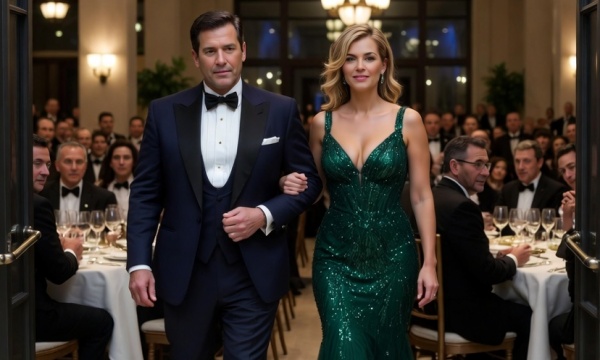
The gala was held at my parents’ country club—the same place where I’d attended cotillions and graduation parties, where I’d always felt like I was performing a role I’d never quite mastered.
James and I arrived in a town car. I wore a midnight blue gown that hugged every curve, my hair swept up, diamond earrings James had given me glinting in the light.
I felt like a different person. Because I was.
We walked into the ballroom, and I saw them immediately.
My mother, holding court near the silent auction table, wearing a gold gown and her signature pearls.
Victoria, stunning in red, her arm linked with—
Daniel.
Of course.
They were married now. I’d seen the announcement in the New York Times wedding section. Dr. Daniel Morrison and Victoria Hartwell, united in a ceremony at the Greenwich Congregational Church.
My mother saw me first.
Her eyes widened. Her mouth opened slightly. Then she recovered, that practiced smile sliding into place.
“Emma,” she said, crossing the room. “What a… surprise.”
“Hello, Mother,” I said evenly.
Her eyes flicked to James, assessing. “And you are?”
“James Chen,” he said, extending his hand. “It’s an honor to meet you, Mrs. Hartwell.”
My mother shook his hand, her smile polite but puzzled. The name hadn’t registered yet.
Then Victoria and Daniel approached.
“Emma?” Victoria’s voice was uncertain. “I didn’t know you were coming.”
“I wouldn’t miss it,” I said. “James is being honored tonight.”
“James…” My father had joined us now, and I saw the moment it clicked.
“Chen,” he said slowly. “James Chen. The biotech entrepreneur.”
“That’s right,” James said warmly.
My father’s expression transformed. “Mr. Chen, it’s a privilege. Your work with affordable insulin has been groundbreaking.”
“Thank you,” James said. Then he put his arm around my waist. “Though I have to say, my wife is doing equally important work. Emma’s been instrumental in expanding healthcare access in underserved communities.”
The silence that followed was deafening.
“Wife?” my mother whispered.
“Four years now,” I said, meeting her eyes. “You would have known if you’d bothered to call.”
Victoria’s face had gone pale. Daniel looked like he’d been punched.
“Emma,” my mother began, “I had no idea—”
“That I was substantial enough?” I finished. “That I was strong enough? That I was enough?”
“That’s not fair,” Victoria said, but her voice lacked conviction.
“You’re right,” I said. “It’s not fair. None of it was fair. But I’m not here for an apology. I’m here because my husband is being honored for changing lives. And I’m proud of him.”
I turned to James. “Shall we find our table?”
As we walked away, I heard my mother’s voice, shaky and small.
“Emma, wait—”
But I didn’t.
I’d waited long enough.
Part 7: The After
Later that night, after James’s speech (which brought the room to its feet), after the dinner and the dancing and the congratulations from people who’d once looked through me like I was glass, my mother found me on the terrace.
“Emma,” she said. “Please. Can we talk?”
I turned to face her. She looked older than I remembered. Smaller.
“What is there to say, Mom?”
“I was wrong,” she said, and her voice cracked. “I was so wrong about you. About everything.”
“Yes,” I said simply. “You were.”
“I thought I was helping. I thought Victoria and Daniel were better suited, and you’d be happier with someone more… more…”
“More what? More ordinary? Less ambitious?”
She flinched. “I underestimated you. And I’m sorry.”
I looked at this woman who’d raised me, who’d fed me and clothed me and sent me to good schools—and who’d never really seen me.
“I forgive you,” I said finally. “But I don’t need your approval anymore. I haven’t for a long time.”
“Can we…” She swallowed hard. “Can we try again? Can I be part of your life?”
I thought about it. Really thought about it.
“Maybe,” I said. “But on my terms. Not yours.”
She nodded, tears streaming down her face. “Whatever you need.”
I left her there and went back inside, where James was waiting with two glasses of champagne.
“You okay?” he asked.
“Yeah,” I said, taking the glass. “I really am.”
Through the window, I could see Victoria and Daniel dancing, their smiles tight, their eyes avoiding mine.
They’d gotten what they wanted. The perfect match. The substantial partnership.
And I’d gotten something better.
I’d gotten myself back.
EPILOGUE
Six months later, I received a birth announcement.
Victoria and Daniel had a baby girl.
I sent a gift—a silver rattle from Tiffany’s, engraved with the baby’s name.
No note. No phone call.
Just a gift, from one aunt to her niece.
Because some bridges can be rebuilt. And some can’t.
But either way, I was finally free.
