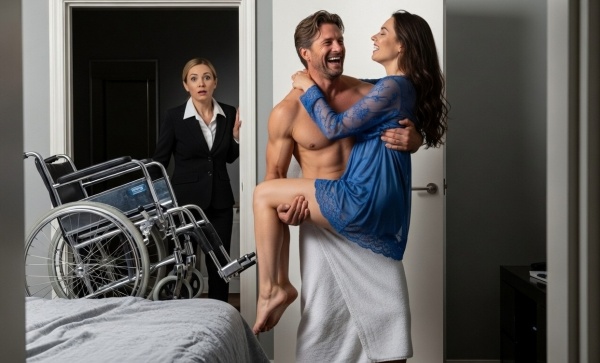
For 10 years, I was the caregiver for my paralyzed husband. I returned from a trip and found him standing upright… with my neighbor…
PART 1: THE SAINT OF SCRANTON
They call me “Saint Elena” around here. Even Mr. Henderson, the mailman who’s been delivering to our street for twenty years, tips his USPS cap and lowers his voice when he hands me the stack of medical bills and insurance claim denials. He treats me like I’m made of glass, as if speaking too loudly might shatter the fragile tragedy that is my life.
I’m 38 years old. But if you saw me under the harsh fluorescent lighting of the Giant Eagle grocery store at 6 AM—the only time I can shop because it’s the only time I can leave him—you’d swear I was pushing 50, maybe 55. My hands are calloused and rough as sandpaper from lifting dead weight. My back has a permanent ache that shoots down my left leg. I have dark circles under my eyes so deep that even the $40 Tarte concealer I splurged on once couldn’t touch them. I stopped trying.
For the last ten years, my entire existence has been contained within the 1,400 square feet of a modest ranch-style house on Maple Street in Scranton, Pennsylvania. The house smells like a hospital—antiseptic wipes, lavender Glade plugins fighting a losing battle, and underneath it all, the unmistakable scent of sickness and decay that no amount of Febreze can mask.
This is the shrine I built for Mark.
Ten years ago, Mark Donovan was a force of nature. He was a foreman at Callahan Construction, 6’2″, 220 pounds of pure muscle, with a laugh so loud it could fill a room and a smile that made me fall in love with him at a dive bar in Wilkes-Barre when I was 23. He was the guy who could lift a steel beam with one hand and crack a beer with the other. He was invincible.
Then came September 14th, 2016. The day that split my life into “before” and “after.”
A support beam fell at the job site. Three tons of steel. It caught him across the back and head. The EMTs said it was a miracle he survived the ambulance ride to Geisinger Medical Center. The neurosurgeon—a tired-looking man with kind eyes—used words like “catastrophic spinal cord injury,” “severe traumatic brain injury,” and “permanent vegetative state.”

They told me Mark would never walk again. Never talk again. Never recognize me, never feed himself, never understand where he was or who he was. He was, for all medical intents and purposes, gone. The body remained, but the man I loved had left the building.
Our friends—the ones who stuck around for the first six months—told me to put him in a state facility. “Elena, you’re 28 years old,” they said, their voices dripping with pity. “You have your whole life ahead of you. Don’t bury yourself alive with him. He wouldn’t want this for you.”
My mother was more blunt: “Honey, he’s gone. That’s not Mark anymore. It’s cruel to both of you to keep this up. Sign the papers. Let the state take care of him. Move on.”
But I couldn’t. When I stood at that altar in 2014 at St. Mary’s Church, I promised “in sickness and in health, till death do us part.” Mark wasn’t dead. His heart was beating. His lungs were breathing. And I’d be damned if I was going to dump him in some understaffed Medicaid facility in Carbondale where he’d be just another body in a bed, rotated every four hours by overworked CNAs who didn’t know his name.
So I brought him home.
My life became a military operation, executed with precision because any deviation meant infections, bedsores, pneumonia, or worse.
4:30 AM: Alarm goes off. Check his vitals—blood pressure, oxygen levels, temperature. Record everything in the log the home health nurse checks once a week.
5:00 AM: Change the bedsheets. He’s incontinent, so this happens multiple times a day. I’ve gotten very good at changing sheets with a 220-pound man still in the bed.
5:30 AM: Sponge bath. Lift each limb. Wash. Dry. Apply lotion to prevent skin breakdown. It takes 45 minutes.
6:30 AM: Breakfast. Blend oatmeal, banana, protein powder, and whole milk into a liquid sludge that can pass through his feeding tube. It looks like something you’d find in a blender at a frat house, but it keeps him alive.
Every 2 hours, around the clock: Reposition his body. Left side, right side, back, slight incline. If I don’t, he gets pressure ulcers—bedsores that can go down to the bone and kill him via sepsis. I set alarms. Even at night. I haven’t slept more than 90 minutes at a stretch in ten years.
To pay for all of this—the $5,000 adjustable hospital bed, the $800/month in medications that insurance won’t cover, the $1,200 mortgage, the utilities, the medical supplies from the surgical supply store—I work two remote data-entry jobs. I type medical billing codes and insurance claims for a hospital in Pittsburgh and a law firm in Harrisburg. I work from a folding chair next to Mark’s bed, listening to the rhythmic whoosh-hiss of his oxygen concentrator, typing until my fingers cramp and my wrists scream.
I make about $38,000 a year. After the mortgage, medical expenses, and utilities, I have about $300 a month for food and gas. I haven’t bought new clothes in four years. I cut my own hair in the bathroom mirror. I eat ramen and peanut butter sandwiches so Mark can have the high-protein Ensure the nutritionist recommended.
I was lonely. God, I was so desperately, crushingly lonely.
That’s where Brenda came in.
PART 2: THE ANGEL NEXT DOOR
Brenda Kowalski lived in the blue Cape Cod next door. She was in her late 40s, a widow—her husband died of a heart attack five years before Mark’s accident. She had no kids, just a fat orange tabby cat named Pumpkin and a garden that was the envy of the neighborhood.
Brenda was the definition of “good neighbor.” She brought over tuna casserole every Tuesday like clockwork. She’d sit with me on the front porch on Friday nights, handing me a glass of cheap Barefoot Moscato and letting me cry on her shoulder about how much I missed hearing Mark’s voice, how much I missed being touched, how much I missed feeling like a woman instead of a nurse.
“You are a saint, Elena,” Brenda would say, patting my hand with her soft, moisturized fingers. “Mark is so blessed to have you. Most women would have run for the hills. You’re one in a million.”
She became my lifeline. If I had to run to the CVS to pick up Mark’s prescriptions, or if I had a telehealth appointment with his neurologist, Brenda would come over to “watch” him.
“Go, honey,” she’d insist, shooing me out the door. “Take an hour for yourself. Get a coffee. Sit in the car and breathe. I’ll stay with Mark. I’ll read to him from the newspaper. He’s in good hands.”
I trusted her completely. She’d been there through the worst of it—the seizures, the pneumonia scares, the time Mark’s feeding tube got infected and I thought I was going to lose him. Brenda held my hand in the ER waiting room at 2 AM. She was family.
Last Monday, the call came from Richmond, Virginia. My mother’s voice was shaking on the other end.
“Elena, the probate lawyers finally closed your father’s estate. You need to be here in person for the final signing. It’s the house deed and the life insurance payout. They won’t release the funds without your signature, and it has to be notarized in person. Virginia law.”
My father had died two years ago—massive stroke, gone in minutes. He left behind a paid-off house in Richmond worth about $240,000 and a $100,000 life insurance policy. My mother and I were splitting it. That money was a lifeline. It meant I could pay off the mortgage, maybe even afford a part-time home health aide so I could sleep through the night for the first time in a decade.
But I panicked. “Mom, I can’t leave. Who’s going to take care of Mark? Who’s going to turn him? Who’s going to feed him? If I miss a rotation, he could get a pressure sore, and those can turn septic in 48 hours—”
“Elena.” My mother’s voice was firm. “This is legally required. You have to be here. It’s two days. Surely you can find someone.”
I hung up and sat at the kitchen table, my head in my hands. I was spiraling. I couldn’t leave him. I’d never left him overnight in ten years.
That’s when Brenda walked in through the back door—I’d given her a key years ago for emergencies.
“Honey, I heard you on the phone,” she said gently, pouring me a cup of coffee from the pot I’d made that morning. “You need to go to Virginia. This is your father’s legacy. You need that money for Mark’s care.”
“I can’t,” I whispered. “I can’t leave him.”
Brenda sat down across from me and took my hands. “Elena, listen to me. I’ll stay here. I’ll sleep on the couch. I’ve watched you do this routine a thousand times. I know the schedule. I know the medications. I know how to work the feeding tube. You’ve taught me. Let me do this for you. Go get what’s yours.”
I looked into her kind, sincere eyes and felt a wave of gratitude so strong it brought tears. “Brenda, I can’t ask you to—”
“You’re not asking. I’m offering. That’s what family does.”
I tried to write her a check for $200 for her time and trouble. She pushed it back across the table. “Don’t you dare insult me,” she said, mock-offended. “You’d do the same for me.”
I packed a small overnight bag—two days’ worth of clothes, my laptop, my phone charger. I wrote out the schedule in excruciating detail: medication times, feeding times, repositioning times. I left the neurologist’s emergency number on the fridge.
I walked into Mark’s room. He was lying in the hospital bed, staring blankly at the ceiling, his mouth slightly open, a thin line of drool on his chin. I wiped it away and kissed his forehead.
“I’ll be back in two days, baby,” I whispered. “Brenda’s going to take care of you. I love you.”
No response. There never was.
I got in my 2008 Honda Civic with 180,000 miles on it and started the five-hour drive south on I-81 toward Richmond. I felt a knot in my stomach—a mix of guilt for leaving him and a strange, fluttering sense of unease I couldn’t name.
I had no idea I was driving away from a lie and straight into a nightmare.
PART 3: THE EARLY RETURN
The probate meeting in Richmond took four hours. Sign here. Initial here. Notarize here. The lawyer, a bored-looking man in a wrinkled suit, droned on about tax implications and estate disbursements. My mother cried when they handed us the checks. I felt numb.
That night, I stayed at my mother’s house. I should have felt relief—$170,000 was life-changing money. But I couldn’t sleep. I kept checking my phone. Brenda had texted me twice:
Tuesday, 8:47 PM: “All good here! Mark ate well. Vitals stable. Don’t worry! Enjoy your time. ❤️”
Wednesday, 9:15 AM: “Another good night. He’s resting comfortably. Take your time!”
But something felt off. I couldn’t put my finger on it. It was like a splinter in my mind.
Wednesday afternoon, my mother and I were supposed to go to lunch, then I’d drive home Thursday morning. But I couldn’t shake the feeling. At 2 PM, I told my mother I had to go home early.
“Elena, you just got here,” she protested. “Stay one more night. Rest.”
“I can’t, Mom. I need to get back.”
I threw my bag in the car and started driving. I didn’t text Brenda. I don’t know why. Maybe some subconscious part of me already knew.
I pulled into my driveway at 7:23 PM on Wednesday night. The house lights were on. Brenda’s car was in my driveway. Everything looked normal.
I unlocked the front door quietly—I didn’t want to wake Mark if he was sleeping. The living room was empty. The TV was off. I walked down the hallway toward Mark’s room.
That’s when I heard it.
Laughter.
Not Brenda’s laughter. Mark’s laughter.
The sound I hadn’t heard in ten years. The sound the doctors told me I would never hear again.
My blood turned to ice.
PART 4: THE MIRACLE
I stood frozen in the hallway, my hand on the doorframe of Mark’s room. My brain couldn’t process what my ears were hearing.
That laugh. That deep, rumbling, unmistakable laugh that used to fill our house when we watched Seinfeld reruns on the couch.
I pushed the door open.
And there he was.
Mark. My husband. Standing upright. STANDING. Next to his hospital bed, wearing jeans and a flannel shirt I didn’t recognize. His hair was neatly combed. His face was shaved. He looked healthy. Strong. Alive.
And he was holding Brenda’s hand.
They were both laughing at something on her phone. Brenda was leaning into him, her head on his shoulder, the way I used to lean into him a lifetime ago.
I must have made a sound—a gasp, a choke, something—because they both turned to look at me.
Mark’s face went white. Brenda’s smile vanished.
“Elena,” Mark said. His voice. Oh God, his voice. “You’re home early.”
I couldn’t speak. I couldn’t breathe. My legs felt like they were going to give out. I grabbed the doorframe to keep from collapsing.
“What…” I finally managed to whisper. “What is this?”
Mark looked at Brenda. Brenda looked at the floor.
“Elena, I can explain,” Mark started, taking a step toward me.
“DON’T.” My voice came out as a scream. “Don’t you DARE take another step. You can WALK? You can TALK?”
Tears were streaming down my face. Ten years. Ten years of my life. Ten years of sponge baths and feeding tubes and setting alarms every two hours. Ten years of poverty and isolation and exhaustion so deep I sometimes wished I would just die in my sleep.
“How long?” I asked, my voice shaking. “How long have you been able to walk?”
Silence.
“HOW LONG?”
Mark’s jaw tightened. “Three years.”
The room spun. I thought I was going to vomit.
“Three years,” I repeated. “Three years. You’ve been faking this for three years?”
“Elena, it’s not what you think—”
“Then what IS it, Mark? WHAT IS IT?”
Brenda finally spoke, her voice small. “Elena, we didn’t mean for it to happen this way—”
“WE?” I turned to her, and the betrayal hit me like a physical blow. “You KNEW? You’ve been helping him?”
She didn’t answer. She didn’t have to. The guilt was written all over her face.
PART 5: THE TRUTH
I don’t remember sitting down, but suddenly I was on the floor in the hallway, my back against the wall, sobbing so hard I couldn’t catch my breath.
Mark knelt down in front of me—KNELT, with legs that worked, legs I’d been rotating and massaging and caring for like they were made of glass.
“Elena, please listen,” he said. “I woke up three years ago. It was gradual—first I could feel my toes, then I could move my fingers. The doctors said it was impossible, but it happened. It was a miracle.”
“A miracle,” I repeated flatly. “And you didn’t tell me.”
“I was going to,” he said quickly. “But then… I don’t know. I saw how you were living. How hard you were working. How much you’d sacrificed. And I felt so guilty, Elena. So much guilt. I didn’t know how to face you. I didn’t know how to tell you that I’d been awake, aware, listening to you cry yourself to sleep every night for years.”
“So you just… kept pretending?” My voice was hollow.
“At first, I was scared,” he admitted. “Scared of what it would mean. Scared of the expectations. Scared of… everything. And then Brenda started coming over more, and we started talking when you were at the store, and…”
“And you fell in love with her,” I finished.
He didn’t deny it.
Brenda spoke up from behind him. “Elena, I’m so sorry. I never meant to hurt you. You’re my best friend. But Mark and I… we connected. He understood my loneliness. I understood his fear. It just… happened.”
I looked at her—this woman I’d trusted with everything, this woman I’d called family—and I felt nothing but cold, burning rage.
“Get out of my house,” I said quietly.
“Elena—”
“GET OUT OF MY HOUSE!” I screamed it this time, my voice raw and broken.
Brenda grabbed her purse and ran. I heard the front door slam.
Mark was still kneeling in front of me, tears running down his face. “Elena, I’m so sorry. I know I don’t deserve your forgiveness. I know what I did was unforgivable. But please, let me explain everything. Let me make this right.”
I looked at him—this stranger with my husband’s face—and I laughed. It was a horrible, bitter sound.
“Make it right?” I said. “You stole ten years of my life, Mark. You let me destroy my body, my career, my health, my future—for a LIE. You let me wipe your ass and feed you through a tube and cry myself to sleep every night thinking I’d lost you—when you were RIGHT THERE. You were there the whole time, and you said NOTHING.”
“I know,” he whispered. “I know.”
“I gave up EVERYTHING for you,” I continued, my voice rising. “I have $847 in my bank account. I haven’t been on a date, haven’t been kissed, haven’t been touched in ten years. I’m 38 years old and I look 60. My back is destroyed. I have carpal tunnel in both hands. I can’t sleep without Ambien because my body is trained to wake up every two hours. I have NO FRIENDS because I couldn’t leave the house. I eat RAMEN so you could have your goddamn Ensure!”
I stood up, my whole body shaking.
“And you gave it all to HER. You gave your miracle to Brenda. The woman I trusted. My only friend.”
Mark reached for me. “Elena, please—”
I stepped back. “Don’t touch me. Don’t ever touch me again.”
PART 6: THE AFTERMATH
I called a lawyer the next morning. By Friday, I’d filed for divorce on the grounds of fraud and emotional abuse. Pennsylvania law was on my side—what Mark did constituted “indignities” that made my life “intolerable and burdensome.”
I also called the insurance company. Turns out, faking a disability to collect insurance payouts and disability benefits is a federal crime. Mark had been collecting $2,400/month in Social Security Disability for three years while fully capable of working. That’s fraud. The kind that comes with prison time.
I didn’t press charges. I’m not that cruel. But I made sure he knew I could.
The divorce was finalized in four months. I got the house, the life insurance money from my father, and a settlement that included every penny of the disability payments he’d fraudulently collected. Mark got nothing but a court order to stay 500 feet away from me.
Brenda moved to Ohio. I heard through the neighborhood grapevine that she and Mark tried to make it work, but the guilt ate them alive. They broke up six months later.
As for me? I sold the house. Too many ghosts. I moved to Portland, Oregon, where I didn’t know a single person. I started over.
I’m in therapy three times a week. I’m learning how to sleep through the night. I’m learning how to trust again, though that one’s harder.
I’m also learning how to be Elena again—not Saint Elena, not Caregiver Elena, just… Elena.
Some days are good. Some days I wake up and I’m so angry I can’t see straight. Some days I cry for the woman I used to be, the ten years I’ll never get back.
But I’m free. And that’s worth something.
EPILOGUE: THE QUESTION
People ask me if I regret it. If I regret staying, sacrificing, giving everything for a man who was lying to me.
The truth? I don’t know.
I did what I thought was right. I honored my vows. I loved him with everything I had.
The fact that he didn’t love me back the same way? That’s on him, not me.
I’m not a saint. I’m not a martyr. I’m just a woman who gave everything and lost everything and somehow, against all odds, is still standing.
So tell me—was I a fool for staying? Or was he the monster for lying?
Drop your thoughts in the comments. I need to know I’m not crazy.
