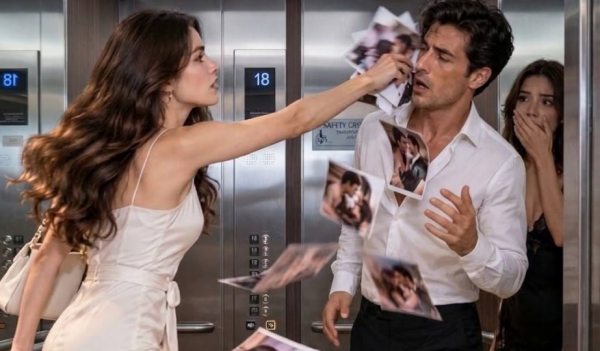
My husband was standing in a private hotel elevator, his tie loose, while a younger woman pressed her hand against his chest and captioned it like she had won. Everyone focused on his face, her nails, and my public humiliation. But when I zoomed in, I saw one tiny detail in the elevator reflection that turned her victory into the mistake that destroyed her.
PART I — THE PICTURE THAT HUMILIATED ME
My husband’s supposed mistress posted a photograph with her hand on his chest inside a private hotel elevator, and millions of people watched my marriage become a public humiliation.
By breakfast, my name was trending.
Not because I had done anything remarkable. Not because of my work, my volunteer projects, or the literacy foundation I had spent three years building from a rented desk in Nashville, Tennessee. I was trending because a twenty-six-year-old woman with a verified account, perfect hair, and a talent for making cruelty look glamorous had decided to turn my husband into content.
Her name was Sienna Vale.
That was not the name on her driver’s license, as I would learn later, but it was the name half the internet knew. Lifestyle creator. “Southern luxury girl.” Host of paid brand trips, boutique try-on hauls, hotel suite tours, and captions about “choosing herself” while standing beside rented sports cars she implied belonged to men who “treated her right.”
The photo appeared at 7:12 a.m. on a Tuesday.
I remember the exact time because I was pouring coffee into my favorite blue mug when my phone began vibrating across the kitchen counter like it was trying to escape. At first, I ignored it. My mornings were usually quiet before 8:00: coffee, toast, emails, then the short drive to my office near 12 South.
Then my sister called.
Then my best friend.
Then my assistant.
Then my mother, who only called before 8:00 if someone was in the hospital or God had personally contacted her with instructions.
I picked up when my sister called the second time.
“Claire,” she said, breathless. “Don’t open Instagram.”
That is the fastest way to make anyone open Instagram.
My name is Claire Bennett, and for eight years, I had been married to Evan Bennett, a commercial real estate attorney with a jawline people trusted and a résumé that made older men at charity dinners clap him on the back. Evan was forty-one, a partner at Hollis, Grant & Bennett, and the sort of person who could move through a room making everyone believe he had remembered them for a reason.
The photo showed him in a private hotel elevator at The Adair, one of those luxury boutique hotels downtown where the lobby smells like cedar, leather, and money trying not to shout.
He was wearing the charcoal suit I had picked up from the dry cleaner the day before.
His tie was loosened.
His eyes were turned slightly away from the camera.
And Sienna Vale stood pressed close to him, one hand spread across his chest, her nails glossy red against his white dress shirt.
The caption read:
When he says he’s in a meeting but the elevator knows better. Some women should check who they married.
Then a lipstick emoji.
Then a champagne emoji.
Then, as if she were performing mercy, no tag.
She did not need to tag him.
People found him in less than eleven minutes.
They found me in thirteen.
By 8:00 a.m., the photo had been reposted to gossip pages, local Nashville accounts, anonymous “wives of professionals” forums, and several national drama pages that treated human humiliation like a sporting event. By 9:30, someone had stitched it into a video with sad violin music and a caption that said, “Imagine building a life just for him to do this.”
By noon, millions of people had seen it.
Strangers were analyzing Evan’s face, Sienna’s hand, my old anniversary photos, our house, my clothes, my age, my hair, whether I looked “too serious,” whether he looked “trapped,” whether Sienna was “messy but iconic,” and whether I had “ignored the signs.”
The comments moved faster than truth.
He looks guilty.
She knew what she was doing.
Wife probably acts shocked but knew.
Men like this always cheat.
That girl is brave for posting.
Brave? She’s proud of being a side chick.
I need part two immediately.
Part two.
That was what my life had become to people brushing their teeth, waiting in Starbucks lines, sitting in school pickup, and avoiding spreadsheets at work.
Content.
I stood in my kitchen wearing a cream sweater and black pants, holding my phone while my coffee cooled beside me. Outside, the magnolia tree in our front yard was beginning to bloom. Inside, the house felt suddenly staged, like I was an actress standing in a set built to look like a marriage.
Evan had not come home the night before.
That fact mattered.
At 10:17 p.m., he texted:
Deal closing ran late. Staying downtown. Don’t wait up. Love you.
I had replied:
Okay. Good luck.
Not I love you too.
Not because I knew.
Because after eight years of marriage, affection sometimes becomes a habit you assume will still be there when you reach for it later.
At 7:26 a.m., after seeing the photo, I called him.
Straight to voicemail.
I called again.
Voicemail.
I texted:
Call me. Now.
Three dots appeared.
Disappeared.
Appeared again.
Then nothing.
That tiny digital hesitation hurt almost as much as the photo.
At 7:41, Evan called.
I let it ring twice because some small, foolish part of me needed him to experience waiting.
When I answered, he said my name like a man approaching a car wreck.
“Claire.”
“Is it real?”
Silence.
I closed my eyes.
“Evan. Is the photo real?”
“Yes.”
My hand tightened around the phone.
“Is the affair real?”
“No.”
That answer came too fast.
Too polished.
Too lawyerly.
I sat down at the kitchen island because my knees felt uncertain.
“She has her hand on your chest in a private elevator.”
“I know what it looks like.”
“That is not an answer.”
“It’s complicated.”
I almost laughed.
Complicated.
The word people use when simple truth would make them look exactly as bad as they are.
“Where are you?” I asked.
“At the office.”
“Already?”
“I came here early.”
“From the hotel?”
A pause.
“Yes.”
I looked at the photo again.
Sienna’s fingers spread over his shirt.
His face turned away.
The elevator walls behind them reflected soft gold light.
Luxury made betrayal photograph beautifully.
“What happened?” I asked.
“I can explain.”
“Then do that.”
He inhaled.
“I met her months ago at the Adair. She was working with a hospitality client. She started reaching out. It got inappropriate.”
“Inappropriate how?”
“Messages. Flirting. She wanted access. Events. Introductions.”
“Did you sleep with her?”
“No.”
“Did you kiss her?”
“No.”
“Did she touch you like that before?”
“Claire—”
“Did she?”
“Yes, but not because I wanted—”
I hung up.
Not because I believed him.
Because I did not trust myself not to scream, and screaming would give him the satisfaction of thinking my pain was bigger than my discipline.
My phone kept lighting up.
My assistant, Maya, texted:
Do you want me to cancel the foundation board call? Also I’m so sorry. Please don’t read comments.
My mother texted:
Your father and I are coming over.
My sister texted:
I will ruin her life if you say the word.
My friend Jules sent only:
Breathe. Lawyer before statement.
That was why Jules was my best friend.
She understood crisis management, not because she was dramatic, but because she worked in public relations for country music clients who regularly confused tour buses with confession booths.
I called her first.
She answered immediately.
“Tell me you haven’t posted anything.”
“I haven’t.”
“Good. Tell me you haven’t commented.”
“I haven’t.”
“Good. Tell me you haven’t called that woman.”
“I haven’t.”
“Excellent. You are already doing better than ninety percent of people.”
I looked at the photo again.
“She wanted me to see it.”
“Of course she did.”
“She wanted everyone to see it.”
“Also yes.”
“Why?”
“Because people who can’t win privately try to win publicly.”
That sentence would stay with me.
Jules told me to screenshot everything but not engage. She told me to preserve the original post, comments from Sienna, any messages, Evan’s texts, the hotel location, timestamps, and reposts from major accounts. She told me to call a family attorney even if I did not know whether I wanted a divorce.
“And Claire,” she added, voice gentler, “call your own lawyer before you believe your husband’s explanation.”
I said I would.
Then she asked, “Are you safe?”
The question startled me.
“Physically? Yes.”
“Emotionally?”
“No.”
“That counts too.”
After we hung up, I did something strange.
I zoomed in on the picture.
Not Evan’s face.
Not Sienna’s hand.
Not the empty space where his wedding ring should have been visible but wasn’t because his left hand was out of frame.
I zoomed in on the polished brass elevator panel behind them.
There was a reflection.
Distorted, faint, but there.
A small black shape near Sienna’s other hand.
At first, I thought it was her phone.
Then I looked closer.
It was not shaped like a phone.
It looked like a key card sleeve.
White, with a dark logo.
The photo was supposed to humiliate me.
Supposed to show the world my husband caught in another woman’s orbit.
Supposed to make Sienna look chosen and me look foolish.
But the most dangerous detail in that picture had nothing to do with Evan’s face.
It was the hotel key sleeve reflected in the elevator wall.
And the room number printed on it.
1708.
At 8:19 a.m., before I called my attorney, before I responded to my family, before I decided whether my marriage had ended, I saved the photo into a folder on my laptop titled:
Adair Evidence.
I did not know yet what it would prove.
I only knew that Sienna had made one mistake every careless person makes eventually.
She thought attention was the same thing as control.
PART II — THE STORY EVERYONE WANTED TO BELIEVE
By 10:00 a.m., the internet had written my biography without interviewing me.
I was either a cold social climber who drove my husband into younger arms, a clueless charity wife who ignored obvious signs, a tragic saint deserving casseroles, or a fool if I did not leave him by dinner. Strangers with usernames like truthhurts_615 and wineauntinvestigates spoke confidently about my marriage based on one elevator photo and three-year-old fundraiser pictures.
The public loves a betrayed wife until she behaves like a person instead of an archetype.
If she cries, she is weak.
If she stays quiet, she is complicit.
If she rages, she is unstable.
If she hires counsel, she is calculating.
If she waits for facts, she is delusional.
So I waited for facts.
My attorney, Monica Hayes, met me at noon in a conference room overlooking West End Avenue. She was a family law attorney with silver-blond hair, rimless glasses, and the moral temperature of a locked filing cabinet. I liked her instantly.
I had used her once before for a prenuptial agreement review before Evan and I married.
Yes, we had a prenup.
Evan’s family insisted.
His father, Robert Bennett, owned property across three states and believed marriage was sacred but asset protection was holier. At twenty-nine, I had found the process humiliating. Evan had held my hand under the table and whispered, “It’s just paperwork.”
Paperwork has a way of becoming prophecy.
Monica read the prenup now while I sat across from her trying not to stare at my phone.
“This agreement has an infidelity clause,” she said.
“I remember.”
“It is narrow but not useless. It requires evidence of physical adultery or financial support of a romantic partner from marital funds. Public embarrassment alone does not trigger it.”
“Good to know humiliation has no cash value.”
Her mouth twitched.
“Not directly.”
I showed her the photo.
She studied it without reaction.
Then I showed her the zoomed reflection.
Room 1708.
She looked up.
“You noticed that?”
“Yes.”
“Good.”
“Does it matter?”
“Potentially. If marital funds paid for the room, gifts, travel, or anything else tied to an affair or improper relationship, it may matter. If she obtained access under false pretenses or there is extortion, harassment, defamation, invasion of privacy, or business misconduct, it may matter in other ways.”
“Extortion?”
“Did your husband say she wanted access and introductions?”
“Yes.”
“Then we do not assume this is only romantic.”
That sentence opened a new door in my mind.
Not only romantic.
I had been so focused on the hand on Evan’s chest that I had not considered Sienna’s motive might be larger than desire.
Monica asked for Evan’s full explanation.
I gave her what little I had.
She asked whether I wanted to file for divorce.
“I don’t know.”
“Then we preserve options.”
She asked whether I wanted to make a public statement.
“No.”
“Good.”
That surprised me.
“Good?”
“Silence can be strategic if it is not passive. Today, everyone wants you emotional. Do not give strangers the first version of your story.”
She told me not to contact Sienna. Not to threaten. Not to post accusations. Not to release private information. Not to access Evan’s devices illegally, no matter what passwords I knew. Preserve shared financial records appropriately. Request information through counsel if needed.
“Claire,” she said, softer, “you are allowed to feel devastated. But do not let devastation drive the car.”
By the time I left, Evan had texted eleven times.
Please call me.
This is not what you think.
I swear I did not sleep with her.
She is dangerous.
That one stopped me.
Dangerous how?
He replied immediately.
Can we talk in person?
I wrote:
At Monica Hayes’s office. 3 p.m. Bring your attorney if you want.
Three dots.
Then:
Claire, please.
I did not respond.
At 2:47, Evan arrived alone.
He looked like he had aged five years since the photo went live. His suit jacket was wrinkled. His eyes were bloodshot. There was a faint red mark near his collarbone, not lipstick, something scratched.
I hated that I noticed.
I hated that part of me still wanted to ask if he had eaten.
Monica sat beside me. Evan sat across from us, hands clasped.
“This is not an affair,” he said.
Monica lifted one eyebrow.
“I advise precision, Mr. Bennett.”
He swallowed.
“I met Sienna Vale in September at a hospitality industry reception. She was there with a boutique hotel consultant. She introduced herself as an influencer helping luxury properties reach younger travelers. She was charming.”
I stared at him.
“How charming?”
“Claire.”
“Answer.”
He looked down.
“She flirted. I liked the attention. I should have shut it down.”
“Yes.”
He flinched.
“We messaged for a while.”
“How long is a while?”
“Two months.”
My stomach tightened.
“What kind of messages?”
“Inappropriate.”
“Sexual?”
“Some.”
There it was.
Not physical, maybe.
But betrayal does not need a hotel bed to become real.
I looked at Monica because I needed something steady.
She asked, “Did you meet her privately?”
“Yes.”
“How many times?”
“Four. Maybe five.”
I closed my eyes.
Evan rushed on.
“Lunches. Drinks. Once at a hotel bar. I never went to a room with her until last night.”
“Why last night?” Monica asked.
He hesitated.
“She said she had information about a client matter.”
Monica’s expression sharpened.
“What client?”
Evan looked at me.
“Claire, this involves confidentiality.”
I laughed once.
“Your confidentiality collapsed in an elevator.”
Monica said, “You can describe generally.”
Evan nodded.
“Our firm represents a development group negotiating financing for a mixed-use project near the riverfront. The Adair’s ownership group has indirect ties to some investors. Sienna claimed she had evidence that someone was using influencer contracts to route undisclosed payments tied to permitting influence.”
I blinked.
That was not what I expected.
“She said she needed legal help?” Monica asked.
“She said she needed protection. Then she said she would only show me the documents privately.”
“At a hotel room?”
“I know.”
“Do you?” I asked.
His face crumpled.
“I thought I could control it.”
That sentence told me more about Evan than any confession.
“She texted me the room number,” he continued. “1708. When I got there, she had champagne out. She was dressed for… not a business meeting. I told her I was leaving. She got angry. Then she grabbed me in the elevator and took the photo.”
I stared at him.
“You expect me to believe she staged the whole thing?”
“No. I expect you to believe I was stupid enough to walk into it.”
That was, unfortunately, more plausible.
Monica asked, “Did she demand anything before posting?”
Evan rubbed his forehead.
“She asked for $250,000 and introductions to two investors. She said if I refused, she would make it look like I’d been sleeping with her for months.”
My body went cold.
“Did you pay her?”
“No.”
“Did you tell anyone?” Monica asked.
“No.”
“Why not?”
“Because I didn’t want Claire to know I’d been messaging her.”
Silence settled over the room.
There it was.
The original sin was not the elevator.
It was the secrecy that made the trap possible.
I looked at my husband and felt both fury and exhaustion.
“You protected your image from me,” I said, “and handed it to her.”
He nodded.
Tears filled his eyes, but I did not let them move me.
Not yet.
Monica asked if he had preserved all communications.
He said yes.
She told him to send everything to his attorney and not delete a single message.
He said he had already contacted his firm’s ethics counsel.
Good.
Consequences had begun speaking professionally.
Before he left, Evan turned to me.
“I didn’t sleep with her.”
I held his gaze.
“That may become the least important thing you did wrong.”
He looked wounded.
Good.
People often expect relief when the betrayal is smaller than imagined. But smaller is not the same as harmless. A fire contained to one room can still burn the house unlivable.
After he left, Monica looked at me.
“You understand what we have?”
“A mess?”
“A potential extortion situation, possible professional exposure, possible misuse of hotel access, possible financial motives, and a marriage crisis.”
“Great. Only four disasters.”
“Five,” she said.
“What’s the fifth?”
She turned the laptop toward me.
A new post from Sienna.
A video this time.
She stood in a hotel bathroom mirror, smiling like the cat that ate someone else’s wedding vows.
“Some men tell the truth in private,” she said, “even if their wives can’t handle it in public.”
Then she winked.
The caption read:
Receipts coming.
My phone buzzed with another thousand strangers arriving to watch.
But now, for the first time that day, I was not only humiliated.
I was focused.
Because Sienna had made the first photo public.
She had revealed the room.
She had put herself inside the hotel, inside the timeline, inside the elevator.
And if she wanted to play with receipts, I was going to learn exactly what her receipt showed.
PART III — ROOM 1708
The Adair did not want to talk to me.
Hotels rarely want to discuss anything that sounds like scandal, liability, guest privacy, or viral content. The general manager, Patrick Lowell, called me at 4:30 p.m. with the voice of a man standing between lawyers and a bonfire.
“Mrs. Bennett, I want to express our concern regarding the online situation.”
“The online situation involves your private elevator.”
“Yes, and we are reviewing internally.”
“I need to know who booked room 1708.”
“I’m afraid we cannot disclose guest information without proper legal process.”
“I expected that.”
He sounded relieved.
I continued, “Please preserve all records related to room 1708, elevator access logs, security footage, key card data, guest communications, payment information, and staff interactions for the last seventy-two hours. My attorney will send a formal preservation letter.”
The relief left his voice.
“I understand.”
“Do you?”
“Yes, ma’am.”
Southern women know the power of a well-placed ma’am. It can mean respect, sympathy, warning, or a shovel hitting dirt.
That evening, I went to my sister’s house instead of home.
Nora lived in Franklin with her husband, two kids, three rescue dogs, and a refrigerator covered in school art and passive-aggressive orthodontist appointment reminders. When I arrived, she hugged me so tightly I could barely breathe.
“I didn’t make soup,” she said into my shoulder.
“Okay.”
“Because this is not a soup-level crisis. This is a tequila-level crisis, except you look like you need electrolytes.”
That was Nora.
My mother had already arrived and was in the kitchen aggressively slicing lemons.
My father sat at the table, quiet.
Dad had been a bankruptcy judge before retirement and had the rare ability to make silence feel like due process. He stood when I entered, kissed my forehead, and said, “Do you want advice or a chair?”
I started crying.
Not pretty crying.
Not silent, dignified tears.
The kind of crying that makes your face hot and your throat hurt.
My family did not ask questions for ten minutes.
That may have been the kindest thing anyone did that day.
Later, after I showered in Nora’s guest bathroom and changed into borrowed sweatpants, we sat at her kitchen table while the internet continued chewing on my life.
Nora wanted to post something violent but legally vague.
My mother wanted to call Evan’s mother and “speak woman to woman,” which meant spiritually assault her with politeness.
My father wanted facts.
“Do you believe him?” he asked.
“I believe he didn’t tell me the whole truth before today.”
“That is not the same question.”
“No.”
“Do you believe this woman is extorting him?”
“Maybe.”
“Do you believe he created the conditions that allowed it?”
“Yes.”
Dad nodded.
“Then separate the legal problem from the marital problem. They overlap, but they are not identical.”
That was why he had been a good judge.
He could put pain into categories without diminishing it.
At 9:18 p.m., Jules called.
“Turn on local news.”
I did.
A segment had picked up the story under the heading:
Nashville Attorney Caught in Viral Hotel Elevator Photo
They blurred Sienna’s photo but showed enough.
They mentioned Evan’s firm.
They mentioned me as founder of a children’s literacy nonprofit.
They mentioned no confirmed affair.
Then they showed Sienna’s public profile and referred to her as a “social media personality.”
Social media personality.
Such a clean phrase for someone lighting matches near other people’s lives.
The next morning, the first useful break came from someone named Tessa Marlow.
She emailed my foundation’s public inbox, which Maya forwarded to me with the subject line:
This seems important.
Tessa wrote:
Mrs. Bennett, you don’t know me, but I worked front desk at The Adair until last month. I saw the picture going around. Please check whether the woman used the name Sienna Vale or Vanessa Cole. She has stayed there before with men tied to business disputes. I’m sorry this is happening to you. She is not what she pretends to be.
I stared at the email.
Vanessa Cole.
Monica had a private investigator on retainer for complex divorce matters. His name was Ray Delgado, a former fraud investigator with a voice like gravel and the patience of a tax auditor. By noon, he had preliminary information.
Sienna Vale was born Vanessa Colton in Scottsdale, Arizona.
She had changed her public name for branding purposes.
No criminal convictions surfaced immediately, but there were civil disputes. Breach of contract. Nonpayment. A defamation threat settled confidentially. Several limited liability companies opened and dissolved. A pattern of relationships with men in finance, hospitality, and entertainment circles.
Not proof of extortion.
But smoke.
Then Evan’s attorney sent Monica copies of messages.
I read them in her office because I did not trust myself to read them alone.
At first, they were flirtatious.
That part hurt.
Evan had been charming.
Sienna had been playful.
He had complimented her insight, her ambition, her “ability to read a room.” She had sent selfies. He had responded with admiration he should have been giving his wife or no one at all.
Then the tone shifted.
Sienna asked for investor introductions.
Evan deflected.
She asked again.
He said it would be inappropriate.
She teased him about “acting married.”
He stopped responding for five days.
Then she sent:
You don’t get to make me feel special and then turn into a Boy Scout.
Later:
I know things about your riverfront deal. Don’t make me regret trusting you.
Then:
Room 1708. Bring your brain, counselor. This is bigger than flirting.
And finally, after midnight:
You have until Friday. $250K or I post what I have. Ask your wife how she feels about being a meme.
There it was.
Not clean.
Not innocent.
Not absolving Evan.
But real.
Monica printed the messages and placed them in a folder.
“This helps.”
“Does it help me feel less stupid?”
“No.”
“Then I’ll wait.”
By Friday, Sienna posted again.
This time it was a carousel of cropped screenshots.
Not the extortion text, of course.
Only flirtatious messages from Evan.
Enough to make him look guilty.
Enough to make me look ridiculous if I believed him.
Enough to keep the internet fed.
Her caption:
Men lie. Screenshots don’t.
That phrase became a hashtag within the hour.
But screenshots do lie.
Not always through fabrication.
Often through cropping.
Context is the first body buried in online scandal.
Evan’s firm released a brief statement:
We are aware of online allegations involving a partner of the firm. We take professional ethics seriously and are reviewing the matter. We have no further comment at this time.
The foundation board asked if I wanted to step back temporarily.
I said no.
Then I cried in my car for twelve minutes.
Humiliation is physical.
It lives in the skin.
In the stomach.
In the moment you walk into a grocery store and wonder whether the woman near the apples recognizes you from a gossip page.
Three days after the photo, The Adair received a subpoena connected to civil claims Evan’s firm was preparing and potential criminal complaints being reviewed. I was not handling the legal action directly. I was not trying to become the heroine of a courtroom drama. But Monica kept me informed where it affected my marriage, finances, and public exposure.
The hotel records showed room 1708 had not been booked by Evan.
It had been booked by V.C. Media LLC.
Payment was made with a business card under Vanessa Colton.
Key card records showed two keys issued.
One used frequently from 6:11 p.m. onward.
One used only once at 12:42 a.m.
Evan’s arrival.
Elevator access logs showed Evan entered the private elevator at 12:44 a.m. and exited at the lobby level at 12:47 a.m.
Three minutes.
The viral photograph was taken during those three minutes.
Three minutes had nearly convinced the world of an entire affair.
Three minutes had turned my marriage into a spectator sport.
Three minutes had made Sienna famous.
But those same three minutes were about to trap her.
Because in the original high-resolution hotel security footage, Sienna was not simply touching Evan’s chest.
Her other hand, the one reflected in the elevator wall, was holding the room key sleeve.
And tucked inside that sleeve was something else.
A black corporate card.
Not Evan’s.
Not hers.
A card connected to a political consulting firm tied to the riverfront development dispute.
When Ray Delgado called Monica with that detail, she looked at me and said, “The photo wasn’t the scandal.”
I already knew.
“It was bait,” I said.
Monica nodded.
“And she accidentally photographed the hook.”
PART IV — WHEN THE INTERNET CHANGED SIDES
Public opinion does not apologize.
It simply changes direction and pretends it was running that way all along.
The shift began with a business reporter at The Tennessean.
Her name was Alicia Porter, and unlike gossip accounts, she seemed allergic to easy conclusions. She had been covering the riverfront development deal for months and had already written about concerns over lobbying, undisclosed consultants, and online influence campaigns targeting city council members.
Alicia contacted Evan’s firm for comment.
Then she contacted The Adair.
Then she contacted Sienna.
Then she contacted Monica.
Monica did not give her private evidence, but she confirmed that legal counsel had issued preservation notices related to potential extortion, business interference, and misuse of digital content. She also said, carefully, that “the public narrative surrounding the viral photograph is incomplete.”
Incomplete.
A lawyer’s word with a blade inside.
Alicia’s article ran on Sunday morning:
Viral Hotel Photo Raises Questions Beyond Alleged Affair: Development Deal, Influencer Payments Under Review
The piece did not clear Evan.
It did not name Sienna as a criminal.
It did something more dangerous to her than accusation.
It asked documented questions.
Why was V.C. Media LLC retained by entities adjacent to the riverfront debate?
Why had Sienna met with multiple men connected to competing development interests?
Why did messages reviewed by counsel suggest demands for money and introductions?
Why had the viral photo been cropped?
Why did hotel records show Evan was in the elevator for approximately three minutes, rather than spending the night as widely implied?
The internet, which had spent days calling me pathetic, suddenly discovered nuance as if it had invented the concept.
Wait, she cropped the screenshots?
Three minutes??
Still wrong of him to text her but this is different.
She may have set him up.
The wife stayed quiet because she knew something. Queen behavior.
Queen behavior.
On Tuesday I was a fool.
On Sunday I was a queen.
Neither version knew me.
I sat at home for the first time since the photo, reading the article at the same kitchen island where my life had detonated.
Evan stood near the back door.
He had asked to come over.
I had agreed because we needed to discuss legal and practical matters, and because avoidance eventually becomes another kind of theater.
He looked at the article on my laptop.
“I’m sorry,” he said.
It was perhaps the twentieth time he had said it.
This time I answered differently.
“For what exactly?”
He sat across from me.
“For liking her attention. For messaging her. For not telling you when she started pushing for favors. For going to that hotel room. For making you face all of this publicly because I was too ashamed to be honest privately.”
Specific apologies hurt more.
They leave fewer places to hide.
I looked at him.
“Did you love her?”
“No.”
“Did you want her?”
He closed his eyes.
“Yes. For a while. Not enough to leave. Not enough to blow up our life. Enough to betray you in smaller ways I convinced myself didn’t count.”
I appreciated the honesty.
I hated needing it.
“Did you sleep with her?”
“No.”
“Can you prove that?”
“No. Not completely.”
That was the first answer that sounded true enough to keep.
I looked toward the window.
Outside, our neighbor’s son was learning to ride a bike, his father jogging beside him with one hand hovering behind the seat. Ordinary life continued with insulting confidence.
“Do you want to stay married?” I asked.
“Yes.”
“Why?”
“Because I love you.”
“That is not enough.”
He nodded.
“I know.”
“Do you?”
“I’m starting to.”
We agreed he would move temporarily into a furnished apartment downtown. Not because the internet demanded it. Because I needed quiet that did not include his remorse filling every room.
We agreed on therapy separately before any couples therapy.
We agreed full financial transparency.
We agreed he would not discuss me publicly.
We agreed I owed him no public defense.
That last one mattered.
Even if he was a target of Sienna’s scheme, he was not my child. I did not have to throw my body over his reputation to prove I understood complexity.
Meanwhile, Sienna began unraveling.
Her first mistake was doubling down.
She posted a video in a white robe, crying without tears, saying powerful men were trying to silence women. She implied I was using money and lawyers to attack her. She said she had “receipts that would ruin everyone.”
That may have worked if she had stopped there.
She did not.
She went live.
Never go live while angry and under legal scrutiny.
That should be stitched onto throw pillows in every influencer house in America.
On the livestream, Sienna contradicted herself several times. First she said Evan had invited her to the hotel. Then she said she invited him because he begged. Then she said the room was booked by “a friend.” Then she said she paid for it herself as “a boss move.” Then someone in the comments asked about V.C. Media LLC and she ended the live abruptly.
Screen recordings spread within minutes.
Alicia Porter published a follow-up.
Then another outlet found archived posts linking Sienna to a political consultant named Dane Mercer, whose firm had been retained by investors opposing Evan’s client’s riverfront project.
Then Ray Delgado found something else.
Three months before the elevator photo, Sienna had posted from a luxury cabin in Gatlinburg with a man whose face was cropped out. Internet sleuths tried to identify him for sport, which I found distasteful until Monica called with the actual relevance.
The man was a city staffer connected to early project review.
He had resigned quietly after an internal complaint.
Suddenly, the story was no longer wife humiliated by mistress.
It was influencer tied to possible influence operation around multimillion-dollar development fight.
Sienna lost three brand deals in forty-eight hours.
Not because brands became moral overnight.
Because risk departments move faster than ethics.
Her follower count rose at first, then stalled, then began dropping after former collaborators posted vague but damaging statements about unpaid invoices, manipulation, and “being used for proximity.”
Then came Tessa Marlow, the former Adair front desk employee.
She did not speak to gossip pages.
She gave a sworn statement through counsel.
According to Tessa, Sienna had repeatedly requested specific floors, private elevator access, and “accidental” encounters with men connected to business or political matters. Hotel staff had flagged unusual behavior, but high-spending guests and influencer partnerships made management reluctant to confront her aggressively.
The Adair issued a statement saying they were cooperating with legal requests and reviewing internal policies.
Translation: lawyers were now running the hotel.
Through all of this, I remained quiet publicly.
Not mysterious.
Not noble.
Quiet because I knew anything I said would become another object for strangers to twist.
Silence was not weakness.
It was containment.
But privately, I was not quiet.
I yelled in therapy.
I cried in my car.
I asked Evan questions that made him pale.
I met Monica twice a week.
I reviewed bank statements, phone records, legal letters, and reputational risk memos that made my marriage sound like a corporate acquisition gone badly wrong.
I also grieved.
That may sound strange when the public part became more favorable to me. People assumed once Sienna’s motives looked dirty, I would feel vindicated. I did, briefly. Then I still had to wake up in a house where my husband had lied to me for months.
Vindication does not hold you at night.
It does not rebuild trust.
It does not unsee messages.
One evening, Nora came over with Thai food.
We sat on the floor of my living room because sitting at the dining table felt too formal for despair.
“Do you want my honest opinion?” she asked.
“No.”
“Great. I’ll give it anyway.”
I smiled despite myself.
“I don’t think Evan had a full affair,” she said. “I think he had an ego affair.”
“What is that?”
“When a man doesn’t want to leave his wife but wants to feel like the version of himself who could. So he opens a door, stands in it, enjoys the breeze, and acts shocked when the house catches fire.”
I stared at her.
“That is annoyingly accurate.”
“I’m younger but wiser.”
“You are two years younger.”
“Still counts.”
She squeezed my hand.
“Whatever you decide, don’t decide because the internet changed its mind.”
That was the best advice anyone gave me.
Because the internet did change its mind.
Again.
After Alicia’s third article, people began apologizing in comments I never asked for.
We owe Claire an apology.
She knew to stay silent.
Her husband is still trash but Sienna is worse.
I hope Claire takes him for everything.
Actually maybe he was a victim too.
Everyone wanted a clean hierarchy.
Villain.
Victim.
Fool.
Queen.
Predator.
Prey.
But real life resisted sorting.
Sienna had targeted Evan.
Evan had entertained Sienna.
I had been publicly humiliated by both.
The hotel had ignored warnings.
Business rivals may have funded manipulation.
Strangers had monetized my pain.
No single truth erased the others.
Then, two weeks after the elevator photo, Sienna’s attorney sent a demand letter.
To Evan.
To his firm.
To The Adair.
And, strangely, to me.
She claimed defamation, harassment, emotional distress, and coordinated reputational harm. She demanded retractions and compensation. Monica read the letter, set it down, and said, “This is either desperation or performance.”
“What do we do?”
“We respond once. Firmly. With facts. Then we let her decide whether she wants discovery.”
Discovery.
The beautiful legal process by which people who enjoy vague accusations are invited to produce receipts under oath.
Sienna did not file.
Instead, she posted one final statement saying she was “stepping back for healing.”
The comments were not kind.
For the first time, I almost felt sorry for her.
Almost.
Then I remembered the caption.
Some women should check who they married.
She had meant to reduce me to a punchline.
She did not know I had checked.
Not just who I married.
Who he became.
Who he wanted to be seen as.
Who I became while helping him be seen that way.
And now I was checking everything.
PART V — THE DETAIL THAT CHANGED EVERYTHING
Three months after the photo, the legal chaos settled into separate lanes.
Evan’s firm survived, though Evan took a leave of absence and lost his leadership role on the riverfront client team. The project itself entered regulatory review after questions surfaced about outside influence campaigns. Dane Mercer’s consulting firm became the subject of investigations I followed only from a distance, because not every fire was mine to stand beside.
Sienna disappeared from social media for six weeks.
When she returned, her content had changed.
Less champagne.
More vague healing.
More quotes about resilience from women who had probably not intended them for someone who posted another woman’s husband in an elevator.
Her follower count never fully recovered.
But people like Sienna rarely vanish. They rebrand. America is generous to reinvention when the lighting is good.
As for my marriage, that was harder.
Harder than the legal letters.
Harder than the gossip.
Harder than watching people debate my dignity like it was a reality show finale.
Evan moved out for four months.
We spoke through therapists and attorneys at first, which sounds cold until you have experienced the mercy of structured communication. Structure kept us from using pain as a weapon every time we opened our mouths.
He gave me full access to financial records.
He provided his phone records voluntarily.
He wrote a timeline of every interaction with Sienna.
It was not pleasant reading.
But it was necessary.
The timeline showed he had crossed lines long before the hotel.
He had hidden messages.
He had accepted compliments.
He had complained about feeling “invisible at home,” which enraged me because I had been the one keeping our home, schedules, family obligations, and his public life functioning.
He had told Sienna she was “easy to talk to.”
That phrase hurt more than some of the flirtation.
Easy.
Of course she was easy.
She did not know his mother’s medications, his father’s estate complications, his client deadlines, his dental insurance password, the way he shut down when ashamed, or the exact tone he used when pretending not to be angry.
Fantasy is easy because it has no laundry.
In therapy, I told him that.
He cried.
I did not.
Not because I was stronger.
Because I had already cried enough alone.
Our therapist, Dr. Elaine Porter, asked Evan why he had not told me when Sienna began pressuring him.
He said, “I was afraid Claire would leave.”
Dr. Porter asked, “So you chose behavior that made leaving more likely?”
Evan stared at the floor.
“That sounds insane when you say it.”
“No,” I said. “It sounds entitled.”
He looked at me.
I continued, “You wanted to keep your secret and keep me. You wanted the thrill and the marriage. You wanted admiration from her and stability from me. You gambled with my dignity because you assumed I would never know.”
He nodded slowly.
“Yes.”
That yes mattered.
Not enough to fix everything.
But enough to stop the old argument from surviving.
We did not renew vows.
We did not post a photo about forgiveness.
We did not turn reconciliation into content because I had learned what happens when private life becomes an audience sport.
We stayed separated while deciding.
During those months, I learned the shape of my own life without managing his.
I ate cereal for dinner without feeling childish.
I watched terrible crime documentaries Nora recommended.
I went to foundation events alone and survived the sympathetic head tilts.
I slept diagonally across the bed.
I took a weekend trip to Asheville with Jules and did not check whether Evan had eaten.
I also missed him.
That annoyed me most.
Missing someone does not mean they deserve immediate return. It means memory has not caught up with injury. The body remembers Sunday pancakes, airport pickups, inside jokes, the song from your first dance, the way someone warms their side of the bed.
The heart is not a court of law.
It allows inadmissible evidence.
In the fifth month, Evan asked if we could have dinner at home.
I said yes.
He brought groceries, not flowers.
Good choice.
Flowers would have felt like a man trying to skip chapters.
We cooked pasta in near silence, bumping around the kitchen like people relearning choreography after an accident.
At dinner, he said, “I resigned from the club board.”
The private business club where he had met half his clients.
“Why?”
“Because I used places like that to feel important instead of honest.”
I looked at him carefully.
“That sounds like therapist language.”
“It is. But I mean it.”
He also told me he had referred out several clients with conflicts connected to the development matter. He was rebuilding his practice under stricter oversight. He had apologized formally to his partners. He had told his mother the truth before she could craft a prettier version.
That last part impressed me.
Evan’s mother, Diane Bennett, had reacted poorly.
Diane believed family problems should be handled privately, ideally by pretending they did not exist until Thanksgiving. Evan told her privacy had become the place his dishonesty grew best.
I wished I had seen that conversation.
By the end of dinner, nothing was solved.
But something had shifted.
Not forgiveness.
Not trust.
Maybe respect returning in work boots.
Six months after the elevator photo, I made my first and only public statement.
Not on Instagram.
Not in a tearful video.
At the annual gala for my literacy foundation.
I stood at a podium in a navy dress in front of two hundred donors, educators, community partners, and people who had definitely seen the photo no matter how politely they avoided mentioning it.
I was supposed to speak about childhood reading outcomes in Davidson County.
I did.
Then, near the end, I paused.
“This year,” I said, “I learned more than I wanted to about public narratives.”
The room went still.
I kept my voice steady.
“I learned that people will often accept the easiest version of a story if it lets them feel entertained, superior, or safely distant from pain. But our work here has always been about refusing easy stories. A child who struggles to read is not lazy. A family in crisis is not a headline. A person’s worst public moment is not the total of who they are.”
I saw Jules near the back, eyes shining.
“So tonight, I am grateful for everyone who chooses patience over performance, facts over frenzy, and dignity over spectacle.”
I did not mention Evan.
I did not mention Sienna.
I did not need to.
The applause came slowly, then fully.
For the first time since the photo, I felt the room return to me on my own terms.
After the gala, Evan waited near the exit.
We were not living together yet.
We were not wearing rings.
But he had come because I invited him, and because I wanted to know whether I could stand beside him in public without feeling like I had abandoned myself.
He looked at me and said, “You were incredible.”
I smiled faintly.
“I know.”
He laughed, softly.
That felt good.
Not romantic exactly.
Human.
We eventually chose not to divorce.
That will disappoint some people.
It disappointed parts of me too.
I wanted the clean empowerment ending: woman betrayed, woman leaves, woman buys white couch, woman glows. Sometimes that is the right ending. Sometimes leaving is survival. Sometimes staying is self-betrayal.
But sometimes staying, under entirely new terms, is neither weakness nor denial.
It is work.
And I made Evan understand one thing clearly: I was not staying because the affair had been “only emotional,” or because Sienna had been worse, or because public opinion turned in my favor. I was staying conditionally, consciously, and with legal protections updated.
Yes, we amended our postnuptial agreement.
Romance is lovely.
Accountability notarizes better.
The new agreement clarified financial misconduct, digital secrecy, reputational harm, and separation terms. Evan signed it without complaint. If he had complained, I would have known my answer.
Trust returned slowly.
Not like lightning.
Like physical therapy.
Uncomfortable repetitions.
Small range of motion.
Setbacks.
Progress that looks unimpressive until one day you realize you can stand without holding the rail.
A year after the photograph, I passed The Adair on my way to a meeting.
For months, I had avoided that block downtown.
That day, traffic forced me past the entrance.
The hotel looked exactly the same.
Valet stand.
Planters.
Brass doors.
People rolling luggage into lives I would never know.
I pulled over two blocks later and sat in my car.
Not crying.
Not shaking.
Just remembering.
The woman I had been that morning in the kitchen, staring at a photo designed to humiliate her. The way my phone buzzed with strangers arriving to consume my pain. The first zoom into the elevator reflection. The room number. The key sleeve. The detail Sienna did not see because she was too busy making sure Evan’s face was visible.
That detail had changed everything.
But not because it saved my marriage.
It saved me from believing the first story handed to me.
That was the real rescue.
The photo showed Sienna’s hand on my husband’s chest.
The internet saw sex, betrayal, victory, humiliation.
I saw those things too.
I am not pretending I floated above pain like some enlightened widow of dignity. I felt every bit of it. I felt the heat of shame, the acid of jealousy, the grief of realizing my husband had made himself available to someone else’s manipulation.
But then I looked again.
Closer.
Past the obvious.
Past the part meant to injure me.
And there, in the reflection, was the truth beginning to betray the lie.
That is what I tell myself now when life presents something humiliating as final evidence.
Look again.
Not to excuse.
Not to deny.
Not to make yourself smaller so someone else can remain comfortable.
Look again because the loudest part of a story is often not the most important part.
Sienna thought the photograph meant she had won.
She thought my marriage was a prize she could dent, display, and monetize.
She thought millions of views made her powerful.
But attention is not power when discovery begins.
A screenshot is not truth when context survives.
A caption is not a verdict.
And a wife who stays quiet is not always a wife who knows nothing.
Sometimes she is reading the room number in the reflection.
