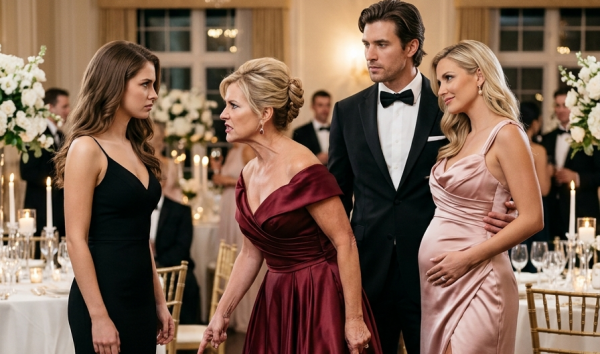
In front of three hundred guests at a Manhattan charity gala, my husband’s mother told me to kneel and apologize to the pregnant woman carrying his child. Julian stood beside her, backed the demand, and threw his wedding ring at my feet when I refused. He thought that moment stripped me of my marriage, my place, and my dignity. Then my phone buzzed with a message that revealed I still had power his family never expected me to know about.
PART I — THE DEMAND
My billionaire husband backed his mother’s demand that I kneel before his pregnant mistress in front of three hundred guests, then threw his wedding ring at my feet when I refused.
For one suspended second, the ballroom went so quiet I could hear the ice shift in someone’s glass.
Three hundred people stood beneath the crystal chandeliers of the St. Regis in New York City, dressed in black tie and diamonds, pretending they had not just witnessed the collapse of a marriage worth more money than most of them would ever see in their lifetime. Waiters froze near the champagne tower. A string quartet stopped halfway through a waltz. And I stood at the center of it all, staring down at the platinum wedding band that had landed near the hem of my silver gown.
My name is Evelyn Vale.
Until that night, most people knew me as Evelyn Vale-Astor, wife of Julian Astor, heir to the Astor Meridian Group, a private investment and luxury real estate empire valued somewhere above $9 billion, depending on which magazine was estimating.
Julian and I had been married for seven years.
Seven years of glossy photographs, charity galas, art auctions, ribbon cuttings, private jets, Hamptons weekends, Aspen Christmases, and magazine profiles calling us “New York’s most elegant young power couple.”
That phrase always amused me.
Power couple.
People assumed the power came from him.
His last name.
His family office.
His penthouse overlooking Central Park.
His mother’s social command.
His ability to make rooms shift when he entered.
I understood why they thought that.
Julian was beautiful in the way expensive men are often beautiful: tall, controlled, dressed by someone who knew exactly how to make wealth appear effortless. He had dark hair, gray eyes, and a voice that rarely rose because he had never needed volume to be obeyed.
His mother, Margot Astor, had raised him to believe obedience was the natural response to his presence.
Margot was seventy-one, though she would have described that number as a clerical error. She wore couture like armor and pearls like punctuation. She had spent five decades turning money into influence and influence into social fear.
If Julian owned the Astor empire on paper, Margot owned its rituals.
Who was invited.
Who was seated.
Who was welcomed.
Who was erased.
And for seven years, she tolerated me because I made Julian look stable.
Not because she liked me.
I was not born into their world. My father was a high school principal in Pittsburgh, and my mother ran the school library. I went to Carnegie Mellon on scholarship, worked in nonprofit development, and met Julian at a fundraiser for children’s hospitals where I had been managing donor relations.
He was thirty-four then, newly in charge of several Astor philanthropic initiatives after a family scandal had forced his uncle into early retirement. I was twenty-nine, wearing a borrowed black dress and carrying a clipboard.
He asked me why I looked annoyed.
I told him because a billionaire had just pledged $2 million from a stage but refused to fund the pediatric mental health wing unless his name was larger on the donor wall.
Julian laughed.
Then he funded the wing anonymously.
That was how he won me.
Not with diamonds.
Not at first.
With a gesture that suggested he saw the same ugliness I did and had chosen, at least in that moment, to stand on the better side of it.
I mistook that moment for character.
It took me seven years to understand that even selfish men sometimes enjoy feeling noble.
The night everything broke was supposed to be a celebration.
The Astor Meridian Winter Benefit was one of the biggest private charity events in Manhattan, raising money for women’s health programs, maternal care access, and family shelter initiatives across the Northeast. The irony would become unbearable later.
Three hundred guests had been invited: investors, board members, socialites, politicians, philanthropists, two former governors, a Broadway producer, several tech founders, and half the people who had ever pretended to care about maternal health while negotiating tax advantages over dessert.
The ballroom was white roses, silver linens, candlelight, and quiet money.
I had planned much of it.
Of course I had.
For years, I had handled the human side of Julian’s empire. I remembered birthdays, smoothed donor tensions, wrote thank-you notes, learned spouses’ names, sent flowers after surgeries, and made powerful people feel personally seen. Julian closed deals in boardrooms. I protected the rooms he entered.
But that evening, I noticed immediately that something was wrong.
People looked at me and then away.
Not everyone.
Just enough.
A whisper near the bar.
A quick silence when I passed.
Margot standing near the stage with an expression of cold satisfaction.
And beside her, glowing under chandelier light, was Serena Bell.
Serena was twenty-six, blond, delicate, and visibly pregnant in a champagne-colored gown that clung softly to her belly. She worked—or had worked—as a communications consultant for one of Julian’s newer philanthropic ventures. I had met her twice. Both times, she had smiled too long at my husband and spoken to me with the sweet confidence of a woman who believed she was already being chosen.
I had asked Julian about her six months earlier.
He said I was being paranoid.
Three months earlier, I found a hotel charge in Miami during a week he claimed to be in Dallas.
He said his assistant had booked incorrectly.
One month earlier, Margot stopped inviting me to family strategy dinners.
She said I seemed tired.
Two weeks earlier, Julian began sleeping in the guest suite.
He said he needed space to think.
I knew.
Women usually know before we have proof.
But knowing and being publicly handed the truth are different injuries.
At 8:40 p.m., Margot tapped her champagne flute with a silver knife.
The room turned toward the stage.
I stood near the front because I was expected to. Julian stood to my right. Serena stood to Margot’s left, one hand resting on her belly like a portrait of innocence.
Margot smiled at the crowd.
“Ladies and gentlemen, thank you for joining us tonight in support of women, mothers, and families who need compassion, dignity, and care.”
I almost laughed.
Compassion.
Dignity.
Care.
Margot continued speaking about legacy, future generations, and the Astor family’s commitment to nurturing life. Then her voice softened dramatically, and the air in the room changed.
“Tonight is also personal for our family.”
My stomach dropped.
Julian did not look at me.
Margot reached for Serena’s hand.
“We are blessed to welcome a new life into the Astor family.”
A murmur moved through the ballroom.
Serena lowered her eyes.
Perfectly timed.
Perfectly rehearsed.
Margot looked directly at me then.
“Sometimes the path to family requires humility, grace, and acceptance from all involved.”
I felt my fingers go numb around my clutch.
Julian finally turned his head slightly.
Not toward me.
Toward the floor.
Margot extended her hand.
“Evelyn, come here.”
It was not a request.
It was a command, wrapped in pearls.
I did not move.
Every camera in the room seemed to rise half an inch.
No one wanted to be seen recording.
Everyone wanted the recording.
Margot’s smile hardened.
“Evelyn.”
Julian whispered, “Just do it.”
I turned to him slowly.
“What?”
His jaw tightened.
“Don’t make this worse.”
Before I could respond, Margot stepped down from the stage, bringing Serena with her. Guests parted automatically. Money knows when spectacle is approaching.
Margot stopped in front of me.
Serena stood behind her, one hand on her stomach, face arranged into fragile discomfort.
Then Margot said the sentence that turned my marriage into ash.
“Evelyn, kneel and ask Serena to forgive you for standing in the way of Julian’s child.”
The ballroom inhaled.
I stared at Margot.
Then at Serena.
Then at Julian.
For a moment, I thought perhaps grief had arrived early, because I felt strangely outside my body. I saw my own hand, steady at my side. I saw Julian’s ring on his finger. I saw Serena’s small smile disappear when she realized I was not collapsing.
“Kneel,” Margot repeated.
Julian did not stop her.
That was the part that mattered.
He had hurt me privately in a hundred smaller ways, but this was different. This was public. Ritualistic. A deliberate stripping.
They did not simply want me to accept the affair.
They wanted me to bless it.
To lower myself in front of the woman carrying my husband’s child, in front of donors and board members and socialites, so the Astor family could convert betrayal into ceremony.
I looked at Julian.
“Is that what you want?”
His eyes met mine, and for one second I saw shame.
Then he chose the family script.
“You cannot give me children, Evelyn.”
The room went colder.
I had suffered two miscarriages during our marriage.
One at nine weeks.
One at fourteen.
Both had nearly broken me. Julian had cried after the first and disappeared emotionally after the second. Margot sent white flowers and a card that said, God’s plan is rarely sentimental.
After that, she began saying things like “legacy” and “succession” more often.
I had never told the public about the losses.
Now Julian had turned my private grief into a weapon.
I felt something inside me become very still.
“No,” I said.
Margot blinked.
“No?” she repeated.
“No, I will not kneel.”
Serena’s eyes filled with tears.
I wondered if she practiced them.
Julian stepped closer.
“Evelyn, this is over. Don’t humiliate yourself.”
I looked around the ballroom.
At the faces watching.
At the phones half-hidden behind champagne flutes.
At the women who looked furious but afraid to move.
At the men pretending this was unfortunate but private.
Then I looked back at my husband.
“You brought your pregnant mistress to a women’s health benefit and asked your wife to kneel before her,” I said. “I am not the one humiliating myself.”
A sound rippled through the room.
Margot’s face went white with rage.
Julian removed his wedding ring.
Slowly.
Deliberately.
Like a performance.
Then he threw it at my feet.
It struck the marble floor once, bounced, and rolled toward the hem of my gown.
“There,” he said. “You wanted dignity? Keep it. You have nothing else here.”
Three hundred people heard him.
That was what he believed.
That I had nothing else.
No children.
No Astor blood.
No claim to his empire.
No place in his world once he withdrew permission.
I looked down at the ring.
Then my phone vibrated in my clutch.
Once.
Twice.
A message appeared on the lock screen from a number I did not recognize.
Do not leave yet. Your name is on more than you know. —M.R.
I stared at it.
My hands remained steady.
For the first time that night, Julian looked uncertain.
“What is it?” he asked.
I lifted my eyes from the phone.
And suddenly, for reasons I did not yet understand, I wondered who in that ballroom truly held the power.
PART II — THE WOMAN THEY THOUGHT I WAS
To understand why Julian believed he could destroy me publicly, you must understand the woman he thought he had married.
He thought I was grateful.
That was the foundation of everything.
Grateful to be chosen.
Grateful to live in the penthouse.
Grateful to wear borrowed jewels from the family vault.
Grateful to sit beside governors and CEOs.
Grateful to be photographed beside him at Davos, Sun Valley, and charity galas where my job was to appear elegant, supportive, and pleasantly silent when finance became the dominant language.
For the first two years, I was grateful.
Not for the money exactly.
For the access money gave to impact.
I watched Julian write checks that changed clinics, shelters, scholarship programs, and research centers. I watched doors open because his last name was printed on an invitation. I believed I could help steer some of that wealth toward people who actually needed it.
And sometimes I did.
The maternal care fund that became the focus of that winter benefit began as my idea.
I had visited a community clinic in Queens and listened to a nurse practitioner describe women skipping postpartum appointments because they could not afford childcare or transportation. I came home furious and wrote a fifteen-page proposal while Julian slept.
The Astor Meridian Maternal Access Initiative eventually committed $25 million over five years to community-based maternal health care, doulas, mental health support, and emergency housing for pregnant women and new mothers.
Julian signed the pledge.
I wrote the framework.
Margot took the photo.
That was how things worked.
I did labor.
Julian received credit.
Margot guarded the family mythology.
For a long time, I accepted that arrangement because the work mattered more than applause. I told myself humility was noble. I told myself I did not need public recognition as long as programs were funded.
My father disagreed.
Dad still lived in Pittsburgh and still called me “Evie” even after Vogue printed my married name. He watched Julian’s interviews with the wary expression of a man who had spent thirty years around teenagers trying to talk their way out of consequences.
“You’re in every sentence he says,” Dad told me once, “but never in the byline.”
I laughed.
“Dad, it’s not journalism.”
“It’s ownership.”
My mother was gentler but no less perceptive.
“Does he thank you when no one is watching?” she asked.
I said yes.
At the time, it was mostly true.
Julian did thank me in private during the early years. He would come home after a successful event, loosen his tie, pour two glasses of wine, and say, “I couldn’t do this without you.” Then he would kiss my forehead and pull me close by the kitchen island, and I would believe partnership did not require public credit.
But wealth has gravity.
It bends relationships toward itself.
The longer I lived inside the Astor world, the more I realized that love there was conditional on usefulness. Margot valued people by function. A spouse was not a companion; a spouse was an asset. A child was not a child; a child was continuity. A scandal was not a wound; a scandal was a management problem.
After my first miscarriage, Margot visited me in the hospital.
Julian had gone downstairs to take a call. I was pale, medicated, and devastated. Margot placed one gloved hand on my blanket and said, “These things happen more often than people discuss. The important thing is not to dramatize it.”
Not to dramatize it.
As if grief were a social faux pas.
After the second loss, Julian changed.
At first, I thought it was grief. He stopped talking about baby names. He avoided the nursery we had foolishly started planning. He went to London for ten days and came back with a new watch.
Then I learned that grief had not made him quiet.
Resentment had.
“You know what my mother said?” he asked one night after too much Scotch.
I was folding laundry in the bedroom because ordinary chores can feel like defiance in a home full of staff.
“What?”
“She said Astor men always find a way to continue the line.”
I stopped folding.
“And what did you say?”
He looked at the glass in his hand.
“Nothing.”
Nothing.
That was the answer that defined him.
Julian rarely said the cruelest thing first.
He let Margot say it.
Then he obeyed.
Serena entered our life under the respectable cover of work.
She was bright, ambitious, and socially fluent. She knew when to flatter Margot, when to praise Julian’s vision, and when to ask me questions that sounded friendly while searching for weakness.
“How do you manage all the travel?” she asked me once at a donor breakfast.
“With lists,” I said.
She smiled.
“I’d be terrified of losing myself in someone else’s world.”
I looked at her.
“You learn which parts of yourself not to bring.”
She laughed, thinking I had made a joke.
I had not.
By the time I suspected the affair, I had already begun separating emotionally from Julian in ways he did not notice because they did not inconvenience him.
I opened my own checking account again.
I restarted contact with old colleagues in nonprofit leadership.
I met quietly with an attorney after the Miami hotel charge, not to file for divorce, but to understand my position. Her name was Nora Feldman, and her office overlooked Bryant Park. She wore reading glasses on a chain and had the calm, unromantic patience of someone who had seen powerful men panic behind mahogany doors.
“Did you sign a prenuptial agreement?” she asked.
“Yes.”
“Do you have a copy?”
I did.
The prenup was thick, cold, and written by attorneys who assumed my chief risk was greed. It limited spousal support, protected Astor family assets, and defined certain marital benefits. At the time I signed it, Julian told me it was “standard.” I had my own counsel review it, but I was in love and eager to prove I was not marrying for money.
Nora read it for fifteen minutes in silence.
Then she said, “This is restrictive, but not the whole story.”
“What does that mean?”
“It means wealthy families often overestimate documents and underestimate conduct.”
I did not understand fully then.
She explained that marital property, separate property, trusts, business interests, employment arrangements, board roles, charitable foundations, intellectual contributions, and public representations could complicate things. She asked whether I held any official positions in Astor-affiliated nonprofits.
“Yes,” I said. “Several advisory boards.”
“Paid?”
“No.”
“Formal appointment letters?”
“I think so.”
“Find them.”
So I did.
Quietly.
In the months before the gala, I began gathering my own life.
Copies of documents.
Emails.
Event plans.
Grant agreements.
Foundation records.
Medical records.
The prenup.
Tax filings.
Bank statements.
Not because I planned a dramatic confrontation.
Because a woman who has been called paranoid learns to preserve reality.
Still, I was not prepared for Serena’s pregnancy.
I found out three days before the gala.
Not from Julian.
From a florist.
The centerpieces had been changed without my approval. White roses replaced with white orchids, Margot’s preference. When I called the planner, she hesitated.
“Mrs. Astor approved it.”
“I am Mrs. Astor.”
Silence.
Then softly, “Mrs. Margot Astor.”
That afternoon, I went to the Astor Meridian office unannounced.
Julian’s assistant looked startled.
“He’s in a meeting.”
“I’ll wait.”
I did not wait.
I walked past her and opened the conference room door.
Julian was inside with Margot, Serena, and two attorneys I recognized from the family office.
On the table was a document titled:
Public Transition and Family Continuity Strategy
Serena’s hand was on her belly.
Julian stood when he saw me.
“Evelyn.”
Margot did not.
She looked almost pleased.
That was how I learned Serena was pregnant.
No one admitted the affair directly.
They spoke in polished evasions.
A private matter.
A complicated emotional situation.
A child deserving recognition.
A family future.
I asked Julian one question.
“Is the baby yours?”
He looked at Serena.
Then at Margot.
Then finally at me.
“Yes.”
There are moments when pain is too large to feel immediately. It arrives as weather behind glass. You can see the storm, but sound has not reached you yet.
I nodded once.
Then I turned and left.
Julian followed me into the hallway.
“Evelyn, wait.”
I stopped by the elevator.
“How far along is she?”
He looked miserable.
“Twenty-two weeks.”
Twenty-two.
Nearly six months.
While I was planning a women’s health benefit.
While I was attending appointments to investigate whether my own losses were due to clotting issues.
While I was sleeping beside him.
“You lied to me for six months.”
“I didn’t know how to tell you.”
“That has never stopped anyone from telling the truth.”
He looked annoyed then.
Not guilty.
Annoyed that I was still articulate.
“My mother wants this handled gracefully.”
I stared at him.
“Your mother.”
“She thinks if we present it properly—”
“We?”
“The family.”
I laughed once.
It sounded like breaking glass.
“I am your wife.”
His face softened briefly.
“I know.”
“No, Julian. You know I am the obstacle.”
He did not deny it.
That was when I should have left.
I know that now.
But leaving a billionaire marriage is not like walking out of a bad dinner. There are homes, staff, security, attorneys, public narratives, charitable boards, donor relationships, accounts, contracts, insurance, and the quiet fear that everyone will believe the person with more money.
So I attended the gala.
Because I needed time.
Because Nora told me not to disappear without a plan.
Because I thought Julian might, at minimum, avoid cruelty in public.
That was my mistake.
I underestimated Margot’s appetite for ritual humiliation.
And I overestimated my husband’s spine.
PART III — THE MESSAGE
After Julian threw his ring at my feet, no one moved.
The ballroom had become a courtroom without a judge.
Margot stood with her chin lifted, waiting for me to break. Serena’s eyes remained wet, but her mouth was tense. Julian watched me with the dangerous impatience of a man whose performance had not produced the expected ending.
I bent slowly.
A murmur moved through the room.
For one terrible second, people thought I was going to kneel.
I was not.
I picked up Julian’s ring between two fingers and placed it on the nearest cocktail table beside an untouched glass of champagne.
Then I looked at Margot.
“I believe that belongs to your family.”
Her face sharpened.
I turned and walked toward the side exit.
Not running.
Not crying.
Walking.
Every step felt like crossing a border.
Julian followed before I reached the hallway.
“Evelyn.”
I kept walking.
Security staff near the doors looked uncertain. They worked for the hotel, not the Astors, which mattered. Hotel staff in New York know how to recognize wealthy chaos and remain professionally invisible until liability appears.
Julian caught my arm.
I stopped and looked at his hand.
“Let go.”
He released me quickly, glancing around to see who had noticed.
Always optics.
“Where are you going?”
“To breathe.”
“We need to manage this.”
“There is no ‘we.’”
His jaw tightened.
“You cannot just walk away.”
“I can. Watch.”
My phone vibrated again.
The unknown number.
Use the service corridor by the east kitchen. Black Escalade waiting on 55th. Ask for Martin. Do not go back upstairs.
My heart pounded.
I should have been frightened.
Instead, I felt an odd clarity.
I typed:
Who is this?
The reply came within seconds.
Michael Rowe. Your father-in-law’s former counsel. Your name is on the Meridian Foundation control documents. Margot does not want you to know.
I stared at the screen.
Julian saw my face.
“What is happening?”
I looked up.
“Who is Michael Rowe?”
The color left his face.
That was answer enough.
“Evelyn—”
“Who is he?”
Julian lowered his voice.
“Not here.”
I almost smiled.
The family motto.
Not here.
Not now.
Not in front of people.
Not while witnesses exist.
I stepped backward.
“You said I had nothing here.”
He looked toward the ballroom doors.
“Please. We need to talk privately.”
“No.”
“Evelyn, that man is bitter. He was fired years ago.”
“For what?”
Julian hesitated.
“For disloyalty.”
That was how the Astors described anyone who told the truth at an inconvenient time.
Margot appeared behind Julian, moving faster than her age and heels should have allowed.
“Evelyn,” she said. “Give me your phone.”
I laughed.
Not loudly.
Just enough.
“No.”
Her eyes flashed.
“You are emotional and vulnerable. You do not understand what is happening.”
“I understand more every minute.”
She reached for my wrist.
I moved away.
A hotel manager stepped subtly into the corridor.
“Is everything all right, Mrs. Astor?”
Margot answered first.
“Family matter.”
I looked at him.
“I’m leaving. Please have someone direct me to the east service corridor.”
His eyes flicked from me to Julian to Margot.
Professional calculation.
Then he nodded.
“Of course.”
That was the first public institution that night not owned by the Astors.
A hallway.
A manager.
A door.
Sometimes freedom begins very small.
I followed a staff member past the kitchen, through a corridor smelling of lemon cleaner, roasted vegetables, and hot bread. My silver gown brushed against stainless steel carts. A dishwasher looked up, saw my face, and immediately looked away with the kindness of strangers who know not to ask.
Behind me, Julian called my name once.
The staff member did not stop.
On 55th Street, cold January air hit my skin like truth.
A black Escalade waited near the curb.
A gray-haired driver stood beside it.
“Mrs. Vale?” he asked.
Not Astor.
Vale.
My maiden name.
“Yes.”
“Martin. Mr. Rowe asked me to bring you.”
“Where?”
“To a law office on Madison. Public building. Cameras. Safe.”
That was the right answer.
I got in.
As the car pulled away, I looked back at the St. Regis entrance. Through the revolving doors, I saw Julian standing under the awning, phone to his ear, Margot beside him, furious and still perfectly dressed.
For the first time in seven years, I was outside the scene before they finished staging it.
Michael Rowe’s office was on the twenty-third floor of a building that smelled like polished stone and old money trying to seem modest. He was in his late sixties, lean, with white hair, tortoiseshell glasses, and the exhausted kindness of a man who had spent too long reading documents powerful families hoped no one would understand.
He did not offer sympathy first.
He offered water.
Then tissues.
Then a chair near the window, away from the door.
“I apologize for the dramatic timing,” he said. “But I believed tonight’s event might become a point of no return.”
“That’s one way to describe it.”
“I saw a livestream clip.”
Of course.
Someone had posted it already.
My humiliation had entered the internet before I had left the block.
I closed my eyes.
Michael’s voice remained calm.
“Before we discuss anything, I need to clarify that I am not currently your attorney. I previously represented certain Astor entities and briefly advised your late father-in-law, Richard Astor, before his death. I can provide information and referrals, but you need independent counsel.”
“I have an attorney.”
“Nora Feldman?”
My eyes opened.
“How do you know that?”
“I hoped you were seeing her. She requested several public foundation filings last month.”
Nora had not told me that.
Good.
Michael slid a folder across the table.
“Your husband and mother-in-law believe the Astor empire is controlled entirely through family bloodlines. That is mostly true for the private holdings. It is not true for the philanthropic foundation.”
“I’m on advisory boards.”
“You are more than that.”
I stared at him.
He opened the folder.
Seven years earlier, shortly after our marriage, Richard Astor—Julian’s father—had restructured several philanthropic entities after a tax controversy and internal dispute. Richard was not warm, but he had respected competence. He died of a stroke three years into my marriage, leaving Margot more powerful socially but not absolute legally.
Michael pointed to a document.
“Richard appointed you as a Class B director with protective consent rights over certain foundation activities connected to maternal health, community clinics, and donor-restricted funds. The language was unusual. It gave you veto authority over reallocation, termination, or reputational use of those programs.”
I shook my head.
“No. I would remember signing that.”
“You signed a board consent package at the Hamptons house in 2020. Julian presented it as routine annual governance.”
I remembered.
A stack of documents.
A summer lunch.
Julian saying, “Just formalities for the foundation. You’re better at this than I am anyway.”
I had signed where tabs indicated, after skimming more than reading.
A mistake.
Or maybe a blessing.
Michael continued.
“Richard also created a separate charitable remainder structure tied to your maternal health initiative. If Julian attempts to remove you publicly while using the program for family image repair, your consent is required for certain continued branding and donor access.”
“Why would Richard do that?”
Michael looked toward the window.
“Because he did not trust Margot with mission-driven philanthropy. And because he watched you work.”
That sentence hit harder than I expected.
Someone had seen.
Not the magazine version.
The labor.
The calls.
The clinic visits.
The grant reports.
The women whose names Julian never learned.
Michael handed me another page.
“There is more. Several donors gave specifically because of your leadership. If you resign under circumstances suggesting coercion, humiliation, or misuse of the initiative, the foundation faces donor review, potential reallocation challenges, and public scrutiny.”
I almost laughed.
Not from joy.
From the absurdity.
Julian had thought I was ornamental.
Margot had thought I was disposable.
But their precious philanthropic shield had my fingerprints embedded in the structure.
“What do they want from me?” I asked.
Michael did not pretend not to understand.
“They want you quiet. They want you to attend a carefully managed announcement. They want you to accept a private divorce settlement, waive claims, maintain public unity, and allow Serena’s child to be folded into the Astor narrative without donors questioning why a maternal health benefit became the site of your public degradation.”
“And if I don’t?”
“Then they have a problem.”
My phone lit up.
Julian.
Then Margot.
Then an unknown number.
Then Nora.
I answered Nora.
Her voice was clipped.
“Where are you?”
“With Michael Rowe.”
A pause.
“Good. Stay there. I’m coming.”
“You know him?”
“I know of him. Do not sign anything. Do not respond to Julian. Do not make a public statement tonight. And Evelyn?”
“Yes?”
“I saw the video.”
My throat tightened.
“I’m sorry,” she said. “But it may help.”
There it was again.
Evidence.
The modern witness.
The thing powerful people hate unless they own it.
When Nora arrived forty minutes later, she looked at me once and softened.
Only once.
Then she became a lawyer.
She reviewed Michael’s documents. Asked precise questions. Made calls. Requested secure copies. Confirmed what could be verified immediately and what required further examination.
At 1:15 a.m., Julian sent a text:
Come home. We can fix this if you behave rationally.
Nora read it and smiled without warmth.
“Helpful.”
Margot sent:
You are embarrassing yourself and damaging charitable work you claim to care about.
Nora smiled wider.
“Even more helpful.”
Serena sent nothing.
That silence interested me.
At 2:03 a.m., a gossip account posted a blurry clip of the ballroom. The angle showed Margot gesturing, me standing still, Julian throwing the ring. The caption read:
Astor Benefit Implodes After Heir Publicly Rejects Wife for Pregnant Lover.
By morning, everyone would know.
But by morning, I would no longer be merely humiliated.
I would be represented.
Documented.
And armed with knowledge Julian had never expected me to possess.
PART IV — THE PART NO ONE EXPECTED
I did not go back to the penthouse that night.
Nora arranged for me to stay at a hotel under my maiden name. Not dramatic. Not secret-agent glamorous. Just safe, documented, and paid for with my own credit card.
At 6:30 a.m., I woke after ninety minutes of sleep to thirteen missed calls, forty-seven text messages, and my face on the front page of several digital tabloids.
The clip had gone viral.
Not because the internet cared about me.
Because the rich behaving badly is a public sport.
Headlines varied from sympathetic to cruel.
Billionaire Heir Throws Ring at Wife During Charity Gala
Pregnant Mistress Revealed at Astor Benefit
Was Evelyn Astor Asked to Kneel? Witnesses Say Yes
That last one mattered.
Witnesses.
By 8:00 a.m., Nora had already received inquiries from reporters, donors, and two board members. She instructed me not to comment. Then she sent formal letters to Julian’s counsel, Margot’s counsel, and the foundation’s general counsel preserving records, communications, video, donor documents, board materials, event footage, and any communications involving Serena’s role.
“Preservation letters are not revenge,” Nora said over the phone. “They are seatbelts.”
My parents called from Pittsburgh.
My mother cried first.
My father did not.
He asked one question.
“Are you safe?”
“Yes.”
“Do you need me there?”
I almost said no.
Old habit.
Then I said, “Yes.”
He arrived by train that evening with one suitcase and the expression of a man prepared to dislike every billionaire in Manhattan individually.
Meanwhile, the Astors began spinning.
Julian released a private statement to board members, not public enough to seem defensive but circulated enough to shape opinion.
He said our marriage had been “privately strained for some time.”
He said Serena’s pregnancy was “a deeply personal matter.”
He said emotions had “run high.”
He did not mention kneeling.
He did not mention the ring.
He did not mention my miscarriages.
Not at first.
Then Margot made her mistake.
She gave an off-record comment to a society columnist she trusted.
It appeared anyway.
Sources close to the Astor family say Evelyn struggled for years with fertility-related emotional instability and had difficulty accepting the family’s need for an heir.
I read it three times.
Fertility-related emotional instability.
There is a special cruelty in using a woman’s pregnancy losses to question her sanity.
My father found me in the hotel sitting area with my phone in my hand.
“Evie?”
I looked up.
“She used my miscarriages.”
His face changed.
My father was a gentle man, but in that moment I saw the principal who once made a football coach cry in a closed-door meeting after he bullied a freshman.
“Give that to your lawyer,” he said.
I did.
Nora’s response was immediate.
Do not respond publicly. We are escalating.
By then, the donors had questions.
The maternal health initiative partners had questions.
The board had questions.
Women’s health advocates had questions.
And unlike society gossip, these questions came with contracts, grant agreements, reputational risk, and governance obligations.
At 4:00 p.m. the next day, Nora, Michael, and I joined a video call with the foundation’s general counsel and several independent directors. Julian appeared from the penthouse, looking composed but strained. Margot sat beside him though she was not a formal board member. Serena was not present.
The general counsel began cautiously.
“We are all concerned about the reputational issues arising from the event.”
I spoke for the first time.
“With respect, the issue is not reputation. It is conduct.”
Julian closed his eyes briefly.
Margot leaned forward.
“Evelyn, no one denies the evening was unfortunate.”
“Unfortunate is spilling red wine on a white carpet,” I said. “Your demand that I kneel before my husband’s pregnant mistress at a women’s health fundraiser was not unfortunate. It was intentional.”
Silence.
One independent director, Dr. Leona Price, a former hospital system CEO, looked physically disgusted.
Margot’s mouth tightened.
“That characterization is emotional.”
Nora interrupted.
“My client’s characterization is supported by multiple witnesses and video.”
Julian spoke then.
“Evelyn, this is becoming destructive.”
I looked at him through the screen.
“No, Julian. It became destructive when you threw your wedding ring at my feet.”
His face flushed.
The general counsel cleared his throat.
“The immediate question concerns program governance. Mrs. Vale-Astor appears to hold certain consent rights—”
Margot cut in.
“Those rights were ceremonial.”
Michael spoke for the first time.
“They were not.”
Margot looked at him like he was something found under a shoe.
“You.”
“Yes,” Michael said calmly. “Me.”
The legal conversation that followed was dense, but its meaning was simple: they could not use the maternal health initiative as a polished backdrop for their family transition without me. They could not quietly remove my name from leadership materials without process. They could not reallocate donor-restricted funds because Serena’s pregnancy had become more convenient branding.
Julian had wanted to strip me of standing.
Instead, he had revealed exactly why my standing mattered.
Then came the part no one expected.
Serena contacted Nora.
Not Julian.
Not Margot.
Nora.
Through an attorney of her own.
She wanted to provide information.
I assumed it was strategy, and it was. But that did not make the information less real.
Serena’s attorney sent a statement first.
Serena claimed Margot had pressured her to attend the benefit publicly, promising family acceptance and financial security for the baby. She claimed Julian had told her he and I were separated “in every meaningful way” and that I knew about the pregnancy. She claimed she had not known Margot intended to demand that I kneel.
I did not believe all of it.
But I believed enough.
Then came the shocking part.
Serena was not sure the baby was Julian’s.
Nora read that sentence aloud in her office while I sat across from her with my father beside me.
For the first time in days, I felt nothing.
Not joy.
Not vindication.
Nothing.
Nora continued.
Serena had been involved with Julian during the likely conception window, but also with another man: Dane Whitlock, a venture investor connected to one of Julian’s private funds. According to Serena, Margot knew there was uncertainty but insisted the child be presented as an Astor because “truth could be managed later.”
My father whispered, “Good Lord.”
That was the most shocking part of the night, though I learned it later.
Not that Julian had a pregnant mistress.
Not that Margot demanded my submission.
Not even that Julian threw his ring at me.
The most shocking part was that Margot may have staged my public humiliation for a child whose paternity she privately knew was uncertain, because the image of an heir mattered more than the truth of one.
Nora was cautious.
“This is an allegation, not a finding. We do not weaponize it publicly. We document it.”
Document it.
Again and again, that was the lesson.
Power loves performance.
Survival loves documentation.
Julian denied everything when confronted through counsel.
He said Serena was unstable.
Of course he did.
Men like Julian have one label for women who stop serving their narrative.
Unstable.
Margot denied knowledge of paternity uncertainty and described Serena as “confused and vulnerable.” That phrase made me sick. Margot had paraded her onstage when useful and discarded her credibility when inconvenient.
I did not pity Serena exactly.
She had participated in hurting me.
But I understood, with cold clarity, that she too had mistaken proximity to Astor power for protection.
The foundation board moved quickly to distance programs from the family scandal. An independent review was announced. My role was affirmed publicly in careful language. The maternal health funds remained protected. Margot was advised not to communicate with program partners.
That last sentence gave me more satisfaction than I expected.
Nora filed for divorce on my behalf within the week.
Grounds were not theatrical. New York divorce does not require proving adultery like an old melodrama. The filing focused on irretrievable breakdown, financial disclosures, marital residence issues, contractual rights, public conduct relevant to negotiations, and protection of my professional and philanthropic interests.
Julian’s attorneys responded aggressively.
They invoked the prenup.
Nora expected that.
They claimed I had benefited enormously from the marriage.
Nora expected that too.
They suggested I was using public sympathy to gain leverage.
Nora smiled when she read that.
“Public humiliation created by their client is not public sympathy manufactured by mine.”
My father liked her immediately.
PART V — WHO HELD THE POWER
Power did not feel the way I expected.
It did not feel like revenge.
It felt like sleeping four hours without checking whether Julian had texted.
It felt like opening a checking account with my maiden name and seeing only my own transactions.
It felt like speaking in a meeting without looking first at my husband’s face to see whether I had said too much.
It felt like my father making bad coffee in a hotel suite and saying, “You know, billionaires buy terrible fruit.”
It felt like silence that did not punish me.
Over the next six months, the divorce became one of those quiet wars fought through lawyers, accountants, and carefully worded statements.
The prenup held in some areas.
Not all.
That is how legal reality often works. Neither side gets the movie version.
I did not walk away with half the Astor empire, and I never expected to. But Julian did not simply erase me either. My independent contributions, board roles, contractual rights, separate professional reputation, and the circumstances surrounding the public incident all mattered in negotiations.
Nora protected what could be protected.
Michael provided historical documentation.
The foundation review confirmed that the maternal health initiative had been developed substantially through my work and should continue under independent oversight. Donors insisted on it. Community partners insisted on it. Dr. Leona Price insisted most fiercely of all.
Julian hated that.
Not because he cared about program governance.
Because it proved I had built something real inside a world that considered me decorative.
As for Serena, the paternity issue became private legal chaos.
I was not involved directly, and I preferred it that way. Eventually, through channels no one officially discussed, it became known that Julian was not confirmed as the father. Whether by test, settlement, or quiet agreement, the child did not become the Astor heir Margot had tried to unveil under chandeliers.
Serena disappeared from society pages.
I heard she moved to California and later negotiated support from the actual father. I do not know if that is true. I stopped needing updates.
Margot never apologized.
People like Margot consider apology a form of taxation.
She did, however, resign from two charity boards “to focus on family matters.” That phrase appeared in a press release so polished it squeaked. I framed nothing, but I did save the article.
Julian apologized once.
In person.
Not at first.
For months, every message came through attorneys. Then, during a required settlement conference, he asked for five minutes alone. Nora said no. He asked for five minutes with counsel present. Nora allowed three.
We sat in a conference room overlooking Midtown traffic.
He looked thinner.
Still handsome.
Still expensive.
But less inevitable.
“I didn’t know about the paternity uncertainty,” he said.
I looked at him.
“That’s what you want to start with?”
His mouth tightened.
“I was humiliated too.”
There it was.
Even then, he reached first for himself.
I almost laughed.
Instead, I said, “You asked me to kneel.”
“My mother did.”
“And you backed her.”
He looked down.
For once, no answer came quickly.
“I was angry,” he said. “I felt cheated out of the life I expected.”
The honesty was ugly.
But at least it was honesty.
“Because I miscarried?”
He flinched.
“I didn’t mean—”
“Yes, Julian. You did.”
He covered his face briefly, then lowered his hands.
“I’m sorry.”
I had imagined those words for years.
After the first affair suspicion.
After the Miami hotel charge.
After he withdrew following the miscarriages.
After the gala.
I thought an apology might open something in me.
It did not.
It landed like mail for someone who no longer lived at that address.
“Thank you for saying it,” I replied.
He looked up, startled by the calm.
“Is that all?”
“Yes.”
“No anger?”
“Oh, there is anger,” I said. “You just don’t have access to it anymore.”
Nora told me later that was her favorite sentence of the year.
The settlement finalized eleven months after the gala.
I returned to using Evelyn Vale professionally and personally.
I kept my own investments, certain negotiated assets, my professional rights, and my foundation role under a restructured governance model. Julian kept the penthouse, the jets, the family empire, and the burden of being exactly who he was.
People online wanted a more dramatic ending.
They wanted me to expose every text, shame Serena, destroy Margot, and take billions.
But real freedom often looks less entertaining.
It looks like clean documents.
A signed agreement.
A new apartment downtown with sunlight in the kitchen.
A locksmith changing the door.
A therapist who asks why humiliation felt familiar.
A father who says, “I’m proud of you,” while pretending to inspect your smoke detectors.
The first event I attended after the divorce was not a gala.
It was a ribbon cutting at a maternal health clinic in the Bronx, funded through the initiative Julian’s family had almost turned into a stage for betrayal. There were no chandeliers. No champagne tower. No society columnist.
Just exam rooms, a lactation consultant, a social worker, two midwives, a stroller parking area, and a wall painted warm yellow.
A young mother holding a newborn thanked me.
She did not know about the viral clip.
She did not care about Julian Astor.
She cared that the clinic had evening hours and childcare during appointments.
That was when I cried.
Quietly.
In a hallway that smelled like fresh paint and hand sanitizer.
Not because of what I lost.
Because something survived.
The work survived.
I survived.
The part of me Julian thought existed only through him had walked out of the St. Regis through a service corridor and kept going.
A year after the gala, I received a package from Michael Rowe.
Inside was a copy of a letter Richard Astor had written before his death but never sent to me directly. Michael said he had debated whether to share it and finally decided I had earned the right to read it.
The letter was short.
Evelyn,
You are better at the work than my son. He knows it sometimes and resents it always. Do not let this family convince you that proximity to power is the same as dependency on it. Institutions survive because people like you do the unglamorous labor of making promises real.
If the day comes when they ask you to disappear for the comfort of the family name, remember that names are only as valuable as the conduct attached to them.
R.A.
I read it twice.
Then I placed it in a folder with the governance documents, the divorce decree, and the preservation letter Nora had sent the morning after the gala.
Not because I wanted to live in the past.
Because paper had saved me when performance tried to bury me.
Sometimes I think about the ring.
Julian’s wedding band, spinning across marble.
At the time, he thought throwing it at my feet was an ending he controlled. A symbol that he was stripping me of wifehood, status, and place.
But symbols are unstable things.
They change depending on who survives them.
To him, the ring meant rejection.
To Margot, it meant dominance.
To the guests, it meant scandal.
To the internet, it meant spectacle.
To me, now, it means the exact moment I stopped mistaking access for belonging.
Because the truth is, I never belonged to the Astor world.
I worked in it.
I improved parts of it.
I loved someone inside it.
But I did not belong to it.
And once I understood that, losing it felt less like exile and more like rescue.
My billionaire husband thought he could strip me of my marriage, my dignity, and every claim to his world.
He believed I had nothing because he forgot to count the things money had not given me.
My name.
My work.
My witnesses.
My documents.
My father waiting on a train platform in Pittsburgh with a suitcase.
My attorney, who understood that silence can be strategy.
My own refusal to kneel.
And a message from a man Julian’s family had dismissed as disloyal because he remembered the truth on paper.
The humiliation was not the most shocking part of that night.
The most shocking part was discovering that the empire did not stand as firmly as it looked.
That Margot’s command could be challenged.
That Julian’s rejection could become evidence.
That Serena’s pregnancy, staged as destiny, was not even certainty.
And that I, the woman they expected to lower herself in front of three hundred guests, had been holding legal power they never bothered to explain because they never imagined I would need it.
They were wrong.
I did not kneel.
I walked out.
And in the end, that was the most powerful thing I had ever done.
