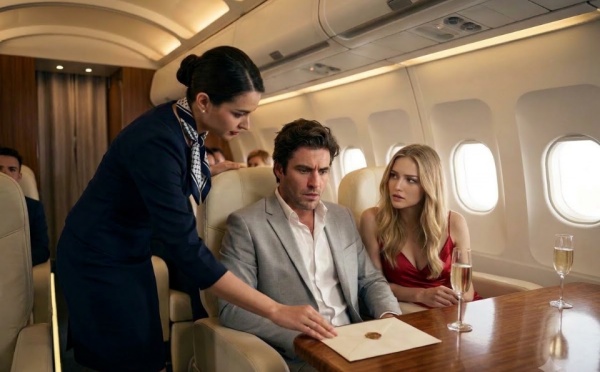
I told my wife I was in Nashville for work, then boarded a flight from Dulles to Los Angeles with another woman on my arm. I thought every lie was perfectly timed, every detail covered, every risk managed. Then I stepped onto the plane and saw Sarah standing there in her flight attendant uniform, calm enough to terrify me. Within minutes, I realized she had not discovered the truth by accident — she had been waiting for me to walk straight into it.
PART I — THE FLIGHT I THOUGHT I CONTROLLED
I boarded the flight with my mistress on my arm after telling my wife I was hundreds of miles away in Nashville.
That sentence is ugly, but truth usually is when it finally stops dressing itself up.
My name is Daniel Mercer, and for most of my adult life, I believed I was a good man because I was careful. I paid the mortgage on time. I remembered birthdays. I never raised my voice in public. I wore a wedding ring, gave polite answers at neighborhood cookouts, and donated every December to a food pantry in Arlington, Virginia, where my wife and I lived in a red-brick townhouse two blocks from a coffee shop that knew her order better than I did.
My wife’s name was Sarah Mercer.
She had been a flight attendant for Atlantic Crest Airlines for nine years. People always imagined her job was glamorous because she got to fly to Seattle, Miami, Denver, and San Diego on a weekly basis. They did not see the aching feet, the irregular sleep, the delayed flights, the polite smile she wore through turbulence, rude passengers, and holidays spent in hotel rooms with bad pillows and vending-machine dinners.
Sarah was calm in emergencies.
That was one of the first things I loved about her.
She could turn a brewing argument into a conversation with one sentence. She could hold a crying baby for a stranger at an airport gate and make the mother feel less alone. She could read a room faster than anyone I knew. For years, I mistook that calmness for softness.
I would learn the difference at Gate C18 at Dulles International Airport.
The woman on my arm that morning was Maya Collins, thirty-one years old, sharp, beautiful, and convinced she was entering a life I had no real intention of giving her. She worked as a marketing director for a hospitality group in Washington, D.C., and we met at a conference in Charlotte nine months earlier. What began as drinks after a panel became texts, then lunches, then hotel rooms, then a second life I built with the confidence of a man who had not yet been caught.
I told Maya my marriage was practically over.
That was the first lie.
I told her Sarah and I slept in separate rooms.
That was the second.
I told her we were waiting to sell the house before filing for divorce.
That was the third.
I told Sarah I was in Nashville meeting with a client for three days.
That was the fourth.
There were more. Lies multiply once you make space for them. They are like receipts in a glove compartment, small enough to ignore until you open it and everything spills out.
The truth was simple: I wanted my wife’s stability and Maya’s admiration. I wanted the respectable life Sarah helped me build and the thrill of being looked at by someone who did not know the exhausted, selfish, ordinary parts of me. I wanted to be both married and free, both loyal and desired, both safe and reckless.
In other words, I wanted to be a coward without paying the price.
Our flight that morning was from Washington Dulles to Los Angeles, a nearly six-hour trip. I had told Sarah I flew out to Nashville the night before. I even sent her a photo of a hotel lobby I found online, cropping out the watermark badly enough that I would later wonder if she had known then.
Maya thought we were flying to California for a romantic weekend.
I told her I had client meetings in Santa Monica and could make it look legitimate on paper. She smiled when I said that. At the time, I thought she admired how clever I was. Now I think she was beginning to understand that a man skilled at deception rarely limits himself to one victim.
We arrived at the airport at 7:40 a.m.
Maya wore a cream coat, dark jeans, and sunglasses pushed up into her hair even though we were indoors. I carried both our bags because I wanted to look like the kind of attentive man I rarely was at home anymore. We moved through TSA PreCheck, bought coffee, and waited near the gate while business travelers typed on laptops and families negotiated with toddlers over granola bars.
My phone buzzed once.
Sarah.
Hope Nashville is going okay. Be safe today.
I looked at the message and felt the briefest pinch of guilt.
Then I buried it under habit.
Long day ahead. Love you.
I typed those words while Maya leaned against my shoulder.
That is the kind of man I was.
The boarding announcement came at 8:26 a.m. First class. Military personnel. Families needing extra time. Then Group 1. We were in first class because I had used points Sarah helped me accumulate over years of married travel. Another small theft I did not recognize as theft because no one had taught me to see emotional dishonesty that way.
Maya took my arm as we walked down the jet bridge.
“You seem nervous,” she said.
“I’m fine.”
“You keep looking at your phone.”
“Work.”
She smiled.
“You’re always working.”
That had been one of my useful excuses with both women.
The air in the jet bridge had that familiar airport smell: metal, coffee, fuel, recycled air, and the faint anxiety of people hoping their overhead bin space would not be gone. I remember thinking the hardest part was over. We had checked in without incident. No one we knew had seen us. Sarah believed I was in Tennessee.
Then I stepped onto the aircraft.
And looked up.
Sarah was standing at the aircraft door in a flight attendant’s uniform.
Navy dress. Red scarf. Name wings pinned above her left breast. Hair pulled back neatly. Lipstick perfect. Eyes steady.
My body forgot how to move.
Maya bumped lightly into my side.
“Daniel?”
Sarah smiled.
Not warmly.
Professionally.
“Good morning,” she said. “Welcome aboard.”
For one impossible second, I told myself it was a coincidence I could survive.
Maybe she had picked up the trip last minute.
Maybe she had not seen Maya’s hand tucked around my arm.
Maybe she would pretend.
Maybe I could explain.
But Sarah’s eyes shifted from my face to Maya’s fingers, then to the two boarding passes in my hand, then back to me. Her calmness did not comfort me. It was the kind of calm that told me panic had already happened somewhere else, earlier, privately, and now what remained was decision.
“Sarah,” I said.
Maya’s grip loosened.
The passenger behind us cleared his throat.
Sarah’s smile stayed in place.
“Sir, please continue to your seat. We’re trying to board on time.”
Sir.
Not Daniel.
Not husband.
Sir.
The word was polite enough to cut skin.
I moved automatically down the aisle because there were people behind us and because public scenes had always been something I avoided. Maya followed me, her eyes sharp now, her confusion transforming into suspicion with every step.
Our seats were 2A and 2B.
First class.
Of course.
Close enough for Sarah to see every movement.
Maya sat by the window. I took the aisle. My hands shook as I shoved my bag into the overhead bin, but I told myself to breathe. I told myself I could still manage this. I had managed worse things.
That was arrogance talking.
I had never managed truth.
I had only delayed it.
Maya turned toward me slowly.
“Why did that flight attendant look at you like that?”
I sat down.
“She didn’t.”
“Daniel.”
“It’s nothing.”
“She knew your name.”
“She heard you say it.”
Maya stared at me.
“Is that Sarah?”
I said nothing.
The silence answered for me.
Her face changed so quickly it frightened me. The confidence, the flirtation, the weekend fantasy—gone. In its place was humiliation. Not because she was innocent, exactly, but because she realized the story she had been given was not the whole truth.
“You told me she was in Virginia,” Maya whispered.
“She is.”
Maya looked toward the front galley.
“She is on the plane.”
“I didn’t know.”
“No,” Maya said. “Clearly, you didn’t.”
Before I could answer, Sarah’s voice came over the intercom.
“Ladies and gentlemen, welcome aboard Atlantic Crest Flight 417 with service from Washington Dulles to Los Angeles. We’re happy to have you with us today.”
Her voice was smooth.
Perfect.
Terrifying.
I stared straight ahead while passengers boarded around us. A man in a gray suit took seat 1C and recognized me from a local business association. A woman across the aisle opened a magazine. A child two rows back asked loudly why the seats up front were bigger.
Sarah moved through the cabin, greeting passengers, helping with bags, checking seat numbers.
When she reached our row, she paused.
“May I take your coat?” she asked Maya.
Maya blinked.
“What?”
“Your coat,” Sarah said pleasantly. “We can hang it for you.”
Maya glanced at me, then back at Sarah.
“No, thank you.”
“Of course.”
Sarah turned to me.
“Mr. Mercer?”
My chest tightened.
“Yes?”
“Would you like anything before departure?”
Mr. Mercer.
Maya’s head snapped toward me.
The woman across the aisle looked up.
I forced a smile.
“No, thank you.”
Sarah nodded.
“Very well.”
She stepped away.
Maya leaned close.
“Your wife is our flight attendant.”
I closed my eyes.
“Maya, keep your voice down.”
She laughed once, quietly and bitterly.
“Why? Is that what you tell all the women in your life?”
I deserved that.
At the time, I was too scared to accept it.
“Please,” I whispered. “Not here.”
Maya looked at me as if I had become smaller in the seat.
“Funny. I’m guessing she’s heard that before.”
The boarding door closed.
The jet bridge pulled away.
And I realized something with a coldness I had never felt before.
There was no escape.
For the next six hours, I would be trapped at thirty-seven thousand feet with the wife I had betrayed, the mistress I had lied to, and a plane full of witnesses who had no idea that the worst thing waiting for me had not even appeared yet.
PART II — THE LIE IN SEAT 2B
The aircraft pushed back from the gate, and I tried to think like a man solving a logistical problem.
That had always been my approach to marriage.
Not feeling.
Not honesty.
Logistics.
If Sarah was working the flight, then she was legally and professionally obligated to perform her duties. She could not make a scene. She could not refuse to serve us. She could not call me out in front of passengers without risking her job. I told myself this because it made me feel less trapped.
I forgot that Sarah knew rules better than I did.
She also knew how to stay inside them while still letting truth breathe.
During taxi, Maya stared out the window and refused to speak. I could see her reflection in the glass: lips pressed together, eyes bright but dry. She was angry, but beneath that was something worse for me—calculation.
I had seen that look on Sarah before.
It meant a woman was replaying every conversation and discovering where the seams had been visible all along.
The safety demonstration began. Sarah stood at the front of the cabin beside another flight attendant named Kelly, demonstrating the seat belt, oxygen mask, and exits with controlled efficiency. Her eyes did not land on me once. Somehow that was worse than if she had glared.
Maya watched her.
Then she leaned toward me.
“You said you moved out.”
I swallowed.
“I said we were separated emotionally.”
“No, Daniel. You said you moved into the guest room months ago.”
“We did for a while.”
“Did you?”
I said nothing.
She laughed under her breath.
“You’re unbelievable.”
The engines roared, and the plane lifted into the morning sky.
I looked down at Virginia shrinking beneath us and felt a strange, irrational anger at the world for allowing this coincidence. I now know it was not coincidence. At least, not entirely. But in that moment, I was still arrogant enough to believe life had betrayed me by exposing the betrayal I created.
Once we reached cruising altitude, Sarah and Kelly began service.
Warm towels.
Drinks.
Menus.
Everything civilized.
Everything unbearable.
Sarah came to row two with the beverage cart.
“Something to drink?” she asked the man in 2C.
“Coffee, please.”
“Cream or sugar?”
“Black is fine.”
Then she turned to Maya.
“Ma’am?”
Maya’s jaw tightened at the word.
“Sparkling water.”
“Lime?”
“Yes.”
Sarah poured it with hands so steady I wanted to confess just to break the calm.
Then she looked at me.
“Sir?”
“Coffee.”
“Cream or sugar?”
She knew exactly how I took coffee.
For twelve years, she had watched me drink it black on weekdays and with cream on Sundays. She had bought my favorite beans from a shop in Old Town Alexandria. She had made coffee before early flights even when she was the one leaving at dawn.
Now she asked like I was seat inventory.
“Black,” I said.
She poured it.
Her ring was not on her finger.
I noticed because I looked for it. I had been wearing mine while traveling with Maya because removing it felt too obvious. Sarah’s absence of a ring was quiet. Devastatingly quiet.
My pulse quickened.
Maya noticed too.
She glanced at my left hand.
The gold band was still there.
Her face hardened.
Sarah handed me the coffee.
“Careful,” she said. “It’s hot.”
I almost laughed from panic.
Instead, I nodded.
“Thank you.”
She moved on.
Maya waited until Sarah was out of earshot.
“You still wear your ring.”
I looked down.
“It’s complicated.”
“No, it’s not.”
“Maya—”
“Did she know you were taking me to L.A.?”
“No.”
“Did she know I existed?”
I rubbed my forehead.
“She suspected.”
Maya stared at me.
“She suspected?”
“I don’t know.”
“You told me your marriage was over.”
“It is.”
“Does she know that?”
I had no answer that would not damn me.
Maya turned away.
For the first hour, I tried to text Sarah.
Can we talk when we land?
No response.
Please. I didn’t know you were working this flight.
No response.
Sarah, I know this looks bad.
I stared at that one after sending it and hated myself for the weakness of it.
Looks bad.
As if the problem were optics.
As if betrayal were a lighting issue.
Ten minutes later, Sarah walked through the aisle collecting cups. She did not look at me, but my phone buzzed.
Her message contained one sentence:
Please do not contact working crew during flight unless it concerns passenger safety.
I read it three times.
Maya saw my face.
“She texted you?”
“No.”
“Daniel.”
I locked the phone.
Maya reached for her bag.
“What are you doing?”
“Moving seats.”
“You can’t.”
“I absolutely can.”
She pressed the call button.
My stomach dropped.
Sarah appeared less than thirty seconds later.
“Yes, ma’am?”
Maya looked directly at her.
“Is there another open seat?”
Sarah’s expression did not change.
“I can check.”
“I’d prefer not to sit here.”
There was a pause.
Short.
Professional.
Loaded.
“Of course,” Sarah said. “Let me see what’s available.”
I wanted to disappear.
The man in 2C looked down at his coffee with the unnatural concentration of someone desperate not to be involved. The woman across the aisle pretended to read but had not turned a page in ten minutes.
Sarah returned.
“There’s an open aisle seat in row seven. Still in the premium cabin. I can help move your bag.”
Maya stood immediately.
“Maya,” I whispered.
She looked down at me.
“Don’t.”
That one word had more dignity than any explanation I could have offered.
Sarah helped her retrieve her bag from the overhead bin. Their hands briefly touched when Sarah handed over the coat Maya had refused earlier. Neither woman flinched. I watched them walk away together, my wife and my mistress, and realized I had made enemies of two women who should never have been placed in competition.
A few minutes later, Sarah returned to the front cabin.
She leaned slightly toward me, still smiling in that professional way.
“Mr. Mercer, please keep your seat belt fastened while seated.”
My belt was already fastened.
She knew that.
The sentence was not about safety.
It was about control.
For the first time in our marriage, Sarah had all of it.
The next two hours were slow punishment.
Not loud.
Not cruel.
Worse.
Civil.
Sarah served meals. She checked on passengers. She helped a child with headphones. She laughed politely at an elderly man’s joke. She gave Maya the same level of service she gave everyone else—no less, no more.
That was what made me sick.
She refused to make herself small, hysterical, or unprofessional to match the size of my betrayal.
I tried to rehearse what I would say when we landed.
I was going to explain that things had been bad between us.
That I felt lonely.
That Maya made me feel alive.
That I never meant for Sarah to find out like this.
Every version sounded cowardly even in my own head.
Because the truth was not that I had fallen helplessly into an affair.
I had scheduled it.
Budgeted it.
Lied around it.
Charged meals to business accounts.
Used Sarah’s layovers as opportunities.
Used her trust as infrastructure.
At some point over Kansas, Kelly the other flight attendant leaned toward Sarah in the galley. They whispered. Kelly looked briefly at me, then away. I wondered how much she knew. Flight crews talk. They are trained observers. Sarah could probably have told her everything without raising her voice.
Then Maya came back.
Not to sit.
To stand in the aisle beside my seat.
Her face was pale but composed.
“We need to talk.”
“Not here.”
Her mouth tightened.
“Of course.”
I glanced toward the galley.
Sarah was watching.
Maya followed my gaze and laughed once.
“You are still more worried about being seen than what you did.”
“Maya, please sit down.”
“No.”
A few passengers looked up.
She lowered her voice, but not enough.
“You told me she was cold. You told me she had already checked out. You told me she wanted the divorce but was waiting because of the house.”
I felt heat rise in my face.
“Maya.”
“You told me I wasn’t the other woman.”
Sarah stepped forward from the galley.
“Ma’am, for safety, I need you seated unless you’re using the lavatory.”
Maya turned to her.
“I’m sorry.”
The apology came so quickly that my chest tightened.
Maya was apologizing to Sarah.
Not to me.
Sarah nodded once.
“Thank you.”
Maya looked back at me.
“I’ll sit down. But when we land, you and I are done.”
She walked back to row seven.
I sat frozen.
Done.
The word should have panicked me because I had built so much deception around keeping Maya.
Instead, what I felt was something closer to exposure.
Maya leaving did not solve anything.
It simply removed one lie from the pile.
The larger truth remained in the galley wearing a navy uniform.
An hour later, turbulence began.
The seat belt sign came on with a chime. The captain’s voice announced light chop over the Rockies and asked passengers to remain seated. Sarah and Kelly secured the cabin quickly. A drink spilled in row six. A baby started crying. The plane dipped, then steadied.
I have never been afraid of flying.
That day, every bump felt deserved.
Sarah walked the aisle one final time before taking her jumpseat. As she passed me, she paused just long enough to place something on my tray table.
Not a note.
Not a ring.
A folded copy of our phone bill.
Highlighted.
My call logs.
My hotel confirmations.
My messages to Maya’s number.
My supposed Nashville trip overlapping with a Washington-to-Los Angeles itinerary purchased three weeks earlier.
I looked up at her.
Her eyes were calm.
“You dropped this,” she said.
Then she walked away.
My fingers went numb.
I opened the folded papers beneath the cover of my napkin.
The highlighted evidence was not random.
It was organized.
Dates.
Times.
Charges.
Cross-references.
Sarah had not discovered me at the aircraft door.
She had known before I boarded.
Which meant her presence on that flight might not have been coincidence at all.
And if she knew enough to build this file, then the worst thing on that plane was still waiting.
PART III — THE MAN IN 1C
The worst thing waiting for me on that plane was not Sarah’s calmness.
It was not Maya’s rage.
It was not even the folder of evidence on my tray table.
It was the man seated in 1C.
His name was Richard Vale, though when he first boarded, I knew him only as a senior partner at Hawthorne & Vale, the consulting firm negotiating a seven-figure contract with my company. I had met him twice. He was in his late fifties, silver-haired, expensive but understated, the type of man who listened more than he spoke and made others fill the silence with useful mistakes.
I had been courting his firm for four months.
My employer, Grayson Bell Logistics, where I served as Vice President of Strategic Accounts, was bidding on a major expansion project involving distribution hubs across the Southwest. Hawthorne & Vale controlled access to a network of investors and operational partners we needed. If I closed the relationship, I would be first in line for Chief Revenue Officer when my boss retired.
My entire professional future was sitting one row in front of me.
And he had been watching everything.
When Maya moved seats, Richard Vale glanced back once.
Not nosy.
Not dramatic.
Just aware.
When Sarah placed the folded papers on my tray table, he did not turn. But I saw his hand pause over his tablet. Men like that notice movements reflected in dark screens.
I told myself personal scandals did not matter in business.
That was another lie.
Personal judgment and professional judgment are not identical, but they are cousins. A man reckless enough to travel with his mistress on a commercial flight while lying to his wife, using company-linked travel, and getting caught by the flight crew was not a man investors would trust with confidential negotiations.
Especially not when the mistress had been introduced to Richard’s firm as a “consulting liaison” at a dinner two months earlier.
My stomach twisted.
I had done that.
I had brought Maya to a client dinner in Georgetown and described her vaguely as someone assisting with brand strategy. She had charmed everyone. Richard had asked how long we had worked together. I had laughed and said, “Long enough to trust her instincts.”
Sarah had been on a layover in Chicago that night.
I remembered texting her from the restaurant bathroom.
Dinner running late. Miss you.
I looked at the phone bill again and felt sweat gather under my collar.
Some lies look absurd only after they stop working.
Meal service resumed after turbulence settled. Sarah moved through the cabin, composed as ever. When she served Richard a fresh coffee, he thanked her by name.
“Thank you, Sarah.”
She smiled politely.
“You’re welcome, Mr. Vale.”
My blood went cold.
She knew him.
Not personally, perhaps. Flight attendants learn names from manifests, especially in first class. But hearing his name in her voice made the connection real in a way I could not avoid.
Richard turned slightly toward me after she left.
“Daniel.”
I looked up.
“Yes?”
“We should speak when we land.”
Six words.
Calm.
Professional.
Fatal.
“Of course,” I said.
He returned to his tablet.
I sat there with my career collapsing quietly at thirty-seven thousand feet.
Maya did not speak to me for the rest of the flight.
Sarah did not either.
That left me alone with myself, a place I had avoided for years.
I thought about how it started with Maya. The first drink. The compliment. The way she laughed at my stories as if they were new. The first message sent too late at night. The first hotel room justified as harmless because nothing had happened yet. Then something happened, and I justified that too because I was unhappy, because Sarah traveled, because marriage was hard, because I deserved to feel wanted.
I had confused explanations with excuses.
A midlife crisis sounds almost respectable until you list the choices involved: booking rooms, deleting texts, inventing work trips, lying to your wife’s face, promising another woman a future built on sand.
When the flight began descending into Los Angeles, Sarah made the final announcement.
“Ladies and gentlemen, we have begun our initial descent into Los Angeles. Please ensure your seat backs and tray tables are upright, your seat belts are fastened, and all carry-on items are stowed.”
Her voice never wavered.
I wondered how many emergency landings, medical incidents, drunk passengers, and crying strangers had trained her to sound steady while something personal burned behind her ribs.
Maybe I had underestimated not only her strength, but the entire architecture of her discipline.
The landing was smooth.
Of course it was.
People clapped lightly in the back, as people sometimes do after cross-country flights and fear they do not want to name. We taxied to the gate. Phones came out. Seat belts unbuckled before the chime. The usual restless choreography began.
I stayed seated.
Maya stood in row seven and did not look at me.
Sarah and Kelly prepared the forward door.
When the door opened, Los Angeles sunlight flooded the cabin. Passengers began filing out. Sarah stood at the front with her professional smile.
“Thank you. Have a great day.”
“Thank you for flying with us.”
“Watch your step.”
One by one, people left.
Richard Vale waited until most of first class had cleared. Then he retrieved his bag and turned to me.
“Walk with me.”
It was not a request.
I followed him onto the jet bridge. Maya was ahead of us, walking fast, phone already pressed to her ear. Sarah remained at the aircraft door, thanking passengers. When I passed, I wanted to say something. Anything.
She looked through me.
Not past me.
Through me.
As if I had become a passenger whose problem she would not carry beyond the flight.
Inside the terminal, Richard stopped near a window overlooking the tarmac.
“I am going to be direct,” he said.
“I understand.”
“I don’t think you do.”
I swallowed.
He looked toward the plane, then back at me.
“I witnessed enough on that flight to question your judgment. I also understand Ms. Collins is not, in fact, a company consultant in the way you implied at dinner.”
My mouth went dry.
“She does marketing work.”
“For your company?”
“Not directly.”
“For you?”
I said nothing.
Richard nodded.
“That is what I thought.”
“Richard, this is personal.”
“No. It became professional when you introduced a personal relationship into a business context without disclosure.”
I felt the floor shifting beneath me.
“I can explain.”
“I’m sure you can. Men in trouble often explain at length.”
That stopped me.
He continued.
“Our firm works with executives under pressure. I don’t require moral perfection. I do require honesty when interests overlap. Today, I watched you deceive your wife, mislead another woman, and potentially misrepresent a relationship relevant to business discussions.”
“I never compromised the deal.”
“You compromised confidence.”
There it was.
The word Preston-like men, Daniel-like men, ambitious men feared most.
Confidence.
Not morality.
Not love.
Confidence.
Richard adjusted his bag strap.
“I will be recommending that Hawthorne & Vale pause all engagement discussions with Grayson Bell Logistics until your role is clarified.”
“That’s not necessary.”
“It is.”
“My CEO will want context.”
“I will provide it professionally.”
That meant without gossip.
Without kindness.
Facts only.
Facts are often more damaging than insults.
He began to walk away, then stopped.
“One more thing.”
I looked at him.
“Your wife handled herself with extraordinary professionalism. You should consider what it says about you that the person you harmed was still the most competent person in the cabin.”
Then he left.
I stood near the window, watching baggage carts move beneath the plane, and understood that my life had not merely been caught.
It had been witnessed.
Maya texted me three minutes later.
Do not come to the hotel. I changed the reservation. I need space, and I need the truth about everything you lied about.
I called her.
No answer.
I called again.
Blocked.
Sarah exited the jet bridge with the crew about fifteen minutes later, rolling her carry-on behind her. She had changed nothing about herself. Same uniform. Same posture. Same calm.
I stepped into her path.
“Sarah.”
She stopped, but only because blocking a walkway would draw attention.
“Not here,” she said.
I almost laughed because those had always been my words.
Now they belonged to her, and in her mouth they sounded like boundaries instead of control.
“Please,” I said. “Just five minutes.”
“I have a crew debrief and a hotel shuttle.”
“I need to explain.”
“No, Daniel. You need to listen.”
Her voice was low enough that only I could hear.
“You lied to me. You lied to her. You brought your affair onto my aircraft after telling me you were in Nashville. You used our life like cover. You made me work a flight where I had to serve the woman you betrayed me with.”
I could not look at her.
She continued.
“I knew about Maya before today. I found the messages three weeks ago. I knew about the Los Angeles trip yesterday. I traded onto this flight because I needed to see whether you would still lie when truth was standing in front of you.”
My eyes lifted.
“You traded onto the flight?”
“Yes.”
The calmness was not coincidence.
It was confirmation.
“Sarah, I—”
“No. I am not doing this in an airport hallway.”
“What happens now?”
She looked at me for a long moment.
“Now you go to your hotel, or don’t. You call your boss, or wait for him to call you. You decide how many more lies you want to tell before they become impossible to track.”
My throat tightened.
“And us?”
Her face changed then.
For the first time, I saw the hurt beneath the discipline.
“There is no us today.”
She walked away with the crew.
I watched her go and felt the full weight of something I had not expected.
I had thought being caught would be the worst part.
It was not.
The worst part was realizing Sarah had given me one final chance to choose truth at the aircraft door, and I had walked past her with another woman anyway.
PART IV — TURBULENCE ON THE GROUND
By the time I reached the hotel in downtown Los Angeles, my phone had become a courtroom.
Maya had sent three messages before blocking me again.
How much of it was true?
Did your wife know about me the entire time?
Do not make me look stupid in front of your business contacts.
Then my boss, Ellen Grayson, called.
Ellen was the founder and CEO of Grayson Bell Logistics. She was sixty-two, brilliant, direct, and allergic to unnecessary drama. She had promoted me twice because I could close difficult accounts and keep senior clients happy. She had also warned me once that charm was not a substitute for judgment.
I ignored her first call.
That was a mistake.
She called again.
I answered.
“Daniel,” she said, “tell me why Richard Vale just informed me that Hawthorne & Vale is pausing engagement discussions due to concerns about your professional judgment and undisclosed conflicts.”
I closed my hotel room door.
“It’s a misunderstanding.”
The silence that followed was deadly.
“Try again.”
I sat on the edge of the bed.
“There was a personal situation on the flight.”
“With a woman you represented socially as connected to our brand strategy discussions?”
“She works in marketing.”
“Does she work for us?”
“No.”
“Does she have a contract with us?”
“No.”
“Was she involved in any confidential discussions?”
“No.”
“Did you allow Richard Vale to believe her role was more formal than it was?”
I closed my eyes.
“I may have been unclear.”
Ellen exhaled.
“Daniel, unclear is what people say when clear would get them fired.”
I had no answer.
She continued.
“Legal will need a written account of any business interaction involving Ms. Collins. You are not to contact Hawthorne & Vale directly. You are not to discuss company matters with Ms. Collins. You are not to expense anything related to this trip. Understood?”
“Yes.”
“Are you in Los Angeles for a client meeting?”
The question landed like a trap because it was one.
I had told my assistant to block my calendar for “West Coast client strategy.” There was no client meeting until Monday, and even that had been arranged loosely as cover.
“I have one Monday.”
“And the weekend?”
“Personal.”
“Was company travel used?”
“I booked it myself.”
“Send receipts.”
“Yes.”
Another pause.
Then Ellen said, “I don’t care about your marriage except to the extent that your choices affect my company. Today, they did. You are on administrative leave pending review.”
The words stunned me.
“Ellen—”
“No. Do not charm me, do not minimize this, and do not make me ask questions I already know you won’t enjoy answering.”
She hung up.
I stared at the phone.
Administrative leave.
Hawthorne paused.
Maya gone.
Sarah gone.
All before noon Pacific time.
I had spent months designing a secret weekend. It had taken one flight to dismantle it.
For the next several hours, I did what selfish men do when consequences arrive.
I tried to find someone else responsible.
Sarah should not have traded onto the flight.
Maya should not have pressed the call button.
Richard should not have overreacted.
Ellen should have protected a valuable executive.
The universe should not have arranged all of them in one aircraft cabin.
But by sunset, in a hotel room overlooking Figueroa Street, the excuses began sounding pathetic even to me.
I ordered room service I did not eat.
I called Sarah.
No answer.
I texted:
I’m sorry.
No response.
Then:
I know I destroyed your trust.
No response.
Then:
Please let me know you’re safe.
This time, she replied.
I am safe. Please communicate through email regarding household logistics only.
Household logistics.
Not marriage.
Not love.
Logistics.
My own language returned to me as punishment.
The next morning, I changed my flight back to Dulles. I did not tell Maya. I did not know where she was staying. I did not have the right to know. She emailed me later from what looked like a newly created address.
Her message was short.
I believed you were separated. I should have asked harder questions, but you gave me specific lies, and I believed them. Do not contact me again except through counsel if necessary. I am keeping records of what you told me because you involved my name in business conversations.
Through counsel.
Records.
Business conversations.
The women in my life were no longer speaking emotionally.
They were documenting.
That scared me more than yelling would have.
On the flight home, I sat in coach by choice because the idea of first class made me nauseous. I watched a flight attendant greet passengers and wondered how many private disasters passed through aircraft cabins every day. Affairs. Proposals. Escapes. Reunions. Endings. People think planes suspend real life, but they do not. They compress it.
When I landed at Dulles, Sarah was not there.
Of course she was not.
I took a rideshare back to Arlington.
The townhouse looked unchanged from the street. Brick steps. Black shutters. Planters Sarah had filled with mums two weeks earlier. A wreath on the door because she believed seasonal touches made a house feel cared for.
My key still worked.
Inside, the house was clean and quiet.
Too quiet.
On the dining table was a manila envelope with my name written in Sarah’s handwriting.
Inside were copies of bank records, screenshots, hotel confirmations, phone logs, and a printed list titled:
Items to Discuss Through Counsel
- Mortgage and household expenses
- Division of accounts
- Credit card charges related to affair
- Use of marital funds
- Health insurance and beneficiary changes
- Temporary living arrangements
- Legal separation options in Virginia
At the bottom, Sarah had written:
I will be staying elsewhere for now. Do not come to my crash pad, do not contact my crew, and do not show up at the airport.
She knew me well enough to cut off the dramatic apology before I could stage it.
I sank into a chair.
The house smelled like lemon cleaner and the lavender hand soap she bought in bulk. Her travel mug was gone from the counter. Her running shoes were gone from the mat. The framed photo from our honeymoon in Maui had been removed from the bookshelf, leaving a rectangle of dustless wood.
That rectangle hurt more than I expected.
It was evidence of absence.
Not sudden.
Deliberate.
I spent the first night in the guest room because sleeping in our bed felt like trespassing.
The next morning, an email arrived from a family law attorney named Patricia Lowell.
Sarah had retained counsel.
The email was professional and precise. Patricia requested that I preserve all financial records, communications with Maya Collins, travel receipts, credit card statements, and any documents relating to marital assets. She proposed a temporary arrangement for household expenses and asked whether I had retained representation.
I had not.
I called a lawyer by noon.
By Friday, my company’s legal department requested a formal statement regarding Maya’s involvement in any client-facing events. I provided one. It was not flattering to me, but it was incomplete. My attorney advised me to amend it before omission became a bigger problem.
So I did.
I admitted I had introduced Maya in ambiguous terms at two dinners involving business contacts. I admitted she had no formal role. I admitted I used personal travel partially disguised on my calendar as work-related. I denied sharing confidential documents because I had not done that, at least.
That distinction did not feel heroic.
Ellen called after reviewing it.
“You will not be returning as VP of Strategic Accounts,” she said.
My chest tightened.
“Am I fired?”
“Not today. HR is preparing options. But trust is central to that role, and you damaged it.”
“I understand.”
“Do you?”
“I’m starting to.”
She sighed.
“That may be true. It is also late.”
Everyone kept saying versions of that.
Late.
Too late.
After the damage.
After the aircraft door.
After the lie had served its purpose.
Sarah and I did not speak for three weeks.
Everything went through attorneys or email. She retrieved belongings when I was not home. I saw evidence of her movements only afterward: half the closet empty, her books gone, the good skillet missing because it had been hers before marriage, the bathroom cabinet cleared of face creams and hair clips.
One evening, I found a small sticky note inside the kitchen cabinet.
Coffee filters are on the top shelf. You never remember.
It was not sentimental.
It broke me anyway.
I sat on the kitchen floor and cried for the first time.
Not beautifully.
Not redemptively.
Just cried.
Because losing Sarah was no longer theoretical. She was disappearing one practical object at a time, and each absence revealed how much of my life she had quietly held together.
The mug I liked was always clean because she loaded the dishwasher before early flights.
My mother’s birthday card always arrived because Sarah mailed it.
The plants lived because she watered them.
The bills were organized because she made spreadsheets.
Our friendships survived because she replied to invitations.
Our marriage had looked stable in public because Sarah did the emotional labor of making it look that way.
I had mistaken her work for my goodness.
That realization was worse than shame.
It was inventory.
PART V — THE WOMAN WHO WALKED AWAY CALMLY
The legal separation was filed in Arlington County two months after the flight.
By then, I had resigned from my executive role under what the company called a “mutual transition agreement.” That phrase was generous enough to be insulting. I kept some equity, lost the promotion path, and signed a non-disparagement agreement that prevented me from blaming anyone publicly even if I had wanted to.
Maya never spoke to me again.
I heard through a mutual contact that she left her marketing job and moved to Austin for a new position. I did not try to confirm it. She had been harmed by my lies too, even if she had made choices she needed to examine for herself. My apology to her went through email once, with no expectation of response.
She did not respond.
Good for her.
Sarah and I entered mediation in Falls Church in early spring.
She arrived wearing navy trousers, a white blouse, and the same calm expression she had worn at the aircraft door. She looked rested. Not happy exactly. But lighter. As if grief had taken weight from her face and put steel in her spine.
I looked older.
I know because I had stopped avoiding mirrors.
The mediator explained the process: equitable distribution under Virginia law, possible spousal support considerations, division of accounts, treatment of marital funds spent on the affair, household property, retirement assets. No children, thankfully. That was the one mercy in the wreckage.
Sarah had always wanted to wait on children until her schedule stabilized and my career settled.
I had resented that quietly.
Now I thanked God I had not betrayed her as a mother too.
During mediation, Sarah asked for three things clearly.
Fair division of marital assets.
Reimbursement to the marital estate for money spent on the affair.
No confidentiality provision preventing her from discussing her own life with close family, therapist, attorney, or future partner.
My attorney advised negotiation.
I agreed to almost everything.
Not because I was noble.
Because for once, fighting felt like another form of lying.
During a break, I asked if Sarah would speak to me privately in the conference room with the door open.
She hesitated.
Then nodded.
We stood near a window overlooking a parking lot and a row of bare trees.
For a moment, I remembered us at twenty-eight, sharing airport food during her layovers, laughing about how adulthood felt like pretending to know how insurance worked. She had loved me when I was less impressive and more honest. I had repaid her by becoming impressive enough to deceive efficiently.
“I’m sorry,” I said.
She looked at me.
“I know.”
That was not forgiveness.
It was acknowledgment.
“I lied to you for months.”
“Yes.”
“I lied to Maya too.”
“I assumed.”
“I embarrassed you on your own aircraft.”
Her jaw tightened slightly.
“Yes.”
“I can’t imagine what that felt like.”
“No,” she said. “You can’t.”
I accepted that.
She continued.
“The worst part wasn’t seeing her with you.”
I looked up.
“It wasn’t?”
“No. It was watching you decide in real time that you would still try to manage me. Even after you saw me standing there, even after you knew I knew something, your instinct was not honesty. It was control.”
The words were quiet.
They landed hard.
“I know.”
“Do you?”
“I’m trying to.”
Sarah folded her arms.
“I traded onto that flight because I needed proof, but also because some small, stupid part of me hoped you would see me and stop. That you would tell her the truth. That you would step out of line, pull me aside later, anything.”
My throat closed.
“But you walked past me,” she said. “With her on your arm.”
“I was scared.”
“I know. You chose fear over me.”
That was the cleanest description of my marriage’s ending.
Not lust over love.
Not Maya over Sarah.
Fear over truth.
Self-image over accountability.
“I did,” I said.
She seemed almost surprised that I did not argue.
Then she looked out the window.
“I loved being your wife for a long time.”
My eyes burned.
“I loved you.”
“I know,” she said again. “But love without honesty becomes unsafe.”
I had never thought of it that way.
Unsafe.
Not dramatic.
Not toxic internet language.
Just unsafe.
A home where truth cannot land is not a home. It is a stage set.
Sarah turned back to me.
“I don’t hate you, Daniel. I did for about a week. Then I was too tired.”
That hurt more than hatred.
“I don’t know how to repair this,” I said.
“You don’t.”
The answer was immediate.
“You don’t repair this marriage. You repair yourself so you don’t do this to someone else.”
I nodded.
The words felt like mercy and exile at the same time.
Our divorce was finalized eight months after the flight.
Sarah kept her retirement account, her car, her grandmother’s furniture, and enough cash from the home equity to buy a condo in Alexandria near the metro. I kept the townhouse for a while, then sold it because every room accused me accurately. The reimbursement for affair-related expenses came out of my share. Seeing the numbers itemized was humiliating.
Hotels.
Meals.
Flights.
Gifts.
Rideshares.
Every charge was a receipt for a choice I had once called complicated.
After the divorce, I took a lower-level consulting job with a smaller firm in Richmond. It paid less but required less performance. For the first time in years, I had evenings with nothing to manage except myself. That turned out to be harder than managing clients.
I started therapy because Sarah’s final sentence followed me everywhere.
Repair yourself.
At first, I wanted therapy to give me language that made me sound redeemable. My therapist did not indulge that. She asked why admiration mattered more to me than intimacy. She asked when I learned to avoid shame by controlling narratives. She asked why I believed being desired by Maya proved something Sarah’s steady love no longer did.
I hated those sessions.
Then I needed them.
Then I stopped measuring them by whether they made me feel better.
A year after the flight, I saw Sarah again at Reagan National Airport.
I was flying to Chicago for a conference. She was walking through the terminal in uniform with a crew bag rolling behind her. My first instinct was to hide behind a column like a guilty teenager. Instead, I stood still.
She saw me.
For a moment, time folded.
Dulles.
The aircraft door.
Maya’s hand on my arm.
Sarah’s professional smile.
Then Sarah nodded once.
Not warmly.
Not coldly.
Just acknowledgment.
I nodded back.
She kept walking.
That was all.
No speech.
No tears.
No closure scene.
Just two people in an airport, one of whom had learned too late that love is not proven by regret after betrayal, but by truth before it.
Later, while waiting at my gate, I received an email from an unknown address.
Maya.
It had been more than a year.
The message was short.
I don’t want contact. I just wanted you to know I’m okay, and I hope you are becoming the kind of honest person you pretended to be. Sarah deserved better. So did I.
I read it twice.
Then I replied with one sentence:
You’re right, and I’m sorry. I won’t contact you again.
I did not.
People prefer stories where the person who fails is dramatically punished or dramatically forgiven.
Real life is usually quieter.
I lost my marriage, my promotion, a version of my reputation, and the illusion that I was a good man simply because I had avoided obvious cruelty. But Sarah lost something too. She lost trust, time, and the safety of a marriage she had built honestly. Maya lost the relationship she believed was real. My company lost confidence in my judgment.
The damage did not orbit only me.
That was the lesson I resisted longest.
For months, I framed my life as something that had collapsed on the plane. But the collapse began long before Flight 417. It began every time I typed a lie and called it necessary. Every time I let Maya believe she was stepping into an honest future. Every time I accepted Sarah’s love while privately betraying its foundation.
The plane did not ruin my life.
It revealed it.
I boarded that flight with my mistress on my arm after telling my wife I was hundreds of miles away in Nashville.
I looked up and found Sarah standing at the aircraft door in uniform, calm enough to terrify me.
Within minutes, the lie I thought I controlled began collapsing in front of the woman I had betrayed and the woman I had lied to about my marriage.
But the worst thing waiting for me on that plane was not Sarah.
It was not Maya.
It was not Richard Vale in seat 1C or the professional consequences that followed.
The worst thing waiting for me was the truth that had nowhere left to hide.
I had not been trapped by coincidence.
I had been delivered into the consequences of my own choices at thirty-seven thousand feet, with the seat belt sign on and no exit available.
Sarah once told me, long before everything ended, that flight attendants are trained to look for danger before passengers notice it. Smoke. Panic. A loose latch. A passenger who seems too nervous. A silence that feels wrong.
I should have remembered that.
My wife had spent years noticing what I thought I was hiding.
And when she finally opened the aircraft door, she did not need to yell.
She simply let me board.
Then she watched the truth take its seat.
