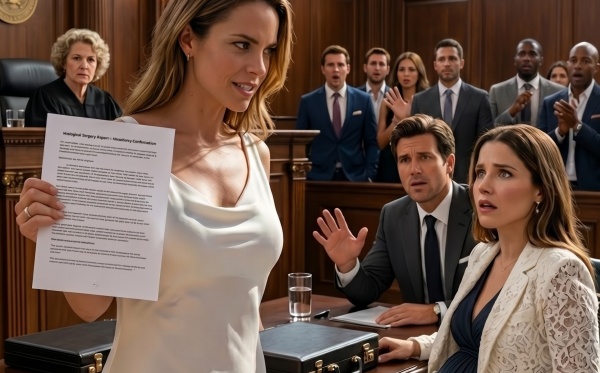
My Husband’s Pregnant Mistress Smiled in Court and Claimed the Baby Was His—Until I Revealed the Secret Surgery That Changed Everything
Part 1 — The Woman in the Cream Dress
The courthouse in downtown Raleigh looked colder than I remembered. Its tall glass doors reflected the gray January sky, and every person walking through them seemed to carry some private disaster under their coat. I sat in my car for three full minutes with my hands wrapped around a paper cup of coffee I had not touched.
My name is Claire Whitmore, and for twelve years, I believed I had a good marriage. Not perfect, not movie-perfect, but solid in the ordinary ways that matter. We had a brick ranch house outside Cary, a golden retriever named Biscuit, two aging SUVs, and a mortgage that made us sigh every month but still feel proud.
My husband, Daniel, taught American history at a high school. I worked as an office manager for a pediatric dental practice. We were not rich, but we were comfortable enough to order takeout on Fridays, drive to the Outer Banks every summer, and argue about whether the thermostat should stay at 68 or 70 degrees.
Then I found the hotel receipt.
It was tucked inside the glove compartment of Daniel’s truck, folded twice, as if folding paper could fold away guilt. The hotel was in Wilmington, two hours from where he had told me he was attending a teachers’ conference in Greensboro. The room had been paid for on a Friday night when I had been home making chicken soup because he claimed he was too tired to talk on the phone.
At first, I did what people do when the truth is too sharp. I tried to make it dull. I told myself there had to be an explanation, some innocent reason why my husband had been in a beach hotel with a king-size room and two breakfasts charged the next morning.
But lies do not stay folded forever.
Within three weeks, I learned her name: Vanessa Reed. She was thirty-one, worked in medical sales, and had the kind of social media page that looked like it had been curated by a woman who never left the house without lip gloss. Every photo showed her smiling like she had already won something.
Daniel did not confess because he felt guilty. He confessed because I knew enough to make denial useless. He sat at our kitchen table one rainy Sunday afternoon, staring at the oak surface like it might open up and swallow him.
“It didn’t mean anything,” he said.
That sentence broke something in me more than the affair itself. Twelve years of marriage, shared bills, shared grief, shared plans, and he had risked it all for something he claimed meant nothing. I remember looking at him and realizing he did not understand that “nothing” can still destroy everything.
I filed for divorce in October.
By January, we were in court over property division, temporary support, and Daniel’s sudden panic about his reputation. He wanted the house sold quickly. He wanted me to sign a settlement that gave him far more than he deserved. Most of all, he wanted the hearing kept quiet.
I thought the worst part would be seeing him across the courtroom.
I was wrong.
The worst part walked in seven minutes after we did.
Vanessa Reed entered the courtroom wearing a cream-colored maternity dress, nude heels, and a camel coat draped over her shoulders like she was arriving for brunch instead of a legal proceeding. Her blond hair fell in soft waves, and one hand rested dramatically on her stomach. She scanned the room until her eyes landed on me.
Then she smiled.
Not a nervous smile. Not an apologetic one. A smirk.
It was small, polished, and cruel.
Daniel’s attorney stiffened. My attorney, Margaret Ellison, leaned slightly toward me and whispered, “Is that her?”
I nodded once.
My throat had gone dry.
Vanessa sat directly behind Daniel, close enough that everyone could understand the message. She was not simply the other woman anymore. She had come as proof of something, as a threat wrapped in perfume and expensive fabric.
Daniel turned around when she touched his shoulder. His face went pale in a way I had never seen, not even when his father had been rushed to the ER two years earlier. For one second, I saw fear—not guilt, not shame, but fear.
That should have warned me.
The judge entered, and everyone stood. The room settled into the quiet rhythm of legal language: exhibits, affidavits, income statements, retirement accounts, marital assets. I tried to keep my face still while strangers discussed my life as if it were a spreadsheet.
Then Daniel’s attorney stood and cleared his throat.
“Your Honor,” he said, “there is a recent development relevant to financial obligations and future support considerations.”
Margaret’s pen stopped moving.
The attorney continued, “My client has been informed that Ms. Reed is pregnant, and she asserts that Mr. Whitmore is the father.”
The courtroom air changed.
I felt every eye shift toward Vanessa.
She lowered her gaze in the practiced way of someone pretending to be overwhelmed by attention. Then, when the judge looked down at the paperwork, Vanessa lifted her eyes and looked directly at me.
That smirk returned.
It said, I have him now.
It said, You lost.
It said, Everyone will believe me.
My hands were folded in my lap, and I pressed my nails into my palms so hard I nearly broke the skin. I had imagined many humiliations during my divorce, but not this one. Not a pregnant mistress sitting behind my husband in court, claiming her unborn child as a bargaining chip.
Daniel did not look at me.
He stared at the floor.
Margaret rose slowly. “Your Honor, we have not received any verified medical documentation or paternity testing, and we object to any unsupported assertion being used to influence today’s temporary financial matters.”
The judge agreed that no finding of paternity could be made without evidence. But the damage had already been done. Vanessa had not come to win a legal point that day.
She had come to wound me in public.
As we left the courtroom, she waited near the marble hallway outside. Her hand still rested on her belly, though she did not look as fragile as she wanted people to think. Daniel stood several feet away, silent and gray-faced.
I tried to walk past her.
She stepped slightly into my path.
“I guess life has a way of moving on,” she said softly.
Her voice was sweet enough for anyone nearby to mistake it for kindness. But her eyes were bright with victory.
I looked at her for the first time without blinking. “It also has a way of telling the truth.”
She laughed under her breath.
“Oh, Claire,” she said. “You should really learn when something is over.”
I said nothing.
But as I walked out into the cold afternoon, one thing would not leave my mind.
Daniel had looked terrified.
Not surprised. Not proud. Not even conflicted.
Terrified.
And after twelve years of marriage, I knew my husband’s fear better than Vanessa knew his smile.
Something was wrong.
Part 2 — The Lie Beneath the Lie
That night, I sat on the living room floor surrounded by boxes. Half the house was packed, and the other half looked like a life interrupted mid-sentence. Biscuit slept beside me, his gray muzzle resting on my knee as if he understood more than anyone else had.
I replayed the courtroom scene again and again.
Vanessa’s dress. Her smirk. Daniel’s silence. His face when his attorney mentioned the pregnancy.
A guilty man might panic because he had created a child outside his marriage. But Daniel’s fear had looked different. It was the fear of a man watching a trap close around him.
At 10:14 p.m., my phone buzzed.
It was a text from Daniel.
We need to talk.
I stared at the screen until it dimmed.
Then another message appeared.
Please. Not at the house. Tomorrow morning. Lake Pine Park.
I almost ignored him. My attorney had told me to keep communication limited and in writing. But something in that single word—please—felt stripped of Daniel’s usual defensiveness.
So the next morning, I drove to Lake Pine Park with my phone recording in my coat pocket, because heartbreak had not made me stupid.
Daniel was already there, sitting on a bench near the walking trail. He looked like he had slept in his clothes. His beard was untrimmed, his eyes bloodshot, and his wedding ring was gone.
For a moment, I remembered him at twenty-eight, standing in my mother’s backyard with barbecue sauce on his shirt, asking if I wanted to dance even though there was no music. Then the memory disappeared, replaced by the man who had lied to me for months.
“What do you want?” I asked.
He rubbed his hands together, though the morning was not that cold.
“I didn’t know she was going to come yesterday.”
“That’s what you wanted to tell me?”
“No.” His voice cracked. “Claire, I don’t think the baby is mine.”
I almost laughed.
The audacity of it was breathtaking.
“You don’t think?”
“I know how it sounds.”
“It sounds exactly like what men say after getting caught.”
He flinched, and I was glad.
“No,” he said. “Listen to me. There’s something you don’t know.”
That sentence turned the air around us heavy.
He looked toward the pond, where two ducks cut slow lines through the water. For a long time, he said nothing, and I refused to help him. If he had dragged me to a public park to confess another secret, he could dig it out himself.
“Three years ago,” he finally said, “after your miscarriage…”
I went still.
We had lost a pregnancy at ten weeks. It had been the quietest grief of my life, the kind people mention once and then forget because there is no funeral, no obituary, no casseroles delivered after the first week. But I had never forgotten the little gray ultrasound photo tucked inside my nightstand.
Daniel swallowed.
“I had surgery.”
“What surgery?”
He looked at me then, and shame crossed his face at last.
“A vasectomy.”
The world narrowed to the sound of wind moving through bare branches.
I stared at him.
“You what?”
“I thought I was protecting us,” he said quickly. “You were so broken after the miscarriage. The doctor said another pregnancy might be emotionally difficult, and I was scared. I didn’t want to watch you go through that again.”
I felt heat rise in my face.
“You made that decision without me?”
“I know.”
“No, Daniel, you don’t know.” My voice shook, but it did not break. “You secretly took away our ability to have children together and let me believe we were still deciding.”
His eyes filled with tears, and somehow that made me angrier.
“We weren’t trying anymore,” he said. “You said you didn’t know if you could handle it.”
“I said I didn’t know,” I snapped. “That is not the same as asking you to choose for both of us.”
A jogger passed on the trail, glancing at us briefly before moving on. The ordinary world continued around us, cruelly indifferent.
Daniel lowered his head.
“I had it done at WakeMed. I went alone. I told you I had a department training day.”
I remembered that day. He had come home sore and irritable, claiming he had pulled a muscle helping move boxes at school. I had brought him ibuprofen and reheated soup.
My stomach turned.
“And Vanessa doesn’t know?” I asked.
“She knows I didn’t want kids.” He looked miserable. “But not about the surgery. I never told her.”
“Convenient.”
“I’m not asking you to forgive me.”
“Good.”
“I’m telling you because she’s lying.”
I laughed once, sharp and humorless. “You lied to me for years, cheated on me, and now you want me to help you prove your mistress lied to you?”
He closed his eyes.
“I deserve that.”
“You deserve worse.”
“I have the medical records,” he said. “The procedure, the follow-up test. Everything. It showed no viable sperm. I know there’s still a tiny chance, but Claire…”
He stopped.
I knew what he meant. In medicine, nothing is impossible, but some things are unlikely enough to become a wall. If his records were real, Vanessa’s claim was not just questionable. It was strategic.
“Why didn’t your attorney know?” I asked.
“He does now. I told him after court. I panicked yesterday.”
“Because you didn’t want your secret surgery exposed.”
Daniel nodded.
There it was.
Even in disaster, he had been protecting himself.
I stood up. “You should have told your attorney before Vanessa walked into court like she owned the place.”
“I know.”
“You should have told me before you let me sit there and be humiliated.”
“I know.”
“You should have told me before you let me spend two years wondering if maybe my body had failed us.”
His face crumpled.
That was the part he had not expected.
Men like Daniel often imagine betrayal as one event: the affair, the lie, the receipt. They do not understand how secrets travel backward in time, poisoning old memories. Suddenly, every conversation about children, every quiet sadness, every doctor’s appointment I had blamed myself for looked different.
I walked away from him, then stopped.
“Send the records to your attorney,” I said without turning around. “If Vanessa tries to use that baby in my divorce, I want the court to know the truth.”
He stood. “Claire—”
“No.” I faced him. “Do not mistake this for loyalty. I am not saving you.”
“I know.”
“I am saving myself from another one of your lies.”
That afternoon, I called Margaret and told her everything. She listened without interrupting, which was one of the reasons I trusted her. When I finished, she exhaled slowly.
“Well,” she said, “that changes the landscape.”
“Can we use it?”
“If Daniel voluntarily discloses the records through his attorney, yes. We need to handle it carefully. Medical records are private, and we are not going to play dirty just because they did.”
That was Margaret: calm, precise, and allergic to drama unless drama had filed a motion.
“What happens next?” I asked.
“If Ms. Reed keeps asserting paternity in a way that affects these proceedings, we can request documentation and ask the court to disregard unsupported claims. Daniel’s counsel can introduce his own evidence if appropriate. And if there’s a sworn statement from her that turns out to be knowingly false, that becomes a serious credibility issue.”
Credibility.
That word stayed with me.
Because Vanessa had built herself entirely out of presentation. The dress, the smirk, the hallway comment, the hand on the belly. She did not just want Daniel to believe her.
She wanted everyone to.
Three days later, Daniel’s attorney filed a response stating that paternity was disputed and that Daniel had medical documentation relevant to the issue. Margaret forwarded me the filing but warned me not to contact Vanessa, not to post anything online, and not to engage in any public back-and-forth.
“Let the courtroom be the courtroom,” she said. “Do not create a sideshow.”
I listened.
Vanessa did not.
By Friday evening, screenshots began arriving from friends who meant well and one cousin who enjoyed chaos a little too much. Vanessa had posted a photo of herself in that cream maternity dress, standing in front of what looked like the courthouse steps.
The caption read:
Some women hate seeing a man choose happiness. But babies are blessings, and the truth always wins.
She did not name me.
She did not have to.
People commented with hearts, prayers, and little crown emojis. One woman wrote, Stay strong, mama. Some wives just can’t let go. Another wrote, He picked you for a reason.
I sat on my bed reading the comments until my hands went numb.
Then I closed the app and did exactly what Margaret had told me to do.
I took screenshots.
I saved the links.
I sent everything to my attorney.
And for the first time since the hotel receipt, I did not cry.
I waited.
Part 3 — Discovery
In North Carolina, winter does not always commit to being winter. One day the air bites your cheeks, and the next day the sun comes out like nothing bad has ever happened. By early February, Bradford pear trees were already threatening to bloom, their white flowers appearing too early and smelling as unpleasant as everyone in town pretended not to notice.
My life became a strange routine of work, paperwork, and restraint.
At the dental office, I confirmed appointments and ordered fluoride varnish while pretending my marriage was not being dissected in legal filings. At home, I packed Daniel’s books into cardboard boxes and labeled them with a black marker. Civil War. Baseball. Random cords. Things he should have taken already.
Every time I wanted to scream, I organized another drawer.
Margaret filed a motion asking the court to exclude unsupported pregnancy-related claims from consideration unless proper evidence was provided. Daniel’s attorney filed his own documentation under seal, meaning it would not become public gossip for anyone with an internet connection. For once, Daniel had done something correctly.
Vanessa responded by hiring an attorney of her own.
That surprised me.
Mistresses do not usually need lawyers in divorce hearings unless they have inserted themselves so deeply into the mess that they cannot climb out. Her attorney filed a statement saying Vanessa had a good-faith belief that Daniel was the father and that she had suffered “emotional distress” from the dispute.
Margaret read the filing over the phone and made a sound that was almost a laugh.
“Good-faith belief is doing a lot of work here,” she said.
“Can she really claim distress because people don’t believe her?”
“People can claim many things. Proving them is different.”
The next hearing was scheduled for February 18.
Before that, there was discovery.
I had always thought discovery sounded elegant, like an expedition. In reality, it was paperwork with teeth. Attorneys requested documents, messages, timelines, financial records, medical information, and anything else that might help reveal who had been lying, who had been careless, and who had been foolish enough to put it in writing.
Daniel’s messages with Vanessa came first.
I expected them to hurt.
They did.
There were hotel plans, jokes, heart emojis, and complaints about me that made my skin burn. He had told her I was “cold lately.” He had told her I cared more about work than him. He had made himself the lonely hero in a story where I was too tired from carrying our life to applaud his selfishness.
But beneath the familiar pain, something else appeared.
Vanessa had been pushing pregnancy long before she announced it.
In November, she wrote: If we had a baby, you’d finally stop going back and forth.
Daniel replied: Vanessa, don’t start. I told you I’m not having more kids.
More kids.
I stared at those words.
Daniel and I had no living children, but Vanessa did not seem to know that. Maybe Daniel had let her assume things because explaining the truth required admitting the surgery. Maybe he had lied to everyone in different directions until the lies began colliding.
A week later, Vanessa wrote: You don’t get to act like a family man with her and then tell me not to want a family too.
Daniel answered: I’m not a family man. I’m just trying to get through this divorce.
That message hurt in a quieter way.
Twelve years reduced to something he was trying to get through.
Then came the December messages.
Vanessa: I’m late.
Daniel: Late?
Vanessa: Don’t play dumb.
Daniel: That’s not possible.
Vanessa: Wow. Nice reaction.
Daniel: I mean it’s not possible.
Vanessa: Every man says that.
Daniel: No. I mean physically.
After that, the messages stopped for two days.
When they resumed, Vanessa wrote: I took a test. Positive. You need to do the right thing.
Daniel replied: We need a paternity test when possible.
Vanessa: You’re disgusting.
Daniel: I’m being realistic.
Vanessa: You think your wife is going to take you back if you pretend this isn’t yours?
Daniel: Claire is not taking me back.
Vanessa: Then stop acting scared of her.
I read that line several times.
Vanessa had mistaken my silence for power over Daniel. Maybe in some twisted way, she believed I was still the obstacle between her and the life she wanted. She did not understand that Daniel and I were already over, and I was not fighting to keep him.
I was fighting to keep myself.
Then Margaret received something unexpected.
A subpoena response from the clinic where Vanessa had attended prenatal visits included dates and estimated gestational age. No private medical details beyond what had been properly requested and approved were shared, but the timeline mattered. Based on the estimate, conception likely occurred during a ten-day window in late October.
Daniel had been in Asheville with the high school debate team for five of those days. His location was supported by hotel records, school travel forms, and photos from the tournament. He had been with students, another teacher, and a bus driver who submitted a statement confirming Daniel did not leave overnight.
That did not make conception impossible.
But it made Vanessa’s certainty look less certain.
Then came the message that changed everything.
It was not from Daniel’s phone.
It came from Vanessa’s.
Her attorney produced selected text messages, probably expecting them to show emotional commitment and reliance. But included in the batch was a conversation between Vanessa and a friend named Marcy.
Marcy: Did you tell him yet?
Vanessa: Yes. He panicked like I knew he would.
Marcy: Are you sure it’s his?
Vanessa: It has to be.
Marcy: Van.
Vanessa: Don’t.
Marcy: What about Evan?
Vanessa: Evan is not an option.
Marcy: That doesn’t answer the question.
Vanessa: Daniel has a house, benefits, and a guilt complex. Evan has a motorcycle and three roommates.
I read that screenshot in Margaret’s office, sitting beneath framed degrees and a watercolor painting of the Cape Fear River. My entire body went cold.
“There’s another man,” I said.
Margaret nodded. “Possibly.”
“Evan.”
“Possibly.”
“Can we find him?”
“We do not find him,” she said. “We request relevant information through proper channels.”
Proper channels became my new favorite phrase. It meant no stalking, no revenge posts, no dramatic confrontations in parking lots. It meant patience sharpened into a blade.
Daniel’s vasectomy records arrived in full through his attorney.
The procedure had been performed in May, three years earlier. A follow-up lab report showed no sperm present. Another test, done after Vanessa’s pregnancy claim, showed the same result.
I stared at the dates until they blurred.
The surgery was real.
The secret was real.
The betrayal was real.
And Vanessa’s courtroom performance was collapsing.
Still, Margaret warned me not to celebrate too soon.
“A vasectomy is strong evidence, but courts prefer definitive proof when a child is involved,” she said. “Eventually there can be DNA testing. For now, the issue is whether her claim should affect your divorce proceedings or Daniel’s finances.”
“His finances affect mine,” I said.
“Exactly.”
Daniel had tried to push for a lower support obligation, arguing potential responsibility for a child. If Vanessa’s claim held, even temporarily, it could influence negotiations, delays, and leverage. She had weaponized uncertainty.
That realization made me angrier than the affair.
An affair was ugly, but this was calculated. Vanessa had not simply fallen in love with a married man and made a mess. She had walked into court with a visible belly and a hidden timeline, expecting the world to reward whoever looked most sympathetic.
The night before the second hearing, I found one more box in the garage.
It was labeled Christmas in Daniel’s handwriting. Inside were tangled lights, a chipped ceramic snowman, and the stockings we had hung every year. Mine had a little embroidered snowflake; Daniel’s had a red truck carrying a tree.
At the bottom was a small wrapped ornament I had forgotten buying.
It was shaped like a baby’s first Christmas rattle.
I had bought it when I was eight weeks pregnant and too hopeful to be cautious. After the miscarriage, I must have shoved it into the box without thinking. Seeing it again felt like being struck by a memory with hands.
For a moment, I sat on the garage floor and let myself grieve all of it.
Not just the marriage.
The child we lost. The children we never had. The decisions Daniel stole from me while pretending to be gentle. The version of myself who had trusted him because trust felt safer than suspicion.
Then I wrapped the ornament again, placed it in a smaller box, and wrote one word on the lid.
Mine.
Some things Daniel did not get to ruin.
Part 4 — The Hearing
The second hearing did not feel like the first.
I wore a navy suit, low black heels, and the pearl earrings my mother had given me when I got promoted at work. My hair was pulled back, my documents were organized, and I had slept almost six hours, which felt like a miracle. I was still hurt, but I was no longer walking into the courtroom blind.
Vanessa arrived ten minutes late.
This time, she wore pale blue.
Her hand went immediately to her stomach as she entered, and I wondered if she practiced that gesture in the mirror. She looked around for Daniel, but he was sitting beside his attorney and did not turn.
That seemed to bother her.
She sat behind him anyway.
When the judge entered, the room rose. I felt my heartbeat in my wrists, but my face stayed calm. Margaret had told me that composure was not about pretending you were fine; it was about refusing to perform your pain for people who had not earned it.
The early part of the hearing covered finances.
Daniel’s salary, my income, the mortgage balance, retirement contributions, insurance premiums, attorney’s fees. Ordinary numbers, extraordinary consequences. Divorce turns love into math, and the math is never as clean as people imagine.
Then Daniel’s attorney addressed the pregnancy claim.
“Your Honor, at the previous hearing, an assertion was made regarding possible paternity. Since then, my client has produced medical documentation under seal that substantially challenges that assertion.”
Vanessa’s attorney stood. “We object to the characterization.”
The judge looked over her glasses. “You may object to evidence, counsel, but not to the existence of a dispute.”
Daniel sat very still.
His attorney continued, careful and measured. “My client underwent a vasectomy approximately three years ago and completed follow-up testing confirming the procedure’s effectiveness. After Ms. Reed’s recent claim, he obtained additional testing, again showing no sperm present.”
A murmur moved through the courtroom before the judge silenced it with a look.
Vanessa’s face changed.
Only for a second.
The smirk vanished, and something raw flashed beneath it—panic, anger, calculation. Then she recovered, lowering her eyes as if wounded.
Her attorney argued that vasectomies can fail and that pregnancy itself was not proof of deceit. That was true enough in the abstract. Rare things happen, and biology is not a courtroom script.
But then Margaret stood.
“Your Honor, my client is not asking this court to make a paternity determination today. We are asking the court not to allow an unverified and heavily disputed claim to influence marital support, property division, or settlement pressure.”
She turned one page in her binder.
“We also have communications produced in discovery that raise serious questions about Ms. Reed’s certainty.”
Vanessa’s attorney objected again.
The judge allowed limited discussion.
Margaret did not dramatize the messages. She did not call Vanessa names. She simply read the relevant lines in the same calm tone she might use to read office directions.
Are you sure it’s his?
It has to be.
What about Evan?
Daniel has a house, benefits, and a guilt complex. Evan has a motorcycle and three roommates.
The words landed harder because Margaret did not embellish them.
Vanessa stared straight ahead.
For the first time since I had seen her, she looked younger than thirty-one. Not innocent, not fragile, but exposed. Her polished surface had cracked, and everyone in the room could see something underneath.
Daniel closed his eyes.
I wondered if he was ashamed because she had lied, or because his own lies had made him vulnerable to hers.
The judge’s expression remained unreadable.
“Ms. Reed,” she said, “you are not a party to this divorce action except to the extent your claims have been introduced by counsel. I will not permit unsupported allegations regarding paternity to be used as leverage in these proceedings.”
Vanessa’s attorney began to speak, but the judge raised one hand.
“If paternity is to be established, there are appropriate legal processes for that. This court will not speculate. Nor will it adjust temporary support based on disputed assertions unsupported by reliable evidence.”
I exhaled for what felt like the first time all morning.
But the judge was not finished.
She looked at Daniel next.
“Mr. Whitmore, your medical decisions are your own. However, introducing this issue at the prior hearing without timely disclosure created unnecessary confusion in an already difficult matter.”
Daniel nodded, his face tight.
Then she looked at me.
“Mrs. Whitmore, the court recognizes that the circumstances presented have been emotionally difficult. We will keep the focus where it belongs: the dissolution of the marriage, the financial realities, and the evidence.”
The evidence.
Not the smirk.
Not the dress.
Not the social media captions.
The evidence.
For a moment, I wanted to cry from relief.
The hearing continued, and the judge issued temporary orders that were fairer than Daniel had wanted. I would remain in the house until sale or settlement. Daniel would contribute to the mortgage for a limited period. His potential responsibility for Vanessa’s baby would not reduce his obligations to our marital estate without proof.
It was not a victory in the way movies define victory.
No one gasped. No one confessed under pressure. No dramatic music swelled as the truth emerged.
But Vanessa’s face when we stood to leave was enough.
Outside the courtroom, she moved quickly toward the elevators. Daniel followed, but not close enough to look supportive. I was several steps behind with Margaret.
Then Vanessa turned.
“You had no right,” she said.
Her voice was low, but people nearby heard it.
Margaret touched my arm, a quiet warning.
I should have kept walking.
Maybe a better woman would have.
But I stopped.
“No right?” I asked.
Vanessa’s eyes shone with furious tears. “You humiliated me.”
I looked at her stomach, then back at her face.
“You came into my divorce hearing and used your pregnancy to humiliate me.”
“That baby deserves support.”
“Then file the proper case against the proper father.”
Her mouth opened, then closed.
Daniel whispered, “Vanessa, stop.”
She turned on him. “Don’t you dare act like you’re innocent.”
He actually laughed, but there was no humor in it. “I’m not. That’s the problem.”
For once, he had said something true.
Vanessa looked at me again, and the old cruelty tried to return. “You think this makes you better than me?”
“No,” I said. “I think it makes me done with you.”
I walked away before she could answer.
In the parking deck, Margaret gave me a look that mixed disapproval and reluctant respect.
“That was not terrible,” she said.
“Is that lawyer praise?”
“That is very high lawyer praise.”
I almost smiled.
That evening, Vanessa deleted her courthouse post.
By morning, she had replaced it with a quote about being attacked by people who feared strong women. I took a screenshot and sent it to Margaret, because by then documentation had become a reflex. Then I blocked Vanessa on every platform where her face might appear.
Daniel called twice that week.
I did not answer.
He texted once.
I’m sorry for everything. I know that doesn’t fix anything.
For a long time, I stared at those words.
Then I typed: No, it doesn’t. Please communicate through attorneys.
I expected sadness after sending it.
Instead, I felt space.
Not happiness yet, not peace, but space. A small clearing inside me where his voice used to live.
Two weeks later, through the legal process, we learned more about Evan.
His full name was Evan Miller. He worked as a bartender in Durham and apparently had dated Vanessa on and off for nearly a year. He had not known about Daniel at first, just as Daniel had not known about him.
Lies, I discovered, rarely travel alone.
Eventually, Evan agreed to cooperate with paternity testing when legally appropriate after the baby’s birth. I did not need to know more than that. The child, whoever their father was, had not chosen any of this mess.
That mattered to me.
It would have been easy to turn bitterness toward the baby, but I refused. Adults had created the wreckage. A child should not have to crawl out from under it.
So I made a rule for myself.
I would speak the truth about Vanessa and Daniel when necessary.
But I would not make a child the punchline.
That decision saved something human in me.
Part 5 — What the Truth Gave Back
Spring arrived slowly that year.
The dogwoods bloomed white and pink along the streets, and the humidity returned like an old relative nobody invited but everyone expected. I began walking Biscuit every evening through our neighborhood, past basketball hoops, porch flags, and lawns waking up after winter.
For months, I had felt like my life was being decided in rooms with fluorescent lights.
Then, one Tuesday in April, I realized I had spent an entire afternoon thinking about paint colors instead of court dates. The realization was small, but it felt like sunlight through a cracked door. I was not healed, but I was beginning to belong to myself again.
The divorce moved forward.
Daniel stopped fighting for things he had no real claim to. Maybe he was tired. Maybe his attorney had advised him to stop making himself look worse. Maybe watching Vanessa’s lie unravel had forced him to see the wreckage of his own.
I did not ask.
We sold the house in June.
On the day I moved out, I walked through every room alone. The kitchen where he confessed only because he was caught. The hallway where we had hung beach photos from summers that now felt like evidence from another life. The bedroom where I had cried silently beside a man who had already started leaving me.
I expected the house to feel haunted.
Instead, it felt empty.
That was almost worse, but also cleaner.
Before locking the door, I stood in the room that had once been our office and whispered goodbye to the version of me who had tried so hard to make a broken thing look whole. She had done her best. She had loved honestly. She had deserved honesty in return.
My new apartment was on the second floor of a complex near Apex, with a balcony just big enough for two chairs and a pot of basil. It was smaller than the house by nearly 1,400 square feet, and the first week there, I kept opening the wrong cabinets because everything was in the wrong place.
But the rent was mine.
The silence was mine.
The future, uncertain and frightening as it was, was mine too.
In late July, Margaret called.
The baby had been born.
I sat down before she could say anything else.
“Are they okay?” I asked.
There was a brief pause on the line. “As far as I know, yes.”
I closed my eyes. “Good.”
Margaret’s voice softened slightly. “DNA testing was completed through the appropriate process. Daniel is not the father.”
Even though I had known, hearing it confirmed felt different.
Final.
A door closing.
“What about Evan?” I asked.
“I’m not involved in that matter, but my understanding is that paternity proceedings are moving in that direction.”
I looked out at my balcony, where the basil plant leaned toward the sun.
“Does Daniel know?”
“Yes.”
“And Vanessa?”
“Yes.”
I expected triumph.
I waited for it to rise in me, hot and satisfying.
It did not.
What came instead was a strange quiet. Not pity, exactly, and certainly not forgiveness. Just the awareness that everyone had lost something, even the people who had caused the losing.
Vanessa lost the story she had tried to force the world to believe.
Daniel lost his marriage, his image of himself, and the comfortable illusion that lies can be controlled once released.
I lost years of trust, a home, and the future I thought we were building.
But I had not lost myself.
That mattered most.
The final divorce hearing happened in August. By then, the courtroom no longer scared me. I knew where to park, which security line moved fastest, and which vending machine sometimes accepted crumpled dollar bills if you fed them slowly.
Daniel arrived alone.
He looked thinner, older, and less certain. When he saw me, he gave a small nod. I returned it because politeness cost me nothing and dignity was something I had decided to keep.
The judge finalized the divorce just before noon.
Twelve years ended in less than twenty minutes.
No thunder cracked. No ceiling collapsed. The world did not pause to recognize the death of a marriage. A clerk stamped papers, attorneys gathered folders, and somewhere down the hall, someone laughed at something on their phone.
Outside, Daniel asked if we could talk for a minute.
Margaret glanced at me, and I nodded.
We stood near the courthouse steps, where the summer heat rose from the concrete. Traffic moved along Salisbury Street, and a food truck nearby smelled like grilled onions. Life, again, refused to be dramatic on command.
Daniel looked at me for a long moment.
“I know sorry isn’t enough,” he said.
“It isn’t.”
“I should have told you about the surgery.”
“Yes.”
“I should have told you I was unhappy before I did what I did.”
“Yes.”
“I should have been a better man.”
I did not answer immediately.
There was a time when I would have comforted him. I would have reached for his hand, softened the truth, given him a way to feel less monstrous. That had been one of my roles in our marriage: translator of his failures into something survivable.
I was retired from that job.
“You should have been honest,” I said. “Better might have followed.”
He nodded, and his eyes filled with tears.
I felt sad then.
Not the kind of sadness that pulls you under, but the kind that stands at a respectful distance. I could mourn him without wanting him back. I could remember loving him without letting that love rewrite what he had done.
“What will you do now?” he asked.
I looked at the courthouse doors, the same doors I had once walked through trembling.
“I don’t know,” I said. “But I’ll decide for myself.”
His face tightened.
Maybe that was when he understood what his secret surgery had truly taken from me. Not just the possibility of children. Not just trust. The right to choose my own life with full knowledge of the truth.
He had made decisions in the dark and expected me to live in the shadow.
I would not do that anymore.
A month after the divorce, I visited my mother in Wilmington. We walked along Wrightsville Beach in the evening, our shoes in our hands, the Atlantic rolling in under a lavender sky. My mother did not push me to talk, which was one of her greatest gifts.
Finally, I told her something I had not said aloud.
“I’m scared I wasted my best years.”
She stopped walking and looked at me as if I had said something deeply foolish.
“Claire,” she said, “your best years are not assigned by a man’s behavior.”
I laughed because it sounded exactly like something she would put on a throw pillow and then deny buying.
But the sentence stayed with me.
Your best years are not assigned by a man’s behavior.
That fall, I started taking a pottery class on Wednesday nights. I was terrible at it. My bowls leaned, my mugs collapsed, and once I created something so lopsided the instructor kindly called it “organic.”
I loved it anyway.
There was something healing about making an object with both hands and accepting that it did not have to become what I first imagined. Clay could wobble and still become useful. A life could too.
One evening after class, a woman named Denise invited me for coffee with a few others from the studio. I almost said no out of habit. Then I remembered I was allowed to become someone who said yes.
We sat at a café until almost 10 p.m., talking about work, books, bad dates, good dogs, and the strange freedom of getting older. Nobody knew me as Daniel’s wife. Nobody looked at me with pity. I was simply Claire, who made crooked mugs and laughed harder than she expected to.
That felt like a beginning.
Months later, I heard through a mutual acquaintance that Vanessa had moved to Virginia to be closer to family. I did not ask questions. I did not search her name. I did not want updates disguised as closure.
Closure, I had learned, is not something other people hand you after they finish hurting you.
Sometimes closure is a blocked number.
Sometimes it is a signed court order.
Sometimes it is a basil plant on a small balcony and a dog snoring under your kitchen table.
And sometimes it is knowing the truth, not because it makes everything right, but because it gives reality back to you.
On the first anniversary of the hotel receipt, I did something that would have seemed impossible the year before.
I took myself to dinner.
Not takeout eaten over the sink. Not a sad salad while scrolling through legal emails. A real dinner at a little Italian place in downtown Apex, with a candle on the table and a server who called me “ma’am” in a way that made me feel both respected and ancient.
I ordered mushroom risotto, a glass of Pinot Noir, and tiramisu I did not share with anyone.
At the table beside me, a couple argued quietly about directions. Near the window, a family celebrated someone’s birthday. Life unfolded all around me in its messy, ordinary, beautiful way.
For a moment, I thought about Vanessa in the cream dress.
That smirk.
That courtroom.
That terrible sentence: The baby is his.
Back then, I thought the truth would save me by proving her wrong.
But the truth did something bigger.
It showed me the entire shape of my marriage, not just the affair. It revealed the hidden surgery, the stolen choice, the lies Daniel told in the name of protection, and the lies Vanessa told in the name of survival. It hurt more than ignorance would have, but it also set me free in a way ignorance never could.
When the check came, I paid with my own debit card.
I tipped twenty percent.
Then I walked outside into the cool evening air.
The streetlights glowed gold against the pavement, and somewhere nearby, music drifted from an open bar door. I stood on the sidewalk for a second, breathing in garlic, rain, and exhaust, all of it strangely wonderful.
My life had not turned out the way I planned.
But it was mine again.
And after everything, that felt like the most dramatic ending of all.
