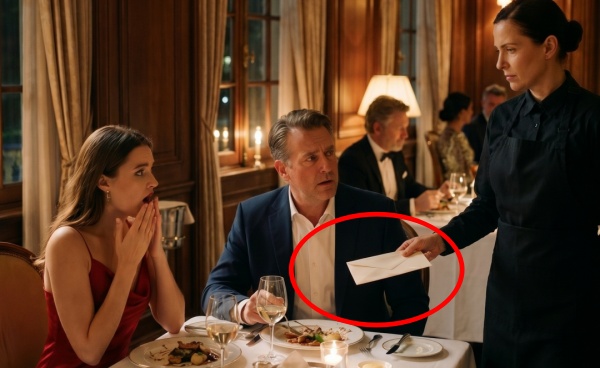
The Waiter Handed My Husband an Envelope During Dinner With His Mistress— And One Page Made His Face Go White
Ethan thought he was having one last private dinner with the woman he had been hiding from me for months. He smiled like a man who still controlled the story—until the waiter placed a sealed legal envelope beside his wineglass. At first, he looked annoyed by the interruption. Then he opened it, saw the confidential health-related evidence my attorney had prepared, and realized his affair was no longer just a betrayal—it was a legal disaster.
Part 1: The Reservation for Two
The waiter handed my husband an envelope during dinner with his mistress.
At first, Ethan looked annoyed.
That was the part I remember most clearly—not fear, not guilt, not shame. Annoyance. The same impatient little frown he used when a flight was delayed, when our daughter spilled juice in his car, or when I asked why his “late client meetings” always ended with a shower before he touched anything in our house.
He was sitting in the back dining room of a private steakhouse in Midtown Manhattan, at a corner table lit by two small candles and a $240 bottle of Napa Cabernet. Across from him sat Vanessa Lowell, his executive assistant, wearing a black satin dress and the diamond tennis bracelet I had seen on our credit card statement three weeks earlier. The bracelet had been listed as a “client appreciation gift.”
Apparently, Ethan appreciated his assistant very much.
My name is Rachel Morgan, and I had been married to Ethan for eleven years.
We lived in a brownstone on the Upper West Side with our seven-year-old daughter, Lily, a rescue dog named Biscuit, and the kind of life people assumed was solid because the Christmas cards looked expensive. Ethan was a partner at a financial consulting firm. I ran operations for a children’s literacy nonprofit in Brooklyn. We were not billionaire-rich, but we were New York comfortable—the kind of comfortable where people still complained about grocery prices while paying private school tuition.
For years, I thought our marriage had ordinary problems.
Too much work.
Too little time.
A child who needed us.
A mortgage that made both of us pretend not to panic whenever the property tax bill arrived.
Ethan had always been ambitious, but in the early years, I admired that. He came from a working-class family in Queens, put himself through NYU, and built a career with charm, discipline, and a terrifying ability to remember everyone’s favorite bourbon. When we met, he was funny, hungry, and still grateful for small things.
Then success changed the shape of his hunger.
He started calling himself “a provider” whenever I asked for emotional presence. He used “stress” as a password that unlocked forgiveness. He missed parent-teacher meetings, forgot my birthday twice, and once told me I was lucky he worked so hard because “not every woman gets this life.”
This life.
As if our marriage were an apartment he rented for me.
The affair did not reveal itself all at once. It came in fragments, like a crime scene assembled from receipts.
A hotel bar charge in SoHo on a night he claimed he was at a board dinner in Jersey City.
A rideshare receipt to Tribeca at 1:14 a.m.
A second phone I found in the pocket of his gym bag, dead but not dead enough to hide the cracked screen notification: Miss you already.
And then there was Vanessa.
She had been his assistant for almost two years. I had met her at office events, where she smiled too brightly and touched my arm like we were friends. She remembered Lily’s name, asked about my nonprofit, and once complimented my coat while standing beside my husband in a way that felt too familiar for someone on payroll.
When I asked Ethan about her, he laughed.
“Vanessa?” he said, loosening his tie in our bedroom mirror. “Rachel, she’s twenty-nine. She lives on cold brew and ambition. Don’t be ridiculous.”
Ridiculous.
That was one of his favorite words for me.
Ridiculous when I asked questions.
Ridiculous when I noticed distance.
Ridiculous when I said I felt alone.
For a while, I let that word do its job. I quieted down. I told myself not to become the suspicious wife. I told myself smart women did not destroy families over instincts.
Then the envelope arrived at our house.
It came by courier on a rainy Thursday afternoon in early November, addressed to Ethan Morgan, Personal and Confidential. I almost left it on the hall table with the other mail. But the return address stopped me.
A medical clinic in Chelsea.
Not a hospital.
Not our family doctor.
A private clinic.
My stomach tightened.
I did not open it. That matters.
I am saying that clearly because in America, medical privacy is serious. People love dramatic stories where someone steals records, exposes a diagnosis, and calls it justice. That is not justice. That is a lawsuit waiting to happen.
I did not open Ethan’s mail.
But I did take a photo of the envelope.
Then I placed it on his desk.
The next morning, it was gone.
Ethan said nothing.
Three days later, I received a text from an unknown number.
“Mrs. Morgan, I know you don’t know me. I know you probably hate me. But you need to get tested. He knows why. I’m sorry.”
Attached was a screenshot of messages between Ethan and Vanessa.
Vanessa: “You have to tell Rachel. This is not optional.”
Ethan: “Don’t bring my wife into this.”
Vanessa: “She has a right to know.”
Ethan: “You’re being dramatic.”
Vanessa: “My doctor said anyone exposed should be notified. I sent you the paperwork.”
Ethan: “Stop texting me about this.”
I read the messages while standing in my kitchen, Lily’s lunchbox open on the counter, a peanut butter sandwich half-wrapped in wax paper.
My hands went numb.
I did not know what the medical issue was. Vanessa had not named it in that first message. But the phrase “anyone exposed should be notified” was enough to turn my entire body cold.
This was no longer just an affair.
This was health.
This was consent.
This was my life and possibly my child’s home being dragged into a risk I had never agreed to take.
I called my doctor that morning.
Then I called an attorney.
Her name was Marianne Tate, a family law attorney with offices near Bryant Park. She had sharp gray eyes, a calm voice, and the kind of professional stillness that made panic feel inefficient. I sat across from her in a conference room with a box of tissues between us and told her everything.
When I finished, she folded her hands.
“First,” she said, “you need medical care and documented testing through your own physician. Second, do not share anyone’s private medical information publicly. Third, preserve communications. Fourth, if the other woman voluntarily provides evidence to counsel, we can use it appropriately and under confidentiality protections.”
I stared at her. “So I can’t just confront him?”
“You can,” Marianne said. “But if you do it emotionally, he will make your reaction the issue. If you do it strategically, the facts remain the issue.”
That sentence saved me.
Over the next two weeks, Vanessa sent more information—not to me directly, but to my attorney. She said she had ended the affair after Ethan refused to tell me about a potential exposure. She provided copies of text messages, clinic notices she had lawfully received, and proof that she had repeatedly urged Ethan to notify me.
Marianne reviewed everything.
The medical records stayed confidential. Redacted. Protected. Handled properly.
But the truth was clear enough.
Ethan had known.
He had known there was a serious health concern connected to his affair.
He had known I should be told.
He had chosen silence.
By then, I no longer wanted an explanation.
I wanted timing.
And timing arrived when I found the reservation.
A table for two at Hawthorne & Gray, one of the most exclusive steakhouses in Midtown, booked under Ethan’s name for Friday at 8:00 p.m. Vanessa had told my attorney she had agreed to meet him once more because he claimed he wanted to “settle things privately.”
Privately.
That was Ethan’s favorite location for accountability.
So Marianne arranged for him to receive a sealed legal envelope at the restaurant. Not a public announcement. Not a stunt. Not stolen medical records slapped onto a table for strangers to see.
A lawful notice.
A preservation demand.
A copy of the divorce petition.
And a confidential summary of the evidence—including the fact that Vanessa had provided proof he had failed to notify his wife of a serious infectious disease concern.
The man who loved secrecy was about to be served with consequences in the one place he thought he was safe.
Part 2: The Envelope at Hawthorne & Gray
I was not sitting at their table.
That was important to me.
I was across the dining room, at the bar, wearing a navy wrap dress, my wedding ring in my purse, and an expression calm enough to make the bartender call me “ma’am” twice. Marianne sat beside me with a glass of sparkling water and a leather folder closed in front of her.
“You do not have to stay,” she said.
“I know.”
“If he approaches you, let me speak first.”
“I know.”
“If you feel yourself wanting to throw something—”
“I won’t.”
She looked at me over her glasses. “I was going to say throw it at me first. I bill hourly. I can take it.”
Despite everything, I laughed.
I needed that laugh.
Across the room, Ethan was already seated with Vanessa. He looked handsome, because of course he did. Betrayal often wears a tailored suit. He had on the charcoal one I bought him for his fortieth birthday, the one he said made him feel “like a serious man.”
Vanessa sat stiffly across from him.
She did not look like a mistress celebrating a stolen romance. She looked pale, nervous, and trapped in a story that had stopped flattering her. Her hair was pulled back, her makeup minimal, and her hands stayed wrapped around her water glass as if she needed something to hold.
Ethan leaned forward, talking quickly.
I could not hear him, but I knew the rhythm. Ethan explaining. Ethan reframing. Ethan making his choices sound like circumstances.
Vanessa shook her head once.
He reached for her hand.
She pulled away.
Something in me loosened.
Not because I cared whether she still wanted him. Because for months, I had imagined her as this powerful rival, a woman who had stolen something from me. But watching her across the room, I understood something uglier and more human.
Ethan had lied to both of us.
Differently, maybe.
But effectively.
At 8:17 p.m., a waiter approached their table carrying a small silver tray. On it was a cream envelope.
Ethan frowned.
The waiter bent slightly. “Mr. Morgan?”
Ethan looked irritated. “Yes?”
“This was left for you at the host stand.”
He took it with the annoyed impatience of a man who believed interruptions existed to insult him.
Vanessa looked at the envelope.
Her face changed first.
Ethan noticed.
He turned it over. His name was printed on the front in plain black type.
ETHAN JAMES MORGAN
PERSONAL AND CONFIDENTIAL
LEGAL NOTICE
His annoyance flickered.
He opened it.
At first, he skimmed quickly. Then he stopped.
I watched the color drain from his face.
The man who could charm investors, talk down angry clients, and lie to his wife without blinking suddenly looked like someone had removed the floor beneath him.
His eyes moved faster.
Divorce petition.
Preservation notice.
Financial review.
Health disclosure evidence.
Vanessa’s voluntary documentation.
Potential exposure.
Failure to notify spouse.
Confidential medical records handled through counsel.
He looked up sharply and scanned the dining room.
His eyes found me at the bar.
For a moment, we simply stared at each other across the expensive room.
The steakhouse kept moving around us. Forks touched plates. Wine was poured. A couple laughed near the fireplace. A waiter carried a tray of oysters past a man whose marriage was ending in real time.
Ethan stood so fast his chair legs scraped the floor.
Vanessa flinched.
Marianne placed one hand gently on my wrist. “Let him come to us.”
He did.
He crossed the room holding the envelope like it burned him. His face was pale, his jaw tight, and for the first time in our marriage, I saw genuine fear behind his eyes.
“Rachel,” he said, voice low. “What the hell is this?”
Marianne stood before I could answer.
“Mr. Morgan, I’m Marianne Tate, counsel for your wife. You’ve been served with legal notice. I suggest you read the documents fully before making any statements.”
He ignored her and looked at me. “You had me served at dinner?”
“You had dinner with your mistress after hiding a health risk from your wife,” I said. “Please don’t lecture me about timing.”
His eyes flashed. “You don’t understand what’s in here.”
“I understand enough.”
“No, you don’t.” His voice dropped to a whisper. “Those are private medical records.”
Marianne stepped in. “The documents provided to you include a redacted evidence summary and notices relevant to civil proceedings. Any underlying medical documentation has been handled confidentially and lawfully. No diagnosis has been disclosed publicly.”
Ethan looked trapped.
Good.
Not because I wanted him humiliated.
Because trapped was how I had felt every night he made me doubt myself.
He leaned toward me. “Rachel, we need to talk alone.”
“No.”
“This is my life.”
I almost smiled.
“Interesting,” I said. “When it was my health, you didn’t seem to consider it my life.”
That landed.
His mouth opened, then closed.
Vanessa had followed him halfway across the room but stopped near a column. She looked at me, and I saw tears in her eyes. I did not comfort her. I did not attack her either.
That restraint cost me more than anyone will ever know.
Ethan turned slightly, noticing the nearby tables had grown quiet.
He lowered his voice. “Don’t make a scene.”
There it was.
The classic line.
The line men use when the consequence of their behavior becomes more embarrassing than the behavior itself.
“I’m not making a scene,” I said. “I’m leaving.”
I picked up my purse.
He reached for my arm, then seemed to remember where he was and stopped himself.
“Rachel,” he whispered. “Please.”
I looked at the man I had loved for eleven years. The father of my child. The man who once cried in a hospital hallway when Lily was born because he said he had never believed he could love someone that much. The man who had risked my trust, my body, and our family’s stability because honesty was inconvenient.
“You had so many chances to tell me,” I said.
His eyes filled.
“I was scared.”
“So was I,” I said. “But I did not get to know why.”
Then I walked out of Hawthorne & Gray with my attorney beside me.
Behind me, I heard Ethan say my name once more.
I did not turn around.
Part 3: What He Knew
The worst part was not the affair.
People expect that to be the worst part, because betrayal is dramatic and easy to understand. Another woman. A secret dinner. A hotel room. A husband slipping off his wedding ring as if vows were jewelry.
But the worst part was the silence.
The worst part was knowing Ethan had received medical information connected to a serious infectious disease concern and decided I did not deserve the truth. He had taken away my ability to make informed choices about my own health. He had turned my trust into a locked room and kept the key in his pocket.
The next morning, I woke up in my sister Caroline’s guest room in Hoboken.
Lily was asleep beside me, one hand tucked under her cheek, her stuffed rabbit pressed against her chest. I had picked her up from school the day before and told her we were having a sleepover at Aunt Caroline’s. She was thrilled because Caroline kept sugary cereal in the pantry and did not believe in bedtime enforcement.
I watched my daughter sleep and felt anger settle into a shape I could carry.
Not explosive anger.
Useful anger.
At 7:12 a.m., Ethan called.
I let it go to voicemail.
Then he texted.
“Please. I need to explain.”
“I made a mistake.”
“Vanessa is trying to make me look worse than I am.”
“Rachel, don’t punish Lily for this.”
That last one almost got a response.
Almost.
Instead, I forwarded it to Marianne.
She replied: “Do not engage. We will respond through counsel.”
So I did not engage.
By 9:00 a.m., Marianne had received an email from Ethan’s attorney, which meant he had found representation quickly. Good. I wanted him represented. Represented people are less likely to perform panic in your inbox.
At 10:30, I went to my doctor.
I will not describe the testing, because some parts of a woman’s dignity do not belong to strangers. I will say this: sitting in a medical office because your husband was too cowardly to tell you the truth is a special kind of loneliness. The nurse was kind. My doctor was careful. Nobody judged me.
That almost made me cry.
When the doctor asked whether I felt safe at home, I paused too long.
Not because Ethan had ever hit me. He had not. But safety is bigger than bruises. Safety is being able to trust the person sleeping beside you not to gamble with your life and call it complicated.
“I don’t know,” I said.
She nodded like she understood.
Later, Marianne and I built the timeline.
September 3: Ethan and Vanessa’s messages began shifting from professional to personal.
September 19: First hotel charge.
October 4: Vanessa told Ethan she had received concerning test results and was under medical care.
October 5: Vanessa urged Ethan to notify me and seek testing.
October 6: Ethan replied, “I’ll handle it.”
October 7: Ethan came home late, kissed me on the forehead, and asked if I wanted to watch a movie.
He did not “handle it.”
He handled me.
That was the pattern.
When I felt suspicious, he handled me with irritation.
When I felt lonely, he handled me with gifts.
When I got close to the truth, he handled me with accusations.
“You’re anxious.”
“You’re reading into things.”
“You’re letting your nonprofit stress spill into our marriage.”
He made my instincts sound like symptoms.
By the time I finished reading the timeline, I no longer felt like a wife whose marriage had failed. I felt like a witness in a case where my own life had been evidence.
Caroline found me at her kitchen table with papers spread around a mug of cold coffee.
She sat across from me quietly.
Caroline is two years older than me and has the emotional range of a courtroom judge until someone hurts me, at which point she becomes a weapon in yoga pants.
“Do you want me to say something comforting or something actionable?” she asked.
“Actionable.”
“Good. Comforting is not my brand.”
I almost smiled.
She tapped the documents. “What do you need?”
“A place for Lily and me for a few days.”
“Done.”
“Someone to pick up Biscuit from the brownstone.”
“Done.”
“Someone to stop me from texting Ethan things that would feel good for ten seconds and look terrible in court.”
Caroline took my phone and slid it into her hoodie pocket.
“Very done.”
That afternoon, Ethan tried to come to Caroline’s building.
The doorman called up. Caroline answered, listened, then looked at me.
“He’s downstairs.”
My stomach tightened.
Lily was in the living room watching a cartoon, unaware that her father was standing under a lobby chandelier trying to get upstairs to the consequences of his own choices.
“Tell him to leave,” I said.
Caroline smiled faintly. “With pleasure.”
She went downstairs.
I did not hear what she said, but Ethan left within four minutes.
When she returned, she handed me my phone.
“What did you say?”
“That this is a residential building, not a redemption arc.”
Despite everything, I laughed.
Then I cried.
Caroline sat beside me and let me.
That night, after Lily fell asleep, I checked my voicemail.
Ethan had left one message.
His voice sounded wrecked.
“Rachel, I know I failed you. I know I should have told you. I was ashamed and scared and I kept thinking if I waited, maybe it would all turn out to be nothing and I wouldn’t have to destroy everything. That was selfish. I see that now. Please let me talk to you. Please don’t let Lily think I don’t love her.”
I listened once.
Then I saved it for my attorney.
Not because I did not feel anything.
Because feeling something was no longer the same as trusting it.
Part 4: The Dinner Became Evidence
Ethan’s firm found out two weeks later.
Not from me.
That distinction mattered.
I did not call his boss. I did not send screenshots to gossip pages. I did not post a dramatic Facebook confession naming Vanessa, the clinic, or the steakhouse. I wanted to. I am human. But my doctor and my lawyer had both told me the same thing in different languages: protect your health, protect your child, protect the record.
The firm found out because Ethan had used company resources to facilitate the affair.
Corporate card charges.
Travel reimbursements.
After-hours access logs.
Calendar manipulation involving Vanessa.
An internal HR complaint Vanessa filed after realizing Ethan had misled her, pressured her to keep quiet, and involved her in a situation that could damage her career and health privacy.
The office rumor mill did the rest.
Ethan was placed on leave pending review. Vanessa resigned after negotiating terms through her own attorney. Everyone acted professionally in public, because that is how companies say “disaster” without using the word.
Ethan called me after the leave became official.
This time, I answered with Marianne on the line.
He sounded smaller.
“Rachel, they’re reviewing everything.”
Marianne spoke first. “Mr. Morgan, this call is being conducted with both parties aware that counsel is present. Please keep the discussion to parenting logistics unless your attorney is also joining.”
“I just want to speak to my wife.”
“She is your co-parent,” Marianne said calmly. “The marital relationship is subject to pending proceedings.”
There was silence.
Then Ethan said, “Rachel?”
I closed my eyes.
“Yes.”
“I am sorry.”
The words landed softly and uselessly.
“I know,” I said.
“I didn’t mean to hurt you like this.”
That sentence lit something in me.
“Then how did you mean to hurt me?”
He went quiet.
I continued, my voice steady. “Did you intend for the affair to be painless? Did you intend for the medical risk to disappear because you ignored it? Did you intend for me to never find out and live gratefully inside a lie?”
Marianne did not interrupt.
Ethan’s voice broke. “I was trying to avoid panic.”
“No,” I said. “You were trying to avoid accountability.”
That was the end of the call.
The divorce filing became formal before Thanksgiving.
Ethan moved into a short-term rental in Long Island City. Lily and I returned to the brownstone after Marianne arranged temporary agreements about access, finances, and parenting time. Ethan was allowed scheduled visits with Lily, but the exchanges happened at Caroline’s apartment or school until things stabilized.
Lily asked questions.
Children always do.
“Why isn’t Daddy sleeping here?”
“Mommy and Daddy are having grown-up problems.”
“Did I do something?”
“No, baby. Never.”
“Is Daddy sick?”
That question stopped me cold.
She had heard too much. Not specifics, thank God, but enough adult whispering to form fear.
I knelt in front of her. “Daddy is okay. Mommy is okay. And if anyone needs a doctor, doctors help. You do not have to worry about grown-up health things.”
She studied me with Ethan’s brown eyes.
“Are you mad at Daddy?”
I breathed in slowly.
“Yes,” I said. “But being mad does not mean I want you to stop loving him.”
Her little face softened with relief.
That was the hardest part.
Not making my pain into her inheritance.
By December, my test results were clear. I cried in the doctor’s office, not because everything was suddenly fine, but because my body had been holding fear so tightly that relief hurt. My doctor reminded me to continue follow-up as recommended, and I did.
I followed every instruction.
I had learned what happens when people decide medical truth is optional.
Ethan’s career did not recover quickly. His firm allowed him to resign instead of firing him publicly, which was more grace than he had earned. He lost clients, status, and the effortless confidence that had once made him dangerous.
But what shocked him most was losing access to me.
He had expected anger. He had prepared for crying. He had even prepared for negotiation.
He had not prepared for boundaries.
Our communication moved to a parenting app. He hated it. The app timestamped everything, preserved everything, and removed the fog where manipulation liked to live.
One night, he wrote:
“I miss my family.”
I replied:
“Your parenting time is Saturday at 10. Please confirm pickup location.”
He replied:
“That’s cold.”
I stared at the message for a long time.
Then I typed:
“Cold is withholding information that affects another person’s health. This is logistics.”
He did not respond.
Good.
Some truths do not require debate.
The settlement discussions began in January. They were not dramatic, just exhausting. Money, retirement accounts, home equity, child support, health insurance, school tuition. The unromantic inventory of a broken life.
Ethan tried, at first, to argue that the affair had no financial relevance.
Marianne produced the charges.
He tried to argue that the health issue was private and should not affect custody.
Marianne agreed that medical details should remain private, then calmly explained that his failure to disclose a serious risk and his pattern of dishonesty were relevant to decision-making and trust.
His attorney stopped arguing that point quickly.
At mediation, Ethan finally said the sentence I had needed to hear months earlier.
“I took away your choice.”
The room went still.
I looked at him across the polished table.
His face was tired, older, stripped of the charm he used to wear like cologne.
“Yes,” I said. “You did.”
He swallowed.
“I am sorry.”
This time, the apology did not fix anything.
But it named the wound correctly.
That mattered.
Part 5: The Woman at the Bar
The divorce was finalized in May.
By then, spring had returned to New York, softening the trees along Riverside Park and filling playgrounds with children in light jackets. Lily had adjusted to two homes better than I expected and worse than I hoped. Some nights she was fine. Some nights she cried because she missed “old us.”
I missed old us too.
Or maybe I missed what I thought old us was.
Ethan became a more attentive father after the divorce, which annoyed me at first. He learned Lily’s school schedule, packed snacks she actually liked, and stopped treating parenting like a guest appearance. Part of me wanted to resent the improvement because it arrived too late for the marriage.
But Lily deserved the better version of him, even if I did not.
So I allowed it.
With boundaries.
Always boundaries.
Vanessa left New York for Seattle. Before she moved, she sent one message through her attorney to mine. It said she was sorry for her role in the affair, sorry for the pain caused, and grateful that I had not exposed her medical information publicly.
I read the message twice.
Then I asked Marianne to send back one sentence:
“I hope you heal and make different choices.”
That was all I had in me.
People imagine forgiveness as warmth. Sometimes forgiveness is simply refusing to keep a room for someone inside your mind.
A year after the dinner at Hawthorne & Gray, I went back.
Not with Ethan.
Not with a date.
Alone.
Caroline thought this was either therapeutic or insane. Marianne said it was “emotionally ambitious.” My therapist said, “Notice what your body tells you, and leave whenever you want.”
So I made a reservation for one at the bar.
The same bartender was there, though he did not recognize me. Why would he? To him, I had been one quiet woman in a navy dress watching her life collapse under steakhouse lighting.
I ordered sparkling water first.
Then a steak.
Then, because I felt like reclaiming something expensive from memory, a glass of Cabernet.
The room looked the same. Dark wood. White tablecloths. Low music. Men in suits performing importance. Women laughing carefully. Waiters moving like secrets had weight and could be carried on silver trays.
For a moment, I saw it again.
Ethan at the table.
Vanessa across from him.
The envelope.
His face going pale.
But this time, the memory did not own me.
It passed through like weather.
Halfway through dinner, an older woman sitting two seats down glanced at me and smiled.
“Celebrating something?” she asked.
I thought about the divorce papers, the doctor’s call, the parenting app, Lily’s laughter returning, the first night I slept without checking whether Ethan was lying beside me.
“Yes,” I said. “Health.”
She raised her glass. “That’s the best thing to celebrate.”
I raised mine too.
She had no idea.
After dinner, I walked outside into the Manhattan night. The city was loud and alive, indifferent in the way cities are. A taxi honked. A couple argued near the curb. A group of women in heels laughed under the awning.
My phone buzzed.
A message from Ethan on the parenting app.
“Lily finished her book report. She wants to read it to you tomorrow. Also, she says Biscuit needs a sweater because he looked chilly.”
I smiled despite myself.
I typed back:
“Tell her I agree about the sweater. Pickup at 6?”
He replied:
“Confirmed.”
That was our marriage now.
A schedule.
A child.
A dog sweater.
Peace in small, documented pieces.
As I walked toward the subway, I thought about the envelope.
People would hear the story and focus on the drama: the waiter, the mistress, the medical records, my husband’s face turning pale in a steakhouse where people paid $80 for ribeye. They would want the scandal version, the revenge version, the version where I exposed everyone and walked out to applause.
But that is not what saved me.
What saved me was not public humiliation.
It was information.
It was the doctor who treated me with dignity.
The attorney who told me to protect the record.
The sister who took my phone when I wanted to burn my life down with one text.
The discipline to understand that rage is real, but evidence is stronger.
Ethan lost his marriage, his reputation, and the version of himself he had spent years selling to everyone else. Vanessa lost the fantasy that being chosen by a married man meant she had won something. I lost the illusion that love could survive without honesty.
But I gained something too.
I gained the right to make decisions with the truth in my hands.
That is what he had stolen from me.
Not just fidelity.
Not just trust.
Choice.
So if you are reading this and wondering whether the thing you suspect is worth investigating, listen to me carefully:
You do not need to be dramatic.
You do not need to scream in restaurants.
You do not need to expose private information or become cruel to prove you were hurt.
But you do need the truth.
Because love without truth is not love.
It is a room where someone else controls the lights.
And the night that waiter handed my husband that envelope, the lights finally came on.
