I Watched My Husband Dance With His Mistress at Our Company’s Gala. I Took Off My Ring, Left It on the Table Between Them, and Walked Out. He Had No Idea the Woman He’d Been Trying to Erase Had Already Dismantled Everything — Before the Night Was Over.
He spent the evening performing a love story with someone else. He didn’t know his wife had already written the final chapter.
PART ONE: The Company We Built Together
My name is Vivienne Calloway, and the company on the invitation — Calloway-Reeves Strategic Communications, Atlanta, Georgia — had my name on it first, which was not an accident and not a formality. It was the accurate record of the order in which things had happened.
I had founded the company eleven years earlier, in a second-floor office on Peachtree Road in Buckhead, with $47,000 in personal savings, a client list of three, and the specific, clarifying certainty of a woman who has spent six years working inside someone else’s firm and has finally run out of reasons not to build her own.
The name had been Calloway Strategic Communications for three years — three years of building the client roster, the team, the brand, the methodologies, the operational infrastructure — before I met Thomas Reeves at an industry conference in Nashville and understood, within approximately forty-five minutes of conversation, that he had the business development instinct that I lacked and that I had the strategic depth that he lacked, and that these two deficits, combined, would make something significantly better than either of us could make alone.
Thomas joined as a partner in the fourth year. His name went on the door. The company became what it became — eighteen employees, a client list that included four major Atlanta-area corporations and two regional nonprofits, annual revenue of $6.2 million, a reputation in the Southeast communications industry that had taken eleven years of my specific, relentless attention to build. Thomas was good at his work. I want to say that clearly and without the corrosive distortion of hindsight, because he was, and the company was better for his partnership, and none of that changes what he did or how the gala ended.
We had been married for seven years. We had met three years after he joined the company, which meant our professional partnership preceded our personal one, and the layering of those two relationships — the shared work, the shared home, the shared equity stake in something we had both built with our actual hands — created an intimacy that I had believed, for most of those seven years, was the specific, irreplaceable foundation of something that could not simply be undone. I was wrong about the undoing. I was not wrong about the foundation.
Her name was Priya Chandler. She was thirty-one years old, our Director of Client Services, and she had been with the company for two years and with my husband for approximately fourteen months, which placed the beginning of their relationship at a point that I would later document with the careful, specific attention that my attorney, Renata James of James & Whitfield Family Law on Piedmont Road, would describe as “unusually thorough.” I had not been unusually thorough by accident. I had been unusually thorough because I had been watching for eleven months, and watching, when you are a communications strategist by training and a meticulous person by disposition, produces documentation.
I had said nothing. I want to be very clear about this, because the decision to observe rather than confront is often misread as weakness, and it was the opposite. I had spent eleven months building a picture — not with suspicion or paranoia, but with the specific, methodical clarity of a woman who understands that the truth she assembles with evidence is unassailable in ways that the truth she announces with emotion is not. I had assembled it. By the night of the gala, it was complete.
PART TWO: The Gala
The annual Calloway-Reeves client gala was held on the first Friday of November, at the Ballroom at St. Regis Atlanta on Peachtree Road — a venue I had selected in September, organized with our events coordinator, and prepared for with the same professional attention I brought to every company event, because Calloway-Reeves events were, in addition to being client appreciation occasions, brand expressions, and the quality of their execution reflected directly on the firm’s reputation.
I had worn a navy crepe gown I’d bought at Saks Fifth Avenue on Peachtree Street and had my hair done at the Blo salon in Midtown. I had arrived with Thomas, in the back of a rideshare, and I had walked into the St. Regis ballroom on my husband’s arm with the specific, composed ease of a woman who knows exactly what the evening holds and has already decided how she is going to move through it.
The ring was a cushion-cut diamond in a platinum pavé setting, 1.8 carats, purchased at Richter’s Jewelers on Peachtree in 2017, and I had worn it for seven years. I want to describe it precisely because it matters to what I did with it later.
The evening proceeded in the way that client galas proceed — cocktail hour, dinner, remarks from Thomas and me, the specific, warm circulation of two people who have done this enough times to make it look effortless. I spoke to clients. I spoke to our team. I had a glass of Malbec that I held more than I drank. Thomas was beside me for the first two hours with the specific, practiced ease of a man who has had eleven months to become accustomed to managing two realities in a single room, and I watched him manage it with the particular, cold attention of a woman who is observing rather than participating.
It was at nine-forty-seven that the evening changed. I know the time because I looked at my phone specifically to note it — the specific, deliberate attention of someone who understands that timestamps matter and has developed the habit of creating them. The band had moved into a slower set. The dance floor, which had been energetic and crowded through the upbeat songs, had thinned to the couples who wanted to be close to each other. Thomas had crossed the room to where Priya was standing near the far end of the bar, and he had said something to her, and she had smiled in the specific way of someone who has been waiting for permission, and they had walked together to the dance floor.
I watched them from across the ballroom. I was standing near the entrance to the terrace with a view of the entire room, which was not an accident — I had positioned myself there twenty minutes earlier, when I saw Thomas begin his slow migration toward the bar where Priya had been standing.
I watched them move together on the dance floor with the specific, practiced ease of two people who have done this before in private and are doing it now in the specific, emboldened carelessness of people who have decided the audience either doesn’t see or doesn’t matter. Several of our clients were on that dance floor. Several of our employees were watching from the perimeter. The room was seeing what I was seeing.
I felt, standing on that terrace threshold, a remarkable absence of the things I had expected to feel. Not the hot, ragged surge of humiliation I had prepared for, not the specific, gasping shock of betrayal delivered in public. What I felt instead was a clean, cold clarity — the clarity of a woman who has been watching for eleven months and is now watching the final frame of a film she has already seen in its entirety. I was not surprised. I was not undone. I was simply finished.
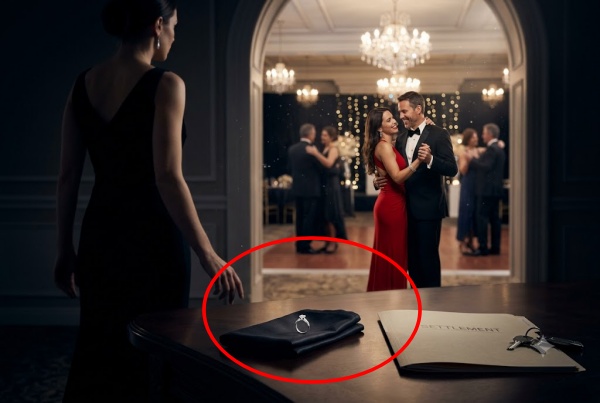
I set my glass on the nearest table. I opened my clutch. I took out the ring — not dramatically, not with the performance of a woman making a scene, but with the specific, quiet deliberateness of a woman completing an action she has already decided to take. I held it for a moment in my palm.
Then I walked to their table — the table assigned to Thomas and me for the evening, where his jacket was draped over his chair and his phone was face-down next to his half-empty glass — and I set the ring on the white tablecloth, precisely in the center of the space between his jacket and his phone, in a position it was not possible to overlook. I did not look at the dance floor. I picked up my clutch, walked through the St. Regis ballroom toward the exit, and handed my valet ticket to the attendant outside.
I was in my car and driving north on Peachtree Road toward Buckhead at nine fifty-eight PM. I called Renata James and left a voicemail that said: “Renata, it’s Vivienne. The gala was tonight. I’m ready to file Monday. Please call me in the morning.”
Then I drove home and began the final piece of a plan I had been building for four months.
PART THREE: The Four Months Before the Gala
I need to tell you about the four months, because the ring on the table was not a beginning. It was a period at the end of a sentence that had been written very carefully over a very long time.
Renata James had been my attorney since July — four months before the gala — retained at the recommendation of my accountant, David Osei of Osei Financial Group in Buckhead, who had been watching the company’s books with the specific, practiced attention of a CPA who has seen enough marital dissolutions to know when a client should have an attorney on standby.
Georgia is an equitable distribution state, which meant the division of marital assets in a divorce was governed by fairness rather than strict equality, and the assessment of fairness depended significantly on the documentation of each spouse’s contributions to the marital estate. David had explained this to me with the specific, clinical precision of a man who deals in facts and wanted me to have mine in order.
My contributions to Calloway-Reeves were, as a matter of the public record and the company’s founding documents, foundational. I had founded the company. I had built it for three years before Thomas joined. I owned fifty-one percent of the equity, a majority stake that I had negotiated in the partnership agreement specifically and deliberately, with the advice of a business attorney, because I understood even in the optimism of early partnership that the person who builds the foundation retains a different relationship to the structure than the person who joins it.
That fifty-one percent was the single most important number in the financial landscape of what was coming, and both David and Renata had confirmed its significance in the specific, careful terms of professionals advising a client on the terrain of a high-stakes proceeding.
The company’s operating agreement also contained a clause — one I had drafted, with legal counsel, when Thomas joined as partner — that addressed the conduct of partners in relation to company employees. The clause was not an infidelity provision in a personal sense; it was a conflict-of-interest provision in a professional one, and it specified that a partner engaged in a personal relationship with a direct report had an obligation to disclose the relationship to the other partner and to the company’s HR framework. Thomas had not disclosed. The relationship had been ongoing for fourteen months. The clause had been in the operating agreement for eight years.
Renata had reviewed the clause in August and had described it, with the specific, careful language of an attorney who chooses her words precisely, as “a meaningful piece of the partnership dissolution framework.” This was the piece Thomas did not know about. He did not know about it because he had not read the operating agreement carefully since he signed it eight years ago, which was his own professional failure and not mine, and because I had not reminded him.
I had also, in the four months between retaining Renata and the night of the gala, taken the following steps, all of which were legally appropriate and all of which Renata had reviewed and advised on. I had engaged a forensic accountant, separate from David, named Patricia Holt of Holt Forensic Accounting in midtown Atlanta, to prepare an independent valuation of my founding contribution to Calloway-Reeves and of the company’s current value.
I had begun the process of identifying the clients whose primary relationship was with me — the clients who had come to the company because of my reputation, whose accounts I managed personally, whose loyalty was to Vivienne Calloway the strategist rather than to Calloway-Reeves the brand. I had not contacted those clients. I had not suggested, implied, or hinted at anything. I had simply documented, accurately, the nature of each client relationship, because documentation of the truth is not interference.
I had also, quietly and without drama, begun the process of researching the formation of a new entity — Calloway Strategic Group LLC — with a business attorney separate from Renata. I had not filed the paperwork. I was not yet in a position to file it, and doing so prematurely would have been legally and ethically inappropriate. But I had done the research, and the research was ready.
Thomas came home from the gala at twelve-forty-three AM. I was sitting in the living room of our Buckhead house — a four-bedroom Colonial on a quiet street off West Paces Ferry Road — with a cup of tea and the specific, settled composure of a woman who has already made every decision that needs to be made and is simply waiting for the conversation that follows.
He saw the bare left hand first. He stopped in the doorway of the living room with his jacket over his arm and his bow tie loosened and the specific, stopped expression of a man encountering a situation he had not prepared for. “Vivienne.” His voice had the quality of someone testing the temperature of something before committing to it.
“Thomas,” I said. “Sit down.”
PART FOUR: The Conversation That Ended It
He sat. I want to describe the conversation accurately, because the conversation mattered and its shape was not what he expected.
He expected, I think, a confrontation in the mode of a betrayed spouse — the elevated emotion, the accusations, the demand for explanation, the specific, painful theater of a marriage coming apart loudly. He had been managing, for fourteen months, the possibility of this conversation, and the version he had been managing for was the loud one. What he got was different.
I told him I knew about Priya. I told him I had known for eleven months. I told him the specific dates and details that I had documented — not exhaustively, not to wound him, but precisely enough that he understood the scope of what I had assembled and the futility of denial. He sat very still while I spoke, in the way of someone absorbing information that is changing the structural map of a situation he thought he understood.
I told him I had retained Renata James in July. I told him I had an independent valuation of the company completed by Patricia Holt. I told him about the conflict-of-interest clause in the operating agreement — and I watched the specific moment when he remembered the clause and understood what it meant, which was a quieter version of the ring-on-the-table moment, but in its way more significant.
I told him that I intended to file for divorce on Monday morning and that the partnership dissolution would proceed under the terms of the operating agreement, with the conflict-of-interest clause as a relevant factor in the equitable distribution of the company’s assets.
He said, “Vivienne, I can explain—” and I said, “Thomas, I don’t need an explanation. I need you to retain an attorney before Monday.”
He said, “The company—” and I said, “I know. That’s why I’ve been prepared for four months and you haven’t.”
There was a long silence. The specific, complete silence of a man who has arrived at a position with no advantageous move. He had built the partnership, and he had done it well, and the partnership documents I had drafted with careful legal counsel eight years ago would now determine the terms of its dissolution, and those terms were not favorable to a partner who had violated a conflict-of-interest provision and had not disclosed it for fourteen months.
He asked if there was anything he could say that would change my mind. I told him there was not — not because I was angry, though I was, and not because the seven years had not been real, because they had, but because I had spent four months arriving at a decision that I had made with my full, clear, methodical self, and that kind of decision is not subject to revision by a single late-night conversation.
He slept in the guest room. I slept, with the specific, surprising completeness of a woman who has been carrying something very heavy for eleven months and has finally set it down, for seven and a half hours.
I called Renata at eight-fifteen the next morning. She said, “I’ll have the filing ready for Monday.”
I said, “Thank you.” Then I made coffee, sat on the back patio of the Buckhead Colonial, and watched the November morning do what November mornings in Atlanta do — cool and bright and carrying in the air the specific quality of something that is ending and preparing, simultaneously, for what comes next.
PART FIVE: What Came Next
The divorce was filed in Fulton County Superior Court on a Monday morning in November, exactly as Renata had promised. The proceedings were, by the standards of a high-asset dissolution involving a shared business, relatively orderly — not simple, not painless, but orderly, which is what careful preparation produces. Georgia’s equitable distribution framework, combined with the company’s founding documents and the conflict-of-interest clause, produced a settlement structure that Renata described as “appropriately reflective of your contributions and your position.”
I will not recount the financial details in full, because they are not the point. The point is that the woman who had founded the company eleven years earlier, who had built its foundation for three years before any partner arrived, who had drafted the operating agreement with the specific, forward-looking care of someone who understood that foundations determine outcomes — that woman received an outcome that reflected what she had actually built. The fifty-one percent mattered. Patricia Holt’s valuation mattered.
The eleven months of documentation mattered. Every deliberate, methodical, unglamorous step of the four-month preparation mattered in the specific, measurable way that preparation always matters when the moment it was designed for finally arrives.
Priya Chandler resigned from Calloway-Reeves two weeks after the filing — a decision I had neither requested nor encouraged, and which I received with the neutral equanimity of someone who has stopped organizing her professional life around Thomas Reeves’s personal choices. The company needed a Director of Client Services, and I hired one — a woman named Angela Park, who came from a Midtown PR firm with twelve years of experience and the specific, grounded competence of someone who has built her career on results rather than proximity to the right people. Angela was excellent. The company, under her and my leadership in the year that followed, had its best revenue year since founding.
Thomas retained a Buckhead family law attorney and navigated the proceedings with the professional courtesy of a man who understood, from the first Monday morning filing, that the legal landscape was not advantageous and that the most rational course was to reach a fair settlement rather than to contest a position that the documents did not support.
I want to be fair about this: he was difficult in the ways that dissolving partners are difficult, and he was reasonable in the ways that reasonable people manage to be reasonable even when the situation is painful. The dissolution was completed in seven months, which Renata told me was fast for a high-asset business divorce in Fulton County, and I believe it was fast because I had done four months of work before the filing that made the shape of the outcome clear to everyone in the room.
Calloway Strategic Group LLC was formally filed with the Georgia Secretary of State four months after the divorce was finalized. The new entity was a natural evolution — a consulting practice built around the specific, methodological approach I had developed over fifteen years, operating independently of the partnership that had run its course. Three former Calloway-Reeves clients, who had contacted me directly and of their own volition after the dissolution became public, came with me.
I had not solicited them. I want to be absolutely clear about this, because it matters both legally and as a matter of the kind of professional I have always tried to be. They called because the relationship had been with me, and because they had watched the events of the previous year and made their own assessments.
The ring. People ask me about the ring — why I left it on the table, what the gesture meant, whether it was calculated or spontaneous. The honest answer is that it was both. I had been wearing it for seven years. I had carried the decision to remove it for four months, and the moment on the St. Regis dance floor was simply the moment when the carrying was finished. It was not a performance for the room, though the room saw it. It was not a message to Thomas, though he received it. It was, as precisely as I can describe it, the physical completion of an internal decision — the specific, irreversible gesture of a woman who has made up her mind and is letting her hands catch up to her head.
Thomas called me on a Sunday in March, five months after the gala. He said he wanted me to know that he had made the worst mistake of his life. He said the company — the new arrangement, the restructured partnership — was not what he had expected. He said he understood, now, what he had had and what he had done to it. I listened with the same quiet attention I had brought to the conversation in the Buckhead living room in November. When he finished, I said: “Thomas, I built something worth having. I’m proud of that. I hope you do something worth having too.” I did not say it unkindly. I meant every word of it.
I have an office now on West Peachtree Street, in a building with a view of midtown Atlanta that changes color in the late afternoon light in a way I find, every day, genuinely beautiful. Calloway Strategic Group is eighteen months old and has nine clients and four employees and the specific, hard-won quality of something built entirely on your own terms — no partnership documents requiring careful drafting, no operating agreement clauses waiting to be relevant, no second name on the door. Just mine.
There is a framed photograph on my desk from the company’s original founding — the second-floor Peachtree Road office, the year I was thirty-two, a client list of three and $47,000 in savings and the specific, clarifying certainty of a woman who had finally run out of reasons not to build something of her own. I look at it on the days when the work is hard and the building feels slow and I need to remember what it felt like to begin.
The ring — the cushion-cut platinum pavé solitaire from Richter’s — I left on the table at the St. Regis. I do not know what Thomas did with it. I did not ask. What I left on that table was not a piece of jewelry. It was the last thing I had been carrying that belonged to someone else.
Everything I carry now is mine.
