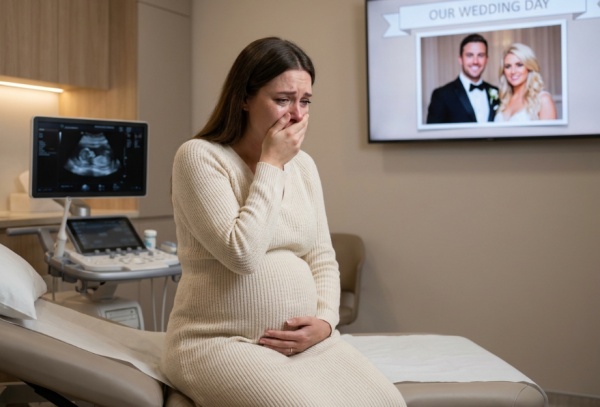
My Husband Announced He Was Marrying His Mistress on National Television While I Was 26 Weeks Pregnant and Lying on an Exam Table Watching Our Baby’s Heartbeat.
And then I finished my appointment, drove to the parking structure, and made the calls that would change everything — because my daughter deserved a mother who moved before she fell apart.
There are moments that split your life into before and after, and mine happened on a Tuesday morning at Cedars-Sinai, in a small room with good light and the sound of my daughter’s heartbeat running like tiny feet toward me from somewhere far away.
After three years of trying and two losses, she was real and strong and exactly where she was supposed to be. And in the same sixty seconds, on the television in the corner, the man I had built that life with was announcing a Hamptons ceremony with a woman I recognized from two industry photographs. I drove home in a different life than the one I’d driven to the hospital in.
PART ONE: The Exam Table
One second, I was lying on the exam table at twenty-six weeks pregnant, staring at the grainy black-and-white image of my daughter’s face. Her heartbeat filled the small room in a fast, beautiful rhythm — like tiny feet running toward me from somewhere far away, which is the only way I have ever been able to describe the sound of a heartbeat you have been waiting three years to hear. After two losses that had left me hollow for months each time, after the specific, grinding hope of fertility treatments that work until they don’t and then require you to reassemble your hope from the beginning — my baby girl was alive. Real. Strong. Twenty-six weeks and measuring perfectly, according to Dr. Rachel Osei, my OB at Cedars-Sinai Medical Center in Los Angeles, who had been with me through both losses and through this pregnancy and who I trusted with a completeness that I reserved for very few people.
The next second, the television mounted in the upper corner of the exam room — the one that was usually tuned to a nature channel with the sound off, the one I had been half-noticing for twenty minutes while Dr. Osei moved the transducer across my belly — cut to breaking news.
The chyron was unmistakable. The anchor’s face was the specific, composed excitement of someone delivering a story they consider significant. The B-roll footage was a photograph I recognized — the lobby of Hartwell Innovations’ headquarters in Santa Monica, the glass-and-steel building I had stood in front of for a company event eighteen months ago, that I had a framed photo of somewhere in the house because my husband had been proud of it and I had been proud of him.
“Tech billionaire and CEO of Hartwell Innovations, Daniel Hartwell, has announced his upcoming marriage to longtime girlfriend Cassandra Voss. The ceremony is expected to take place next month at the Ashford family estate in the Hamptons. Hartwell, whose company went public last year at a valuation of $4.2 billion, has been linked to Voss, a former model and current lifestyle influencer, for approximately—”
Dr. Osei reached up and turned the television off.
I looked at the blank screen. I looked at the ceiling. I looked at Dr. Osei, who was looking at me with the specific, careful expression of a physician assessing a patient who has just received a shock and whose blood pressure is something she is actively concerned about.
“Naomi,” she said, very quietly.
“I’m okay,” I said. My voice sounded, to my own ears, like it was coming from a distance.
“Your blood pressure—”
“I know,” I said. “Give me a minute.”
She gave me a minute. She gave me several minutes, in fact, during which she continued the ultrasound with the quiet professional focus of someone who understood that the best thing she could do for me right now was to keep doing her job, to keep showing me the image on the screen, to keep letting the heartbeat fill the room. I looked at my daughter’s face — the specific, unfinished beauty of a twenty-six-week face, the nose, the curve of the cheek, the hand near her chin — and I thought about what I had just watched on that television screen, and I made a decision.
I was going to get through this appointment. I was going to leave this clinic in the condition I needed to be in to protect my daughter and myself. I was going to grieve this — the full, necessary, devastating grief of what had just been announced on national television about my husband of four years — but I was going to grieve it on my own terms, in my own time, and not on an exam table in a hospital gown with cold ultrasound gel on my abdomen.
“How does she look?” I asked.
Dr. Osei looked at the screen. “She looks perfect,” she said. “She is doing exactly what she should be doing.”
“Good,” I said. “Then let’s finish the appointment.”
PART TWO: The Architecture of a Lie
My name is Naomi Hartwell. I am thirty-seven years old, a former litigation attorney who had left practice two years ago to manage the philanthropic arm of my husband’s company — the Hartwell Foundation, which funded STEM education initiatives in underfunded California school districts and which I had built from a tax designation into a functioning organization that had disbursed $14 million in grants over three years.
I had met Daniel at a charity gala in Beverly Hills when I was thirty-two and he was thirty-five. He was, at the time, the founder of a mid-size tech company that was beginning to attract serious investor attention, and he had the particular magnetism of someone who is intelligent and driven and not yet fully accustomed to being the most important person in the room. I was drawn to the not yet — to the version of ambition that is still in process, that still has enough humility to be interesting. We were married fourteen months after the gala, at a small ceremony in Santa Barbara with forty guests, and the four years that followed had been, by every measure I had been applying, a good marriage — not without friction, not without the occasional hard week, but fundamentally sound.
I understood, driving home from Cedars-Sinai on the afternoon of the ultrasound, that I had been applying the wrong measures.
The signs, retroactively, had been there. The evening trips to the office that ran later and later. The phone managed with the specific carefulness of someone protecting information. A changed energy in the way he was around me — not cold, not absent, but edited, the way people are when they are performing a version of themselves rather than inhabiting it. I had noticed these things and explained them with the vocabulary of a woman whose husband runs a $4.2 billion public company: he’s under pressure, the board is difficult, the IPO aftermath is complicated. All of these explanations were true, and none of them were the full story.
Cassandra Voss. I looked her up from my car in the hospital parking structure before I started the engine, which was probably not the wisest sequencing but which my hands did before my mind could advise against it. Twenty-nine years old. Former model, current influencer with 1.4 million Instagram followers, a curated aesthetic that leaned heavily into wellness and luxury travel and the specific, expensive beauty of someone whose full-time occupation is their own image. She had been photographed with Daniel at two industry events that I could find with a thirty-second search — both times identified in the captions as a “guest” or “friend,” which is the specific caption language that means something and is not meant to.
Longtime girlfriend, the anchor had said. Longtime.
I sat in the parking structure and did the arithmetic that I had been, apparently, declining to do for some period of time. I called my sister, Renee, who lived in Pasadena and who answered on the second ring because she had already seen the news — she told me this immediately, the specific rushed honesty of a person who has been watching something coming toward her sister and couldn’t figure out how to say it first. She was in her car and at my house in forty-five minutes.
I called my attorney while I waited. Not a family law attorney — not yet, not that afternoon. I called my former colleague James Park at Park & Associates on Wilshire Boulevard, who had been a litigation partner at the firm where I had practiced and who knew my situation well enough for me to say “James, I need a family law referral and I need it today” without explanation. He had a name and a number for me in eleven minutes. Her name was Margaret Cho of Cho & Wilder Family Law in Century City. I called and left a message. She called back in twenty minutes. I had an appointment for the following morning.
Renee arrived, made tea, and sat with me on the couch in the house in Brentwood — the house that Daniel and I had purchased three years ago for $3.8 million and that had been, until approximately two hours ago, the house I expected to bring my daughter home to in three and a half months. We sat there for a long time. Renee did not offer explanations or silver linings or the particular, unhelpful comfort of people who want to make a wound smaller than it is. She just sat there, which was what I needed, and she refilled my tea when it was empty, and when I finally cried — which happened at approximately seven-fifteen p.m., when the adrenaline and the operational clarity of the afternoon finally exhausted themselves — she let it happen completely.
“What are you going to do?” she asked, afterward.
“I have an attorney appointment at nine tomorrow,” I said.
She nodded. “That’s the right answer.”
PART THREE: Margaret Cho
Margaret Cho’s office in Century City had the specific, purposeful aesthetic of a woman who practices family law for high-net-worth clients and understands that her environment communicates competence before she says a word — clean lines, good light, the kind of furniture that says I have been doing this long enough to know what matters. She was fifty-two years old, had been practicing California family law for twenty-four years, and had handled dissolution proceedings involving technology company assets and equity structures many times in the preceding decade, which was one of the specific reasons James had recommended her.
I brought everything I had access to. Tax returns for four years. The Hartwell Innovations stock documents that I had been named on as Daniel’s spouse during the IPO process. The Hartwell Foundation’s organizational documents, which established my role as Executive Director and documented the three years of work I had done building the organization. The mortgage documentation on the Brentwood house. The prenuptial agreement that Daniel and I had signed four years ago — which I had reviewed the previous evening, for the first time since signing it, with the specific, focused attention of a woman who needs to understand exactly what she agreed to.
Margaret reviewed the prenuptial agreement first. She was quiet while she read it, which is the specific quiet of someone encountering a document and assessing it against twenty-four years of experience. When she finished, she looked at me and said: “This is a California prenuptial agreement. It was drafted by competent attorneys. It protects Daniel’s pre-marital assets, including Hartwell Innovations as it existed at the time of marriage.” She paused. “It does not, however, account for several significant developments that have occurred since the marriage that are going to be worth examining carefully.”
The significant developments: First, the IPO. Hartwell Innovations had gone public fourteen months into our marriage — eighteen months ago — at a valuation that produced a substantial increase in the company’s assessed value. The question of how much of that increase occurred during the marriage, and how much of that increase was attributable to marital contributions including my own work at the Foundation, which had materially contributed to the company’s public profile and community standing, was a question that California community property law addressed with specific provisions that the prenuptial agreement had not fully anticipated.
California is a community property state, and the earnings, accumulations, and asset growth that occur during a marriage are generally community property regardless of which spouse’s name they are in — unless a valid prenuptial agreement specifically addresses them, and this one had gaps.
Second, the Foundation. I had left a litigation practice — a career with a specific, documented market value — to build and run the Hartwell Foundation. My compensation as Executive Director had been below market rate for the role I performed, a fact that Margaret’s forensic accountant could establish by comparing my compensation to comparable nonprofit leadership positions in Los Angeles. The differential between what I was paid and what the role was worth on the open market was a compensable contribution to the marital estate.
Three years of that differential, compounded against the Foundation’s growth and its documented contribution to the company’s valuation narrative during the IPO roadshow, was a number Margaret’s team wanted to calculate.
Third, the pregnancy. California law provides specific protections for a spouse who is pregnant during dissolution proceedings, including provisions related to the timing of the proceedings and the establishment of paternity, support obligations, and the child’s rights to inherit and be supported from the parent’s estate. Daniel’s announcement of a marriage ceremony scheduled for next month — the words on the news broadcast were seared into my memory with complete clarity — created a legal situation that required immediate attention, because if Daniel was attempting to expedite a second marriage, the legal sequencing of our dissolution mattered significantly.
“He can’t legally remarry,” I said.
“Not until this dissolution is final,” Margaret said. “Which it is not. Which it won’t be for some time. California dissolution has a mandatory six-month waiting period from the date of service, and we haven’t served him yet.”
She looked at me with the focused attention of someone determining how much information her client needs right now versus how much will be most useful in sequence. “Naomi, I want to file this week. Before the news cycle moves on, before he controls the narrative, and before any asset movements occur that we would prefer to intercept. Do you authorize me to proceed?”
I said yes.
We filed on Thursday.
PART FOUR: The Hamptons and What Didn’t Happen There
Daniel was served at the Hartwell Innovations offices in Santa Monica on a Friday morning, by a process server who handled the moment with the professional discretion of someone who understood the specific sensitivity of serving dissolution papers to a public figure at his place of business. I know the approximate time because Margaret’s paralegal called me at ten-forty-seven a.m. to confirm service. I was at my prenatal yoga class in Brentwood — a class I had been attending every Friday for twelve weeks and which I was not going to stop attending because my husband had been served with dissolution papers that morning, because my daughter and I both needed the practice and the community of it.
Daniel called me at eleven-thirty. I let it go to voicemail. He called again. I let it go to voicemail again. His attorney — a prominent Los Angeles family law practitioner named Edward Vance of Vance & Kellerman on Avenue of the Stars — called Margaret the same afternoon and the two of them had the first of what would be many conversations about the proceedings.
The Hamptons ceremony did not happen. I know this because it was reported in the same entertainment media outlets that had reported the announcement, approximately three weeks after the filing, in the specific, briefly-noted way that media reports on things not happening — a short item noting that “the Hartwell ceremony has been postponed indefinitely due to personal circumstances.” Cassandra Voss’s Instagram, which I had stopped looking at by that point as a deliberate act of self-preservation, apparently went quiet for several weeks, which was noted by the entertainment press with the specific interest they bring to influencer silence.
I did not follow any of it closely. I made a conscious and deliberate decision in the week after the filing that my attention — the limited, finite, increasingly valuable resource of a woman who was twenty-seven weeks pregnant and building a legal case and managing the emotional architecture of a significant loss simultaneously — was going to be spent on what I could control and not on what I could not. I could not control what Daniel and Cassandra did or said or planned. I could control what I ate, how I slept, whether I kept my prenatal appointments, and whether I showed up to every meeting with Margaret Cho as prepared as I could be.
I controlled all of those things with the specific, focused discipline of a former litigation attorney who knows what it means to prepare a case.
The financial picture that Margaret’s team assembled over the following three months was, in her description, “the most thoroughly documented contribution case I have seen from a client who was not a forensic accountant.” This was because I had, in the course of running the Hartwell Foundation for three years, developed the documentation practices that nonprofit leadership requires — board minutes, grant disbursement records, communication logs, impact reports — and because those practices had also, incidentally, produced a comprehensive record of the Foundation’s contribution to the company’s public narrative during the IPO roadshow. The IPO prospectus itself referenced the Foundation’s community programs twice in the section on corporate values and social impact, which was a documented, material contribution to the offering’s public reception.
Marcus Webb, the forensic accountant Margaret retained from a firm in Brentwood, spent six weeks analyzing the community property questions with the specific, granular focus of someone who understands that the difference between a thorough analysis and a partial one is measured in significant dollars. What he found, and what his report established, was a community property interest in the post-marital appreciation of Hartwell Innovations equity that the prenuptial agreement had not clearly excluded, a compensable contribution differential from my Foundation work, and a comprehensive picture of four years of marital contribution that was documented, traceable, and difficult to argue against.
Edward Vance argued against it for four months. He was a competent and experienced attorney doing what his client was paying him to do, and Margaret met every argument with the documentation and the patience of someone who has been doing this for twenty-four years and has learned that well-documented cases have their own gravitational pull toward resolution.
My daughter was born on a Tuesday in February, at Cedars-Sinai, with Dr. Osei delivering and Renee in the room and a playlist I had curated over the previous three months playing quietly in the background. Seven pounds, four ounces. Dark hair. A cry that Dr. Osei described, with the warm understatement of someone who has delivered thousands of babies, as “very healthy.” I held her for the first time with the specific, complete, unprecedented feeling of a person whose body has been carrying something precious and has now delivered it to the world, and who is meeting that person for the first time while also recognizing them completely.
I named her Clara. Clara Renee — Renee for my sister, who had sat on my couch on the worst evening and refilled my tea and let me cry without trying to make it smaller. Clara Renee, who arrived at seven pounds four ounces with dark hair and strong lungs, three and a half months after her mother had watched breaking news on a television in an exam room and decided, in that moment, what kind of mother she was going to be.
PART FIVE: Century City, Thirteen Months Later
The mediation was in September, in a conference room at a neutral facility in Century City with a view of the West Los Angeles basin that stretched, on a clear fall day, all the way to the water. Margaret and Edward Vance and the mediator — a retired Los Angeles Superior Court judge named Patricia Reinholt who had been mediating complex family law cases for nine years — sat in that room for eleven hours with the documents and the numbers and the four years of a marriage that had to be divided according to what could be proven and what the law said it was worth.
I was in the building. I was not in the room — Margaret had advised me not to be, because the presence of a party in mediation sessions can complicate the negotiation and because she had everything she needed to represent my position without requiring me to sit across from Daniel for eleven hours. I was in a smaller conference room down the hall with Renee and a good book and a thermos of tea, and Margaret came to update me at two intervals during the day with the specific, efficient briefings of someone who has managed this kind of proceeding before and knows how to transmit the essential information without the surrounding noise.
The settlement that Margaret and Edward Vance and Judge Reinholt arrived at by seven p.m. was, in Margaret’s assessment when she came to find me in the smaller conference room, “an outcome that reflects the full weight of what the documentation showed and the law supports.” I will not publish the specific financial terms — that is not the point of this story and the details belong to my daughter’s future and not to a public accounting — but I will tell you that the Brentwood house is Clara’s home, and that the Hartwell Foundation continues its work under my leadership with its independence formally established, and that what Margaret’s team built from six weeks of forensic accounting and three years of my own documentation practice produced an outcome that I consider fair in the specific, grounded sense of a word I have been thinking about carefully.
Daniel and I have a co-parenting agreement that is working, which is the word I use deliberately rather than easy or perfect. It is working because we have both chosen, in the way that divorced parents choose, to make the child’s stability the organizing principle of everything we do in each other’s proximity. Daniel sees Clara on the schedule the court established, and he is present and attentive in the hours he has with her, and I give him full credit for that the same way I would note any other verifiable fact. The rest of what happened between us belongs to the chapter that is closed.
Cassandra Voss. I am asked about her sometimes by people who know the story, and my honest answer is that she is not a significant figure in my current chapter. Whatever she and Daniel are to each other is their situation, in the same distant way that weather systems that have passed through are interesting to remember but not to track.
Clara is seven months old. She is in a specific developmental period of discovering that her hands belong to her and can be made to do things, which she approaches with the focused intensity of a scientist who has found a new instrument and is determining its full range. She laughs at the ceiling fan. She has opinions, clearly and specifically expressed, about the speed at which meals should arrive. She has her father’s eyes and my grandmother’s hands, and she makes a sound when she is thinking that I have decided is her version of hmm and which I find, every single time, the most interesting sound I have ever heard.
I go back to Cedars-Sinai for Clara’s pediatric appointments — not to Dr. Osei’s floor, but to the pediatric wing, where her doctor is a warm and thorough woman named Dr. Angela Torres who has seen Clara at every scheduled visit and who described her, most recently, as “absolutely thriving.” I walk through the lobby of that hospital and I sometimes think about the afternoon fourteen months ago, the exam table and the ultrasound gel and the television in the corner, and the specific, terrible moment when the world on that screen and the world in my body were suddenly, irrevocably in collision.
I think about what I did in the ninety seconds after that television went dark. I looked at my daughter’s heartbeat on the screen. I said I’m okay to a doctor who was watching my blood pressure. I finished my appointment. I drove to the parking structure and made the calls I needed to make. I did not fall apart in a way that would have compromised either the pregnancy or the case. I did not perform collapse for an audience. I sat in my car in a hospital parking structure with cold ultrasound gel still drying on my skin and I decided what I was going to do.
What I was going to do was: be Clara’s mother. That was the first and organizing decision, and everything else followed from it — the attorney, the documentation, the eleven hours of mediation, the settlement, the Brentwood house, the co-parenting schedule, the life I am building now in the specific, daily, non-dramatic way that lives are actually built.
On a Saturday morning in October, I took Clara to Palisades Park on Ocean Avenue in Santa Monica and sat on a bench with her in my lap and looked at the Pacific, which was doing exactly what the Pacific does on October mornings in Los Angeles — being enormous and blue and entirely unconcerned with anything happening on the shore. Clara looked at the ocean with the specific, wide-eyed focus of a seven-month-old encountering something too large to fully process, which I found completely relatable.
I thought about three years of trying for her. I thought about the two losses. I thought about the specific, fast, beautiful rhythm of her heartbeat filling a small hospital room, like tiny feet running toward me from somewhere far away — the moment I had been waiting for, which turned out to also be the moment everything else ended.
I thought: She arrived exactly when she was supposed to. Into the life she needed. Into the hands that would keep her.
The Pacific was still there. Clara was still looking at it. I held her a little tighter and thought about nothing else for a while.
That is the whole story. That is the version worth telling.
