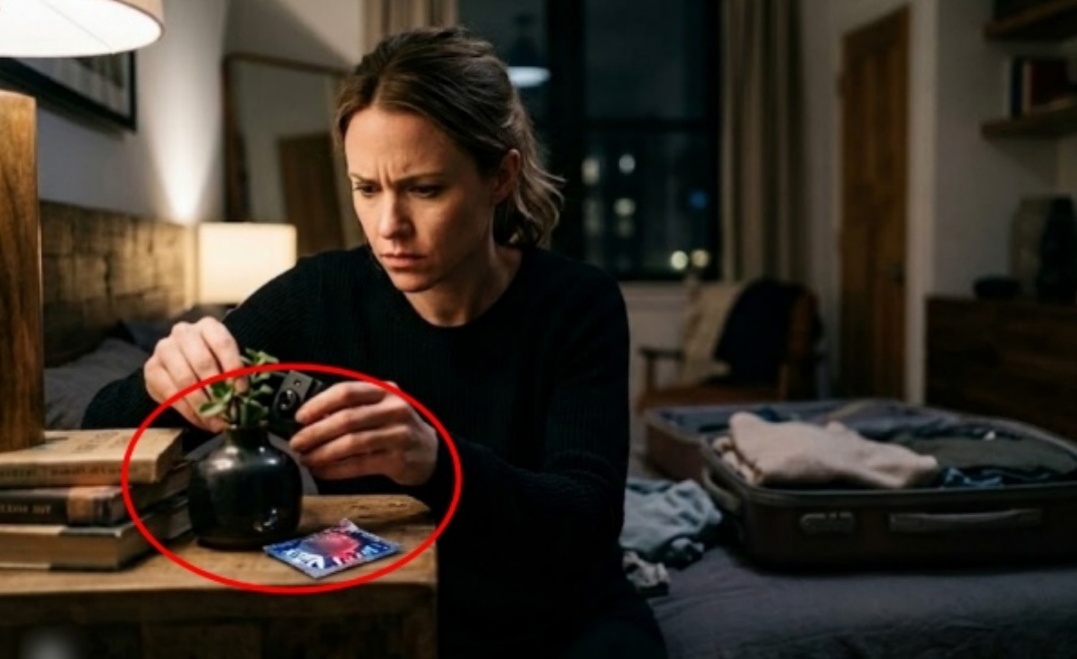
I Found a Condom Wrapper in My Husband’s Bedroom After a Business Trip — So I Set Up a Hidden Camera and Pretended to Leave Again. What I Saw Next Was Something I Never Could Have Imagined.
PART ONE: What I Found at Two-Forty P.M.
There are discoveries that change everything, and there are discoveries that change everything while also making you question every single thing you thought you knew about the life you were living.
My name is Caroline Marsh. I am forty-two years old, a regional sales director for a pharmaceutical company based in Nashville, Tennessee, and I travel for work approximately eight to ten days every month — a schedule that my husband and I had negotiated and agreed upon when I took the promotion four years ago, and that had been, as far as I understood, a functional part of our marriage rather than a fracture in it.
I am telling this story because I believe that the truth, told completely and without the softening that people apply to difficult things to make them easier to hear, is the only version worth telling. What I found when I came home from a four-day trip to Atlanta in March was the beginning of a story that went in a direction I never anticipated, ended somewhere I never expected, and taught me something about the people closest to me that I am still, fourteen months later, processing.
My husband’s name is David Marsh. We had been married for fourteen years, living in a four-bedroom house in the Green Hills neighborhood of Nashville that we had purchased nine years earlier for $520,000 and that had appreciated, in Nashville’s extraordinary real estate market, to approximately $940,000.
David was forty-five, a high school history teacher at a private school in Belle Meade, and he was a man I had believed I knew completely — not in the naive, unexamined way of someone who has never questioned their assumptions, but in the specific, grounded way of a woman who has been paying attention for fourteen years and built her understanding of her husband on the accumulated evidence of daily life.
I came home from Atlanta on a Thursday afternoon, earlier than expected because my last meeting had been canceled and I had caught an earlier flight. David knew I was coming home Thursday but expected me in the evening — I had texted him from the airport that I was on the earlier flight, but the text had not delivered because my phone had been in airplane mode and I had forgotten to resend it when I landed. I let myself into the house at two-forty p.m. The house was quiet. David’s car was in the garage, which was unusual for a Thursday afternoon when he was supposed to be at school until at least three-thirty.
I set my bag down in the entryway. I walked through the kitchen. I went upstairs to our bedroom to change out of my travel clothes. The bedroom was empty, the bed made, everything in its ordinary place. I changed, and as I was putting my travel clothes in the hamper in the master bathroom, I noticed something on the floor beside the trash can — something small and metallic and unmistakable, the kind of thing that has only one meaning, and that meaning was not a meaning that belonged in my bathroom.
A condom wrapper.
I stood in my bathroom and looked at it for a long time. Then I picked it up with a tissue, because I am a methodical person and I understood immediately that I was looking at evidence and that evidence should be handled carefully. I heard movement downstairs. I heard David’s voice — and another voice, lower, that I could not immediately identify. I stood at the top of the stairs and listened. The voices were in the kitchen, carrying the specific, casual quality of a conversation between two people who are comfortable with each other, who are not performing anything, who believe they are alone in the house.
I went back into the bedroom. I sat on the edge of the bed. I thought about what I was going to do.
I want to tell you that I went downstairs and confronted him — that I walked into my kitchen and said what needed to be said and let the scene unfold as it needed to. But that is not what I did, because I am not a woman who acts from the throat when she can act from the mind. I had a condom wrapper in a tissue in my hand and a voice downstairs I hadn’t yet identified, and what I needed most at that moment was not a confrontation — it was information. I sat on the bed for four minutes, and I made a decision.
I put the wrapper in my travel bag. I went quietly back downstairs. I exited through the side door to the garage, got in my car, and drove away before anyone knew I had ever been there.
PART TWO: The Camera
I drove to a coffee shop on Hillsboro Pike and sat at a corner table for two hours.
During those two hours I ordered a black coffee I barely touched, opened my laptop, and did three things. First, I reviewed our joint credit card statements for the previous six months — something I had access to at any time but had never felt the need to examine closely until now, which tells you something about the specific trust that a fourteen-year marriage produces and the specific vulnerability that trust creates.
Second, I opened the notes app on my phone and began writing down everything I had observed in the past several months with the retroactive attention of a woman who is suddenly looking at familiar data with different eyes. Third, I searched online retailers for small, high-definition home security cameras with local storage capability, selected a model with strong reviews, ordered two-day shipping to a UPS Store on Charlotte Avenue, and paid for it with my personal credit card.
The credit card statements told a story that was, in retrospect, hiding in plain sight. Three charges from a restaurant in Sylvan Park that I had not visited with David — modest amounts, $47, $63, $58 — on evenings when I had been traveling. A charge from a wine shop on 12th Avenue South for $94, on a Tuesday in February when I had been in Memphis. I had seen these charges before and assigned them to dinner with colleagues, the kind of casual explanation that a trusting spouse applies to ambiguous data. I applied no such explanation now.
The voice I had heard in the kitchen that afternoon — I had finally placed it on the drive to Hillsboro Pike, in the way that recognition sometimes arrives after the fact. It was low and familiar, and it belonged, I was almost certain, to a man. Not a woman.
I sat with that for a long time.
I want to be precise about what I felt in that moment, because I think the feeling is important and because I do not want to sanitize it. I felt the specific disorientation that comes when a piece of information lands in a framework that is not built to accommodate it — when you have been assembling a picture of what is happening and a new element arrives that requires you to rebuild the picture entirely. I had been building a picture of an affair. The picture I was now building was different, and more complicated, and in some ways harder to hold.
I drove home at six o’clock, as though I were arriving at the normal time. David was in the kitchen making pasta, a playlist going on the Bluetooth speaker on the counter, entirely alone. He kissed me hello and asked about Atlanta. I told him about Atlanta. I sat at the kitchen island and watched him cook and talked about ordinary things with the specific, controlled calm of a woman who is performing normalcy while an entirely different level of her mind is cataloging everything.
The other voice was gone. There was no evidence of a visitor — no extra glass in the drying rack, no jacket on the hook by the door that wasn’t David’s. David was relaxed, present, entirely himself as far as I could observe. I ate dinner. I did the dishes. I went to bed when he did and lay in the dark listening to him breathe and thought: I need to see what I cannot see when I’m not here.
The camera arrived at the UPS Store on Charlotte Avenue on Saturday morning. I picked it up while David was at a faculty thing at the school. It was smaller than I expected — a cube about the size of a golf ball, with a wide-angle lens and a thirty-two-gigabyte SD card that would hold approximately seventy-two hours of motion-triggered footage. I brought it home, tested it in the garage, confirmed it worked correctly, and spent twenty minutes identifying the optimal placement in the master bedroom — a spot on the bookshelf where it would blend into the books and small decorative objects that had accumulated there over nine years, invisible unless you were looking specifically for it.
I want to address the legal question directly, because I researched it and I think it matters. In Tennessee, recording in your own home — a space where you have a legal ownership interest and a reasonable expectation of presence — is legally permissible, and recording a conversation in a space where at least one party to the conversation consents to being recorded is consistent with Tennessee’s one-party consent statute.
I was not conducting surveillance on a neighbor or a public space. I was placing a camera in my own bedroom, in my own house, where I had every right to be at any time. I confirmed this with a brief online research session and, later, with an attorney, who validated the approach entirely.
I set the camera on the shelf on Sunday afternoon, between a copy of Educated by Tara Westover and a small framed photo from our trip to the Smoky Mountains in 2018. I checked the angle on my phone app. It was perfect. I told David on Sunday evening that I had a three-day trip to Knoxville starting Monday morning, which was true — I had a Monday-through-Wednesday regional meeting at our East Tennessee office that had been on the calendar for six weeks.
I kissed him goodbye Monday morning at seven-fifteen, put my bag in my car, and drove down the street. I parked two blocks away and watched the app on my phone until I saw David leave for school at seven-forty-five. I drove back to the house, went upstairs, confirmed the camera was recording correctly, and left again.
I drove to Knoxville. I checked the app four times a day. For the first two days, the footage showed nothing except David coming home, making dinner, watching television, and going to sleep — the completely ordinary domestic footage of a man living his regular life, which under different circumstances would have been both boring and reassuring.
On Tuesday evening, at seven-fourteen p.m., the motion sensor triggered.
PART THREE: What the Camera Saw
I was in my hotel room at the Marriott on Gay Street in Knoxville when my phone buzzed with the motion alert. I opened the app with the specific, physical steadiness of someone who has been waiting for something and is now making herself be calm about receiving it.
The footage showed David coming into the bedroom. Behind him was a man I recognized immediately — not a stranger, not a colleague I had never met, but a person whose face I had seen at our dinner table, at neighborhood gatherings, at a barbecue in our backyard the previous summer. His name was Greg Pallister. He was forty-three years old, a financial advisor with an office in Cool Springs, and he had been, as far as I had understood, one of David’s closest friends for the past seven years. He had been in our home at least a dozen times. His wife, Michelle, had sat across from me at our kitchen table and talked about her kids’ soccer schedules and the new restaurant on 12th Avenue South.
I watched the footage for several minutes. I will not describe it in detail, because some things do not require description to be understood and because what I saw was sufficient — completely and irrefutably sufficient — to tell me what I needed to know. What the camera showed me was not a moment of ambiguity. It was the specific, unambiguous footage of two people who had been here before, who were comfortable in this space, who had established a pattern that my absence had, apparently, made routine.
I set my phone face-down on the hotel room desk. I sat with my hands flat on my knees and breathed in the specific, controlled way that I use when I am managing a large amount of input and need my mind to stay organized. I thought about David. I thought about Greg. I thought about Michelle Pallister, who had sat across from me at my own kitchen table. I thought about fourteen years of a marriage I had believed I understood.
Then I picked up my phone, opened my contacts, and called my attorney.
Her name was Patricia Yuen of Yuen & Associates Family Law on Broadway in Nashville. I had consulted her briefly in 2021 for an unrelated estate matter and had kept her number because she was direct and thorough and the kind of person you want in your corner when things become complicated. She answered on the third ring.
I told her I was in Knoxville, that I had footage from a home security camera in my own bedroom, that the footage was legally obtained under Tennessee one-party consent provisions, and that I needed to understand my options before I returned to Nashville on Wednesday evening. She said: “Come to my office Thursday morning. Bring the footage on a drive and bring whatever financial documentation you have access to right now.”
I said I would.
I did not sleep much on Tuesday night. I lay in the hotel room and thought about what I was going to do with what I knew — not in the chaotic, overwhelming way of a woman who has been blindsided, but in the focused, deliberate way of a woman who has received information and is deciding how to act on it. There is a difference between those two states, and the difference is everything.
I thought about Michelle Pallister. I thought about her kids’ soccer schedules and the new restaurant and the specific, unknowing ease of a person who has not yet received the information I now had. I made a decision about that which I will describe in its time.
I drove home Wednesday evening. David was in the kitchen. He kissed me hello and asked about Knoxville. I told him about Knoxville. We ate dinner. We watched television. We went to bed. I lay beside my husband of fourteen years in the bedroom where the camera was still recording from the shelf between Educated and the Smoky Mountains photo, and I thought: Thursday morning.
PART FOUR: Thursday Morning, and What Followed
Patricia Yuen’s office was on the fourth floor of a building on Broadway with a view of the Cumberland River on clear days. She was fifty-four years old, had been practicing Tennessee family law for twenty-eight years, and had, within the first ten minutes of our Thursday meeting, reviewed the footage on the drive I brought, confirmed its legal admissibility under Tennessee recording statutes, and said: “Tell me about the financial picture.”
The financial picture was, in the clear light of a family law attorney’s office, both more complicated and more legible than it had seemed at my kitchen island. Tennessee is a dual-property state — meaning assets can be either marital or separate, with marital assets subject to equitable distribution in a dissolution. The Green Hills house had been purchased during the marriage with joint funds and was marital property. My pharmaceutical company income — significantly higher than David’s teacher’s salary — was marital income, and four years of salary growth from the promotion meant that my earnings had been the primary financial driver of the household’s stability and the house’s continued mortgage payments.
Patricia’s team retained a financial analyst named Marcus Webb from a firm in Brentwood to run the numbers over the following two weeks. What Marcus found, when he examined the full financial record, was that my income had funded approximately seventy-one percent of the household expenses over the previous four years, including the mortgage, the property taxes, home maintenance, and the joint savings account. The documentation of this was thorough — four years of direct deposits, payment records, tax returns — and it established the kind of clear financial contribution that matters in equitable distribution proceedings.
We filed the petition for dissolution in Davidson County Circuit Court on a Monday morning, six weeks after my hotel room in Knoxville. David was served at the school on a Tuesday, by a process server who handed him the papers between his second and third-period classes, which I had not specifically planned but which was the logistical outcome of the timing. He called me that afternoon.
I let it go to voicemail. He called again. I let it go to voicemail again. Then I called Patricia and told her he was attempting contact, and she sent his attorney — a competent Nashville family law practitioner named Robert Finch — a letter noting that all communications should go through counsel.
The question of Michelle Pallister was one I had been sitting with since the hotel room. I had made a decision about it in Knoxville, and I had not changed my mind. Whatever had happened between our husbands was not a decision I had made or could have prevented, but Michelle was a person who deserved to have accurate information about her own life — the same information I had needed and had gone to considerable lengths to obtain. I called her on a Wednesday afternoon, two weeks after the filing, and asked if I could come over. She heard something in my voice — she was a perceptive woman — and said “yes” immediately.
I sat at Michelle Pallister’s kitchen table in their house in Sylvan Park and I told her what I knew, and I showed her the documentation that Patricia had advised was appropriate to share. I did not describe the footage in detail. I told her it existed, what it established, and that she deserved to decide what to do with the information from a position of full knowledge rather than partial knowledge. Michelle was very quiet for a long time.
Then she thanked me. She said it twice. She thanked me the second time in a way that told me she had been carrying something she had not had language for, and that what I had given her was not just information but permission to stop explaining away the thing she had been sensing and could not name.
She retained her own attorney the following week. I know this because she called to tell me. She did not need to call. She called because she wanted me to know, and I appreciated it.
The mediation between David and me was scheduled for September, in the offices of a neutral mediator in Green Hills — a woman named Dr. Sandra Park who had been mediating Nashville family law cases for sixteen years. It lasted one full day. David’s attorney was competent and prepared.
Patricia had been doing this for twenty-eight years and had the documentation. The settlement reflected the full financial record: I received the house — with a buyout structure that gave David his equitable share of the appreciation while allowing me to remain in the home if I chose to, which I did. I received the full balance of my separate retirement accounts and a portion of the joint brokerage account proportional to my documented contributions. The financial outcome was, in Patricia’s assessment, “consistent with what the record supported and then appropriately some.”
PART FIVE: May, Fourteen Months Later
The Green Hills house is mine now, in the specific, unencumbered way that things become yours when the legal work is done and the paperwork is final and you have walked through every room by yourself on a quiet Saturday morning and understood that the space is entirely your own.
I repainted the master bedroom in January. Not because the old color was wrong, but because I wanted the room to be different — to belong to the current version of my life rather than the previous one. I chose a warm, deep blue called Hale Navy that a designer friend recommended, and I painted it myself over two weekends with the specific, physical satisfaction of doing something transformative with your own hands. I moved the bookshelf. I bought new bedside lamps. The Smoky Mountains photo is in a box in the garage — not thrown away, but not on the shelf. Some things you keep without displaying.
The camera I returned to the UPS Store as part of the legal process preservation — Patricia’s office handled the chain of custody for the SD card as documentary evidence, and the camera itself I had no further use for. I do not have a security camera in my bedroom now. I have a modest Ring doorbell camera at the front door, which is a reasonable home security measure rather than an act of investigation, and which I mention only to note the difference between the two things.
David and I have no children, which is the fact that I have been most grateful for across the entirety of this fourteen months — not because children are not a gift, but because the absence of that particular complication allowed the dissolution to be clean in ways that dissolving a shared life with a shared child rarely is. We have no ongoing contact. His attorney handles any necessary communication, which has been minimal since the settlement was finalized.
I returned to full travel rotation in May of last year — the eight to ten days per month that had been my schedule before, that I had felt briefly uncertain about in the months following the discovery, and that I have now fully reclaimed as a professional reality rather than a marital liability. I am good at my job. I have been regional sales director for four years and I have exceeded my targets in three of those four years, and the work is meaningful to me in the way that work becomes meaningful when it is attached to your own name and your own effort and no one else’s narrative.
I have thought a great deal, in the fourteen months since the Thursday afternoon in Atlanta, about what I wish I had known earlier — the signs I might have read differently, the questions I might have asked, the data I had access to and hadn’t examined closely enough. But I have also thought about what good came out of the specific way things unfolded, and the good is this: I found out the truth in a way that was documented, legal, and complete, and I acted on that truth in a way that was methodical and deliberate rather than reactive and chaotic. I did not do anything I regret.
I did not say anything in anger that I had to walk back. I did not make a single move without legal counsel and a clear head. I handled the worst discovery of my marriage with the same professional precision I bring to a difficult client situation — not because I am cold, but because precision, in moments that matter, is its own form of strength.
Michelle Pallister and I have stayed in touch. We are not close friends — the circumstances that connected us are too complicated for easy friendship — but we are something. We have had coffee twice. We texted on the day her dissolution was finalized. She is, from what I can tell, doing the work of rebuilding in the way that people do who were not given the chance to see it coming. I admire her for it.
I am forty-two years old. I live alone in a four-bedroom house in Green Hills with one bedroom I use as an office and one bedroom I use as a guest room for my sister when she comes from Memphis, and one bedroom that is simply a bedroom in a house that is mine. I travel eight to ten days a month and I come home to my own space and my own things and the specific, uncluttered quiet of a life that belongs entirely to me.
On a Sunday in April, I drove out to Percy Warner Park with a thermos of coffee and sat on a bench at the end of the Mossy Ridge Trail watching the late morning light come through the trees, which were doing exactly what Tennessee trees do in April — going green with the complete, unhurried confidence of things that know what they are supposed to do and simply do it. I sat there for an hour and thought about nothing in particular, which is a thing I could not have done fourteen months ago and can do now with the ease of someone who has cleared the space.
I drove home down Hillsboro Pike in the Nashville Sunday morning light and thought: This is what it looks like on the other side.
The condom wrapper is still in an evidence bag in Patricia’s office files, where it will remain until the retention period expires and then be destroyed in the ordinary course of document management. It was the beginning of a story I never would have chosen and could not have anticipated, and it led me somewhere I did not expect, and what I found there was not the life I had planned but the life I am now, without apology or qualification, living.
That is the whole story. That is the version worth telling.
