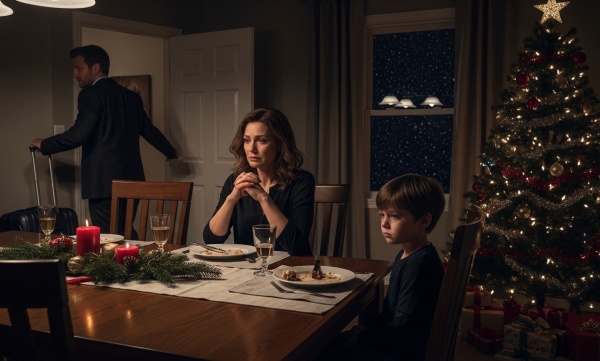
My husband told me he had to leave for an emergency business trip to Atlanta two days before Christmas. I helped him pack. I kissed him goodbye. I spent Christmas Eve making sugar cookies with our seven-year-old daughter and putting her to bed and waiting for his call. He called at nine-fifteen. He said Merry Christmas. I said it back. I started to ask how things were going and he cut me off — “I can’t talk, I have to go” — and hung up after one minute and forty-three seconds.
I sat on the couch with my wine and the lit tree and the specific, quiet wrongness of a conversation that had ended too fast. And then I remembered: I had left my fitness tracker in his car the week before. I opened the app. The blue dot was not in Atlanta. It was at a Marriott in South End Charlotte, six miles from my house. I put on my coat. I got my keys. My neighbor came over to sit with my daughter. I drove to the hotel.
Part 1: The Business Trip That Came Out of Nowhere
My name is Jennifer Caldwell, and I am 38 years old, and I live in Charlotte, North Carolina, and I am writing this because what happened to me on Christmas Eve two years ago is the kind of story that starts with a small, overlooked detail — a fitness tracker left in the wrong place at the wrong time — and ends with a truth so complete and so final that it changed every single thing about my life in the space of about four hours.
I work as a dental hygienist at a practice in the Ballantyne area, making $58,000 a year, and I drive a silver Toyota Highlander that I bought three years ago and that still has a half-empty box of Christmas ornaments in the back from the year everything fell apart, because I have not been able to bring myself to fully unpack the holiday that broke my marriage open.
I am telling this story because I have been asked about it by more people than I expected, and because the version that circulated through our friend group in the weeks after was incomplete and distorted and flattering to no one, and because the truth — the specific, detailed, almost absurdly cinematic truth — deserves to be told in full at least once.
I need to describe my husband before I describe anything else, because he is the center of this story and because I want to be fair about who he was before he became who he turned out to be. His name is Brandon Caldwell, and he is 41 years old, and he is a regional operations manager for a logistics company that has offices in Charlotte, Raleigh, and Atlanta. He is six feet tall, with the easy, practiced confidence of a man who has been professionally successful for long enough that the confidence has become indistinguishable from his personality.
We had been married for nine years when this happened. We have a daughter named Sophie who was seven at the time and who is the best thing either of us has ever done, and the fact of Sophie is the reason I am going to tell this story as carefully and as honestly as I can, because she deserves a mother who tells the truth about her own life rather than a version of it that has been softened for comfort.
The call came on December 23rd, a Sunday, at around four in the afternoon. Brandon was in the kitchen when his phone rang, and I was in the living room helping Sophie finish decorating the tree — we had been doing it in stages all weekend, the way we did every year, with Christmas music on the speaker and hot chocolate on the coffee table and the specific, warm chaos of a seven-year-old who has opinions about where every ornament should go.
I heard Brandon’s voice shift in the kitchen — the specific register change of a man who has moved from casual to professional — and then he came into the living room with his phone in his hand and the expression of a man who is delivering news he has already decided how to frame. He said his boss had called. There was a situation at the Atlanta distribution center that needed to be handled in person. He needed to drive down first thing Monday morning and would probably be gone through Christmas, back by the 26th at the latest. He said he was sorry.
He said he had no choice. He looked at Sophie and said, “I’m so sorry, bug. Daddy has to work.” Sophie looked at the ornament in her hand and then at her father and then back at the ornament, and she said, “Okay,” in the small, accepting voice of a child who has learned that some disappointments are just part of how things are.
I did not argue. I want to be clear about that — not because I was passive or because I had no reaction, but because the argument would have been pointless and because I had no reason, at that moment, to doubt him. Business emergencies happen. His job involved travel. The Atlanta office had had operational issues before.
I helped him pack that evening, which is the specific, domestic intimacy of a marriage — folding his shirts, finding his phone charger, putting his toiletry bag together — and I kissed him goodbye on Monday morning and I watched his car pull out of the driveway and I went inside and I told Sophie that Christmas was going to be just the two of us this year and that we were going to make it wonderful anyway. She said, “Can we make pancakes on Christmas morning?” I said yes. She said, “Can we put sprinkles on them?” I said absolutely. She seemed satisfied. I made coffee and I started the day.
Part 2: Christmas Eve, the Phone Call, and the Moment Everything Shifted
The days between Brandon’s departure and Christmas Eve were ordinary in the specific, slightly melancholy way of days that are supposed to be festive and are instead just quiet. Sophie and I had a good time, genuinely — we baked cookies, we watched Christmas movies, we drove through a neighborhood in South Charlotte that does an elaborate lights display every year that Sophie has loved since she was old enough to understand what she was looking at.
Brandon texted regularly, which I now understand was the specific, careful texting of a man who is maintaining a cover story and knows that irregular communication would raise questions. The texts were normal — short, affectionate, the kind of messages that a husband on a work trip sends to his wife. Miss you guys. How’s Sophie? Crazy busy here. Can’t wait to be home.
I read them and responded and felt the low, manageable sadness of a holiday without the person who was supposed to be there, and I did not look for anything in them that was not on the surface, because I had no reason to.
Christmas Eve was a Tuesday. Sophie and I had spent the afternoon doing the things we always did on Christmas Eve — the specific, ritual activities of a family that has built its own traditions over years of repetition. We made her grandmother’s sugar cookie recipe, which requires more steps than any cookie recipe reasonably should and produces cookies that are worth every one of them.
We set out milk and cookies for Santa, which Sophie still believed in at seven with the specific, fierce conviction of a child who has decided that belief is a choice and is choosing it deliberately. We read the Christmas story from the children’s book we had read every Christmas Eve since she was two.
By eight o’clock she was in bed, vibrating with the specific, barely contained excitement of a child on Christmas Eve, and I was downstairs in the living room with a glass of wine and the lit tree and the quiet of a house where a child is asleep and everything is, for the moment, still.
Brandon called at nine-fifteen. I answered on the second ring, glad to hear from him, ready to have the conversation that married people have on the evenings they are apart — the catching up, the small details of the day, the specific intimacy of two people who know each other well enough to fill a phone call with nothing in particular and have it feel like something. He said Merry Christmas. I said Merry Christmas back. I asked how the day had been.
He said busy, crazy, the usual. I started to ask about the specific issue he had gone to Atlanta to handle — I was going to ask whether it had been resolved, whether he had a better sense of when he would be home — and he cut me off. Not rudely, but abruptly, with the specific, clipped urgency of someone who has somewhere to be and is ending a conversation rather than continuing it. He said, “I can’t talk right now, I have to go.”
I said, “Go where? It’s nine-fifteen on Christmas Eve.” He said, “Work stuff, I’ll explain later, Merry Christmas, love you,” and the call ended.
I sat with the phone in my hand and the wine on the coffee table and the lit tree in the corner and I looked at the call log on my screen — duration: one minute and forty-three seconds — and I felt something that I want to describe accurately because I think the accuracy is the point.
It was not suspicion, exactly, not yet. It was a specific, small wrongness — the feeling of a note played slightly off-key in a piece of music you know well, the feeling of something that does not quite fit the pattern it is supposed to fit. I set the phone down. I picked up my wine. I looked at the tree. And then, in the specific, random way that the mind makes connections when it is working on something below the level of conscious thought, I remembered the fitness tracker.
Part 3: The App, the Map, and the Hotel Six Miles Away
I had left my Garmin fitness tracker in Brandon’s car the previous Thursday — I had taken it off during the drive to Sophie’s school pickup because the band was bothering me, set it on the center console, and forgotten it when I got out. I had noticed it was missing on Friday and assumed it was somewhere in the house, and I had not thought about it again until this moment, sitting on the couch on Christmas Eve with a glass of wine and a phone call that had lasted one minute and forty-three seconds and ended with a man who had somewhere to be at nine-fifteen on Christmas Eve in a city that was supposedly four hours away.
I picked up my phone. I opened the Garmin Connect app. I navigated to the device location feature, which I had set up months ago when I had briefly lost the tracker at the gym and had spent twenty minutes looking for it before remembering the app existed.
The map loaded. The blue dot appeared. I looked at it for a moment without fully processing what I was seeing, because what I was seeing did not match what I had been told and my brain needed a second to reconcile the two. The blue dot was not in Atlanta. The blue dot was in Charlotte. Specifically, the blue dot was at a location in the South End neighborhood of Charlotte, approximately six miles from my house, at an address that I did not immediately recognize but that I looked up in about four seconds using the satellite view on my phone.
It was a hotel. A Marriott, specifically — a mid-range business hotel with a parking lot that was visible in the satellite image as a gray rectangle beside the building. Brandon’s car — and my fitness tracker, sitting on the center console of Brandon’s car — was parked in that lot. In Charlotte. On Christmas Eve. While Brandon was supposedly in Atlanta handling a work emergency.
I sat on the couch for approximately ninety seconds. I want to be honest about those ninety seconds, because I think they matter. I did not immediately react. I did not call him back or text him or do anything external. I sat with the information and I let it settle, the way you let something settle when it is too large and too definitive to be processed quickly.
I thought about the possibility of an error — that the tracker had been left somewhere else, that the location data was wrong, that there was an explanation I was not seeing. I thought about each of these possibilities for approximately the amount of time they deserved, which was not very long, because the location data was precise and current and the blue dot was sitting in a hotel parking lot six miles from my house and Brandon had just told me he was in Atlanta and had somewhere to be at nine-fifteen on Christmas Eve. I finished my wine. I put on my coat. I got my keys.
Sophie was asleep. My neighbor Carol, who is 62 and retired and who has been my emergency childcare solution for three years, answered her phone on the third ring and said she would be at my door in five minutes without asking a single question, which is the specific, invaluable quality of a neighbor who has known you long enough to understand when questions are not what is needed. She arrived in four minutes.
I told her I had to run an errand and would be back within the hour. She looked at my face and said, “Take your time.” I drove south on I-77 toward the South End neighborhood with the Charlotte Christmas Eve traffic thin around me and the radio playing something I did not hear and my hands steady on the wheel at ten and two, the same way they are always steady when I am doing something that requires steadiness.
Part 4: The Hotel Lobby and the Truth I Found There
The Marriott parking lot was about two-thirds full when I pulled in, which made sense for a hotel on Christmas Eve — business travelers who had not made it home, people in town for the holiday, the specific, transient population of a mid-range hotel on a night when most people are somewhere else.
I drove slowly through the lot until I found Brandon’s car — a black Ford F-150 with a University of North Carolina sticker on the rear window that I had been looking at from the passenger seat for nine years — parked in a spot near the side entrance. I pulled into a spot three rows away. I sat in my car for a moment. Then I got out and I walked into the hotel.
The lobby was decorated for Christmas — a tree near the entrance, garland on the front desk, the specific, corporate version of holiday cheer that hotels produce with reliable efficiency every year. There were a few people in the lobby seating area, a couple near the elevator, a man at the bar off the main entrance.
The front desk had one clerk on duty, a young woman in her mid-twenties who looked up when I came in with the professional, welcoming expression of someone who has been trained to look welcoming regardless of what they are actually feeling at nine-thirty on Christmas Eve. I walked to the desk. I said, “I need some help.” She said, “Of course, what can I do for you?” I said, “My husband is a guest here. His name is Brandon Caldwell. I need to know his room number.”
She said, with the specific, apologetic professionalism of someone following policy, that she was not able to share guest room information for privacy reasons. I said I understood. I said, “Can you call his room and let him know his wife is in the lobby?” She looked at me for a moment. She said, “One moment.”
She made the call. I watched her face while she waited for the answer, and I saw the specific, involuntary expression of someone who has just heard something on the other end of a phone call that they were not expecting — a slight widening of the eyes, a micro-adjustment of the professional expression. She said, into the phone, “Sir, your wife is in the lobby.” There was a pause. She said, “Yes, sir.” She hung up. She looked at me and said, “He’ll be right down.”
I said, “Thank you.” I walked to the seating area near the elevator bank and I sat down in an armchair that faced the elevator doors and I waited. The lobby Christmas tree was about ten feet to my left. The bar was playing something low and jazzy. A couple near the entrance was laughing about something.
Everything was entirely ordinary except for the specific, absolute stillness inside me that had been there since I left my house and that I understood, in that moment, was not going to break until I had seen what I had come to see.
The elevator opened three minutes later. Brandon stepped out first. He was in jeans and a button-down shirt, the specific casual dress of a man who has been in a hotel room for the evening and has dressed quickly.
He saw me immediately — I was directly in his line of sight — and his face did something that I am going to describe as precisely as I can because I think the precision matters: it went through shock, and then through the specific, rapid calculation of a man who is assessing a situation and looking for the version of it that is most manageable, and then through something that was neither of those things, something that was closer to the specific, exhausted expression of a man who has been running a lie for a long time and has just run out of road.
Behind him, stepping out of the elevator a half-second later, was a woman I recognized. Her name was Ashley. She worked in Brandon’s office. I had met her at the company Christmas party two years earlier and had shaken her hand and made small talk about the appetizers and thought nothing of it.
Part 5: The Christmas Morning That Changed Everything
I did not make a scene in the lobby of the Marriott. I want to be clear about this, not because the not-making-a-scene was virtue — I think I was simply too far inside the shock to access the kind of emotion that produces scenes — but because I think it is true and the truth is what this story is about.
I stood up from the armchair. I looked at Brandon. I looked at Ashley. I looked back at Brandon. I said, in a voice that was entirely level, “Sophie asked if we could have pancakes with sprinkles tomorrow morning. I told her yes. I need you to be home by eight.” Then I picked up my purse and I walked out of the hotel lobby and I got in my car and I drove home.
Carol was on my couch when I got back, watching a Christmas movie with the sound low so as not to wake Sophie. She looked at my face when I came in and she said, “Do you want to talk?” I said not tonight. She said, “Okay. I’m here if you do.” She hugged me and she went home and I stood in my living room with the lit tree and the plate of cookies Sophie had left for Santa and the specific, complete silence of a house where a child is asleep and everything has just changed. I ate one of the cookies. I refilled Santa’s milk.
I put the presents under the tree. I went to bed. I did not sleep, but I lay in the dark and I let the night pass, because Sophie was going to wake up in a few hours and Christmas morning was going to happen regardless of what had happened the night before, and she deserved a mother who was present for it.
Brandon came home at seven forty-five the next morning, fifteen minutes before I had asked him to be there. He came in quietly, with the specific, careful movements of a man who does not know what he is walking into. Sophie was still asleep. We stood in the kitchen and we had the conversation in low voices — not the full conversation, not the one that would take weeks and then months to complete, but the immediate, necessary one.
He did not try to explain or minimize or construct an alternative version of what I had seen. He said he was sorry. He said it had been going on for seven months. He said he had not known how to stop it, which is the specific, inadequate explanation of a man who has been making a choice and has decided to frame it as something that happened to him. I listened.
I said, “Sophie is going to wake up in about an hour and she is going to want pancakes with sprinkles and she is going to want her father here for Christmas morning. Can you do that?” He said yes. I said, “Then do that. We’ll figure out the rest later.”
We gave Sophie her Christmas morning. We made the pancakes — the sprinkles were rainbow, which she had specified the night before — and we sat at the kitchen table and we watched her open her presents and we were, for those two hours, the parents she needed us to be, which is the specific, difficult, necessary thing that parents do when their own lives are falling apart and their child is opening a present with the specific, total joy of a seven-year-old on Christmas morning.
I watched Brandon watch Sophie and I felt something that was not forgiveness and not love but something more complicated than either — the specific, painful recognition that a person can be two things at once, that the man who had lied to me for seven months was also the man who was crying quietly while his daughter showed him her new art set, and that both of those things were true simultaneously and that the truth of one did not cancel the truth of the other.
The divorce was filed in March. It was handled through a family law attorney in Charlotte named Rebecca Torres, who was thorough and fair and who helped us reach a custody agreement that put Sophie’s stability at the center of every decision, which is what both Brandon and I wanted even when we wanted very little else in common. Sophie spends alternating weeks with each of us. She has adjusted with the specific, resilient adaptability of children who are loved consistently by both parents even when those parents are no longer together.
I have the house. I have my job. I have Carol next door and my sister in Raleigh who drives down once a month and my therapist on Tuesday afternoons who has helped me understand that what happened on Christmas Eve was not a failure of my perception but a failure of someone else’s integrity, and that those are not the same thing.
I still have the fitness tracker. It sits in the drawer of my nightstand, charged and synced and tracking my steps every day with the same quiet, reliable accuracy it has always had. I have thought about getting rid of it — about buying a new one, starting fresh, removing the object that is most directly associated with the night everything changed. I have not done it.
I keep it because it told me the truth when I needed the truth, and because I think objects that tell you the truth deserve to be kept. Some people have asked me if I am angry at Brandon. The honest answer is that I was, for a long time, and that the anger has become something else over the past two years — not forgiveness, exactly, but a kind of settled understanding that people make choices and choices have consequences and the consequences of his choices were mine to navigate, and that I have navigated them and am still navigating them and am, in the specific, hard-won way of someone who has been through something real, going to be fine.
Sophie asked me last Christmas if Santa knew our new address. I said yes, absolutely, Santa always knows. She said, “Good.” She went to bed satisfied. I made coffee and I sat by the tree and I thought about the Christmas Eve two years before and the blue dot on the map and the hotel lobby and the elevator doors opening, and I thought about how much had changed and how much had stayed the same — Sophie’s belief in Santa, my neighbor Carol’s willingness to answer the phone, the specific, stubborn continuity of a life that keeps going even when the ground shifts underneath it. Then the coffee was done and I went to bed, and in the morning we made pancakes, and she asked for sprinkles, and I said yes.
