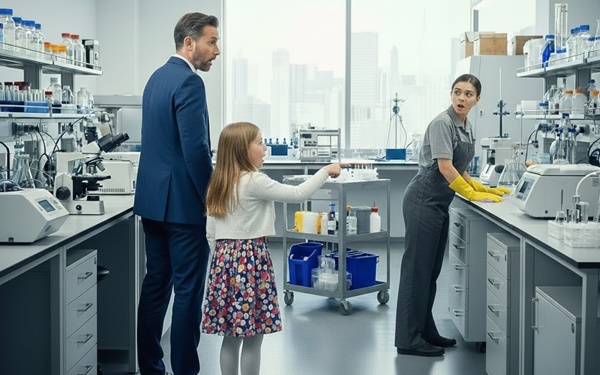
A powerful billionaire took his daughter to a restricted biotech facility for a secret $250,000 genomic test. Ten years after his wife’s tragic passing, he was looking for answers—but his daughter found them first. The second she spotted the janitor in the shadows, she screamed, ‘Mommy’s back!’ The woman’s chilling reaction didn’t just stop the room; it changed everything we thought we knew about that ‘accident’ a decade ago…
They say grief has five stages, but for a man with money, grief just becomes a problem to be solved.
My wife, Sarah, died ten years ago. A rainy Tuesday in Seattle, a hydroplaning semi-truck, and a closed casket. That was the official narrative. The police report was filed, the insurance was paid out, and I was left to raise our two-year-old daughter, Maya, alone.
I built an empire in the decade that followed. I turned a small tech startup into a multi-billion-dollar venture capital firm. I bought the house on the hill, the private jets, and the security detail. But no amount of wealth could buy Maya the one thing she lacked: the truth.
Maya is twelve now. She’s brilliant, quiet, and possesses a “sensory memory” that doctors couldn’t explain. Since she was five, she would stop in the middle of a crowded mall, sniff the air, and whisper, “Mommy was here.” Or she would point at a random woman in a magazine and say, “She has Mommy’s hands.”
I thought it was trauma. A child’s mind trying to fill a void.
Then came the “Genetic Memory” breakthrough. Dr. Aris Thorne, a leading scientist at a private lab in Massachusetts, contacted me. He proposed a highly specialized, $250,000 genomic sequence test. It wasn’t just about DNA; it was about epigenetic imprinting—the theory that a mother’s specific sensory memories can be passed to her child.
I didn’t care about the cost. I wanted to know why my daughter was haunted.
The Encounter
We flew into Boston on a private charter and drove to the research facility—a cold, glass-and-steel monolith tucked away in the woods of Lexington. The air inside smelled of ozone and clinical sterility.
As we walked down the long, white corridor toward Lab 402, Maya suddenly stopped. Her hand, small and cold, tightened around mine until her knuckles turned white.
“Maya? What is it?” I asked.
She didn’t answer. She was staring at a woman about fifty feet ahead of us.
The woman was dressed in a faded navy blue janitorial uniform. She was hunched over, pushing a heavy industrial floor buffer. Her hair was pulled back in a messy bun, and her face was obscured by a surgical mask.
Suddenly, Maya let out a scream that shattered the silence of the hall. It wasn’t a scream of fear. It was a primal, heartbreaking wail of recognition.
“MOMMY! MOMMY, YOU’RE HERE!”
I felt a jolt of ice water hit my spine. “Maya, honey, stop. That’s not—”
But Maya was gone. She sprinted down the hallway, her sneakers squeaking on the polished tile. She threw herself at the woman, clambering onto her as if she were trying to merge into her skin.
The woman froze. The floor buffer spun out of control, hitting the wall with a loud thud.
Slowly, the woman looked up. She pulled down her mask.
My heart didn’t just skip a beat; it stopped.
The Impossible Reflection
It was her.
Not a look-alike. Not a coincidence. It was Sarah.
The same tiny mole beneath her left eye. The same way she nervously touched her throat when she was overwhelmed. But she looked… tired. There were lines around her eyes that shouldn’t have been there, and her hands, once soft and manicured, were red and calloused from years of harsh chemicals.
Sarah looked at Maya, and her face went a deathly shade of pale. She didn’t hug her back at first. She looked terrified, her eyes darting toward the security cameras in the ceiling.
“Mommy, don’t hide anymore,” Maya sobbed, burying her face in the coarse fabric of the janitor’s uniform. “I’ve been looking for you for so long. I smelled your perfume in my dreams.”
The hallway was silent, save for Maya’s muffled cries.
Then, Sarah’s resolve broke. She dropped to her knees, clutching Maya so hard her fingernails dug into the girl’s jacket. A jagged, broken sob escaped her throat—a sound of ten years of suppressed agony.
“I’m so sorry, baby,” Sarah whispered, her voice a ghost of the one I used to hear every morning. “I wasn’t allowed to come back. I’m so sorry.”
The Shadow Program
I took a step back, my world tilting on its axis. Ten years of mourning. A funeral. A headstone I’d visited every month.
“What is this?” I roared, my voice echoing through the facility. “Sarah?! How are you alive?”
Before she could answer, Dr. Thorne stepped out of the lab. He wasn’t surprised. He looked at us with a grim, clinical sadness.
“Mr. Sterling,” he said softly. “We need to go inside. Now. Before Security monitors the audio.”
Inside the lab, the truth came out like a lead weight.
The accident ten years ago was real, Thorne explained. But Sarah hadn’t died. At the time, she was a lead researcher for a defense contractor specializing in Human Genomic Splicing. The “accident” was an attempted kidnapping by a foreign entity that went wrong.
“The government couldn’t protect her if she stayed ‘Sarah Sterling,'” Thorne said. “She was the only one who had the sequence for a specific biological stabilizer. If the wrong people got it, it would be catastrophic. So, they faked her death. Witness Protection on a global scale.”
I looked at my wife—the woman I’d cried for, the woman I’d built a monument to in my heart.
“You let us think you were dead,” I said, my voice trembling with a mix of fury and relief. “For ten years?”
“I had no choice, David,” Sarah said, her tears dripping onto the white tile. “They told me that if I ever contacted you, you and Maya would become ‘targets of interest.’ I was dead to the world so that you could be safe. I took a job as a cleaner in every lab I could find that was doing genomic research… just hoping, praying, that one day I’d see your name on a patient list. I just wanted to see her grow up through a window.”
The Price of Safety
I stood there, one of the wealthiest men in America, realizing I was a pauper. I had everything—the cars, the mansions, the power—but I had been living a lie orchestrated by men in dark suits who viewed my family as “collateral data.”
Maya looked up at her mother, her eyes red but shining with an unbreakable light.
“I knew it,” she said. “I knew you never left us.”
Sarah kissed the top of Maya’s head, ignoring the fact that security was likely already on their way to relocate her.
“I never left, Maya. I was always the shadow in the hallway. I was always the one watching.”
The story of the Sterling family changed that day. I didn’t just take my wife home; I used every dollar of my billions to hire the best legal and private military team in the country to “de-list” her from the program. It took two years and more money than most small nations see in a decade, but Sarah Sterling finally “came back to life.”
There are stage-four cancers, and then there are stage-four secrets.
We learned that some separations aren’t caused by a lack of love, but by a truth so massive it crushes everything it touches. But we also learned that a child’s heart is the most sophisticated tracking device in the universe.
Maya didn’t need a $250,000 gene test. She just needed to hear the sound of a floor buffer and a heartbeat she’d never forgotten.
