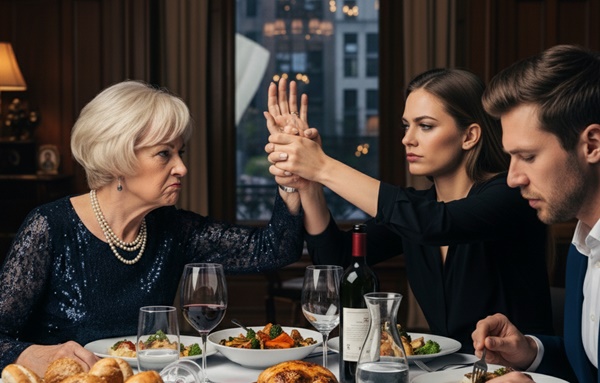
Her hand flew up, aimed at my face, but she forgot one thing: I’m not the quiet girl she married off to her son anymore. I caught her wrist mid-air, looked her dead in the eye, and whispered, ‘That was your last strike. Consider us strangers.’ I didn’t just walk out of that dinner; I walked out of a four-year nightmare.
In the wealthy suburbs of Westchester, New York, Sunday dinners at the Belmont estate weren’t about food. They were about performance. And for the four years I had been married to Julian, I was the only one failing the audition.
His mother, Eleanor, was the unofficial matriarch of the local country club. To the world, she was a philanthropist. To me, she was a silent assassin with a smile. Every comment she made was a micro-aggression wrapped in silk: “Oh, you’re still working at that non-profit, Audrey? So brave of you to ignore your husband’s social standing.” Or, “I saw you wore that dress to the gala. Very… economical.”
Julian, bless his heart, was a master of “The Shrug.” “She’s just from a different generation, Audrey,” he’d whisper later. “She means well. Don’t be so sensitive.”
But that Sunday in October, the air in the dining room felt heavy, like the humidity before a thunderstorm.
Eleanor had been three glasses deep into a Napa Valley Cabernet before the main course was even served. She was in a “mood.” When I mentioned that Julian and I were looking at townhomes in Brooklyn to be closer to my new firm, she didn’t just disagree. She detonated.
“Absolutely not,” she snapped, her fork clattering against the fine china. “Julian has a legacy here. You are not dragging my son into some trendy borough just so you can play ‘career woman.’”
I felt the heat rise in my neck, but I kept my voice low. This was the boundary. “Eleanor, we’re thirty. It’s a discussion about our commute and our future. We aren’t asking for permission.”

Eleanor’s face turned a shade of crimson that matched her wine. She looked at her daughter, Serena, and let out a sharp, jagged laugh. “Listen to her. She actually thinks she has a seat at this table.”
“I am at this table, Eleanor,” I said, setting my napkin down. “And I’m not going to be spoken to like a child in my own family.”
Eleanor stood up so fast her chair screeched against the hardwood floor like a wounded animal. “In my house, you will show respect. You’ve done nothing but disrupt this family since the day you walked in.”
“I’m setting a boundary, Eleanor. If you can’t speak to me with basic human decency, we’re leaving.”
The word “boundary” acted like a match to gasoline. For a woman like Eleanor, a boundary was a personal insult.
She lunged. Her hand flew up, a blur of manicured nails and expensive rings aimed straight for my left cheek.
The world went into slow motion. I saw Julian’s eyes widen as he sat there, frozen, his hand still hovering over his wine glass. I saw Serena gasp.
But I didn’t flinch. My years of Pilates and a newfound sense of self-preservation kicked in. Before her palm could make contact, I reached out and caught her wrist mid-air.
The silence that followed was deafening. You could hear the hum of the refrigerator in the kitchen.
I gripped her wrist—not enough to hurt, but enough to let her know the power dynamic had shifted forever. I looked her dead in the eye, my voice as cold as a New York winter.
“That’s enough. From this moment on, your lives… have absolutely nothing to do with me.”
I felt Eleanor tremble. Not from pain, but from the sheer shock of being stopped. I released her arm and turned to Julian. He was finally standing, his face pale.
“Audrey, wait… let’s just sit down. Mom, you need to apologize, Audrey, you need to calm down—”
“Calm down?” I whispered. “She just tried to hit me, Julian. And you’re still trying to ‘negotiate’ the peace.”
I didn’t wait for his response. I walked out the front door, the heavy oak clicking shut behind me. It was the most beautiful sound I had ever heard.
THE AFTERMATH: THE SILENCE THAT SPOKE VOLUMES
The drive home was quiet. Julian followed me in his car, and when we got to our apartment, the “Gaslighting Express” arrived right on schedule.
“She’s an old woman, Audrey! You humiliated her! You grabbed her! Do you know how that looks?”
I stopped packing my bag and looked at him. Truly looked at him. “It looks like a woman defending herself because her husband was too busy eating his mashed potatoes to protect her.”
The next 48 hours were a masterclass in toxic family dynamics. My phone was a war zone.
Eleanor sent a formal email accusing me of “physical assault” and threatening to call the police.
Serena texted me saying I was “dramatic” and that I had “ruined the family’s reputation” over a “minor disagreement.”
Julian begged me to go to a “family therapy session” where we could all—and I quote—”take accountability for our parts in the blow-up.”
I realized then that in this family, the victim was always the one who spoke up, never the one who swung the fist.
I didn’t call the police. I called a divorce attorney.
In the state of New York, catching a wrist to prevent a strike is the definition of Justifiable Self-Defense. My lawyer, a shark of a woman named Elena, smiled when I told her the story. “She gave you the greatest gift she could, Audrey. She gave you a clear exit.”
I moved out while Julian was at the office. Every box I taped up felt like a brick being removed from my chest. I left my wedding ring on the granite countertop next to a copy of the “Morality Clause” in our prenup that his mother had insisted on.
Eleanor tried one last time. She showed up at my new office, demanding I “stop this nonsense” and come back to Julian so they could keep the divorce out of the local papers.
I looked at her, the woman who had lived her whole life on the fear of others. “Eleanor, you lost the right to speak to me the moment you forgot I was a human being. Please leave before I have security escort you out.”
She called me ungrateful. I called for the elevator.
Julian didn’t fight for me. He fought for the status quo. He tried therapy for exactly two weeks before asking if I’d come to Thanksgiving “to make things look normal for his dad’s business partners.”
I said no.
It’s been a year. My life is quieter now. I live in that Brooklyn townhome I wanted. I don’t flinch when people raise their voices. I don’t check my tone to make sure I’m not being “too opinionated.”
I lost a husband, a sister-in-law, and a social circle. But what I gained was the one thing Eleanor could never buy with her millions: Peace.
If you’re reading this and you’re being told to “keep the peace” while your soul is being shredded—ask yourself: Whose peace are you protecting? Because it certainly isn’t yours.
Would you have caught the wrist? Or are you still waiting for the slap?
Share this if you’ve finally learned that “Family” isn’t a license for abuse. Enough is enough.
